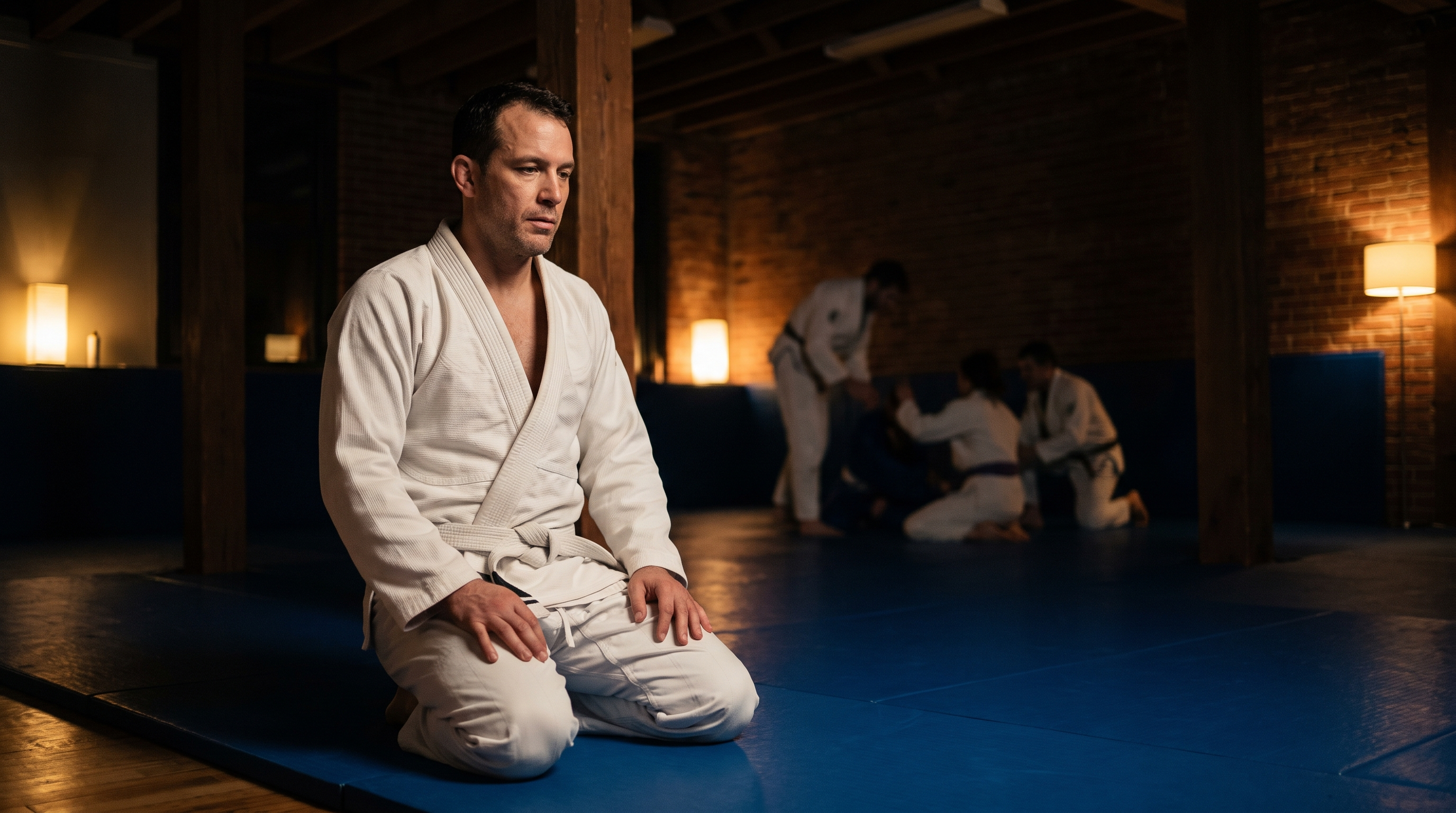
The Adult Beginner's Guide to Starting BJJ After 35: How to Train Smart and Stay Healthy
TL;DR. Starting BJJ after 35 works if you treat it as a long game: shorter sessions, honest tap timing, positional sparring over hard rolls, and a simple retention system so you stop relearning the same escape every month. Build strength and mobility off the mat, pick training partners carefully, and schedule 5–15 minutes of daily review between classes. The goal for your first year is not to win rounds — it is to still be training pain-free a year from now with a small library of techniques you actually remember.
Walking into a Brazilian Jiu-Jitsu academy in your late 30s or 40s can feel like showing up late to a class where everyone else already knows the language. The good news: BJJ is one of the most beginner-friendly martial arts for adults, and plenty of people start after 35 and stick with it for decades. The bad news: if you train like a 22-year-old, your body will send you the bill within a few months.
This guide is written for the adult beginner — the reader who wants to start jiu-jitsu after 35 (or 40, or 50), avoid the classic injury traps, and build a training habit that actually lasts.
Key takeaways
- Adults starting BJJ after 35 do not need more classes — they need better recovery, safer partner selection, and a system to remember what they learn.
- Tap early and tap often; ego is the single biggest injury risk for late-starting beginners.
- Two to three classes per week with a rest day between sessions is a sustainable starting rhythm for most adults over 35.
- Positional sparring from bad spots (side control bottom, mount bottom) teaches more than full rolls in your first six months.
- Five to fifteen minutes of daily technique review closes the gap between watching a move and actually pulling it off in live training.
- Strength, mobility, and sleep are part of your BJJ training, not extras — neglect them and injuries decide your progress for you.
- A structured technique log turns scattered class notes into a personal game you can build on for years.
The specific constraint of starting BJJ after 35
Your constraint is not talent. It is recovery, joint health, and time. A younger training partner can roll five nights a week, sleep four hours, and bounce back. You cannot — and pretending otherwise is how people end up on the sidelines with a tweaked knee or a chronically sore neck three months in.
Adult beginners over 35 typically deal with:
- Slower recovery between hard sessions, especially after high-intensity rolls.
- Older joints and connective tissue that punish bad neck bridges, forced escapes, and knee-on-knee scrambles.
- Life outside the gym — a job, kids, a mortgage — that competes for your energy and your training days.
- Retention gaps — you learn a technique on Tuesday, life happens, and by next Tuesday it is gone.
None of this means you cannot train. It means your training has to be more deliberate than a 20-year-old's. Fewer wasted reps. Smarter partner selection. Real recovery. And a way to remember what you learned last week so you are not permanently a first-day white belt.
Remember. BJJ is a marathon. The average adult beginner's real limiting factor is not skill — it is staying uninjured and consistent long enough for the skill to compound.
Set expectations honestly
Progress after 35 is not slower because you are older. It is slower because you have less time on the mat per week than a college student who trains six days a week. Adjust your expectations to your actual mat hours, not to Instagram reels of black belts. You are here to build a game for the next 10–20 years, not to win an intramural tournament in your first six months.
A daily 5–15 minute structure for adult beginners
Between classes, the highest-leverage thing you can do is review, not more sparring. A short daily block turns scattered class notes into a real technique library. Here is a simple, repeatable structure you can run in 5–15 minutes at your kitchen table.
- Minute 0–2: recall. Close your eyes and try to talk through the technique your coach taught last session — step by step, out loud. Notice where your memory goes blank. Those blanks are what you actually need to review.
- Minute 2–6: review the source. Watch the exact class clip, coach video, or YouTube instructional the technique came from. Watch it slowly, twice.
- Minute 6–10: write the card. Note the position, the 3–5 key steps, the one detail most people miss, and the common mistake. Keep it short — a technique card, not an essay.
- Minute 10–13: shadow-drill. On your carpet or in front of a mirror, walk through the movement without a partner. Grips, hips, feet.
- Minute 13–15: schedule the revisit. Decide when you will review this card again — before your next class is ideal.
Do that four or five days per week and by month three you will have a personal reference library instead of a foggy sense that "there was a triangle setup, I think."
Remember. Retention is not about intelligence. It is about revisiting a technique enough times, spaced out, so your brain stops treating it as disposable.
The common failure pattern (and how to fix it)
The classic adult-beginner failure loop looks like this:
- Sign up excited, train four or five times the first week.
- Get smashed by everyone, tap late trying to "tough it out."
- Wake up on day 6 with a strained neck, a swollen finger, and a bruised ego.
- Take two weeks off to heal.
- Come back, forget most of what you learned, feel like you are starting over.
- Repeat until you quit.
Every step is fixable. Here is the fix:
| Failure pattern | Fix for adults over 35 |
|---|---|
| Training 5+ days in week one | Cap at 2–3 classes/week for the first 8 weeks |
| Late taps to protect ego | Tap the moment you know the submission is on — no exceptions |
| Going 100% every roll | Ask training partners for flow rolls; save intensity for one round |
| Skipping warm-ups | Arrive 10 min early for mobility (hips, neck, shoulders) |
| Rolling with the biggest, hardest partners | Choose upper belts who have control; avoid spazzy new white belts |
| Never reviewing techniques between classes | 5–15 min daily technique review (see previous section) |
| Ignoring sleep, protein, hydration | Treat recovery as part of training, not optional |
Adults who avoid this loop are the ones still training at purple and brown belt. Adults who do not, aren't.
The tap rule for late starters
One rule to internalize before your first roll: the tap is a training tool, not a loss. Tapping early to a heel hook or a neck crank protects the tissue you need for the next 20 years of training. Tapping late costs you months. Your training partners do not respect stubbornness — they respect people who show up healthy every week.
Build strength and mobility off the mat
Adult beginners who add two short strength and mobility sessions per week get injured less and progress more. You do not need a bodybuilder split. You need:
- Two full-body strength sessions per week — squats, hinges, pushes, pulls, carries. Moderate weights, good form.
- Daily 5–10 minutes of mobility — hip openers, neck CARs, shoulder rotations, ankle work.
- Cardio you can talk through — easy zone-2 work (walking, cycling, rowing) 1–2 times per week for recovery capacity.
This is not "extra." This is the infrastructure that lets you tap into everything you learn in class without your body breaking down.
One BJJ Memo feature that helps: the Technique Card library
Of everything BJJ Memo does, the single most useful feature for an adult beginner is the Technique Card library. Paste a YouTube URL of the instructional or class breakdown you watched, and the app generates a structured card — steps, key details, tappable timestamps of the important visual moments — and files it into your personal, searchable library.
For a late starter, this fixes the single biggest retention problem: you stop losing techniques between sessions. Instead of a Notes app full of half-written scraps you never open, you get a clean library organized by position (side control escapes, closed guard sweeps, half guard bottom) that you can search and revise before class. Five minutes reviewing the card the morning of training is often the difference between "I know that move" and "I know that move and I hit it in rolling."
One feature, one purpose: help you remember what you already learned so your limited mat time actually compounds.
A sample 7-day plan for an adult beginner over 35
This is a template — adjust to your class schedule. The point is to show what a sustainable week looks like when you are starting jiu-jitsu in your late 30s or 40s.
| Day | Focus | Time | Notes |
|---|---|---|---|
| Monday | BJJ class (fundamentals) | 60–90 min | Focus on the technique of the day; flow-roll only |
| Tuesday | Strength + mobility | 40 min | Full-body lift, then 10 min hips/neck |
| Wednesday | BJJ class + short review | 60–90 min class + 10 min review | Positional sparring only; write a technique card after |
| Thursday | Active recovery | 20–30 min | Easy walk, mobility, review yesterday's card |
| Friday | BJJ class (optional) | 60–90 min | Skip if sore; if training, prioritize technique over hard rolls |
| Saturday | Strength + mobility | 40 min | Full-body lift, sled/walk cardio if you have it |
| Sunday | Rest + weekly review | 15 min | Review the 2–3 cards from the week; plan next week's focus |
Two to three classes plus two strength sessions is a realistic, sustainable adult-beginner load. You can absolutely train more later — but earning that capacity takes months, not days.
Remember. More classes is not the goal. More remembered classes is the goal.
Choosing the right academy as an older beginner
Not every gym is the right fit for a late starter. Before you commit, look for:
- A visible masters/adult class — a healthy population of 35+ students is a strong signal.
- Coaches who watch the rolls — not just black belts who talk and then disappear.
- A culture that respects the tap — spazzy rooms where white belts crank submissions are a red flag at any age; at 40, they are disqualifying.
- Fundamentals classes — not just "open mat and figure it out."
- A trial week — visit two or three gyms before you sign anything.
If you would like a broader look at what to expect in your first months, our guide to starting BJJ as a total beginner covers the class structure, etiquette, and gear basics.
Related reading on BJJ Memo
- How to remember BJJ techniques between sessions
- Learning BJJ from YouTube: how to actually retain what you watch
- Positional sparring: the highest-leverage drill for beginners
Frequently asked questions
Is 35 too old to start Brazilian Jiu-Jitsu?
No. People start BJJ in their 30s, 40s, 50s, and even 60s and train for decades. The main adjustment is training smart — fewer hard rolls, better recovery, and a system to remember what you learn — rather than trying to keep up with 20-year-olds. Many academies have a dedicated masters program precisely because adult beginners are common.
How many days a week should an adult beginner train BJJ?
For most adults over 35, two to three classes per week for the first two to three months is a sustainable starting point. Space sessions with at least a day of rest or light activity in between. You can add more classes later once your body has adapted, but front-loading intensity is the fastest way to a preventable injury.
How do I avoid getting injured in my first year of BJJ?
Tap early, choose training partners carefully, arrive warmed up, prioritize flow rolls and positional sparring over hard live rolls, and treat sleep, strength work, and mobility as part of your training. Most first-year BJJ injuries come from ego and late taps, not from the techniques themselves.
Should I lift weights if I'm starting BJJ after 35?
Yes. Two full-body strength sessions per week build the joint resilience and muscle mass that protect you on the mat. You do not need to become a powerlifter — basic squats, hinges, pushes, pulls, and carries are enough. Strength training also helps you recover between sessions, which matters more as you get older.
How do I remember techniques I learn in class as an adult beginner?
Write a short note the same day — position, 3–5 steps, one key detail, one common mistake — and revisit it within a day or two, then again before your next class. Reviewing the video source of the technique (if you have one) helps enormously. Apps like BJJ Memo automate this by turning YouTube videos into structured technique cards you can file and revise.
What should I expect from my first BJJ class as a 40-year-old?
Expect to feel awkward, get tired quickly, and understand very little of what is happening. That is normal at any age. A good coach will pair you with a controlled upper belt, walk you through basic movements, and let you drill at your own pace. Go in with the goal of finishing the class healthy and coming back — not of "looking good."
Start training smart, and remember what you learn
Starting BJJ after 35 is one of the best decisions you can make for your body and your mind — as long as you play the long game. Train two to three times a week, tap early, invest in strength and mobility, and build a simple daily review habit so the techniques you learn actually stick.
Next time you watch an instructional or leave class with a new technique, save it as a Technique Card in BJJ Memo so it is there — organized, searchable, and ready to revise — before your next roll. For real feedback and safety, train the techniques at a legit academy with a qualified coach. BJJ Memo helps you remember and revise; it does not replace mat time.
Last updated 2026-09-06.