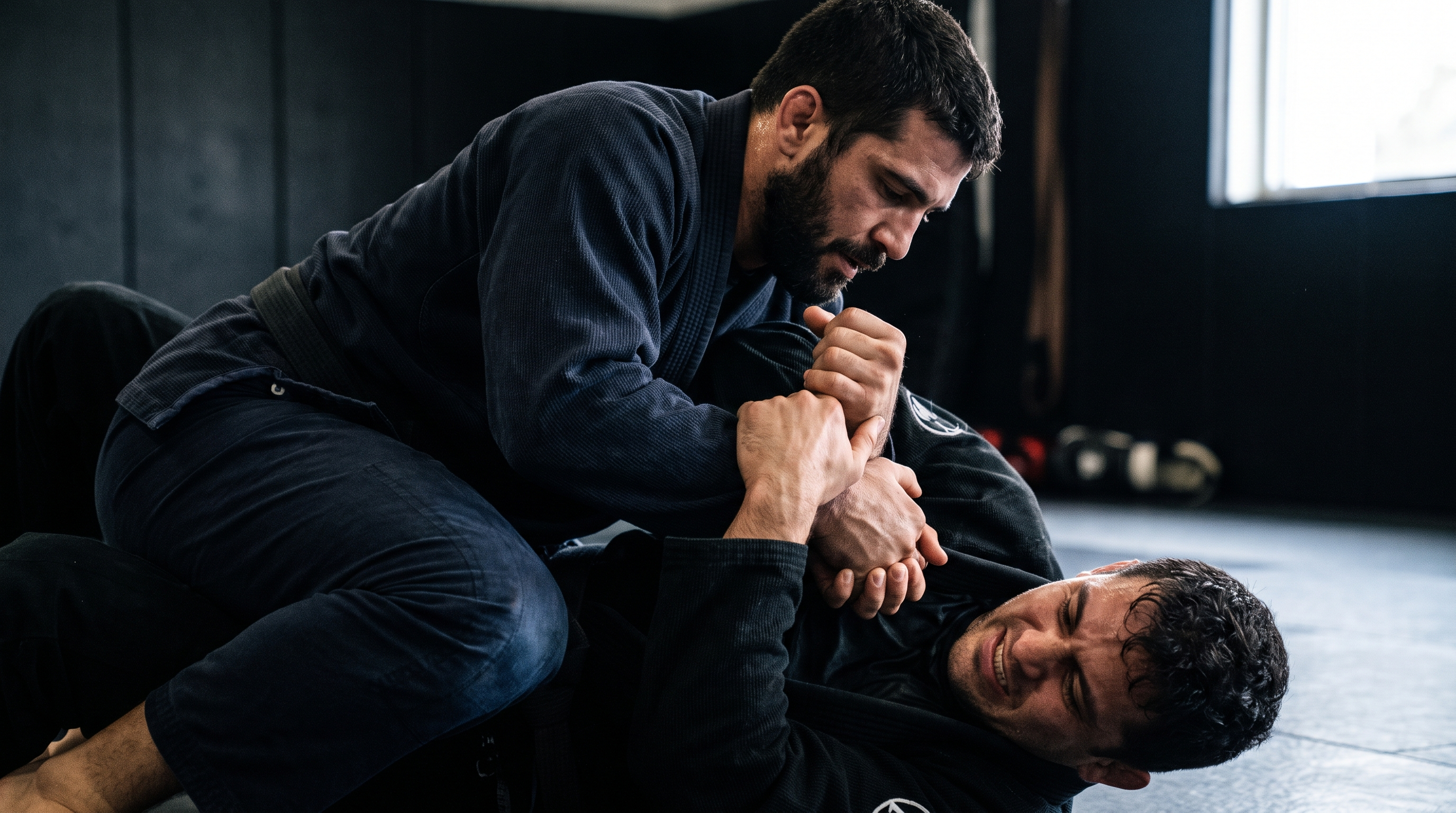
Americana from Side Control: The Setup, the Angle, and Why Yours Keeps Slipping
TL;DR. The Americana from side control is one of the first submissions white belts learn and one of the first they stop landing. It fails because people muscle the wrist instead of turning the shoulder. Pin the shoulder line, walk the hand toward the mat, glue elbow to elbow, then rotate. Angle, grip, and head position matter more than strength. This guide gives you the step-by-step, the common mistakes, and the way to actually remember it before your next class.
The Americana (sometimes called the keylock or figure-four) is usually the first submission new grapplers learn from side control. It looks simple in a demo and impossible in a live round. You get the grip, you start to turn, and the arm straightens, or your partner bridges, or the elbow slides down and suddenly you're defending your own guard pass.
The good news: nothing about the Americana is athletic. It's a mechanical submission. If your setup, angle, and grip are correct, a smaller person can finish it on a bigger one. If any of those three are wrong, no amount of squeezing will save it. This article breaks down why yours keeps slipping and gives you a simple system you can drill on Monday.
Key takeaways
- The Americana is a shoulder rotation, not a wrist crank — you finish by lifting the elbow while dragging the hand toward the hip.
- You need chest-to-chest side control with the arm already above the shoulder line before you even think about the submission.
- Grip the wrist with a thumbless (monkey) grip so your partner can't peel your thumb off with a bump.
- Your elbow must be tight to their elbow; a gap here is why they straighten the arm and escape.
- Head position (crossface or ear-to-ear) controls the far shoulder and stops the bridge that kills the finish.
- If the arm is straight, switch to a straight armlock or kimura — don't force the Americana.
- Drill the setup off resistance from a partner who knows the escape, not against a compliant training partner.
Why this happens
Most white and blue belts learn the Americana as a shape: figure-four the arm, push the wrist down, lift the elbow. They memorize the picture and skip the mechanics. Then in a live roll, the picture never appears — the arm is straight, the partner is bridging, and there's no shape to copy.
Here's the honest breakdown of why the submission slips:
- You're trying to submit the wrist. The Americana rotates the shoulder joint. If you push the wrist to the mat without controlling the elbow, you just bend their arm and nothing more happens.
- You have no side control. Loose top pressure = a mobile bottom player. If they can shrimp their hips out even a few inches, the arm angle is gone.
- The arm is straight. You can't Americana a straight arm. If you commit to it anyway, you get shrugged off.
- Your grip is a thumb-around grip. A thumb-wrapped grip on the wrist is easy to peel with a bridge. A monkey grip (thumb on the same side as the fingers) stays glued.
- Elbow-to-elbow gap. If your elbow floats above theirs, they have room to slide the arm out toward their hip.
- You gave up head pressure. The moment your head lifts off the crossface, the far shoulder can rise and the bridge follows.
Once you name the failure, the fix is obvious. Below is the sequence that turns those failures into finishes.
A simple system
Use this same order every time. Consistency is what makes muscle memory possible.
- Establish real side control first. Chest-to-chest, hip to hip, one arm crossfacing (elbow past their far ear), the other arm blocking the near hip or under-hooking the far armpit. If your side control leaks, the Americana leaks with it. Do not skip this step.
- Bait the arm. Slide the near-side hand up their body so your shoulder pressure travels toward their face. Most partners will push into your neck or jaw with their far arm — that's the arm you want. If they don't offer it, use your chest to scoop it above their shoulder line.
- Pin the wrist to the mat. The instant the wrist is above their shoulder, drive it down to the mat with your near-side hand. Use a monkey grip (thumb tucked next to your fingers). Their knuckles should point toward their own ear.
- Get elbow-to-elbow. Bring your other elbow (the crossface-side arm) tight to their elbow. This is the pivot point of the whole submission. There should be zero gap between your elbow and theirs.
- Thread the figure-four. Reach your bottom hand (the one that was crossfacing or underhooking) under their triceps and grip your own wrist. You now have a rigid frame around their arm — their wrist is trapped against the mat, their elbow is trapped by yours, and your two arms lock it all together.
- Walk the hand down first. Before you lift anything, drag their hand toward their hip — keeping the wrist bent, the elbow at 90 degrees. This pre-loads the shoulder rotation.
- Lift the elbow, not the wrist. Now slowly bring their elbow up off the mat while your grip keeps the hand pinned. The shoulder rotates. Squeeze slow — the tap comes from shoulder pressure, not wrist pain. If they don't tap and you feel the arm max out, hold; if it feels loose, re-check your elbow-to-elbow.
Remember. The Americana is finished by lifting the elbow while pinning the hand — not by pushing the hand while lifting nothing. Reverse the order and the submission stops working.
The angle nobody teaches you
Most demos show the Americana with the attacker perpendicular to the partner. In a live roll, that angle is rarely available because your partner is bridging and turning into you. The fix is to step your near knee up toward their ear as you finish. This does three things at once: it kills the bridge, it drops your weight onto the shoulder you're attacking, and it opens the space for your elbow to travel up cleanly.
Common mistakes
| Mistake | What actually happens | Fix |
|---|---|---|
| Thumb-around wrist grip | Partner bridges, your thumb pops off | Use a monkey grip (thumb with fingers) |
| Elbow floats above theirs | Arm straightens, submission gone | Glue your elbow to their elbow before rotating |
| No crossface | Far shoulder lifts, bridge escape works | Keep the crossface until the tap |
| Pushing the wrist first | You bend the arm, nothing else | Walk hand to hip, then lift elbow |
| Attacking a straight arm | You get shrugged off | Switch to straight armlock or kimura |
| Sitting up to finish | You lose chest pressure, they escape | Stay chest-heavy, drop weight into the shoulder |
| No knee up by the head | Partner bridges and turns in | Post the near knee near their ear |
Remember. If the arm is straight, stop. The Americana is for bent arms. A straight arm wants a different submission — respect what the position gives you.
When to abandon the Americana
A good partner will straighten the arm the moment they feel the figure-four coming. Don't fight physics. If the arm extends, transition:
- Straight armlock (push their wrist across your chest, pin their arm to your shoulder, lift your hips).
- Kimura (switch your grip to the opposite side of their arm — under the elbow now — and rotate the shoulder the other direction).
- North-south kimura if they turn away from you.
The Americana is one of several side control attacks that share the same setup. Treating them as a chain, not a single move, is what makes side control a real threat.
Drilling this without wasting reps
Here's a small routine that actually builds the submission into your game:
- Two rounds of positional drilling from side control. Start already in the position, attacker only allowed to attack Americana. Partner escapes at 50%. Reset every finish or escape.
- One round with the chain. Attacker can hit Americana, straight armlock, or kimura. Partner defends at 70%. This teaches the transitions.
- Video review. Watch one instructional on the Americana after class and write down the three details you missed. This is where retention lives.
Most people skip the third step. It's the one that separates "I know the Americana" from "I can finish the Americana on a resisting blue belt."
Where BJJ Memo fits in
If you're watching instructionals on the Americana — or any high percentage side control submissions — you already know the problem. You watch the video, nod along, forget the crossface grip by the time you're on the mat Tuesday. BJJ Memo was built for exactly this: paste the YouTube URL, get a structured technique card with the steps and the timestamps of the details that actually matter, and revise it in one tap before class. It's not a coach and it doesn't replace mat time — it just makes sure the details you paid attention to are still there when you need them. You can start your technique library with the Americana breakdown you already watched.
Frequently asked questions
Is the Americana the same thing as a keylock?
Yes. "Americana" and "keylock" refer to the same shoulder-rotation submission where the partner's arm is bent at 90 degrees, the wrist is pinned above their head, and the elbow is lifted to rotate the shoulder. Some coaches call it a top wrist lock or a paintbrush; the mechanics are identical.
Why does my Americana keep slipping when I lift the elbow?
Almost always because your elbow isn't tight to your partner's elbow. If there's a gap, they can slide their arm down toward their hip and straighten it out. Before you lift anything, check that your elbow and their elbow are touching. If they're not, close the gap first.
Can I finish the Americana on a straight arm?
No. The Americana requires a bent arm to rotate the shoulder. If your partner extends the arm, switch to a straight armlock or a kimura. Trying to force the Americana on a straight arm wastes the position and often leads to losing side control entirely.
What's the safest way to drill this in class?
Apply pressure slowly and stop the moment your partner taps or the arm reaches its limit. The Americana loads the shoulder joint, which doesn't have a lot of warning before injury. Never crank. If you're new, ask your coach to watch a rep before you go live with it.
How is the Americana different from the kimura?
Both rotate the shoulder, but in opposite directions. The Americana rotates the arm so the hand goes toward the partner's feet (from bent-arm side control). The kimura rotates the arm so the hand goes toward the partner's head. Grip position on the wrist is reversed between the two.
How long should it take to get good at the Americana?
It varies. Most white belts can hit it on lower-experience partners within a few months of consistent drilling, but landing it on an equally experienced blue belt takes deliberate practice — positional rounds, video study, and a coach who corrects your grip. Focus on the details in this article and it will come faster than fumbling in the dark.
Wrap up
The Americana is a beginner's submission that turns into a lifelong tool if you learn the mechanics instead of the shape. Pin the shoulder line. Monkey grip. Elbow to elbow. Walk the hand, lift the elbow. Post the knee. That's the whole thing.
For real feedback and safety, drill this at a legit academy with a qualified coach — BJJ Memo helps you remember and revise the details, it doesn't replace mat time. Next time you watch an instructional on the Americana or any other side control attack, save it as a technique card in BJJ Memo so the details are still there before your next roll.
Last updated 2026-08-27.