Best BJJ Apps vs YouTube Playlists: Which Actually Helps You Remember Techniques?
TL;DR. YouTube playlists are unbeatable for free volume and coach variety, but they're built to keep you watching — not to help you remember what you watched. A dedicated BJJ technique app turns videos into structured, revisable cards so techniques actually stick before your next roll. If you already train and forget half of what you study, pair the two: hunt on YouTube, capture in a technique app, revise before class.
Every self-studier hits the same wall. You save a great instructional, watch it twice, feel like you finally understand the underhook escape from side control — and then Friday's open mat comes, someone pins you, and your brain is completely blank. The video did its job. Your memory didn't.
This article compares the two most common study setups for BJJ self-learners: curated YouTube playlists and a dedicated BJJ technique app. The goal isn't to bash YouTube (it's incredible) or to oversell an app. It's to help you pick the workflow that actually leaves techniques in your head.
Founder disclosure
I built BJJ Memo because I was losing techniques faster than I was learning them. I train, I take notes, and I studied YouTube for years before I ever wrote a line of code. So yes, I'm biased — but I've tried to make the weaknesses section of this article as honest as the strengths. If a YouTube-only workflow fits your life better, that's a completely legitimate answer.
Key takeaways
- YouTube gives you the biggest free library of BJJ instruction, but no built-in structure for retention or revision.
- A dedicated BJJ technique app is designed around capture, organization, and spaced review — not watch time.
- Passive watching produces recognition, not recall; on the mat you need recall.
- The best setup for self-studiers is usually both: YouTube as the source, a technique app as the memory layer.
- No app, playlist, or notebook replaces mat time with a qualified coach.
- Choose YouTube-only if you're brand new and just exploring; choose an app-first workflow once you're actually training and forgetting.
- Judge any BJJ study tool by one question: can I recall the technique cold, without opening the video?
Who each option is for
Before comparing features, it helps to be honest about who each tool actually serves.
Curated YouTube playlists are for you if:
- You're new to BJJ and still exploring what interests you (guard passing? leg locks? wrestling?).
- Cost matters and you want the widest free library available.
- You enjoy the format of long-form instruction and don't mind rewatching.
- You're a coach or content curator building study lists for others.
A dedicated BJJ technique app is for you if:
- You already train and keep forgetting the details of what you learn.
- You want a searchable personal library organized by position, not by "whatever I bookmarked in 2024."
- You want to revise a handful of specific techniques before Tuesday's class instead of scrolling YouTube for 40 minutes.
- You're building a personal game and want to see, at a glance, what you actually know.
Most committed hobbyists sit between these — which is exactly where combining the two shines.
Comparison table
| Dimension | Curated YouTube playlists | Dedicated BJJ technique app (e.g. BJJ Memo) |
|---|---|---|
| Cost | Free (ad-supported) [source] | Freemium / paid tier |
| Content volume | Enormous — most of the world's free BJJ instruction lives here [source] | Whatever you choose to capture |
| Content quality control | You curate; algorithm influences discovery [source] | You choose the source video; the app structures it |
| Organization | Playlists, titles, YouTube search [source] | Position-based library, tags, search across your own cards |
| Structured notes / steps | None by default | Auto-generated technique cards with steps and key details |
| Timestamps to key moments | Manual, in the description if the creator adds them [source] | Tappable timestamps built into each card |
| Spaced revision / review flow | None [source] | Built-in review flow before training |
| Offline access | Limited to Premium subscribers [source] | Cards viewable in your library |
| Optimized for | Watch time and discovery [source] | Recall and retention |
| Replaces a coach? | No | No |
Remember. A tool optimized for watch time and a tool optimized for retention are not the same product. YouTube is brilliant at the first job. Don't blame it for being average at the second.
Strengths of each option
Where YouTube playlists genuinely shine
- Sheer breadth. From closed guard fundamentals to modern leg entanglements, from Gordon Ryan breakdowns to Danaher lectures, if it exists in BJJ, someone has posted about it [source].
- Free access. You can build a serious study habit for the price of tolerating ads [source].
- Discovery. The algorithm is genuinely useful for stumbling onto coaches whose game matches yours.
- Long-form context. Full seminars and match breakdowns give you the "why," not just the "how."
- Comment sections and creators. You can ask questions, and top creators often reply or clarify in follow-up videos [source].
Where a dedicated technique app shines
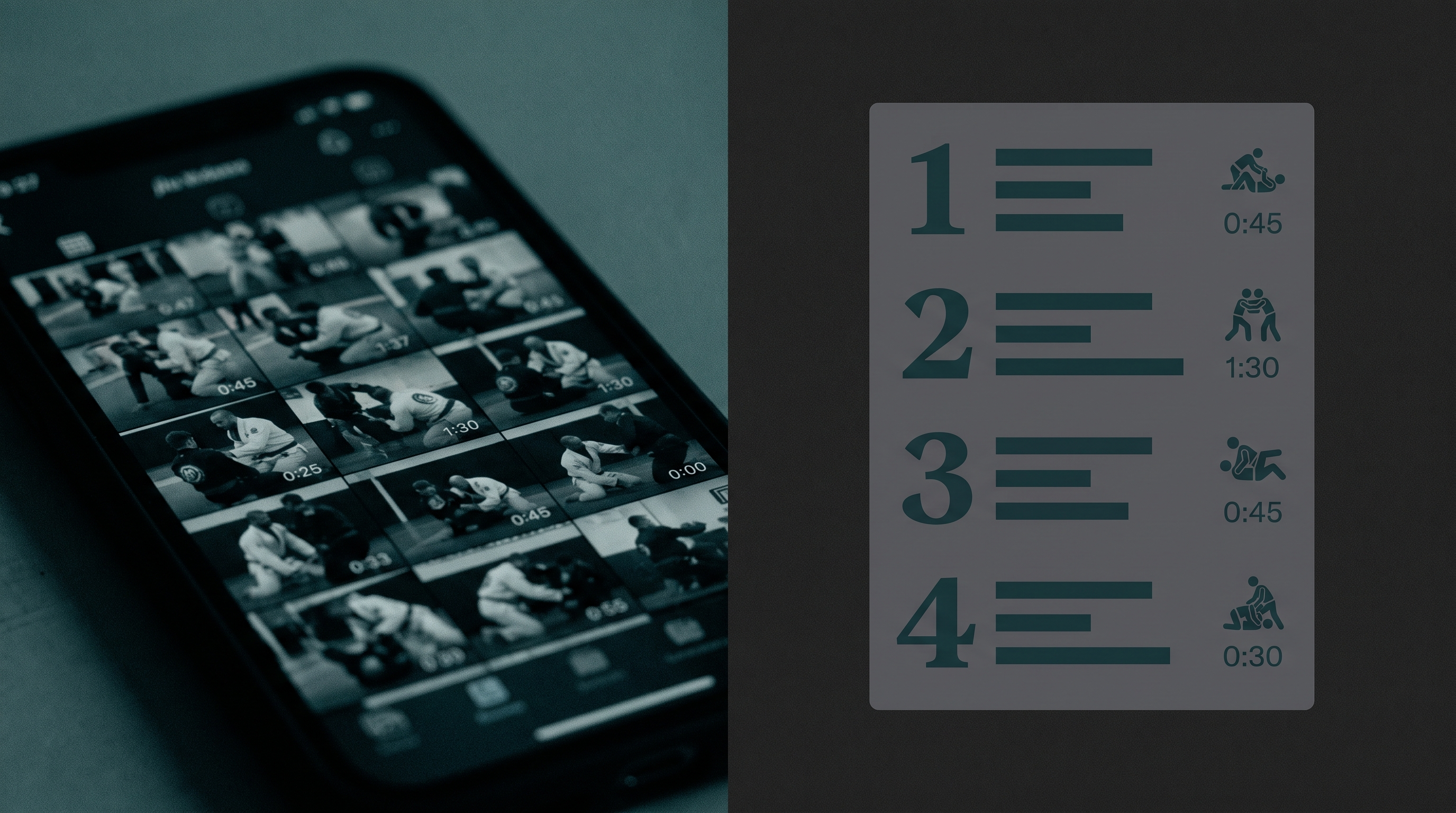
- Structure by default. Every video becomes a card with steps, key details, and timestamps — not a 42-minute wall of talking.
- Retention built in. A review flow surfaces techniques on a cadence, so you're recalling instead of rewatching.
- Personal library, not a public feed. You're organizing your own game, position by position.
- Fast recall before class. Two minutes of card review beats twenty minutes of scrubbing through a playlist for "that one detail."
- You stay in control. You decide what enters your library — no algorithm nudging you toward the next thing.
Where BJJ Memo is honestly stronger (with reasons, not adjectives)
- It's designed around forgetting, not around watching. The core loop — capture, structure, revise — exists because retention decays fast when you only watch once. YouTube's core loop is "watch the next one."
- Structured cards reduce re-search time. When you want to review the underhook escape from side control before class, you open one card, not a playlist. Less friction means you actually do it.
- Tappable timestamps stay with the technique. If a detail lives at 7:42 of a 22-minute video, that timestamp is inside the card, not lost in a comment thread.
- Your library reflects your game. Because you choose what to capture, your library becomes an honest map of what you're actually studying — useful for spotting gaps.
- Revision is a first-class feature, not a habit you have to invent. Most BJJ notebooks fail because nobody re-reads them. A review flow removes that willpower cost.
Remember. Recognition is when you see a technique and think "yeah, I know this." Recall is when you're pinned under side control at 90% and your body executes it. Only recall wins rolls.
Where BJJ Memo is honestly weaker (mandatory)
An honest comparison has to include this section.
- YouTube's library is bigger than any app's, forever. BJJ Memo depends on you feeding it videos — it doesn't magically know every instructional ever posted.
- No live coach feedback. An app can structure information; it can't correct your posture, base, or grip. A qualified coach does that.
- No comment section debate. You lose the collective sanity-check of thousands of viewers pointing out details or disagreements.
- You still have to watch the source video first. The app helps you remember it — it doesn't watch it for you.
- Not a fit for pure explorers. If you're browsing BJJ out of curiosity rather than training, YouTube alone is enough.
Final recommendation by user profile
Total beginner, not sure BJJ is for you yet. Stick with YouTube. Save a small playlist of fundamentals videos, book a trial class at a legit academy, and see if you love it. You don't need another app in your life yet.
Committed white or blue belt training 2–3× a week. This is the sweet spot. Use YouTube to find instruction, then capture the videos you actually want to remember in a technique app like BJJ Memo. Review a card or two before class.
Serious competitor building a game. You need a library, not a feed. An app-first workflow, organized by position and game plan, will beat a chaotic bookmarks folder every time. Explore how to organize BJJ techniques into a coherent personal system.
Coach. Use both. YouTube for what you show; a technique app so students can review what you taught in class.
Traveler or hobbyist between gyms. A structured library that lives on your phone is worth more than any playlist. You already know how it feels to lose techniques when you can't drill weekly.
Remember. The winner isn't the tool with the most content — it's the tool that gets techniques into your body by Tuesday night.
Frequently asked questions
Is YouTube enough to learn BJJ on its own?
For learning concepts, yes — YouTube is an extraordinary resource. For actually getting good, no. BJJ is a contact sport with subtle pressure and timing that has to be felt on the mat with a qualified coach and live partners. Use video (and apps) to accelerate your understanding between sessions, not to replace training.
What's the single biggest difference between a BJJ technique app and a YouTube playlist?
Intent. Playlists are built for watching. A dedicated technique app is built for remembering. That difference shapes every feature: structured cards, tappable timestamps, and a review flow that surfaces techniques before you forget them.
Do I still need a notebook if I use an app?
Probably not, unless writing by hand helps you think. The point of a notebook was always retention — an app that captures, structures, and prompts revision covers the same need with much less friction. If you love your notebook, keep it; if it's collecting dust, that's your answer.
How many techniques should I focus on at once?
Fewer than you think. A short list of positions you're actively working, revised consistently, will beat a giant library you never open. Pick a small set, drill them at your academy, and review the corresponding cards before class.
Will BJJ Memo work with any YouTube video?
It's built around BJJ YouTube URLs — instructionals, technique clips, and breakdowns. Paste the link, and the app produces a structured technique card you can save to your library and revise later.
Is this really better than just paying for a premium instructional platform?
Different job. Premium instructional platforms give you high-production courses. A technique app gives you a personal, revisable memory system on top of whatever you study — free YouTube, paid courses, or notes from class. They complement each other.
Bottom line + safety note
YouTube is your library. A dedicated BJJ technique app is your memory. If you're serious about not forgetting what you study, you almost certainly want both.
Next time you save a BJJ video you actually want to remember, capture it as a technique card in BJJ Memo so it's there — organized, timestamped, and ready to review — before your next roll. Grab it on the App Store or Google Play and start building your library one card at a time.
For real feedback and safety, train the techniques you study at a legit academy with a qualified coach. BJJ Memo helps you remember and revise — it doesn't replace mat time.
Last updated 2026-09-19.