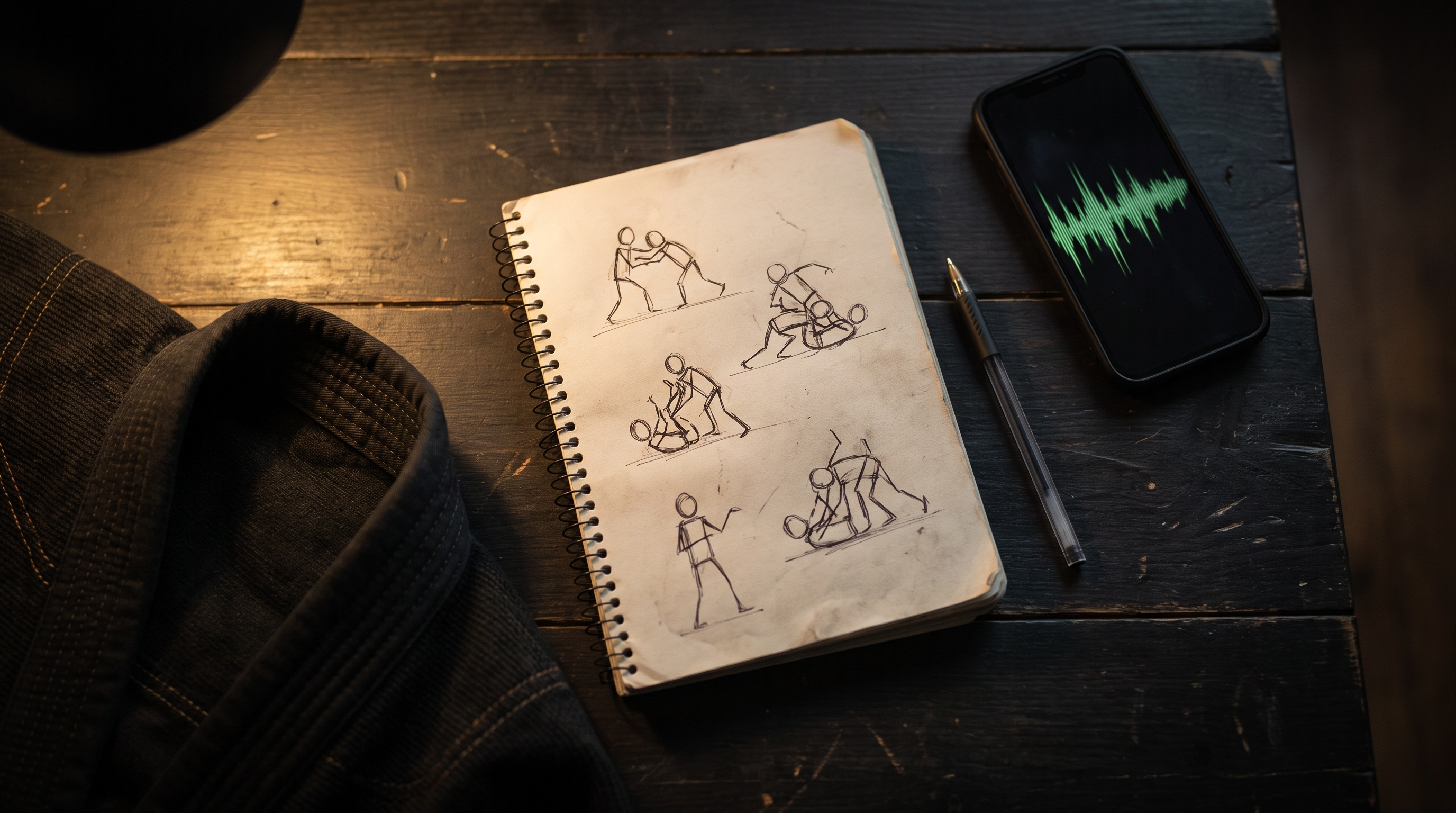
Best BJJ Note-Taking Methods Compared: Voice Memos, Notebooks, and Technique Cards
TL;DR. The best BJJ note-taking method is the one you'll actually reopen before training. Voice memos are fastest to capture but hardest to revise; paper notebooks build memory through handwriting but don't search; digital notes (Notes, Notion) search well but decay into chaos; spreadsheets suit competitors but feel clinical; technique-card apps like BJJ Memo trade flexibility for structure and built-in revision. Choose by how you actually study, not by what looks impressive.
Every grappler has felt it: you leave class with a new detail on the underhook, tell yourself you'll remember it, and by next week it's gone. The fix isn't more instructionals — it's a system for capturing what you learn and revisiting it before your next roll. This article compares the most common ways grapplers take BJJ notes, honestly, without pretending any one method is universally best.
Key takeaways
- No note-taking system helps if you never reopen it — retention comes from revision, not capture.
- Voice memos win on speed after class but almost always get buried in your phone unless you transcribe them.
- Paper notebooks strengthen encoding through handwriting, but they can't be searched or linked to the video you learned from.
- Generic digital notes (Apple Notes, Google Docs, Notion) are powerful but require you to invent your own structure — most grapplers abandon theirs within months.
- Spreadsheets suit competitors tracking a specific game, but they discourage the messy detail beginners need.
- Structured technique-card apps like BJJ Memo enforce a repeatable format and add spaced revision, at the cost of raw flexibility.
- The right method depends on your belt, how you learn, and whether your bottleneck is capture or recall.
Founder disclosure (read this first)
I build BJJ Memo, a technique-card app for grapplers. That's a bias you should know about before reading a comparison that includes it. To keep this useful, I've tried to describe each method the way a training partner would — including where BJJ Memo is genuinely weaker than the alternatives. If a paragraph reads like marketing, ignore it.
Who each method is for
Before comparing features, it helps to be honest about who each option is actually built for.
- Voice memos — grapplers who can't or won't stop to write, and who process ideas by talking out loud. Great for the car ride home; bad for anyone who won't relisten.
- Paper notebooks — learners who encode better by writing, who like drawing stick figures, and who don't mind losing search or linking to source video.
- Generic digital notes (Apple Notes, Google Docs, Notion, Obsidian) — tinkerers who enjoy building their own system. Powerful, but demands maintenance most people quit within a few months.
- Spreadsheets — competitors and data-minded grapplers tracking a specific game (e.g., "attempts and finishes from k-guard") rather than accumulating raw class notes.
- Technique-card apps (e.g., BJJ Memo) — grapplers whose main problem is retention, especially self-studiers of YouTube instructionals who want a repeatable card format and built-in revision.
If you already know which camp you're in, skip to Final recommendation by user profile.
Comparison table
| Method | Capture speed | Search | Handles video | Enforces structure | Built-in revision | Best for |
|---|---|---|---|---|---|---|
| Voice memo (default recorder) | Fastest | None (audio) | No | No | No | Post-class brain dump in the car |
| Paper notebook | Slow | None | No | You | Manual | Kinesthetic learners, drawings |
| Apple Notes / Google Docs | Medium | Yes (text) | Links only | You | Manual | Casual, low-effort digital notes |
| Notion / Obsidian | Medium (after setup) | Yes | Embeds | You (via templates) | Plugin-dependent | Tinkerers who enjoy the system |
| Spreadsheet (Sheets/Excel) | Medium | Yes | Cell links | You | No | Competitors tracking a specific game |
| Technique-card app (BJJ Memo) | Medium | Yes | Yes (YouTube → card) | Yes (fixed template) | Yes | Retention-focused self-studiers |
Remember. Every column matters less than one that isn't in the table: did you actually reopen this note before your next session? A messy paper page you review beats a beautiful Notion database you never touch.
Strengths of each option
Voice memos
Voice memos are unbeatable for capture speed. You can talk through the detail from tonight's armbar setup while walking to your car, without opening an app or finding a pen. Talking out loud also forces you to reconstruct the technique in your own words, which is a form of retrieval practice — useful even if you never listen back.
The catch: audio isn't searchable. Six months in, you'll have hundreds of untitled voice notes, and finding the one about "that grip from half guard" is essentially impossible unless you transcribe them.
Paper notebooks
Handwriting has a real learning effect for most people. Slowing down to write "post underhook → hip escape → knee shield" forces you to sequence the technique correctly, which strengthens the memory more than typing does. Doodled stick figures — even bad ones — help spatial recall.
A notebook is also frictionless in the way phones aren't: no notifications, no scrolling. It's just you and the page. The trade-off is that you can't search, can't link to the YouTube timestamp you saw the move at, and if you lose the book, you lose everything.
Apple Notes, Google Docs, Notion, Obsidian
Generic digital notes are the most flexible option here. You can paste YouTube links, embed images, and search across years of notes in seconds. Notion and Obsidian go further with templates, tags, and linked databases — you can build almost any system you want.
"Almost any system you want" is also the problem. Every grappler I know who started a Notion BJJ vault either loves it three years in or abandoned it by month four. The tools don't tell you how to structure a technique note, so you invent your own — and often re-invent it every few weeks.
Spreadsheets
Underrated for competitors. A spreadsheet is the right tool when your question is "how often does my k-guard entry lead to a finish?" rather than "what did coach say about the underhook tonight?" Columns like position → attack → outcome → notes give you real data over a training block.
Spreadsheets are less useful for the messy, detailed observations beginners and hobbyists need to capture. A cell doesn't invite you to write "remember to keep my elbow pinched or he slips the underhook."
Technique-card apps (BJJ Memo)
Structured apps trade flexibility for consistency. In BJJ Memo, every technique becomes a card with the same fields — steps, key details, common mistakes, and tappable timestamps from the source video — so you never sit down to a blank page wondering how to write it up. The library is searchable by position, and a revision flow surfaces cards before your next session so you actually re-encounter what you saved.
The honest downside: the format is fixed. If you want to journal about your mental game or track sparring rounds in the same place, an app built around technique cards isn't the right tool.
Where BJJ Memo is honestly stronger
Not better on vibes — better for specific reasons:
- It removes the blank-page problem. Because the card template is fixed, you're not designing a note-taking system every time you sit down. You fill in the fields. This is why most casual Notion vaults die: too many decisions per note.
- It ties the note to the source video. For anyone learning from YouTube instructionals, being able to jump back to the exact timestamp of a detail is the difference between "I think coach did this" and actually seeing it again in ten seconds.
- Revision is built in, not something you promise yourself. Almost every other method on this list requires you to remember to reopen your notes. A dedicated app can surface a card the morning of training without you scheduling anything.
- The structure enforces the same discipline for every technique. Steps, details, common mistakes — you fill each field or you notice you can't, which itself tells you where your understanding is thin.
Remember. Structure is only a strength if your problem is inconsistency. If you already have a note-taking habit you love, a rigid template will feel like a downgrade — that's fair.
Where BJJ Memo is honestly weaker
A comparison that only lists strengths isn't honest. Here's where the other methods win:
- Flexibility. Notion, Obsidian, and even a paper notebook will bend to anything: gym logs, sparring reflections, competition prep, drills, mental-game notes. A technique-card app is opinionated by design — it's for techniques.
- Capture speed for a fleeting thought. Nothing beats a voice memo when you're walking to the car with a half-formed idea. A structured card takes longer to fill in, even quickly.
- Offline-first, forever. A paper notebook doesn't need an account, a subscription, sync, or a working phone. Fifty years from now you can still open it. That's a real advantage no app can fully match.
- Handwriting's encoding effect. For learners who genuinely retain more when they write by hand, typing into any digital tool — including BJJ Memo — loses something real.
- Data-style tracking for competitors. A spreadsheet is still the better tool if what you're actually doing is counting attempts and finishes in a specific position over a training camp.
If any of those five points describes your bottleneck, another method probably fits you better.
Final recommendation by user profile
- Brand-new white belt, overwhelmed: Start with a cheap paper notebook and one voice memo after class. Don't build a system yet. Once you've been training a few months and know what you actually want to remember, migrate the good stuff into a structured tool.
- Blue belt studying YouTube instructionals: This is the sweet spot for technique-card apps. Your bottleneck is that you watch a lot and remember little — a card per technique with a timestamped link fixes exactly that.
- Hobbyist training 2–3×/week who forgets class details: Try a hybrid: voice memo in the car, then convert the two or three ideas that mattered into structured cards the next day. Revise them before your next session.
- Competitor prepping for a specific bracket: A spreadsheet tracking your A-game plus a notes tool (paper or app) for detail work. Different jobs, different tools.
- Coach wanting students to review class material: A shared structured format beats "remember what I said tonight." Cards, a shared doc, or a class-notes group chat — anything that makes revision the default.
- Tinkerer who loves systems: Notion or Obsidian if you'll genuinely maintain it. Be honest with yourself about month four.
For more on the why behind revision, see how to remember BJJ techniques and how to learn BJJ from YouTube.
Frequently asked questions
What's the best BJJ note-taking method for a complete beginner?
A cheap paper notebook plus the occasional voice memo. As a white belt your bottleneck isn't organization — it's just capturing enough reps of exposure to techniques so you start to recognize positions. Don't over-engineer a system in month one.
Are voice memos actually useful for BJJ?
Yes, but only if you do something with them. Recording a voice memo after class is one of the fastest ways to capture detail while it's fresh. The failure mode is leaving them in your phone forever. Either relisten within 48 hours or transcribe the good ones into a searchable note.
Should I use Notion or Obsidian for my BJJ notes?
Only if you enjoy building and maintaining the system itself. Both are excellent tools, but they demand that you design your own template — and most grappler vaults get abandoned within a few months for that reason. If you don't want to be a system-builder, a more opinionated tool will serve you better.
How is a technique-card app different from just using Apple Notes?
Apple Notes gives you a blank page and total freedom. A technique-card app like BJJ Memo gives you a fixed structure — steps, details, common mistakes, timestamps — and adds a revision flow so cards resurface before your next session. It's a trade of flexibility for consistency and retention.
How often should I revise my BJJ notes?
Lighter than you think, more often than you're doing now. A quick scan the morning of training — even three minutes — is worth more than a long weekend deep-dive once a month. The goal is to arrive on the mat with a specific detail you're actively trying to hit.
Can note-taking replace mat time?
No. Notes are for retention between sessions; the reps only happen on the mat. Anyone selling you the opposite is selling you something. For real feedback and safety, train at a legit academy with a qualified coach — notes and apps help you remember and revise, they don't replace live training.
Ready to actually remember what you learn?
If your bottleneck is capturing what you learn from YouTube instructionals and actually recalling it before your next roll, that's the exact problem BJJ Memo was built for. Paste a video URL, get a structured technique card with tappable timestamps, and let the revision flow surface it before your next session. If your bottleneck is something else — journaling, competition data, handwriting — pick the method above that matches it. The best system is the one you'll reopen.
Teacher disclaimer. BJJ Memo is a retention and study tool. It does not replace mat time, and it does not replace a qualified coach at a legitimate academy. For real feedback on your technique — and to train safely — work with a black belt or credentialed instructor in person. Use notes to remember; use the mat to learn.
Last updated 2026-09-16.