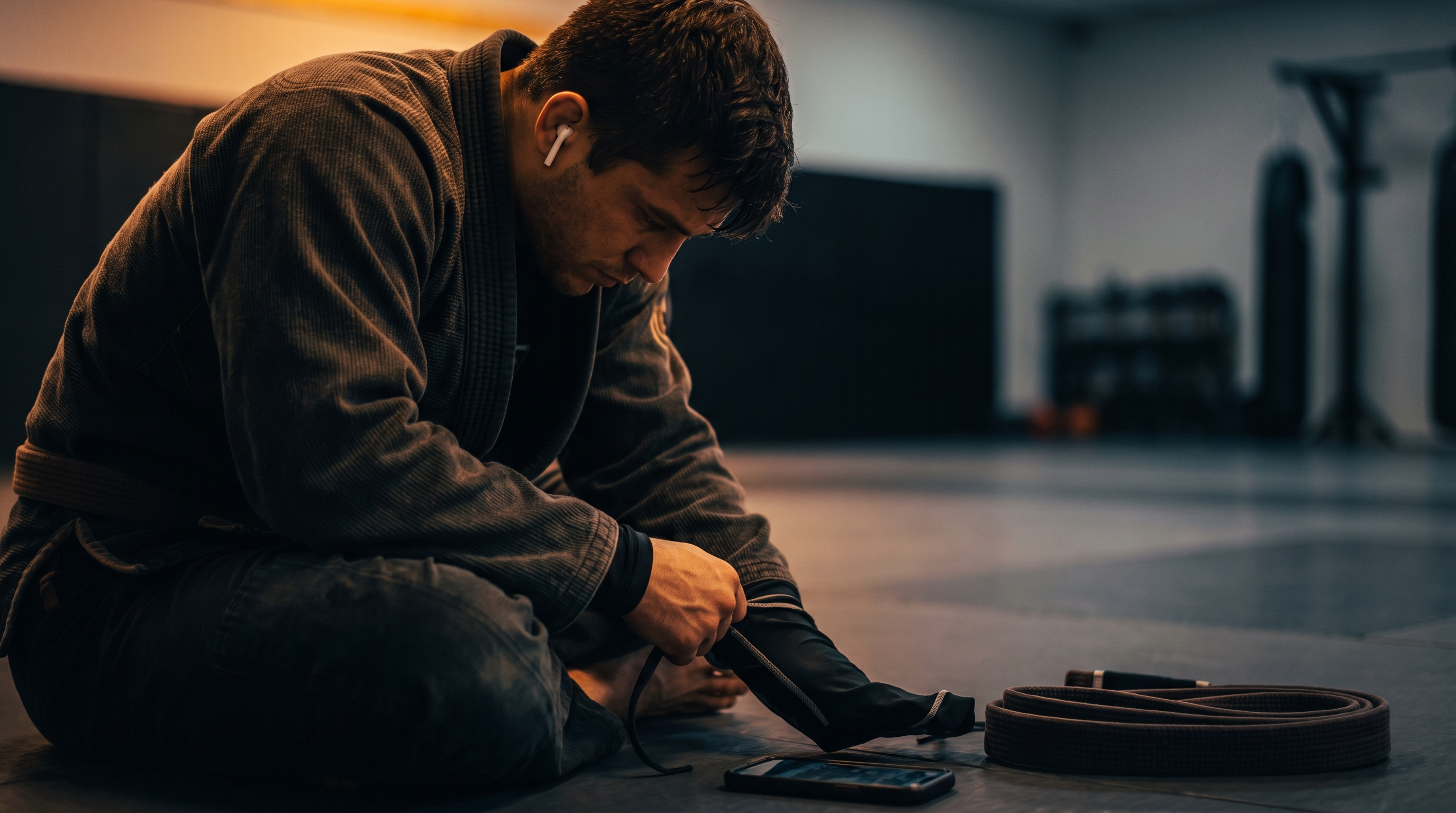
Best BJJ Podcasts for Learning the Game Between Training Sessions
TL;DR. Podcasts are one of the highest-leverage ways to keep your BJJ brain switched on between rolls. The best jiu jitsu podcasts do more than interview champions — they break down concepts, decision trees, and training philosophy in a way you can actually use. Below we compare the BJJ podcasts we recommend most, what each is best for, and how to pair audio learning with structured technique notes so nothing you hear goes to waste.
Key takeaways
- The best BJJ podcasts fall into three buckets: concept breakdowns, coach interviews, and news/scene coverage.
- For beginners, concept-first shows do more for your game than long-form interviews.
- Podcasts are a passive input; you retain more when you capture one or two ideas per episode and revise them before training.
- No single podcast covers everything — mix a concept show, a coach interview show, and a scene/news show.
- Audio can't show technique; pair podcasts with instructional video and a retention system so ideas turn into mat reps.
- BJJ Memo turns YouTube instructionals into revisable technique cards — the counterpart to what you hear on podcasts, not a replacement.
- Listen active: pause, take a note, look up the technique later. Passive listening on the drive to work fades fast.
Founder disclosure
I built BJJ Memo, a mobile app that turns BJJ YouTube videos into structured technique cards you can revise before training. That means I have skin in the game and I'm biased. To keep this honest: this article is about podcasts, not our app, and I'll only mention BJJ Memo where it's a fair fit for what a podcast can't do — capture visual technique. Every claim about a specific podcast below should be verified against the show's own site before you take it as gospel [source].
Who each podcast is for
BJJ Mental Models Podcast
For grapplers who want the "why" behind techniques, not just the how. The show frames BJJ as decision trees and concepts — ideal for hobbyists trying to build a system instead of collecting moves [source].
Chewjitsu Podcast (Nick Albin)
For beginners and hobbyists who want a friendly, coach-in-your-ear vibe. Nick Albin is known for practical training advice, mindset, and answering listener questions in plain language [source].
Grappling Central Podcast
For grapplers who love the community and history of the sport. Long-form interviews with black belts, competitors, and coaches — closer to a "who's who" of BJJ than a technique lecture [source].
The Sonny Brown Breakdown
For readers who want thoughtful, long-form conversations about training methodology, coaching, and the philosophy behind rolling well [source].
BJJ Fanatics Podcast
For fans of specific instructors. Because BJJ Fanatics hosts instructional content, their podcast often features the coaches behind popular systems — useful for context around a particular game [source].
FloGrappling Podcast
For the competition side. Athlete interviews and event breakdowns — most useful if you compete or follow the pro scene [source].
The Joe Rogan Experience (BJJ episodes only)
For occasional deep dives with names like John Danaher, Gordon Ryan, or Craig Jones. Not a BJJ-only show, but the episodes with elite grapplers are worth queueing up [source].
Comparison table
| Podcast | Best for | Format | Beginner friendly? | Technique-heavy? |
|---|---|---|---|---|
| BJJ Mental Models | Concept & framework learning | Solo/duo breakdowns | Yes | Conceptually, yes |
| Chewjitsu | Q&A, mindset, coaching | Solo host + guests | Very | Some |
| Grappling Central | Long-form coach interviews | Interviews | Somewhat | Indirectly |
| Sonny Brown Breakdown | Training methodology, philosophy | Interviews | Somewhat | Indirectly |
| BJJ Fanatics Podcast | Instructor stories, system context | Interviews | Yes | Yes, indirectly |
| FloGrappling Podcast | Competition scene | Interviews / analysis | Somewhat | No |
| JRE (BJJ episodes) | Star grappler conversations | Long-form interview | Yes | Some |
[Verify each show against its own site before quoting — source placeholders left for human editorial review.]
Remember. A podcast is an input, not a training session. If you finish an episode without writing down at least one idea to try, you probably won't remember any of it by Thursday.
Strengths of each option
BJJ Mental Models
Its strength is compression. Concept episodes give you a framework — like positional hierarchy, or the retention/frame/base loop — that survives across guards, gis, and rulesets. For someone building a game rather than collecting moves, this is where audio learning pays off [source].
Chewjitsu
Approachability. Nick Albin talks like a coach, not a guru. If you're a white or blue belt overwhelmed by information, his tone alone reduces the noise [source].
Grappling Central
Depth of scene. If you want to know the story of a coach, a lineage, or a competitor beyond their highlight reel, this is where you'll find it [source].
Sonny Brown Breakdown
Rigor. Sonny asks the kind of coaching-nerd questions that most interviewers skip [source].
BJJ Fanatics Podcast
Access. You get to hear the instructors behind popular systems explain the reasoning they can't always squeeze into a highlight clip [source].
FloGrappling Podcast
Timeliness. If you follow major competitions and the pro scene, this is your feed [source].
JRE BJJ episodes
Room to breathe. When a top grappler sits down for a long conversation, ideas come out you rarely get in a short YouTube interview [source].
Where BJJ Memo is honestly stronger
BJJ Memo isn't a podcast, so this is less "we beat them" and more "we do the thing they can't":
- Podcasts are audio; jiu jitsu is visual. You can't drill a hip-switch you only heard described. BJJ Memo turns a YouTube instructional into a Technique Card with tappable timestamps for the key visual moments.
- Podcasts fade fast. By next week's roll, much of what you heard is gone. BJJ Memo files each card into a personal, searchable library and surfaces it for revision before training.
- Structured, not linear. A podcast is an hour in order. A Technique Card is steps, key details, and common mistakes you can scan in seconds.
- Search by position, not episode number. You can look up "side control escape" across everything you've saved, instead of scrubbing through a two-hour episode trying to find the moment they mentioned it.
For a broader take on turning video into notes, see our guide on how to learn BJJ from YouTube.
Where BJJ Memo is honestly weaker
Also fair to say:
- Podcasts give you personality and context. You won't build the same relationship with a Technique Card that you do with a host whose voice you've heard for a year.
- Podcasts cover ground an app can't — mental game, coaching philosophy, competition politics, injury stories. That's not what technique cards are for.
- Podcasts are free. You don't need any app to listen; a phone and earbuds are enough.
- BJJ Memo needs a video. If a coach only ever taught a detail in a podcast interview, we can't turn that into a card — you'd need to find a video demonstration.
Use both. Our post on how to remember BJJ techniques covers how to combine passive inputs (podcasts, video) with active revision.
Remember. The point isn't to consume more BJJ media. It's to remember more of what you've already consumed.
Final recommendation by user profile
If you're a total beginner
Start with Chewjitsu for tone and mindset, and add BJJ Mental Models once you have a few months of mat time and words like "guard" and "pass" mean something concrete. Skip competition-heavy shows until you actually care about the scene.
If you're a hobbyist (2–3×/week)
BJJ Mental Models for concepts, Sonny Brown Breakdown for methodology, and one instructional-adjacent show like BJJ Fanatics or Grappling Central for variety.
If you compete
Add FloGrappling and any JRE episodes with elite grapplers. Pair with focused film study — our guide on studying instructionals has a workflow.
If you coach
Sonny Brown Breakdown and Chewjitsu for coaching craft. Grappling Central for lineage and history you can share with students.
Remember. No podcast will make you better on its own. What makes you better is the small loop between listening, capturing an idea, drilling it in class, and revising the note before your next session.
How to actually learn from a BJJ podcast
- Listen with a purpose. Pick one theme per week (guard retention, pressure passing, mindset) and lean toward episodes that match.
- Pause and note. If a host says something you'd want to try, write it down — even a single line is enough.
- Cross-check with video. Concepts click faster when you see them; a short YouTube search usually surfaces a demo.
- Save and revise. Turn the video into a Technique Card in BJJ Memo (or handwritten notes if you prefer) and revise before your next class.
- Ask your coach. Real feedback on a real mat still beats every podcast in the world.
For a broader take on capture-and-revise, our post on BJJ note-taking that actually works goes deeper.
Frequently asked questions
What is the best BJJ podcast for beginners?
For most beginners, Chewjitsu is the friendliest starting point — coach-in-your-ear tone, mindset advice, and practical answers to common white-belt questions. Add BJJ Mental Models once basic terminology feels natural.
Are BJJ podcasts a substitute for training?
No. Podcasts and instructional videos are inputs; mat time under a qualified coach is what actually makes you better. Audio is best used to reinforce and organize what you've already trained.
How do I remember what I hear in a jiu jitsu podcast?
Pause when something lands, write one line, then find a short video demo to see the concept. Save it as a technique note (in a notebook or an app like BJJ Memo) and revisit it before your next class.
How many BJJ podcasts should I follow?
Two or three is plenty: one concept-first show, one coach or interview show, and optionally one scene/news show if you follow competition. More than that becomes noise.
Are there BJJ podcasts specifically for white belts?
There aren't many white-belt-only shows, but Chewjitsu, BJJ Mental Models, and beginner-tagged BJJ Fanatics episodes cover white-belt questions frequently. Filter by episode title.
Can I learn technique from audio alone?
Only partially. You can learn the "why" — decision trees, priorities, common mistakes — but not the "how." For the how, you need to see it and drill it, ideally with a coach watching.
Bring your audio learning back to the mat
Podcasts fill the space between sessions well, but ideas fade if you don't capture them. When a host mentions a technique you want to try, find the YouTube demo, paste the link into BJJ Memo, and let the app turn it into a Technique Card you can revise before your next class. Build a library of the moves you actually want to keep — and stop losing what you learn.
Get BJJ Memo on iOS and Android and start saving what you hear.
A note on coaching. BJJ Memo helps you organize and revise; it does not replace a qualified coach. Train the technique at a legit academy with someone who can give you real feedback and keep your training partners safe.
Last updated 2026-09-10.