Best BJJ Instructional Channels on YouTube for Studying Fundamentals
TL;DR. Free BJJ instruction on YouTube is better than it has ever been, but you have to know where to look. This guide compares six trusted channels — Chewjitsu, Bernardo Faria, Stephan Kesting (Grapplearts), Lachlan Giles, Knight Jiu-Jitsu, and Gracie Breakdown — and explains which one fits your belt, your game and your learning style. It also covers a common trap: watching a lot without a system to remember what you learned before your next roll.
Key takeaways
- YouTube is a legitimate way to study fundamentals — thousands of hours of black-belt instruction are available for free.
- Different channels serve different needs: mindset and beginner Q&A, technical breakdowns, competition analysis, self-defense basics.
- The best channel for you depends on your belt, your training frequency and the position you're stuck in right now.
- Passive watching is close to useless — you need to filter, capture and revise, not just consume.
- YouTube complements class; it does not replace a coach or live sparring feedback.
- Pair the channels below with a note-taking or review workflow so techniques actually reach the mat.
- Free is not the same as low-quality — several of these channels are run by world-class competitors and instructors.
Who this guide is for
This is a shortlist for grapplers who want to study Jiu-Jitsu fundamentals without paying for a subscription instructional site yet. It's aimed at white and blue belts, hobbyists training two to three times a week, and self-learners who want to make YouTube time count. If you already train regularly, these channels will help you fix leaks between classes. If you're brand new, they will help you understand what you're being shown.
Founder disclosure. I run BJJ Memo, an app that helps grapplers save YouTube instructionals as structured technique cards and revise them before training. I built it because I was drowning in bookmarked videos and forgetting almost everything before my next session. That bias should be obvious. Everything below still stands on its own — pick a channel, start studying, and use whatever review method works for you.
1. Chewjitsu (Nick "Chewy" Albin)
One-liner: A friendly, no-ego channel that mixes technique with the mental side of training.
Who it's for: New white belts, returning grapplers, and anyone who finds most technique videos intimidating. Chewy talks like a coach, not a highlight reel.
Strengths (factual):
- Focuses heavily on beginner questions: gym etiquette, tapping, dealing with bigger training partners, when to compete.
- Covers common early-game positions — closed guard, mount escape, side-control escape — in plain language.
- A large back catalogue of Q&A-style videos means you can search almost any beginner problem and find an answer.
Best if: You want a training partner in your headphones and prefer explanations over flashy transitions.
Pricing: Free on YouTube. Chewjitsu also runs a paid online academy, which is separate from the free channel.
2. Bernardo Faria (BJJ Fanatics channel)
One-liner: Free full-length technique breakdowns from a multiple-time world champion, plus interviews with top black belts.
Who it's for: White to purple belts who want black-belt-level detail on classic positions.
Strengths (factual):
- Bernardo teaches many fundamentals himself — over-under pass, closed guard, half guard — in his own methodical style.
- Regular guest teachers include world-class competitors and coaches, giving you exposure to many different games.
- Videos are typically single-technique deep dives rather than short highlights, which is better for actual learning.
Best if: You want detailed, no-music, coach-style teaching from top-tier practitioners.
Pricing: Free on YouTube. BJJ Fanatics also sells paid instructionals; the YouTube content is genuinely useful without buying anything.
Remember. A great technique video is not the same as a technique you own. What you watch has to be captured, drilled and revisited — otherwise you are just entertaining yourself.
3. Stephan Kesting — Grapplearts
One-liner: Longform, systematic fundamentals from a veteran coach who's excellent at explaining "why".
Who it's for: Analytical learners who want the concepts behind the moves, not just the steps.
Strengths (factual):
- Emphasises principles — posture, base, frames, hip position — that transfer across techniques.
- Covers no-gi and self-defense material alongside sport BJJ.
- Excellent for grapplers who prefer to understand a position deeply before adding variations.
Best if: You are the kind of student who reads the manual before playing the game.
Pricing: Free on YouTube. Kesting also sells paid instructional courses through Grapplearts.
4. Lachlan Giles (Absolute MMA)
One-liner: Technical, competition-oriented breakdowns from one of the sport's most respected coaches.
Who it's for: Blue belts and above who want to see how modern competition Jiu-Jitsu actually works.
Strengths (factual):
- Frequently posts match breakdowns of high-level competitors, showing why specific decisions won or lost the position.
- Strong leglock and half-guard content, taught with clear concepts rather than "secret" details.
- Comfortable teaching for both gi and no-gi audiences.
Best if: You want to bridge the gap between watching high-level competition and understanding it.
Pricing: Free on YouTube. Lachlan also produces paid instructionals separately.
5. Knight Jiu-Jitsu (Chad Hardy)
One-liner: Clean, systematic breakdowns aimed squarely at hobbyists trying to build a coherent game.
Who it's for: White and blue belts who feel like they know a lot of moves but nothing that connects.
Strengths (factual):
- Organises content around positions (e.g. side-control escapes, guard retention) so you can study a full topic in one sitting.
- Explains common mistakes explicitly, not just the "correct" version.
- Tone is patient and practical — closer to a private lesson than an Instagram highlight.
Best if: You want structure — you're tired of random techniques and want a plan.
Pricing: Free on YouTube. Paid content is available separately.
6. Gracie Breakdown / Rener Gracie
One-liner: Fundamentals and self-defense taught through breakdowns of real fights and iconic matches.
Who it's for: Beginners who want to understand where modern BJJ comes from and why the fundamentals matter.
Strengths (factual):
- Uses recognisable events (MMA fights, viral clips) to teach position, control and escapes.
- Emphasises safety-first fundamentals: base, posture, distance management.
- A large catalogue of episodes covering everything from mount escapes to trap-and-roll basics.
Best if: You want context — why a technique exists, when it's used, and what happens if you skip a step.
Pricing: Free on YouTube. Gracie University offers separate paid programs.
Honest comparison matrix
| Channel | Best for | Depth | Beginner-friendly | Competition focus |
|---|---|---|---|---|
| Chewjitsu | Mindset + first year on the mats | Medium | Very high | Low |
| Bernardo Faria | Detailed fundamentals from top black belts | High | High | Medium |
| Grapplearts | Concept-first learners | High | High | Medium |
| Lachlan Giles | Understanding modern competition | Very high | Medium | High |
| Knight Jiu-Jitsu | Building a structured hobbyist game | High | High | Low |
| Gracie Breakdown | Context, self-defense roots, classic fundamentals | Medium | Very high | Low |
Remember. No channel is "the best". The best channel is the one that answers the question you're actually stuck on this week — usually the position you just got smashed in.
How to actually learn from YouTube (not just watch)
The problem with free instruction is not quality — it's volume. It is very easy to spend an hour a night watching Jiu-Jitsu and remember almost none of it by Friday's class. A simple workflow beats a big watchlist:
- Pick one position. Not "guard" — "the specific side-control escape you can't hit yet".
- Watch two or three videos on that exact position from different channels. Different angles catch different details.
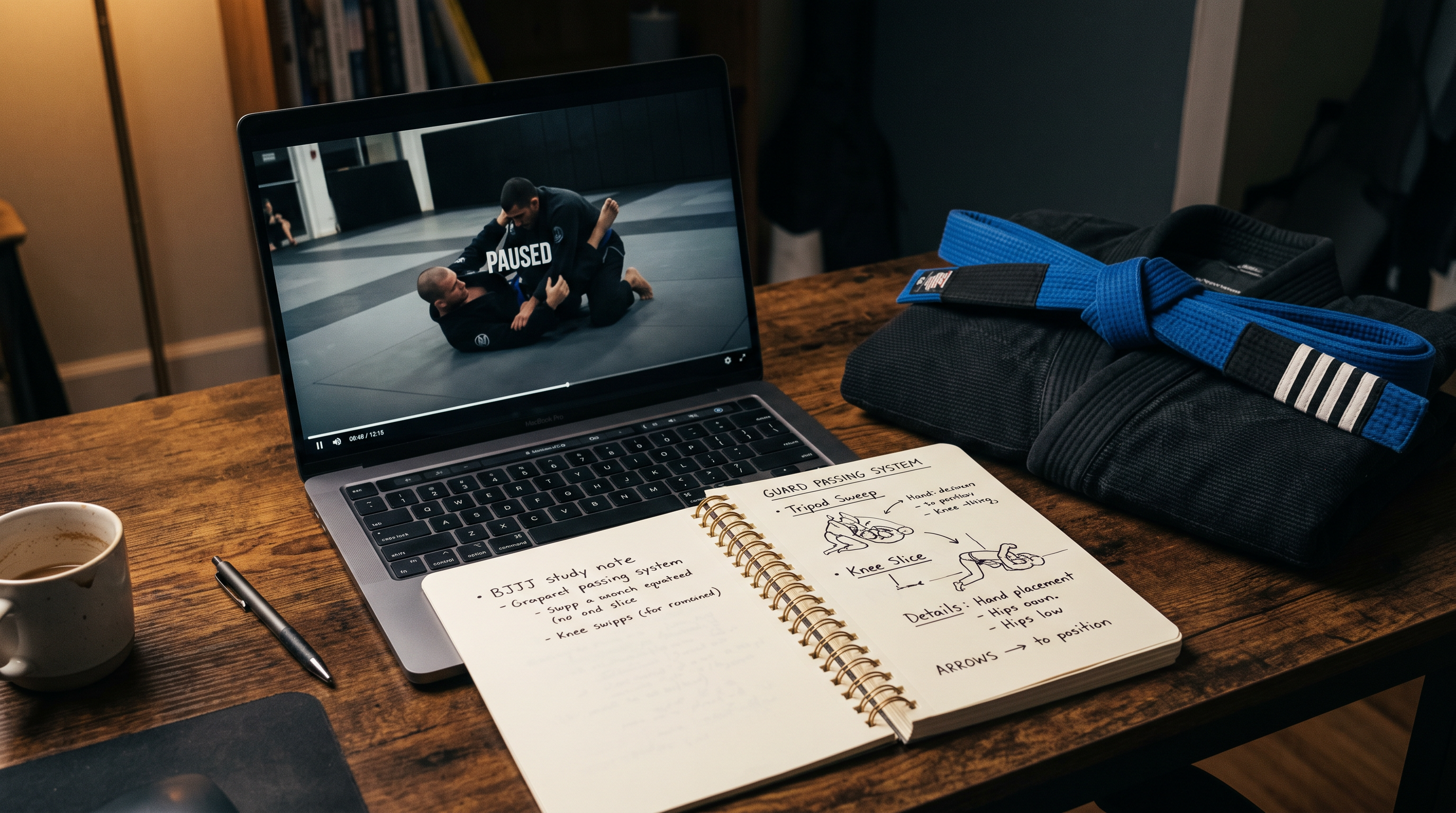
- Write down the three details that mattered — grips, hip direction, common mistake, coach's warning.
- Drill it in warm-ups or open mat for a week before adding anything else.
- Review the notes the night before class so it's fresh when you spar.
If you'd rather not scribble notes by hand, tools exist. Our own app, BJJ Memo, turns a YouTube URL into a structured technique card with the key steps and tappable timestamps, and files it into a searchable library so you can revise before training. You can read more about the underlying idea on the BJJ Memo blog — the workflow works with a paper notebook too.
Remember. Two focused videos on the position you're actually stuck in beat two hours of scrolling every single time.
Frequently asked questions
Can I really learn BJJ from YouTube alone?
You can learn the ideas and see the shapes, but you cannot learn Jiu-Jitsu without a training partner and, ideally, a coach. YouTube is excellent preparation and review; it is a poor substitute for live rolling and real-time feedback.
Which channel is best for a total beginner?
Chewjitsu and Gracie Breakdown are usually the least intimidating starting points. Both explain fundamentals in plain language and address the mental side of your first months. Add Bernardo Faria once you're comfortable with basic vocabulary.
Are free YouTube channels as good as paid instructionals?
For fundamentals, the free content on the channels above is very strong — often taught by the same instructors who sell paid courses. Paid instructionals tend to shine when you want a full A-to-Z system on one topic (for example a specific guard) or advanced material. Start free until you know what you want to specialise in.
How much time should I spend watching BJJ videos?
Less than you probably think. A short focused session on one position is more useful than an hour of scrolling. If you can only do ten minutes, spend them on the exact problem you had in last class.
Do I need to take notes to remember techniques?
Some form of capture makes a huge difference. Whether it's a notebook, a Notes app, or a dedicated tool like BJJ Memo, the point is the same — put the detail somewhere you'll actually revisit before training.
What should I study first as a white belt?
Escapes and posture. Learn how to survive from bottom side control and mount, and how to keep your posture in closed guard. Every one of the channels above has strong content on these positions. Our blog covers a suggested order for beginners in more detail.
Final word
YouTube has quietly become one of the best free Jiu-Jitsu educations available. The channels above will not turn you into a black belt, but they will help you understand what you're being shown in class, fix specific leaks in your game, and study high-level competition with real context. Pick one channel, pick one position, and study it properly for a week — that alone will outperform months of casual watching.
For real feedback and safety, train the techniques you learn at a legit academy with a qualified coach. BJJ Memo helps you remember and revise what you study; it does not replace mat time or your coach's eyes on your reps.
Ready to stop losing what you learn? Save your next YouTube instructional as a technique card in BJJ Memo so it's waiting for you before your next roll. Available on iOS and Android — more on bjjmemo.com/blog.
Last updated 2026-08-21.