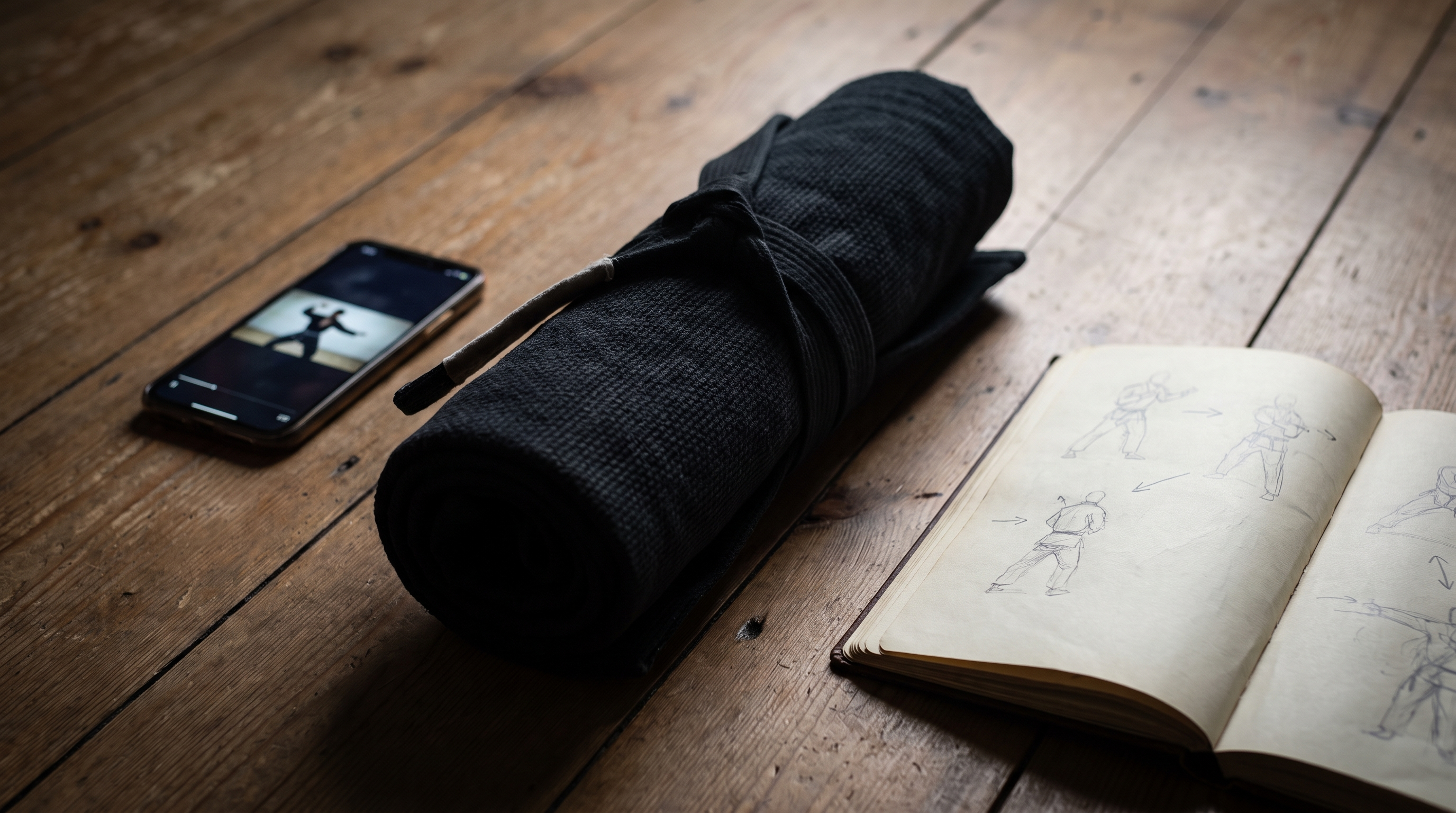
Best Free Ways to Study BJJ at Home: YouTube, Note Apps, and Drilling Without a Partner
TL;DR. You can make real progress between classes for free — but you need to combine the tools, not just pick one. YouTube gives you infinite instructionals, generic note apps let you organize what you learn, and solo drills keep your body sharp when no partner is around. Each has a real weakness: YouTube is a black hole of half-watched videos, note apps aren't built for grappling, and solo drills can't replicate live pressure. This is a neutral comparison, plus an honest look at where our own app (BJJ Memo) fits and where it doesn't.
Key takeaways
- Free BJJ study at home works best as a system: capture (video) → structure (notes) → move (solo drills).
- YouTube is the strongest free instructional library ever built for grapplers, but retention from passive watching is poor.
- General-purpose note apps (Apple Notes, Google Keep, Notion, Evernote) are flexible but not designed for technique steps + timestamps.
- Solo drills — shrimping, technical stand-ups, bridges, inversions — build attributes coaches assume you already have.
- BJJ Memo is a paid retention layer specifically for cards + revision; it doesn't replace mat time, coaches, or YouTube.
- The best "stack" for most white/blue belts is YouTube for source, a note tool for structure, and 10 focused minutes of solo movement a day.
- Consistency with a simple stack beats an over-engineered system you stop opening after two weeks.
Disclosure (founder note). This article is written by the team behind BJJ Memo, a mobile app that turns BJJ YouTube videos into revisable technique cards. We obviously want you to try it, but we also want you to know that most of what's in this guide is genuinely free and doesn't need our app. Where we're weaker than the alternatives, we've said so — see the "honestly weaker" section below.
Who each option is for
- YouTube instructionals — for anyone who wants to watch world-class technique for free. Best if you can be honest with yourself about your attention span. [source]
- Generic note apps (Notion, Apple Notes, Google Keep, Evernote) — for the organizer who already lives inside one of these tools and just wants a place to jot what class covered. [source]
- Solo drilling routines — for the grappler who can't get to the gym daily, or who wants extra reps on movement patterns without a partner.
- BJJ Memo — for the practitioner who watches instructionals but forgets the details by their next session, and wants a purpose-built system for revision.
Free BJJ study options at a glance
| Option | Cost | Best for | Main weakness |
|---|---|---|---|
| YouTube instructionals | Free | Watching top instructors on any position | Passive watching leads to weak retention [source] |
| Apple Notes / Google Keep | Free | Quick post-class scribbles | No structure for steps or timestamps [source] |
| Notion / Evernote | Free tier | Building a personal database | Setup-heavy; not BJJ-aware [source] |
| Solo drills (home floor) | Free | Movement, guard retention, injury prevention | No live resistance |
| BJJ Memo | Paid app | Turning videos into revisable technique cards | Requires a video source; not a coach |
Remember. No app or tool builds your jiu-jitsu — mat time does. Everything here is a way to make the hours between classes count.
Strengths of each option
YouTube instructionals
Free access to Gordon Ryan breakdowns, Lachlan Giles seminars, Craig Jones tutorials, Danaher back-attack lectures, and thousands of hobbyist channels covering every position you can name. If you can find the right rabbit hole, YouTube is the single most valuable free resource in the sport. [source]
The catch is human: watching is not learning. Most people finish a long breakdown and struggle to recall a few concrete steps a day later. If you don't capture it, much of it fades.
Generic note apps
Apple Notes, Google Keep, Notion, and Evernote are all fine places to write down what you learned in class. They're free (or have generous free tiers), they sync across devices, and they let you tag or fold entries into notebooks. [source]
Their weakness is that they were built for shopping lists and meeting minutes, not for the shape of a technique: setup, grip, entry, finish, common mistake, key detail, timestamp in the source video. You end up either overbuilding a Notion template you eventually abandon, or scribbling three lines you can't decode two weeks later.
Solo drilling at home
You do not need a partner to work on:
- Hip escapes (shrimping) and reverse shrimping — foundational for guard retention.
- Technical stand-up — the single most useful self-defense movement in BJJ.
- Granby rolls and inversions — for building comfort upside-down.
- Bridge and roll — the mechanic underneath every mount escape.
- Breakfalls — cheap insurance against injury when you do get thrown.
Ten focused minutes a day beats an hour once a week. Solo drills won't teach you timing, but they build the attributes coaches assume you already have.
BJJ Memo
BJJ Memo is a mobile app (iOS/Android) that takes a BJJ YouTube URL and generates a structured Technique Card: steps, key details, common mistakes, and tappable timestamps for the visual moments. Cards go into a searchable personal library, and a revision flow surfaces them before your next session. It's built for one specific job — helping you remember what you watch — and nothing else.
Where BJJ Memo is honestly stronger
Reasons, not adjectives.
- It's purpose-built for grappling notes. Every card has fields that map to how techniques actually work (setup, entry, finish, detail, mistake), instead of a blank Notion page you have to design yourself.
- Timestamps stay linked to the video. When you revise a card, you can jump straight back to the exact second of the source YouTube video — no more scrubbing through a long breakdown to find "that grip Gordon showed".
- Revision is part of the loop. The app resurfaces cards you haven't seen recently, so a technique you learned weeks ago comes back the night before you train. Note apps don't do this — they store, they don't remind.
- The friction is low. Paste a URL, get a card. Compare that to typing out steps from memory in Notes after training, which most people simply don't do.
Where BJJ Memo is honestly weaker
We'd rather you know this upfront:
- It's not free. YouTube, Apple Notes, Google Keep, and solo drilling all are. If cost is the deciding factor, use the free stack.
- It requires a video source. For techniques your coach showed live and never filmed, you're back to typing notes by hand — a plain notes app is fine for that.
- It doesn't replace coaching or live rolling. No app can tell you your posture is bad or that your elbow is flaring. Only a human on the mat can.
- It's a younger product. Big note apps like Evernote and Notion have years of polish, integrations, and community templates that we don't have yet. [source]
- YouTube itself is deeper as a source. As a raw catalogue of instructionals, nothing beats YouTube — we sit on top of it, we don't replace it.
Remember. If the honest answer for you is "I already have Notes and I'll never pay for another app", use the free stack well. That's a better outcome than paying for a tool you don't open.
Final recommendation by user profile
- Complete beginner, first months on the mat: Skip the tools. Go to class, take one photo of the whiteboard, and jot two lines in Apple Notes on the way home. Add YouTube only for positions you saw in class.
- White belt, 6+ months, drowning in info: Pick one YouTube channel and one note tool. Consistency matters more than the stack.
- Blue belt building a game: This is where a dedicated system starts to pay off. Try BJJ Memo for video-based revision; keep a general note app for class notes.
- Traveling, injured, or without a gym nearby: Combine YouTube study with 10–15 minutes of solo drills a day. Capture what you watch so it's ready when you return to the mat.
- Competitor: You already know retention wins matches. Build a personal library — in whatever tool you'll actually open the night before a comp.
For more on this, see our guides on how to remember BJJ techniques and how to study BJJ instructionals on YouTube.
Frequently asked questions
Can I really learn BJJ at home for free? You can study BJJ at home for free — watch, take notes, drill movements — and it will meaningfully speed up your progress. You cannot learn BJJ without live training with real partners and a qualified coach. The two are complementary, not interchangeable.
What's the best free YouTube channel for beginners? There's no single right answer, but channels that focus on fundamentals — position before submission, escapes before attacks — tend to serve white belts better than highlight-focused channels. Watch a few episodes from a channel before committing to a rabbit hole.
Is Notion overkill for BJJ notes? For most hobbyists, yes. Notion rewards people who enjoy building systems. If you don't, Apple Notes or Google Keep will get you most of the value with a fraction of the setup.
How long should I solo-drill at home? Ten to fifteen focused minutes daily beats an hour once a week. Prioritize hip escapes, technical stand-ups, and bridges — the movements every position eventually asks of you.
Is BJJ Memo free? BJJ Memo is a paid app. The free options in this article (YouTube, a general note tool, and solo drills) will take you a long way on their own. BJJ Memo is worth considering if you specifically want video-based cards and automatic revision.
How do I stop forgetting techniques between classes? Capture, structure, revise. Capture the source (video, whiteboard photo, class note). Structure it into steps and one key detail. Revise it briefly before your next session. The tool matters less than doing all three steps.
Next step. If you want to try the video-based side of this stack, download BJJ Memo on iOS or Android and turn your next YouTube instructional into a revisable card. If not, keep the free stack — just make sure you actually use it.
Teacher disclaimer. BJJ Memo helps you remember and revise techniques. It does not replace a qualified coach. For real feedback, safety, and progression, train at a legit academy with a black belt or accredited instructor.
Last updated 2026-09-01.