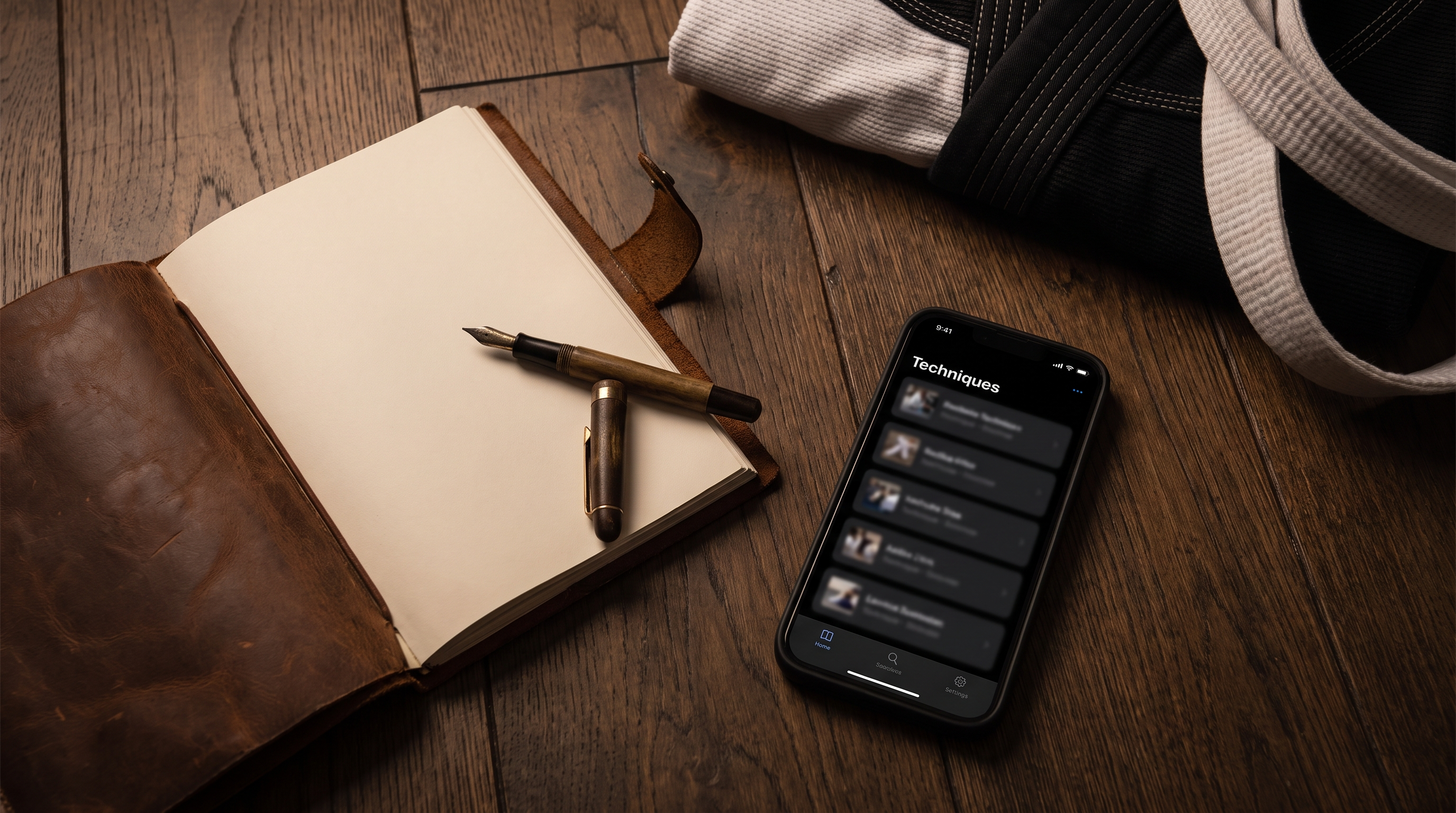
BJJ Journal vs Technique App: How Modern Grapplers Are Replacing the Paper Notebook
TL;DR. A paper BJJ journal is cheap, honest, and forces you to think through what happened in class — but it's hard to search, easy to lose, and rarely re-opened once the page is turned. A digital technique app like BJJ Memo turns a YouTube instructional into a structured card with steps, key details, and tappable timestamps, then surfaces it again before training. This is a side-by-side look at both options, where BJJ Memo is honestly stronger, and where a paper notebook still wins.
Key takeaways
- A notebook is a reflection tool; a technique app is a retrieval tool — they solve different halves of the problem.
- Most grapplers who "keep a journal" stop reading it after a few months; searchability is the main reason.
- BJJ Memo is built around one loop: capture from video → structured card → revise before you roll.
- Paper wins on focus, tactile memory, and privacy; digital wins on search, media, and spaced revision.
- Neither option replaces a real coach — the goal is remembering what you were already taught.
- Hybrid works: write reflections on paper, save techniques and video breakdowns in the app.
- Pick the tool you will actually open again the day before class — that is the entire game.
This article started as a private argument I kept having with my own notebook. If you're weighing a bjj notebook alternative against sticking with paper, or if you're already scanning for the best bjj tracking tool, the goal here is a fair, specific comparison — not a pitch.
Founder disclosure
I built BJJ Memo because my own paper journal stopped working. I have a stack of notebooks from my early years of training, and I can barely find the entry where I finally understood the underhook from half guard. The information was in there — I just couldn't get back to it in the ten quiet minutes I had before a Wednesday class. BJJ Memo exists to fix that specific problem. That bias should be obvious throughout the comparison; I've tried to be fair to paper anyway, because for a lot of people it still works.
Who each option is for
The paper BJJ journal
A notebook is for the grappler who thinks by writing. You come off the mat, sit in the car or at the café, and process the round with a pen. It suits people who value focus over features, who don't want another screen in their life, and who use the act of writing itself as the memory aid. It's also the natural pick if you train in academies with strict no-phone rules on the mat.
A digital technique app (BJJ Memo)
A technique app is for the grappler who learns from video, forgets by next week, and wants a searchable library instead of a stack of pages. It fits people who study instructionals on YouTube, competitors building a personal game, and hobbyists who train two or three times a week and want each session to compound. If your problem is "I watched a great breakdown and I can't remember any of it three days later," this is the category you want.
Comparison table
| Feature | Paper BJJ Journal | BJJ Memo (Technique App) |
|---|---|---|
| Capture from YouTube instructional | Manual transcription | Paste URL → structured card generated |
| Tappable video timestamps | No | Yes, on the key visual moments |
| Search by position or submission | Flip through pages | Instant search across your library |
| Spaced revision reminders | You have to remember to review | Built into the review flow |
| Works with no phone / no signal | Yes | Requires the app, mostly online |
| Distraction level during writing | Very low | Higher — it is still a phone |
| Cost | A notebook and a pen | Free to try; premium tier for heavier users |
| Backup if lost | None (unless you photograph pages) | Cloud-synced library |
| Handwriting / tactile memory benefit | Strong | None |
| Best for | Reflection, feelings, sparring notes | Technique retention, video study |
Strengths of each option
Where the paper journal genuinely wins
- Focus. No notifications, no autoplay, no algorithm. Just the page.
- Tactile encoding. Writing by hand engages motor and visual memory in a way typing does not, which many learners find helps recall.
- Reflection over retrieval. A notebook is a great place to unpack a bad round, a frustration, or a small breakthrough — the kind of entry you would not type into an app.
- No phone on the mat. In academies where phones are frowned on, a notebook fits the culture.
- Simplicity. Zero setup, zero subscriptions, zero updates.
Where a digital technique app genuinely wins
- Retrieval. Search "kimura from half guard" and every note, timestamp, and card is right there.
- Video-native capture. Most modern BJJ learning happens on YouTube. A tool that ingests the video is meeting the reality of how you learn.
- Structure. A generated technique card enforces "steps, key details, common mistakes" so your notes are actually usable later.
- Revision. A review flow surfaces techniques you're about to forget — the exact moment paper journals fail.
- Portable library. Every card lives in your pocket, backed up, searchable.
Remember. The tool that works is the one you re-open. If your notebook is full but unread, it isn't helping you retain anything.
Where BJJ Memo is honestly stronger
Not adjectives — reasons.
- It closes the loop. A paper journal captures information but does nothing to bring it back to you. BJJ Memo's review flow is designed to surface a card before your next session, which is exactly when you need it.
- It handles video. The last decade of BJJ learning shifted to YouTube. Handwriting the transcript of a long instructional breakdown is not a realistic workflow; pasting the URL is.
- It structures your notes for you. "Steps + key details + timestamps" is a format most people don't stick to on paper, but it's the format that actually helps you drill later.
- It's searchable. You can find that one detail about hand-fighting from the back in seconds, not by leafing through six months of pages.
- It survives you losing the notebook. A synced library doesn't get left in a gym bag.
Where BJJ Memo is honestly weaker
This section is mandatory because pretending otherwise would be dishonest.
- It is still a phone. A paper journal doesn't ping you or tempt you into a scroll. If your relationship with your phone is already bad, that matters.
- It doesn't capture feelings. A journal is a good place to write "I gassed out in the third round and I know why." A technique card isn't the natural home for that.
- Handwriting has real learning value that typing on a screen doesn't reproduce. If you're the kind of person who remembers what you write by the act of writing it, keep the pen.
- It depends on the video existing online. If the technique was shown in class by your coach and never filmed, you still have to type it in yourself.
- Battery, signal, and account. A notebook has none of those failure modes.
- It won't replace a coach. No app will. Feedback on your actual movement has to come from a person on the mat.
Remember. BJJ Memo is a retention tool, not a coaching replacement. For real feedback and safety, drill the technique at a legit academy with a qualified coach.
Final recommendation by user profile
If you're a beginner (white belt, first six months): Start with a cheap notebook for how class felt and what you struggled with, and use BJJ Memo for the small number of techniques per week you actually want to remember. Don't try to capture everything — you'll drown. Our companion piece on how to remember BJJ techniques walks through a starter workflow.
If you're a hobbyist training two or three times a week: A digital technique app is the higher-leverage tool. Your bottleneck isn't reflection, it's retrieval — you already know what you want to work on, you just can't find your own notes. Move the technique side of your journaling into BJJ Memo and keep paper for reflection if you enjoy it.
If you're a self-learner studying instructionals: This is exactly the profile BJJ Memo was built for. Paste the URL, get a structured card, revise before class. Pair it with our notes on studying BJJ from YouTube for a more deliberate approach.
If you're a competitor building a personal game: You need a searchable, tagged library of your A-game. A notebook can't do this at scale. A digital library can — and it's the whole point of using a proper bjj technique app rather than a general notes app.
If you're a coach: Consider recommending BJJ Memo to students as the "homework" tool between classes. Anything that gets them revising the week's material is a win for your academy.
Frequently asked questions
Is a paper BJJ journal still worth keeping?
Yes, if you actually re-read it. A notebook that sits closed on a shelf isn't a learning tool, it's a souvenir. If you enjoy writing by hand and it helps you process training, keep it — and pair it with something searchable for the technique side.
What's the fastest way to remember a new technique?
Capture it the same day, before the details fade. Break it into concrete steps with the common mistakes, and revise it briefly before your next relevant session. That "capture → structure → revise" loop is the entire point of a digital bjj journal.
Do I need a subscription to use BJJ Memo?
BJJ Memo is free to try. There is a premium tier for heavier users; details are on the app store listings and on bjjmemo.com. We deliberately don't quote a price in an article because it can change — check the store before you decide.
Can BJJ Memo replace my coach?
No. BJJ Memo is a retention and revision tool. It helps you remember and study what you're already being taught. Real feedback on your movement, timing, and pressure has to come from a qualified coach in a real academy.
What if I don't want to bring my phone to the mat?
You don't need to. Capture and revision both happen off the mat — before or after class, at home, on the commute. Mat time stays mat time.
Can I use both a notebook and BJJ Memo?
Absolutely, and it's what a lot of people settle into. Use paper for reflection and feelings about training; use BJJ Memo for the technique library and video breakdowns. See our beginner's guide to BJJ note-taking for a hybrid template.
Try BJJ Memo before your next class
If you've read this far, the honest answer is: the tool you'll re-open is the one that wins. Next time you watch a YouTube instructional, paste the URL into BJJ Memo, save the technique card, and open it in the ten minutes before your next session. That's the whole loop.
Download BJJ Memo on iOS and Android from bjjmemo.com, and keep training with a qualified coach at a legit academy — the app is here to help you remember what they teach you, not to replace them.
Last updated 2026-08-24.