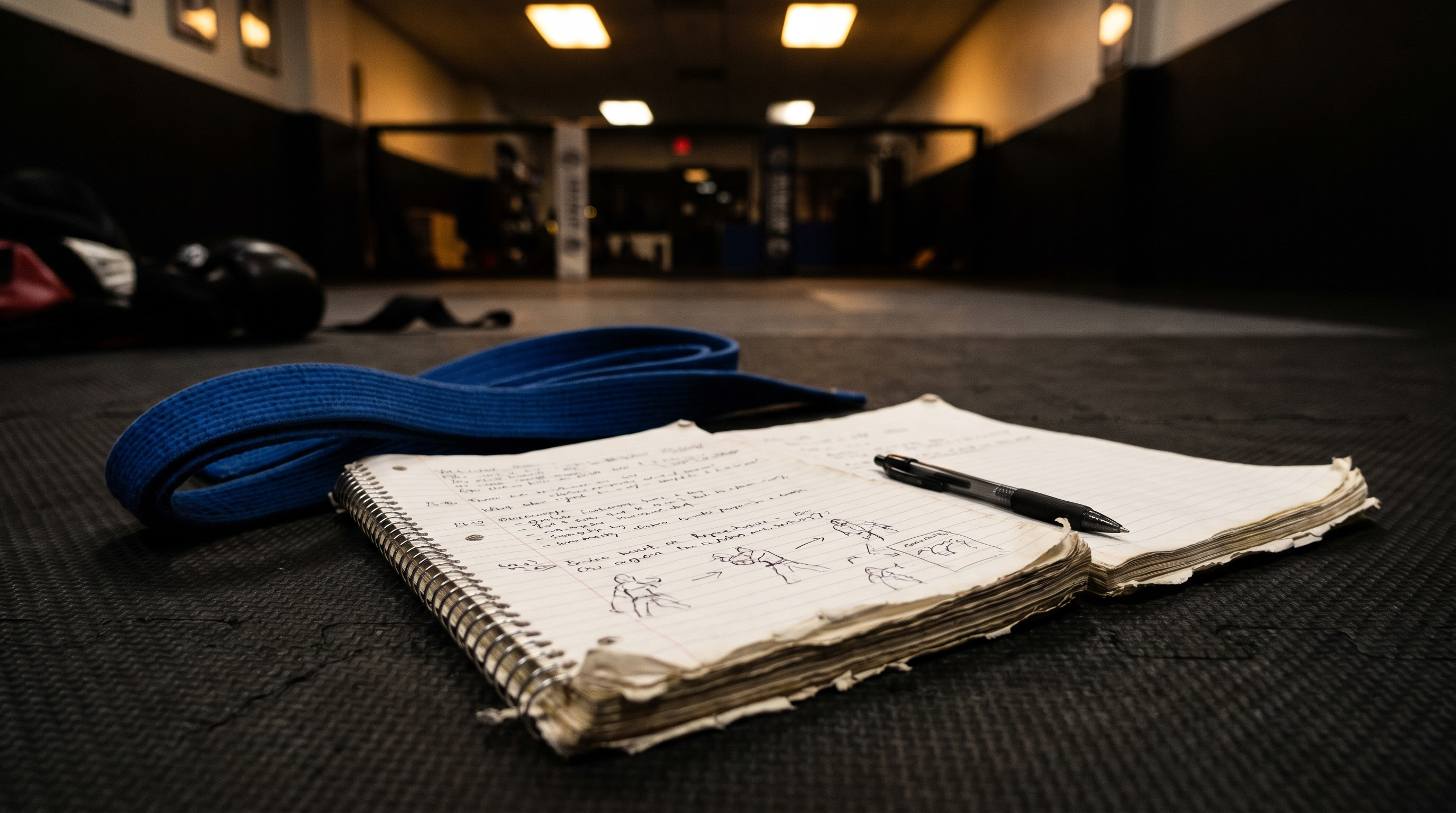
BJJ Progress Tracking: How to Measure Improvement When You Can't See It Yet
TL;DR. Belts and stripes are lagging indicators — real BJJ progress shows up long before promotions. Track it by measuring what you can survive, what you can execute on resisting partners, and what you can teach back. A weekly training journal, a short list of position-specific goals, and honest roll-review beats vibes every time. If you feel stuck, you're probably still improving in ways you can't yet see — you just don't have a system to notice them.
Every grappler who trains seriously hits the same wall: you show up, you drill, you roll, and after a few months you have no idea if you're actually getting better. You're still getting smashed by the same purple belt. You still forget the sweep you learned last Tuesday. The stripe on your belt hasn't moved in eight months. So you ask the question every honest jiu-jitsu student eventually asks: am I improving in BJJ, or just training?
The problem isn't your training. The problem is that BJJ progress is invisible without a system. Belts are a snapshot taken once every year or two — a terrible resolution for something as detailed as your game. This guide gives you a practical framework to track BJJ progress week to week, using metrics you can actually measure on the mat, plus a simple training journal that takes two minutes after class.
Key takeaways
- Belt promotions are lagging indicators; you can measure real BJJ improvement week to week using survival, execution, and teach-back metrics.
- Progress in BJJ is non-linear — plateaus are usually the moment your baseline is rising, not stalling.
- A one-page training journal filled in for two minutes after class captures more useful data than any wearable.
- Pick two or three position-specific goals per month (e.g., escape side control, retain guard) instead of chasing every technique you see online.
- Rolling with the same partners repeatedly gives you a control group — if your usual training partners tap you less, you improved.
- If you can teach a technique back with the key details, you actually understand it; if you can't, you only recognized it.
- Track fewer things consistently rather than many things sporadically — the point is honest signal, not spreadsheet theater.
Why you can't see your BJJ progress
BJJ improvement doesn't feel like improvement while it's happening. It feels like getting caught in the same triangle for the tenth week in a row — except this time you almost defended it. That "almost" is the actual progress, and it's almost impossible to notice without paying attention on purpose.
There are three reasons the gains stay hidden:
- Your training partners get better with you. You're all improving in parallel, so relative performance can look flat even when everyone's baseline is climbing.
- The game gets deeper as you learn. A white belt sees "guard". A blue belt sees closed guard, half guard, De La Riva, spider, X. The map grows faster than your ability to fill it in, so the map always looks empty.
- You forget more than you remember. Without any capture or review system, most of what you learn in class fades before your next session. It's not that you're not learning — it's that the learning isn't sticking long enough to compound.
This is why practitioners describe BJJ as a plateau followed by a plateau followed by a jump. The plateaus are real, but they're also where the wiring is happening. The jump is the moment your nervous system finally exposes what was already there.
Remember. If your rolls feel harder, it's often because you're seeing more of what's actually happening — not because you're getting worse.
A simple system to track BJJ progress
Here's a lightweight framework built around three questions: What can you survive? What can you execute? What can you teach? You don't need a spreadsheet. You need a notebook (paper or digital) and about ten focused minutes a week.
1. Pick two or three position-specific goals per month
Don't try to improve at "BJJ". Improve at escaping side control from the underhook side, or retaining closed guard against a standing pass, or finishing the cross collar from mount. Two or three focused goals per month is plenty. Write them at the top of your journal. Everything else you learn is a bonus.
2. Log rolls with a simple shorthand
After class, spend two minutes writing three lines per roll you remember:
- Partner + belt/size (relative reference is what matters, not names).
- What happened to you — where you spent time, what got you tapped, what nearly worked.
- One thing to fix or drill next time.
That's it. You are not writing a report. You are leaving your future self a breadcrumb.
3. Track survival before submissions
Submissions are noisy signal. Survival is clean signal. Ask yourself weekly:
- Did I get tapped fewer times by my usual training partners this week?
- Did I spend less time under pressure in bad positions?
- Did I survive rounds with a specific higher belt I usually can't survive?
If yes, you improved. Full stop.
4. Track execution on resisting partners, not drilling
A technique you can hit in drilling isn't yours yet. A technique you can hit on a partner who knows it's coming is. Keep a short list of "live-tested moves" — techniques you've landed at least a handful of times in live rolling with resistance. That list is the honest version of your game.
5. Do a monthly teach-back
Once a month, pick a technique you think you know. Explain it out loud (or write it out) as if you were teaching a brand-new white belt: the grips, the steps, the two or three details that make it work, the common mistake. If you can do that cleanly, it's in your game. If you fumble the details, you recognized the technique — you didn't learn it. Go back to the source.
6. Review your notes before you train
This is the single most under-used habit in BJJ. Five minutes of reviewing last week's notes before class puts the details back into working memory, which is where they need to be for your body to actually use them during rolling. Notes you never re-read are a diary. Notes you re-read are training.
7. Run a quarterly check-in
Every three months, sit down for fifteen minutes and answer four questions:
- What positions do I understand better than I did three months ago?
- What's on my "live-tested moves" list now that wasn't there before?
- Which training partners have gotten harder or easier to roll with?
- What's the one position I most want to improve in the next quarter?
That's your progress report. It will surprise you almost every time.
BJJ improvement metrics that actually matter
Here's how the useful metrics compare to the ones people usually reach for:
| Metric | What it actually measures | Honest signal? |
|---|---|---|
| Stripes and belts | Coach's overall judgment over months | Yes, but very low resolution |
| Tap count in rolling | Partner mix, energy, ego | Only if partners stay consistent |
| Survival time vs. usual partners | Defensive skill + composure | Strong signal |
| Number of live-tested techniques | Applied skill under resistance | Strong signal |
| Techniques you can teach back | Depth of understanding | Strong signal |
| Class attendance | Consistency (input, not output) | Useful as a floor, not a ceiling |
| Instagram highlight reel | Nothing about you | No |
The pattern: measure what you can do to a resisting human and what you can explain clearly. Skip the rest.
Remember. A training journal you actually fill in beats a perfect tracking system you abandon after a week. Ugly and consistent wins.
Common mistakes when tracking BJJ progress
- Comparing yourself to people who train more than you. If you train two nights a week, your reference is other two-nights-a-week grapplers — not the guy on the competition team drilling every morning.
- Chasing new techniques every week. Novelty feels like progress but produces the opposite. You end up with a library of half-learned moves and no working game. Depth beats breadth, especially in the first few years.
- Only logging the good rounds. The rounds where you got smashed are the ones with the most information. Write those down first.
- Waiting for the stripe. Promotions run on coach-time, not student-time. Your job is to make the promotion obvious; the coach's job is to notice.
- Judging progress inside a single roll. You will have terrible rolls forever. It's a five-minute snapshot of a body that didn't sleep well. Zoom out to the week and the month.
- Tracking too much. If your system takes longer than the drive home from the gym, you'll quit it. Two minutes per session, ten minutes per week, fifteen minutes per quarter.
- Ignoring context. New partners, fatigue, injury coming back, a rank test coming up — all of it changes the read. A one-line note about how you felt going in makes the data honest.
Where BJJ Memo fits in
Most of the system above is just "pay attention on purpose". The part that breaks for most grapplers is the capture: you watch a great instructional on YouTube, learn a sweep in class, tell yourself you'll remember it — and by Friday's open mat it's gone.
That's what BJJ Memo is built for. Paste a BJJ YouTube URL and the app turns the video into a structured Technique Card — clear steps, key details, and tappable timestamps of the important visual moments. Cards are filed into a searchable personal library so your "live-tested moves" list, your position goals, and the instructionals behind them all live in one place you actually revisit. It plugs directly into steps 4, 5, and 6 above: the review, the teach-back, and the pre-training refresh. It doesn't replace your training journal, and it definitely doesn't replace mat time — it just makes sure what you learn survives long enough to become part of your game. Available on iOS and Android.
For more on the retention side, see our guides on how to remember BJJ techniques and how to study instructionals effectively.
Frequently asked questions
How do I know if I'm improving in BJJ if I keep losing rolls?
Look at how you lose, not that you lose. Are you surviving longer against the same partners? Are you getting caught by new submissions rather than the same one every week? Are you ending up in positions you understand, even if you can't finish yet? Those are all wins. Rolling outcomes with better training partners are a bad progress metric; the shape of your losses is a great one.
How often should I update my BJJ training journal?
After every class you can, even if it's three lines on your phone in the car. The habit matters more than the depth. A weekly ten-minute review of those short entries is where the actual insight comes from. Miss a session? Skip it and pick up next class — a journal you use imperfectly is infinitely better than one you use perfectly for two weeks and abandon.
Should I focus on more techniques or fewer techniques as a beginner?
Fewer, deeper. In your first year or two, pick a handful of core positions and submissions and drill them until they're reflexive. New white belts often collect techniques the way people collect apps — the pile grows and nothing actually gets used. A small, well-drilled game beats a huge, shallow one every time.
Are BJJ progress tracking apps worth it?
They're worth it if they solve a problem you actually have. If your problem is forgetting techniques between sessions, a capture-and-review tool like BJJ Memo helps. If your problem is not knowing what to work on, a written training journal with two or three monthly goals helps more than any app. Match the tool to the bottleneck.
What's a realistic BJJ improvement timeline?
Most grapplers feel their first real "jump" somewhere in the middle of their white belt, another around blue belt, and periodically after that. Between jumps you're on plateaus that feel like nothing is happening. That's normal. Consistency beats intensity here — showing up regularly for years is what compounds, not any single training block.
Do I need to compete to track my progress?
No. Competition is one useful stress test, not the only one. Open mats at other gyms, rolling with visitors, or simply making a point of rolling with the same set of training partners for months in a row all give you data. If you like competing, compete. If you don't, use your regular training as the benchmark.
Where to go from here
Start small this week. Write down two position-specific goals for the month. Keep a three-line log for each roll. Spend five minutes before your next class re-reading last week's notes. That's the entire system — the rest is showing up.
If you want the capture side handled for you, BJJ Memo turns the YouTube instructionals you already watch into revisable technique cards so the details are still there when you need them on the mat. Build your library, review before training, and let your notes do the remembering so you can focus on rolling.
For real feedback and safety, train the techniques you're studying at a legit academy with a qualified coach — BJJ Memo helps you remember and revise, it doesn't replace mat time.
Last updated 2026-08-20.