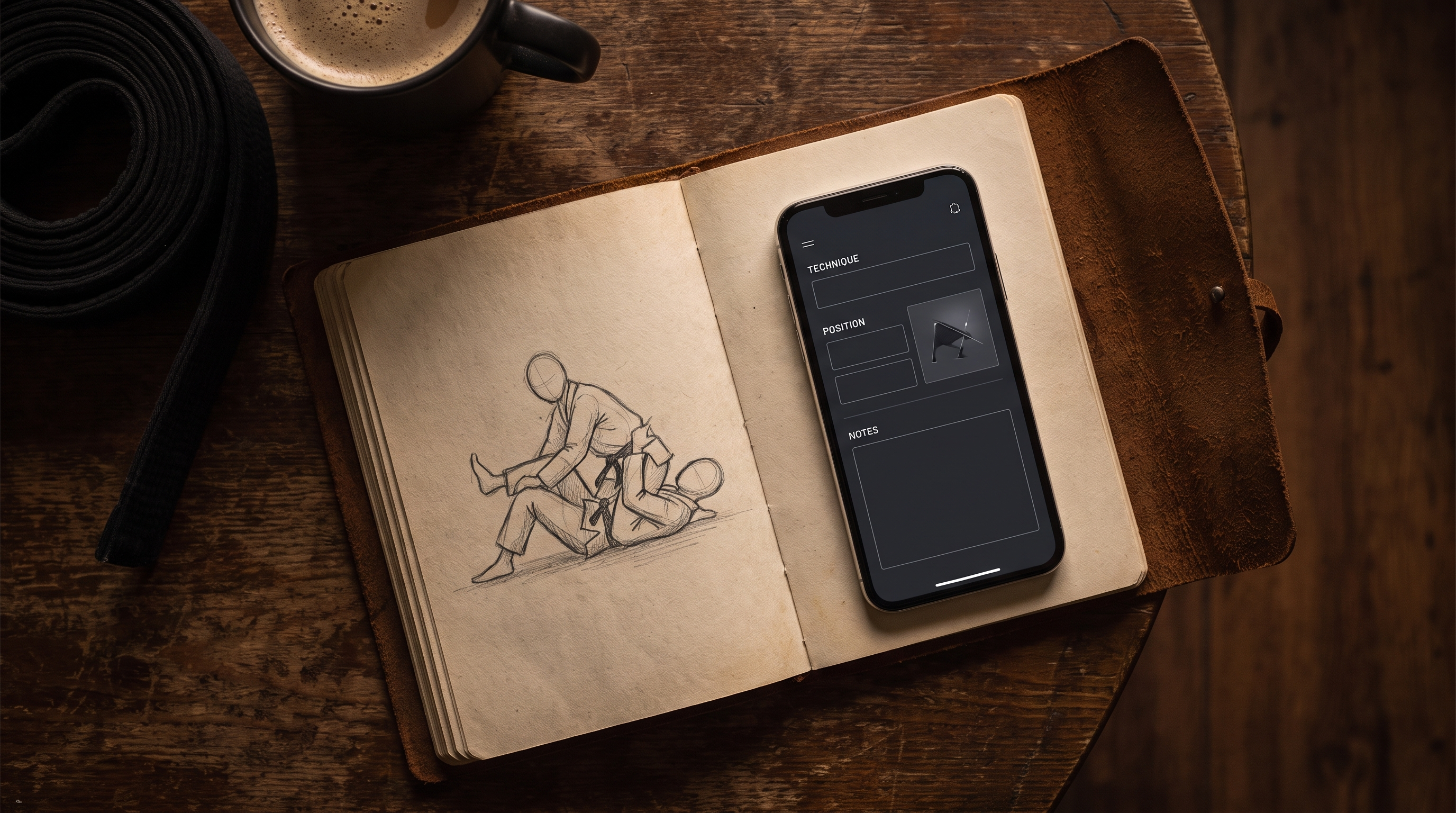
BJJ Technique App vs Physical Playbook: Which Format Grapplers Actually Revise
TL;DR. Physical BJJ playbooks feel legit and force you to slow down, but most grapplers stop reopening them after a few months. A digital BJJ technique app wins on search, timestamps back to the original video, and quick revision on your phone before class. Neither format matters if you don't build a revision habit. Pick paper if you love the ritual of writing, pick an app if you learn from YouTube and want to actually find your notes six months later. Hybrid setups — sketch on paper, store searchable notes in an app — work well for many practitioners.
Most grapplers eventually hit the same wall: they've watched hours of instructionals, taken class notes, and still can't recall the details of a technique when the roll starts. The question isn't whether to take notes — it's which format you'll actually reopen. Below is an honest comparison between a physical BJJ playbook and a digital technique app, written for someone who trains a few times a week and wants more retention per session.
Founder disclosure
I build BJJ Memo, a mobile app that turns BJJ YouTube videos into structured, revisable technique cards. So yes, I'm biased toward the digital side of this comparison. I'll flag where BJJ Memo is honestly stronger and where paper (or another tool) is a better fit — this article isn't useful to anyone if it's a sales pitch.
Who each format is for
The physical BJJ playbook
A paper notebook, sketchbook, or bound "playbook" where you handwrite techniques, draw stick figures, and sometimes glue in printouts. It fits grapplers who:
- Learn by writing and drawing, not typing.
- Take notes right after class, on the drive home or in a car park.
- Enjoy the ritual and don't want another screen in their day.
- Are building a personal game they'll reference occasionally, not daily.
The digital BJJ technique app
A mobile app (or well-organized note tool) built for storing, searching, and revising BJJ techniques. It fits grapplers who:
- Study YouTube instructionals and want to keep the link to the source video.
- Train several times a week and want to revise on the way to the gym.
- Have already tried and abandoned a physical notebook.
- Care about being able to find a specific detail six months later.
Remember. The right format is the one that survives contact with your actual weekly routine — not the one that looks best on Instagram.
Comparison table
| Dimension | Physical playbook | Digital BJJ technique app |
|---|---|---|
| Capture speed | Slow, deliberate | Fast, especially for YouTube sources |
| Search ("find that armbar detail") | Manual page-flipping | Instant text search |
| Link to original video | Lost once you close the tab | Preserved with tappable timestamps |
| Organization by position | Requires strict discipline | Built-in tags/folders |
| Revision on the way to the gym | Impractical | Native use case |
| Sharing with a training partner | Photocopy or photo | Share a card or link |
| Battery / offline | Always on | Depends on the app |
| Cost | Notebook + pen | Free tier or subscription, varies by app [source] |
| Feels "real" and personal | Very high | Depends on design |
| Risk of becoming a graveyard | High if you don't revise | High if you don't revise |
Strengths of each option
What a physical playbook does well
- Forces synthesis. Handwriting is slower than typing, so you compress the technique into what actually matters.
- Zero notifications. No pop-ups pulling you off the page.
- Personal artifact. Ten years of belt promotions in one worn notebook is genuinely meaningful.
- Drawing beats typing for positions. A quick sketch of a grip or angle often communicates more than a paragraph.
What a digital technique app does well
- Search that works. Type "knee shield" and get every card that mentions it.
- Video is a first-class citizen. You can jump back to the exact second of the instructional instead of re-scrubbing a 40-minute video.
- Structure by default. Fields for setup, steps, key details, and common mistakes push you to write useful notes, not stream-of-consciousness paragraphs.
- Revision loop. A good app resurfaces cards on a schedule — the whole point of note-taking is being reminded of what you'd otherwise forget.
- Portable. Your entire library is on the phone already in your gym bag.
Remember. Notes you can't find quickly are almost the same as notes you never took. Searchability is not a luxury feature — it's the whole game.
Where BJJ Memo is honestly stronger
These are reasons, not adjectives:
- YouTube-native capture. Paste an instructional URL and the app generates a structured technique card with tappable timestamps for the key visual moments. A paper notebook can't do that; a generic notes app makes you do it by hand.
- Structure is enforced, not optional. Cards have clear fields (setup, steps, details, mistakes). That structure is what makes them scannable the night before class.
- Library grows without organization work. Cards are filed by position/submission automatically, so you don't need to hand-maintain a table of contents like you would in a physical playbook.
- Revision happens on your phone, not at your desk. You can revise five techniques in the car park before class — a paper playbook lives on a shelf at home.
- You keep the source. Every card links back to the exact moment in the video, so you can re-verify a detail instead of misremembering it.
Where BJJ Memo is honestly weaker
Mandatory honesty:
- It doesn't replace handwriting for people who learn by drawing. If a stick figure sketch is what makes a position click for you, paper still wins for that step.
- It's a screen. Some grapplers deliberately want less phone in their training life — that preference is valid.
- It depends on your phone battery and, for capture, an internet connection. A notebook doesn't.
- A card is only as good as the video and the review you give it. Auto-generation is a starting point; you still have to actually revise.
- It won't teach you the technique. A card helps you remember what a coach or instructional already showed you — mat time is non-negotiable.
Final recommendation by user profile
- Pure hobbyist, trains 1–2×/week, doesn't watch YouTube: a physical playbook is fine, as long as you reopen it before class. Consider our guide on how to remember BJJ techniques for the revision half of the equation.
- White/blue belt, trains 2–4×/week, learns from class + YouTube: a digital technique app is almost certainly higher leverage. This is the profile BJJ Memo is built for.
- Competitor building a specific game: digital, no debate. You'll need to search, filter, and revise on a schedule as your match plan evolves.
- Coach who wants students to review class material: digital, so students can revise on their phones between sessions.
- Old-school grappler who hates screens: paper. Just build the revision habit — a notebook you never open helps no one.
Remember. Format is downstream of habit. A cheap notebook you open twice a week beats a beautiful app you open twice a year.
Hybrid setups that actually work
You don't have to choose. Common combinations:
- Sketch positions in a small notebook right after class → later that evening, capture the technique properly in a digital card.
- Use paper for principles and concepts (harder to structure) and an app for specific techniques (easier to structure).
- Keep a paper "match journal" for competitions and a digital library for the day-to-day game.
For more on the note-taking side of this, see our post on how to take BJJ notes that you'll actually re-read.
The CTA and a teacher disclaimer
If you learn from YouTube and want a system that turns those instructionals into structured, revisable cards, try BJJ Memo on iOS or Android. Paste a URL, get a technique card, revise before your next training session.
Teacher disclaimer. No app or notebook replaces a qualified coach and mat time. Techniques should be learned and pressure-tested under the eye of a black belt (or a very senior belt) at a legit academy. BJJ Memo is a retention tool — it helps you remember what your coach and your training partners are already teaching you. When in doubt about safety, mechanics, or whether a detail applies to your body type, ask your coach, not your notebook.
Frequently asked questions
Is a paper BJJ playbook still worth it in 2026?
Yes, if you'll actually reopen it. Handwriting forces synthesis, and for many grapplers a physical artifact is more motivating than another app icon. The failure mode is the same as with digital: no revision loop, no retention. If you're already the kind of person who journals daily, paper is a strong choice.
What is the best format for BJJ notes if I learn mostly from YouTube?
A digital BJJ technique app that preserves the link back to the source video. When a detail is unclear a week later, you want to jump straight to the moment in the instructional instead of re-scrubbing a 40-minute video from scratch. Paper can't do that.
Won't a digital app just become another graveyard of notes I never read?
It can. The safeguard is a revision loop — either a spaced-review feature inside the app, or a simple rule like "revise five cards on the drive to the gym." Format matters less than the habit around it.
Do I need a BJJ notebook alternative if I already take notes in a generic app?
Only if the generic app makes it hard to find what you wrote. If you can search "triangle from closed guard" and land on a structured note in under ten seconds, you're fine. If you can't, a purpose-built BJJ technique app will save you time.
Can I use both a physical playbook and a digital app?
Absolutely, and many practitioners do. Sketch or freewrite on paper right after class, then transfer the useful stuff into structured cards in an app when you have time. You get the synthesis benefits of writing and the searchability of digital.
Does BJJ Memo work without an internet connection?
Capture from YouTube needs an internet connection because the app pulls metadata and the transcript. Once a card is saved, revising it is designed to be quick and low-friction on your phone. For specifics on offline behavior, check the current app details on bjjmemo.com.
Last updated 2026-09-03.