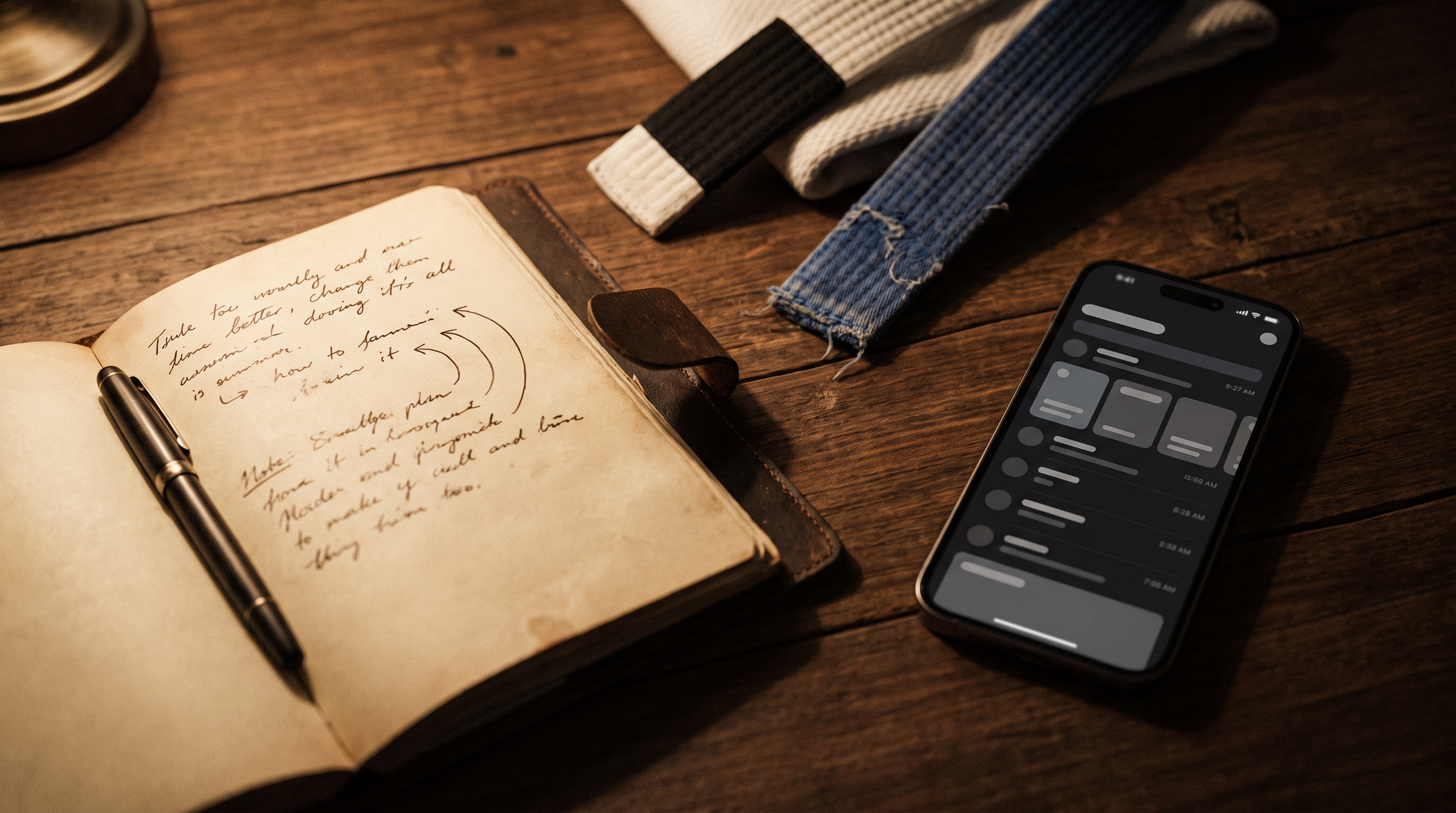
BJJ Technique Card vs Written Notes: What Actually Sticks Before You Roll
TL;DR. Written notes are cheap and personal, but text alone rarely rebuilds the visual feel of a technique. BJJ technique cards pair short steps with the exact video timestamps you'd rewatch, which is closer to how you actually recall a move on the mat. Use written notes for reflections, tap-outs, and game plans; use technique cards for the mechanical details you keep forgetting. BJJ Memo focuses on the cards side of that split.
Key takeaways
- Written notes capture your interpretation; technique cards capture the technique's mechanics linked back to the source video.
- Recall on the mat is mostly visual and kinesthetic, so notes that link back to a moving image tend to reload faster than pure text.
- Paper notebooks win on tactile ritual and zero distraction; digital cards win on search, revision, and video re-entry.
- Flashcards work for BJJ only when the "answer" side triggers a clear mental picture, not a wall of words.
- The best system usually blends both: a physical journal for lessons learned, and technique cards for detail retention.
- No note system replaces mat time and a qualified coach — it just makes your reps count for more.
- BJJ Memo is honestly stronger at video-linked recall and honestly weaker at freeform journaling.
Why this comparison matters
Most grapplers already have some kind of "system." A notebook in the gym bag. Voice memos in the car. A cluttered YouTube "Watch Later" list. And yet the same detail — the grip, the head position, the shoulder angle — keeps slipping between sessions. The question isn't "should I take notes?" It's which format of notes actually rebuilds the movement in your head when you need it live. This article compares two of the most common answers: traditional written notes and structured BJJ technique cards.
Founder disclosure
I build BJJ Memo, an app that generates technique cards from BJJ YouTube videos. So I'm not neutral. What I can do is be honest about where cards genuinely help, where a paper notebook is still the better tool, and where neither will save you if you're skipping drilling. Every claim below is written to survive a skeptical white belt reading it on their phone before class.
Who each method is for
Written notes are for you if:
- You already journal in some form and enjoy the writing process.
- You mostly want to track how you felt, what you tapped to, and what you want to work on next week.
- Your gym has a no-phones-on-the-mat culture and you can jot things right after class.
- You retain information better by physically writing it out.
BJJ technique cards are for you if:
- You learn a lot from YouTube instructionals and lose the details within days.
- You want to search past techniques by position ("everything I saved on half guard bottom").
- You care about being able to rewatch the exact 12 seconds a detail was shown, not scrub through a 40-minute video.
- You want a revision flow that surfaces old techniques before you forget them.
Most dedicated grapplers actually want both. The mistake is trying to force one format to do the other's job.
Head-to-head comparison
| Dimension | Written notes (notebook / notes app) | BJJ technique cards |
|---|---|---|
| Best for | Reflections, sparring lessons, game planning | Mechanical detail retention from video and class |
| Recall cue | Your own words | Structured steps + link back to the source moment |
| Search | Manual scroll / basic keyword | Filter by position, submission, guard, tag |
| Video re-entry | You'd have to relocate the video yourself | One-tap back into the timestamp that matters |
| Revision system | You have to design one | Built-in surfacing of older cards |
| Cost | Basically free | App-dependent (BJJ Memo is a mobile app) |
| Distraction risk | Very low | Higher — it's on your phone |
| Personal expression | High — freeform text, diagrams | Lower — structure is constrained on purpose |
| Learning curve | None | Small — you have to build the habit of capturing |
Remember. The best note is the one you'll actually reopen. A perfect system you never revise is worth less than a scrappy one you check twice a week.
Strengths of each option
What written notes get right
Writing is thinking. Forcing yourself to describe a sweep in your own words exposes the gaps in your understanding faster than reading someone else's version. A physical notebook also has zero notifications, no algorithm, and no battery. For sparring reflections — "I got stuck under knee-on-belly again, I need to frame earlier" — a notebook is almost impossible to beat. It's also durable: a leather journal from your blue-belt year is a genuinely nice artifact ten years later.
What technique cards get right
BJJ is a visual art. When you try to recall a technique on the mat, you don't recite a paragraph — you replay a short mental clip. A structured card that pairs a short step list with the exact timestamps of the visual moments makes it far easier to reload that clip. You also stop losing techniques inside a 45-minute YouTube video you swore you'd come back to. Cards are searchable, taggable, and can be revised in short bursts — a few minutes on the bus is enough. For details like grip placement, angle of the head, or the order of the tilt-and-cut on a back take, that structure is a real advantage.
Remember. Text can describe a technique. Only video can show it. A good card is a bridge between the two.
Where BJJ Memo is honestly stronger
Not because it's shiny — because of specific mechanics.
- Video re-entry. Every card in BJJ Memo is anchored back to the YouTube moments that generated it. When you can't remember whether the near-side arm goes over or under, you're one tap from the exact clip. Written notes can't do this without a manual link + timestamp discipline that almost nobody maintains.
- Structure enforces clarity. "Steps," "key details," and "common mistakes" are separate fields. That constraint forces you to actually decide what the core mechanic is, instead of writing a paragraph that feels smart and teaches you nothing on re-read.
- Search by position, not by date. Cards can be filtered by guard, pass, submission, escape. A notebook is chronological — good for a diary, bad when you want "everything I've ever saved on deep half."
- Revision built in. The app is designed around resurfacing older cards. Most notebooks require you to invent your own review ritual, which is where retention systems usually die.
- Capture speed. Pasting a URL and getting a structured draft is faster than transcribing a technique by hand after a long training day.
If you want the retention-first case in more depth, see our guide to how to remember BJJ techniques.
Where BJJ Memo is honestly weaker
This section is mandatory in every comparison we publish, because pretending an app is perfect is how you lose a reader's trust.
- Freeform journaling. If you want long, emotional entries about a hard week of training or a competition day, a notebook or a plain notes app is a better home. Cards are designed around technique, not diary writing.
- In-class capture without a phone. Some gyms don't allow phones on the mat. A pocket-size notebook and pen still wins there. A card can be built after class from memory, but paper is faster in the moment.
- Tactile satisfaction. Some people learn because they wrote it out longhand. If that's you, don't fight it — write it out, then optionally re-house the mechanical parts as a card later.
- Not a substitute for a coach. A card can remind you of the shape of a technique. It cannot correct your posture, feel your weight distribution, or catch the reason your pass keeps failing. That's your coach's job.
- Dependence on video quality. If the source instructional is vague or poorly shot, the card will inherit that vagueness. Good input, good card.
- It's a phone app. Phones are distraction machines. That is a real, non-trivial cost.
Remember. If your problem is that you don't drill enough, no note system will fix it. Cards multiply the value of reps you're already putting in.
What about traditional flashcards?
People sometimes ask about generic flashcard apps (Anki, plain paper decks) for BJJ. They can work, but with a big caveat: BJJ recall is visual. A flashcard whose "answer" is a paragraph of text usually doesn't reload the movement in your head. If you go the Anki route, put a short looping clip or a screenshot on the answer side. Otherwise you're mostly quizzing yourself on vocabulary, not technique.
Final recommendation by user profile
- Absolute beginner (first 3–6 months): Use a paper notebook for feelings, questions, and things your coach said. Add a small handful of technique cards for the moves you actually got shown, so you have something concrete to revise. Read our take on starting BJJ well alongside.
- Hobbyist blue belt training 2–3×/week: This is where cards pay off the most. You're watching instructionals between sessions and forgetting them. Save the ones you actually want to steal from as cards; keep the notebook for post-roll reflections.
- Competitor building a game: Use cards to build a game map — attacks from each position, escape trees, common problems. Keep a separate document (paper or digital) for match reviews and opponent notes.
- Coach: Use cards to give students a shared, revisable reference for class material. Keep your own notebook for curriculum planning.
- Pure old-school: Stay on paper. Just design a revision ritual — a specific day and time when you re-read last month's notes. Without that, any note system leaks.
Frequently asked questions
Is a BJJ technique card just a fancy flashcard?
There's overlap, but the point of a technique card is that it's structured (steps, details, mistakes) and linked back to the source video. Traditional flashcards test vocabulary. A technique card is designed to reload a movement in your head, which is what you actually need on the mat.
Do written notes really lose that much detail?
Not always. If you're diligent, write in your own words, and re-read regularly, notes are excellent. The realistic issue is that most grappling notebooks get written after class, filed, and never opened again. The format isn't the problem — the revision habit is.
Can I use both?
Yes, and most serious learners do. Notebook for reflection and game planning; cards for the mechanics you keep forgetting. Treat them as complementary, not competing.
Do I need a phone in the gym to use technique cards?
No. Most people capture cards at home from YouTube or after class, then review them on the bus, at lunch, or the night before training. In-gym phone use is optional and often discouraged, which is fine.
Will this make me improve faster than just training more?
No. Nothing beats mat time with a real coach and honest sparring. What good notes (in any format) do is stop you from losing details between sessions, so the reps you are putting in stack instead of resetting.
How is BJJ Memo different from just saving YouTube videos to a playlist?
A playlist gives you a list of long videos. A technique card gives you a short, structured summary of the specific technique inside that video, with tappable timestamps for the key moments. It's the difference between a bookshelf and a well-indexed notebook.
Bringing it together
There's no single "right" way to remember techniques — there's the way you'll actually keep doing. If a leather notebook and a pen keep you engaged, use them. If you're honest that your instructionals are vanishing into a black hole and you want the details to stick, structured technique cards will pay for themselves quickly. Most grapplers benefit from both.
If you want to try the cards side of that split, BJJ Memo turns any BJJ YouTube video into a technique card you can revise in one tap before your next roll. There's more context on the approach on the BJJ Memo blog.
Teacher disclaimer. No app, notebook, or system replaces mat time with a qualified coach. Cards and notes help you remember what you're being shown; a black belt at a legit academy is the person who actually corrects your technique and keeps you safe. Train there first, take notes second.
Last updated 2026-08-18.