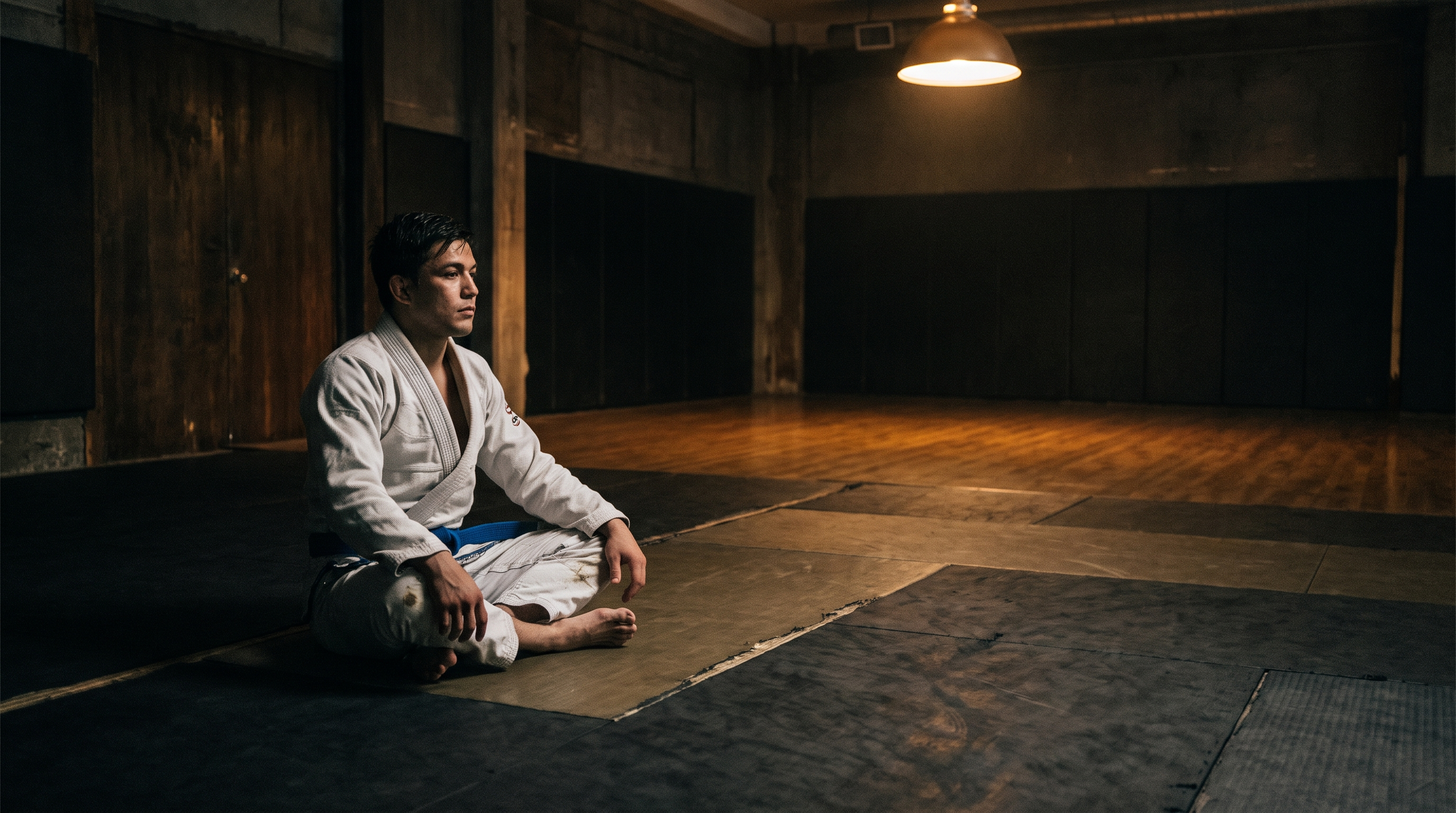
The Blue Belt Plateau: How to Break Through When Progress Feels Frozen
TL;DR. The blue belt plateau is almost never about talent — it's about training that has stopped generating new information. You keep rolling with the same people, using the same A-game, and reviewing nothing between sessions. Break the plateau by narrowing your focus to one position for 4–6 weeks, drilling with clear intent, rolling with self-imposed constraints, and reviewing what you learned before the next class. Below is a diagnostic, a 5–15 minute daily structure, the most common failure pattern, and a 7-day plan you can start tomorrow.
Key takeaways
- The blue belt plateau usually signals a training system problem, not a talent ceiling.
- Rolling more without a specific focus tends to reinforce your existing habits instead of building new skill.
- Narrowing your training to one position or problem for several weeks accelerates progress far more than chasing new techniques.
- Constraint-based rolling (start in a bad spot, limit your submissions) exposes gaps your A-game hides.
- Reviewing techniques between sessions — even for a few minutes — is the difference between learning and forgetting.
- A short daily 5–15 minute practice of visualization, note review, and one movement drill compounds quickly.
- Belt promotions follow skill; obsessing over the stripe slows you down.
The blue belt's specific constraint: you already know enough to survive
At white belt, everything is new. Every class you learn a submission you didn't know existed, and every roll teaches you a hard lesson. Progress is loud and obvious.
By blue belt, the situation flips. You have a functional guard, at least one sweep you trust, a couple of submissions, and enough defense to survive with lower belts. That competence is exactly the trap. You now have a stable A-game, and your body will default to it in every roll because it works often enough to keep you from getting smashed. New techniques you learn in class rarely get repped live, so they never make it into your game.
The blue belt plateau is not a mysterious ceiling. It is the completely predictable result of a training loop that looks like this:
- Show up to class.
- Learn a technique from the current position/theme.
- Roll — default to your A-game because you don't want to lose.
- Go home. Do nothing between now and the next class.
- Repeat.
No new information gets stored. Nothing gets revised. The technique from Tuesday is gone by Thursday. You feel like you're grinding but not moving, because you literally aren't retaining what would let you move.
Remember. "I've been at blue belt for two years" almost always translates to "I've been running the same fifty rolls for two years." Change the input, and the output changes.
Diagnose which plateau you actually have
Before you fix anything, figure out which of these you're dealing with. Most stuck blue belts are one of these four:
| Plateau type | What it feels like | Likely root cause |
|---|---|---|
| A-game trap | You tap lower belts easily, freeze against equal/higher | You only rep what you already know |
| Volume-only trap | You train a lot, learn nothing new | No focus, no review, no drilling with intent |
| Comfort trap | You avoid people, positions, and rolls that expose you | Ego protecting your record instead of your growth |
| Life-load trap | You show up but you're exhausted, injured, or distracted | Recovery and consistency need fixing before technique does |
Be honest. If two of these describe you, start with the one on top of the list — the A-game trap is almost universal at blue belt and it's the fastest to fix.
A daily 5–15 minute structure that actually compounds
You don't need a second training session. You need a small, consistent off-mat practice that turns each class into retained skill. Fifteen minutes a day is plenty. Five minutes is still worth doing.
Here is a simple structure you can run on any day of the week, whether you trained or not.
The 5-minute version (busy day)
- Minute 0–2: Open your notes from your last class. Read the one technique or detail you wrote down. Picture it, step by step.
- Minute 2–4: Watch or re-watch a short clip of the technique from a trusted instructional or your saved library. Not to learn something new — to reinforce what you already saw.
- Minute 4–5: Write one line about how you'll try to use it in the next roll. Not "practice it" — a specific plan: "From closed guard, break posture, then hunt the collar."
The 15-minute version (normal day)
- 3 minutes — Review. Read your last 2–3 class notes. Skim, don't study.
- 5 minutes — Visualize a full sequence. Pick one position (say, side control bottom). Mentally play the roll: they pin you, you frame, hip escape, get to your knees, come up. Do it three times, slowly, in your head.
- 5 minutes — Solo movement. Ten hip escapes each side. Ten technical stand-ups. A few bridges. Small dose, done properly.
- 2 minutes — Plan. Write the one thing you'll try in your next training session.
The point isn't the movements. It's that you're keeping the material warm in your brain between sessions instead of letting it decay to zero.
Remember. Retention is a compounding asset. Ten minutes a day, repeated over a training week, will beat one three-hour Saturday marathon every single time.
The most common failure pattern — and how to fix it
The failure pattern: rolling your A-game every round
Almost every stalled blue belt has the same problem. They know they should try new things in rolling, but the second the round starts, the body reaches for what works. You pull guard, you sweep with the same sweep, you pass with the same pass, you finish with the same submission. Every round is a rerun.
This feels productive because you're moving and sweating. It isn't. Your nervous system is being told, over and over, that the current game is the whole game.
The fix: constraint-based rolling
Pick one restriction per training week and enforce it every roll:
- Position start: Every roll starts with you in a bad spot — under mount, in side control bottom, or your partner has your back.
- Submission ban: No armbars or triangles this week. Forces you to hunt other attacks.
- Grip restriction: No lapel grips. Or only lapel grips. Both work.
- Guard swap: If you always play closed guard, play only open. If you always play open, play only closed.
- First 30 seconds rule: For the first 30 seconds of every roll, you must try the technique you learned in class that day.
You will get tapped more. You will look worse. That is the sign it's working. You're finally generating the new reps you've been avoiding.
Pair constraints with lighter, more curious rolling — you cannot learn if every round is a war. Save the hard rolls for one or two rounds a night, and use the rest to explore.
A simple 4–6 week focus block
Instead of chasing the class theme each night, run a personal focus block on one problem area for a full month.
Example: side control escapes. For four weeks, every drilling round you have any say in, you drill side control escapes. Every constraint round starts you flat on your back under side control. Every off-mat review is a side control detail. Every clip you save is about escaping side control.
At the end of the block, side control is no longer a leak. It's a position you understand. Then pick the next one.
The BJJ Memo feature that helps: the Technique Card library
Blue belts don't lack information — they lack a system to store and revise it. The single most useful thing you can do off the mat is keep every technique you care about in one place you can actually find again.
That's what BJJ Memo's Technique Cards are for. You paste a BJJ YouTube URL — a short instructional clip, a competition breakdown, a technique your coach recommended — and the app turns it into a structured card: clear steps, key details, and tappable timestamps for the important visual moments. The card is filed into your searchable library by position, so when you're working through a side control block, you can pull up every side control escape you've ever saved in seconds.
One feature, used consistently, fixes the biggest blue belt leak: techniques stop disappearing between class and the next roll. You spend five minutes before training re-reading the card, and the technique is loaded and ready when you step on the mat.
That's it. No streaks, no gimmicks — just a way to make sure the good stuff you've already seen doesn't quietly evaporate. Explore more on the BJJ Memo blog for related reading on retention and video study.
Remember. For real feedback and safety, drill and pressure-test techniques at a legit academy with a qualified coach. BJJ Memo helps you remember and revise between sessions — it doesn't replace mat time.
Sample 7-day plan to break the plateau
Here is a concrete week you can start tomorrow. Adjust class days to your schedule. This assumes three mat sessions in the week — if you train more, keep the review/solo work the same; the mat count isn't what breaks the plateau.
| Day | Mat work | Off-mat (5–15 min) | Focus |
|---|---|---|---|
| Mon | Class + rolling. Constraint: every roll starts with you in side control bottom. | 10 min — review notes from last week; save one side control escape clip as a Technique Card. | Diagnose the leak |
| Tue | Rest day. | 15 min — visualize the side control escape sequence three times; 10 hip escapes each side. | Retention |
| Wed | Open mat. Ask 2–3 partners to start on top of side control. Light, exploratory rolls. | 5 min — re-read the card before class; 2 min — write one line about what worked / didn't. | Reps under low pressure |
| Thu | Class + rolling. Constraint: no armbars, no triangles. | 10 min — save one new technique from tonight's class as a card. | Break the A-game default |
| Fri | Rest day. | 15 min — read the last three cards; solo movement drills. | Consolidation |
| Sat | Class + rolling. First 30 seconds of every roll, try the technique from Thursday. | 5 min — quick note on what happened when you tried it. | Live application |
| Sun | Full rest. Sleep, eat, walk. | 10 min — review the week's cards; pick next week's focus (probably still side control). | Plan next block |
Run this pattern for four to six weeks on a single focus area. You will feel it change.
Frequently asked questions
How long does the blue belt plateau usually last?
As long as your training loop stays the same. Blue belt is often described as the longest belt precisely because most people never adjust their approach — they train more but don't train differently. Once you narrow your focus, add constraint rolling, and start reviewing between sessions, most stuck blue belts report noticeable change within a few weeks, not months.
Should I compete to break through my plateau?
Competing is one of the best pressure tests available, but it isn't the fix. If you're stuck because you never leave your A-game, competing will just show you your A-game under stress. Use competition prep as a reason to focus on a specific position or gameplan for a training block — that's where the real value lives.
I'm training three times a week and still stuck. Should I add more sessions?
Add off-mat review before you add mat time. Three focused sessions with consistent review will outproduce five unfocused sessions. If you can already review and drill with intent and still feel stuck, then add a fourth session — but only one. Injuries and burnout stall progress harder than under-training does.
What if my coach doesn't teach the position I want to focus on?
Your focus block runs in parallel with class, not against it. Learn whatever your coach teaches in class, and use your open mat time, your constraint rolls, and your off-mat review for the specific position you're working on. If your gym has open mat, that's your lab.
Is it normal to feel worse when I start doing this?
Yes, and it's the sign the fix is working. Every time you leave your A-game — starting in a bad spot, banning your favorite submission, playing an unfamiliar guard — you will get tapped more. That's the price of new reps. Give it four weeks before you judge whether it's helping.
How do I stop forgetting techniques from class?
The short answer: capture them the same day, in a structure you can search later, and re-read them before the next session. Whether you use a notebook, a note app, or Technique Cards in BJJ Memo, the mechanism is the same — write it down, review it before you need it, then use it in your next roll.
Bringing it together
The blue belt plateau is a system problem, not a talent problem. You already know enough BJJ to be dangerous — you just need to stop losing what you learn and stop hiding inside your A-game. Pick one position. Constrain your rolling. Review a little every day. Give it a month.
Next time you watch an instructional or leave a class with a technique you want to keep, save it as a Technique Card in BJJ Memo so it's there in your library before your next roll. Build your revisable library on iOS and Android, and read more on retention and learning on the BJJ Memo blog.
Last updated 2026-08-25.