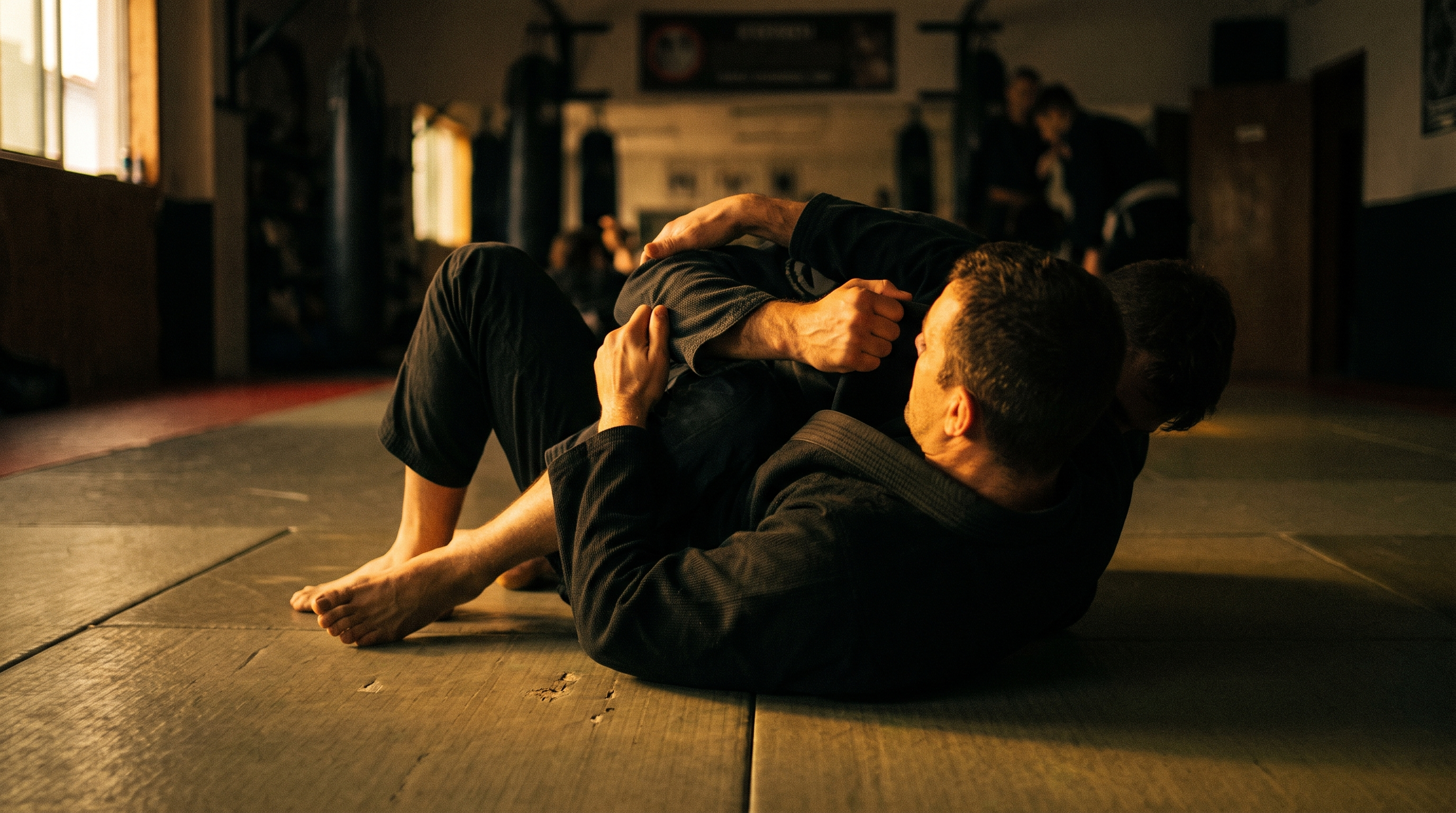
Building a BJJ Game Around a Single Guard: A White-to-Blue Belt Playbook
TL;DR. If you're a white or blue belt trying to build a BJJ game, the fastest path is to pick one guard system and stack every rep, note, and video around it for the next several months. Specializing gives you a recognizable A-game, faster decision-making, and something to fall back on when you get tired or scrambled. This playbook shows you how to choose a guard, structure 5–15 focused minutes a day, avoid the classic 'collector' trap, and follow a sample 7-day plan you can actually stick to.
Key takeaways
- Pick one guard (closed, half, butterfly, or de la Riva are all good starting points) and commit to it for at least a training block of several months.
- A real 'A-game' is a small map: one entry, two or three sweeps, one submission, and one recovery — not a highlight reel of moves.
- Short, daily 5–15 minute sessions of video study and mental review beat one long weekly cram every time.
- Track which specific detail you're working on each week; without a target, class turns into random reps.
- The most common failure pattern is collecting new techniques faster than you can drill or revise them.
- Sparring should be biased: pull your chosen guard on purpose, even when it costs you the round.
- Retention, not exposure, is what turns a white belt into a blue belt with a game.
The specific constraint of the white-to-blue belt
You are drinking from a firehose. Every class introduces new positions, your coach shows detailed variations you can't yet execute, and YouTube throws a fresh 40-minute breakdown at you every time you open it. On top of that, you probably train two to three times a week — enough to keep learning, not enough to naturally 'absorb' everything by volume.
That's the real constraint: limited mat time, unlimited information. The higher belts who look calm in your gym aren't calm because they know more techniques. They're calm because when a scramble happens, they already know where they want to end up. They have a game.
At white and early blue, you don't need more techniques. You need a default position — one guard you're willing to fight to establish, and a small set of things you do from there. Specializing in one guard sounds limiting; in practice it's the fastest way to stop feeling lost in every round.
Remember. You are not trying to learn all of BJJ. You are trying to become genuinely dangerous from one place, then expand outward from there.
How to actually pick your guard
Don't overthink this. Choose based on:
- Body type. Long limbs love closed guard, spider, and De La Riva. Shorter, denser builds often thrive in half guard and butterfly.
- What your coach teaches. If your academy runs a lot of half guard, that's your guard. Coaches beat 'the internet's best guard' every time because you get live corrections.
- What already feels okay. If you consistently pull one guard when tired, that's your body voting.
Good beginner-friendly options: closed guard, half guard, butterfly, De La Riva. Save the more athletic or flexibility-heavy systems (berimbolo, rubber guard, inverted stuff) for later blocks when your base is solid.
Building your daily 5–15 minute structure
Most lower belts try to add "more training" and burn out. What actually compounds is a short, daily off-mat session focused on your one guard. Here's a structure that fits into a normal work or school day:
| Time | Focus | What you actually do |
|---|---|---|
| 5 min | Passive study | Watch a short clip of your guard — one entry, one sweep, or one detail. |
| 5 min | Active note | Write or update a technique card: steps, key detail, common mistake. |
| 5 min | Mental rep | Close your eyes and walk through the sequence, feeling the grips and angles. |
Even if you only have five minutes on a busy day, do the passive-study block. On days you train, replace the mental-rep block with a two-minute post-class note: what worked, what didn't, one thing to try next time.
The goal isn't to become a scholar of your guard. It's to keep it loaded in your brain so when class or open mat starts, you already know what you're hunting.
Bias your sparring on purpose
Off-mat study is worthless if you play a different game in live rounds. Pick one round per session — ideally against someone your level or slightly better — where you commit to pulling your guard immediately, even if you get passed. Losing that round is part of the deal. You are buying reps in your chosen system, not chasing wins today.
Against much bigger or much better partners, defend safely and stay technical; you don't need to force a specialty game every single round.
The common failure pattern (and the fix)
Here is the pattern that traps most white and blue belts trying to build a game:
- You decide to specialize in, say, half guard.
- Week one: you drill the underhook sweep and it feels great.
- Week two: your coach shows a slick armbar from mount. You get excited and start hunting that.
- Week three: a YouTube video convinces you De La Riva is the answer.
- Six months later, you know the first move of thirty techniques and can finish none of them under pressure.
This is the collector trap. It feels productive because you're constantly "learning", but you never accumulate the reps needed to make anything reflexive. Under stress, your body defaults to whatever you've drilled hundreds of times — and if you've never drilled anything hundreds of times, it defaults to survival mode.
The fix: a written A-game map
Write a one-page map of your A-game. Keep it tiny on purpose:
- Entry: how you get into your guard (e.g., pull half guard from standing with an underhook).
- Primary sweep: the sweep you'll drill until it's automatic.
- Backup sweep: where you go when the primary is defended.
- Submission: one finish that connects naturally to your sweeps.
- Recovery: what you do when your guard gets partially passed.
That's it. Five items. Everything else you learn in class goes into a "parking lot" — noted, but not part of your current training focus. Revisit the parking lot at the end of your training block (three to six months out) and decide what earns a spot in the A-game.
Remember. You don't have a game until you can name the five items above without looking. If you can't, that's your homework this week.
The BJJ Memo feature that helps: the technique card library
The single reason most players never build a real A-game isn't laziness — it's that the information gets lost. You learn a nasty half-guard detail on Tuesday, don't train again until Saturday, and by Saturday it's gone. Then a new detail comes in on Sunday, and the cycle repeats.
The feature in BJJ Memo that directly solves this is the technique card library. When you watch a YouTube instructional on your chosen guard, you paste the link, and the app turns it into a structured card — steps, key details, and tappable timestamps for the important visual moments. You then file it under your guard (say, "Half guard → underhook sweep") in a searchable library.
Why this matters for a specialization plan:
- Every video you study lands in the same folder, so your A-game literally grows in one place instead of scattered across YouTube tabs and phone notes.
- Before class or open mat, you open your guard's folder and revise the two or three cards you're currently working on — the mental-rep block from above becomes a 60-second habit.
- After a few weeks, you can see your A-game map as an actual list of cards, which makes the collector trap obvious. If you have seventeen cards and can only execute two, you know what to do: drill, don't add.
That's the entire point of the app in this context — not to replace your coach, and not to teach you jiu-jitsu, but to make sure the details you already learned are still there when you need them. For real feedback and safety on any technique, train it at a legit academy with a qualified coach.
If you want to read more about the study side of this, our guide on how to remember BJJ techniques covers the retention habits that pair well with specialization.
A sample 7-day plan (half guard example)
This assumes three mat sessions in the week and short daily off-mat work. Adapt the guard and the specific technique to your own A-game — the structure is the point, not the moves.
| Day | Mat time | Off-mat focus (5–15 min) | A-game target |
|---|---|---|---|
| Mon | Class | Post-class card: one thing that worked, one that didn't | Establish half guard from standing |
| Tue | Rest | Study a short clip on the underhook sweep, update card | Underhook sweep entry |
| Wed | Class + one biased round | Mental rep of underhook sweep before class | Underhook sweep under resistance |
| Thu | Rest | Study backup: knee-lever sweep when opponent flattens you | Backup sweep |
| Fri | Rest or light drilling | Review both sweep cards; add one detail from Thursday | Chain: primary → backup |
| Sat | Open mat, biased rounds | Two-minute post-mat note: which detail failed | Live pressure test |
| Sun | Rest | Read through your A-game map. Decide next week's target | Recap + plan |
A week like this looks unimpressive on paper — one entry, two sweeps, some notes. That is exactly why it works. Repeat this shape for three months and you will have a real, tested piece of a game.
Remember. Boring, focused weeks are what build a game. Exciting, chaotic weeks are what keep you a permanent white belt with a lot of half-learned moves.
Frequently asked questions
How long should I specialize in one guard before adding another?
At least one training block of a few months, and honestly longer is better. A useful rule: you're ready to add a second guard when you can hit your primary sweep on people your own level who know it's coming. Before that, you don't have the specialty yet — you have an idea of it.
Won't specializing make me one-dimensional?
Short-term, yes, and that's the point. Long-term, no. Higher belts with a clear A-game usually have a clear B-game too, because their first system taught them how to actually build one. White belts who try to be well-rounded from day one tend to end up thin everywhere.
What if my coach teaches a different guard every week?
Still go to every class and learn what's taught — you're building base and getting corrections. Just be honest that your personal A-game work happens on the side: your daily off-mat study, your biased sparring rounds, and your notes all stay pointed at your chosen guard.
Does specializing in one guard work for no-gi too?
Yes, but pick a guard that translates. Half guard, butterfly, and single-leg X work well in both. Deep gi-grip systems (spider, worm, some collar-sleeve setups) don't transfer cleanly, so if you split your training between gi and no-gi, choose accordingly.
How many techniques should actually be in my A-game?
Fewer than you think. A tight A-game map — one entry, one primary sweep, one backup, one submission, one recovery — is enough to be genuinely dangerous at white and blue belt. Add complexity only when the base moves are automatic.
What if I pick the 'wrong' guard?
There is almost no wrong choice among the standard guards. What matters is committing long enough to actually test it. If, after a full training block of honest specialization, the guard clearly doesn't suit your body or game, switch — but switch to another single guard, not to "a bit of everything".
Bringing it together
Building a BJJ game is not a matter of learning more; it's a matter of choosing less and going deeper. Pick one guard. Write your five-item A-game map. Do five to fifteen focused minutes a day off the mat. Bias one round per session toward your specialty. Revise before you train, not after you've forgotten.
Do that for one training block and you will feel it: rounds get quieter, decisions get faster, and the phrase "my game" will actually mean something when you say it.
Next time you watch an instructional on your guard, save it as a technique card in BJJ Memo so it's there before your next roll — your A-game grows in one place instead of getting lost in browser tabs. BJJ Memo is available for iOS and Android on the BJJ Memo site, and you can find more retention-focused guides on the BJJ Memo blog.
Last updated 2026-08-23.