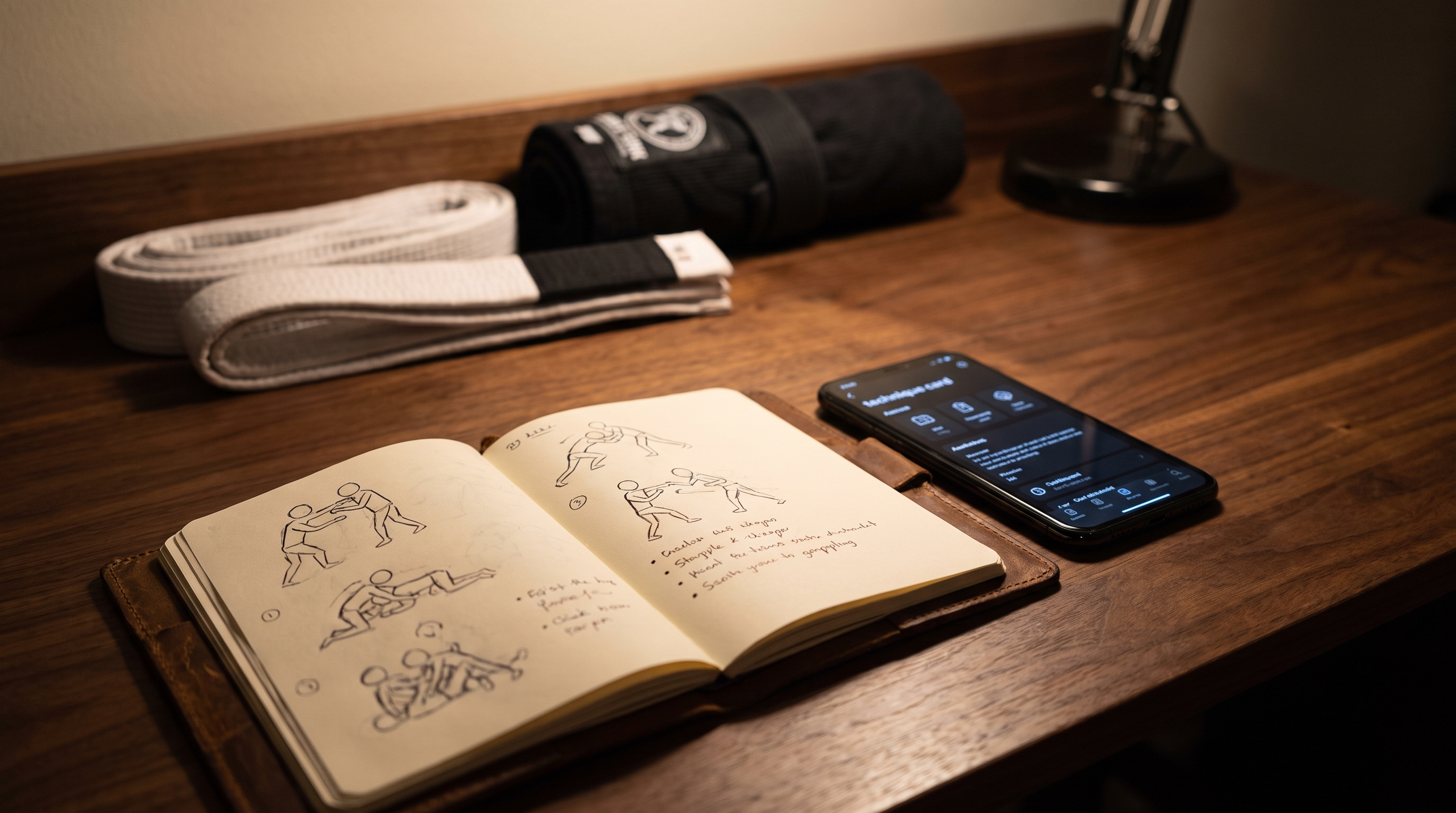
How to Build a BJJ Technique Library from Scratch: A 30-Day Plan for White Belts
TL;DR. White belts forget most of what they learn because there's no capture-and-review system between class and the next roll. A BJJ technique library fixes that: one simple template per technique, filed by position, revisited before training. This 30-day plan walks you through choosing a format, capturing techniques from class and video, organizing by position, and building a weekly review habit. By day 30 you'll have a searchable set of techniques you actually remember — and a system you can carry through blue belt and beyond.
You walk out of class with your gi still damp, buzzing about that armbar setup your coach just showed. Three days later, you're in a live round, in exactly the right position — and your brain is blank. Sound familiar? Almost every white belt lives here. The problem isn't that you're a slow learner or that BJJ is "too complicated for beginners." The problem is that you have no system. Techniques go in one ear and out the other because nothing catches them on the way out. A BJJ technique library — a small, structured record of what you're actively learning — is the fix. This guide gives you a concrete 30-day plan to build one from scratch, even if you've never taken a note about jiu-jitsu in your life.
Key takeaways
- A BJJ technique library is a personal, organized record of the techniques you're actively learning, filed by position rather than by class date.
- Most white belts forget techniques because they capture nothing between class and their next roll — the fix is a lightweight system, not a better memory.
- Use one consistent template per technique: position, setup, 3-5 steps, key details, common mistakes, and where you got it.
- Organize by position first (mount, side control, closed guard, half guard, back, standing), then by attack or escape underneath each position.
- Capture within 24 hours of learning — details fade quickly, so even a 3-minute voice note after class beats a perfect write-up a week later.
- Review before training, not after: a 5-minute skim of the position you're likely to hit tonight is worth more than an hour of passive re-watching.
- By day 30, aim for a small, high-quality library of techniques you can actually recall and drill — not a giant dump you never open again.
Why this happens: the white-belt forgetting problem
BJJ has an enormous surface area. A single class can include a warm-up, two or three technique variations, positional sparring, and live rolling. In that same hour, your coach might casually mention a grip detail, a hip angle, and a common mistake — each one worth its own note. You couldn't remember all of it even if you tried. And then you don't try, because taking notes on the mat feels weird and no one else is doing it.
Here's the honest reality: memory of complex physical skills fades fast unless it's reinforced. You're not just trying to remember words — you're trying to remember body positions, angles, grips, timing, and the feel of pressure. Watching a YouTube instructional or drilling twice in class barely scratches the surface. Without a way to capture and revisit what you learned, most of it slips away long before you get another rep at it.
The good news: this is a solvable, boring problem. You don't need a photographic memory or a coaching background. You need a small, repeatable system that turns every class and instructional into something you can find again in ten seconds. That's what a technique library is.
Remember. You don't forget techniques because you're bad — you forget because you never revise them. Capture beats intelligence, every time.
A simple system: your 30-day plan to build a BJJ technique library
The plan is designed for a white belt training two to four times per week. If you train more, you'll fill it faster; if you train less, stretch the timeline. The goal by day 30 isn't a giant archive — it's a small, well-organized set of techniques you can actually recall on the mat, plus a habit you can keep going.
Step 1 — Days 1-2: Pick one tool and commit for 30 days
Stop looking for the perfect app. The best tool is the one you'll actually open after class. Reasonable options:
- A dedicated BJJ retention app (like BJJ Memo) that turns YouTube videos into structured technique cards and files them for you.
- A note-taking app you already use (Notes, Obsidian, Notion, Google Docs).
- A physical notebook — old school, but works if you'll actually carry it.
Pick one. Not three. Commit for 30 days, then reassess. Switching tools mid-plan is one of the fastest ways to abandon the whole project.
Step 2 — Days 3-4: Design a one-template card
Consistency is what makes a library searchable later. Every technique gets the same fields:
- Name (e.g., "Cross-collar choke from mount")
- Position (e.g., "Mount — attack")
- Setup / when to use it (1-2 sentences)
- Steps (3-5 numbered actions, short)
- Key details (grip depth, elbow position, hip angle — the small stuff that makes it work)
- Common mistakes (what you or your partner did wrong)
- Source (coach's name, class date, or YouTube link with timestamp)
That's it. Resist the urge to add ten more fields. A short card you actually fill out beats a beautiful template you abandon by day 6.
Step 3 — Days 5-10: Set up your position folders
Organize by position, not by date. Dates are useless when you're trying to remember "that thing coach showed from half guard." Create these top-level folders:
- Standing / takedowns
- Guard (closed, open, half — split later if needed)
- Mount
- Side control
- Back
- Turtle / knee-on-belly
- Submissions from anywhere (leglocks, chokes, etc.)
Under each position, split into attacks, escapes, and transitions as you accumulate cards. Ten cards under "Side control — escape" is far more useful than 200 unsorted cards.
Step 4 — Days 11-20: Capture every class within 24 hours
This is where the library actually gets built. After every class, before you sleep, write one card per technique you learned. If you're wrecked, do a voice memo on the drive home and transcribe it the next morning. Rules:
- One card per technique, not per class.
- Keep it short — a card you'll re-read beats an essay you won't.
- If you can't remember a step clearly, note the gap ("forgot the grip on the far arm — ask coach").
- Add a source link if it came from a video.
At the same time, start pulling in techniques from YouTube. Pick one instructional per week — a Lachlan Giles concept video, a Gordon Ryan breakdown, a coach on your feed — and turn it into one or two cards. Do not try to capture everything on YouTube. Capture what fits your current game.
Step 5 — Days 15-30: Review before training, not after
A library you never open is a graveyard. Build a review habit:
- Before every class: 5 minutes skimming cards from the position you're likely to work on that day. If class is guard passing, re-read your guard-passing cards.
- Weekly: 15 minutes reviewing everything you added that week. Mark anything you're still fuzzy on to ask your coach.
- Monthly: skim the whole library, delete or merge duplicates, and note two or three techniques you want to actively drill next month.
This is where retention actually happens. Passive re-watching feels productive but does much less than a focused, short review right before you get to try the move.
Step 6 — Day 25: Prune ruthlessly
Around day 25, your library probably has some noise: half-finished cards, techniques you'll never use as a white belt, duplicates. Spend 20 minutes cleaning. Delete anything you don't understand or won't drill. A small, sharp library is more valuable than a bloated one.
Step 7 — Day 30: Set your next 30 days
At day 30, you should have:
- A working template.
- A position-based folder structure.
- A meaningful set of techniques (quality over quantity).
- A habit of capturing within 24 hours and reviewing before training.
Now pick a focus. Choose one position (e.g., "escape side control" or "pass half guard") and dedicate the next 30 days to deepening that section of your library. This is how a personal game gets built.
Suggested weekly rhythm
| Day | Time | Action |
|---|---|---|
| After each class | 10 min | Write one card per technique learned |
| Before each class | 5 min | Skim cards for tonight's likely position |
| One weekday | 15 min | Watch one instructional, make 1-2 cards |
| Sunday | 20 min | Review the week, prune, plan focus |
Remember. Capture within 24 hours, review within 24 hours of next training. Everything else is optional.
Common mistakes when building your first technique library
Most failed libraries fail for the same handful of reasons. Watch for these:
- Trying to capture everything. You cannot save every technique you see on YouTube. Focus on what your coach is showing and what fits your current position problems.
- Organizing by date, not position. Class dates mean nothing three weeks later. Position folders are how your brain will actually search.
- Writing essays instead of cards. If a note takes longer than five minutes to write, you'll stop writing. Short, structured, consistent.
- Capturing but never reviewing. Notes without review are journaling, not learning. Set a review trigger you can't ignore (before every class).
- Switching tools every two weeks. The tool almost never matters. Consistency does.
- Skipping the "common mistakes" field. The mistake notes are often more valuable than the steps — they tell you why it doesn't work when you try it live.
- Building a library without drilling. A library supports mat time; it doesn't replace it. Every technique in your library should be one you're willing to actually drill and try in rolling.
Remember. Small, consistent reps beat marathon sessions — the same is true of your notes. Ten minutes after every class beats a three-hour "catch-up" once a month.
Where BJJ Memo fits in
If you're building your library from YouTube instructionals, the slow part is usually the write-up: scrubbing back to catch details, pausing to transcribe steps, remembering where the good bit was. BJJ Memo is built exactly for this — you paste a BJJ YouTube URL and it generates a structured technique card (setup, steps, key details, tappable timestamps for the visual moments), then files it into your personal library by position. There's also a review flow so cards resurface before you train.
It's not a replacement for taking your own notes after class, and it's definitely not a replacement for your coach — mat time and real feedback are still where jiu-jitsu is learned. But if the friction of capturing video is what's stopping you from building a library, it removes that friction. You can also read more about learning BJJ from YouTube effectively on the blog.
Frequently asked questions
How many techniques should I have in my library after 30 days?
There's no magic number, and chasing one is a mistake. If you trained two to four times a week and captured what your coach actually showed, you'll likely have somewhere between one and three cards per class, plus a handful from video. Quality matters more than volume — a smaller set of techniques you can recall and drill is far more useful than a huge dump you never open again.
Should I organize my BJJ technique library by position or by submission?
By position first. Almost every problem on the mat starts with "I'm stuck in X position — what do I do?" so your brain naturally searches that way. File submissions as attacks under the position they come from (e.g., "Mount — attack — cross-collar choke"). You can add a cross-referenced "submissions" folder later if it helps, but position is the primary axis.
Is it worth writing notes if I already film my rolls or my coach's demos?
Yes. Raw video is a capture, not a system — you'll rarely re-watch it and you can't search it. Turning a demo into a short structured card (setup, steps, key details, common mistakes) forces you to actually understand it, and gives you something you can skim in five minutes before class. Use video as your source and notes as your library.
What if I miss a few days of capturing?
Don't try to reconstruct classes you can't remember — you'll invent details and pollute your library. Just resume with the next class. A technique library is a long-term habit, not a streak. Missing three days out of thirty doesn't matter; quitting because you missed three days does.
Do I really need a system as a white belt, or should I just train more?
More mat time is always the answer, but it's not the only answer. A basic capture-and-review habit compounds every session — the same amount of training produces more retention. Think of it as a lightweight tax (10-15 minutes a day) that dramatically increases the value of every hour you spend on the mat.
Won't a technique library make me overthink and freeze in rolling?
Only if you try to use it during rolling. The library is for before and after training, not during. On the mat, you play. Off the mat, you study what happened and what to fix. Kept in that lane, a library reduces overthinking because you stop trying to hold everything in working memory.
Next steps
Start today, not next Monday. Pick your tool, sketch your template, and write your first card after your next class. In 30 days you'll have something no white belt without a system ever gets: a personal, searchable record of the game you're actually building.
When you're ready to remove the friction from capturing video instructionals and building a searchable library, try BJJ Memo — paste a YouTube URL, get a structured technique card, and revise it before your next training session.
For real feedback and safety, train the techniques in your library at a legit academy with a qualified coach. BJJ Memo helps you remember and revise — it doesn't replace mat time or coaching.
Last updated 2026-08-24.