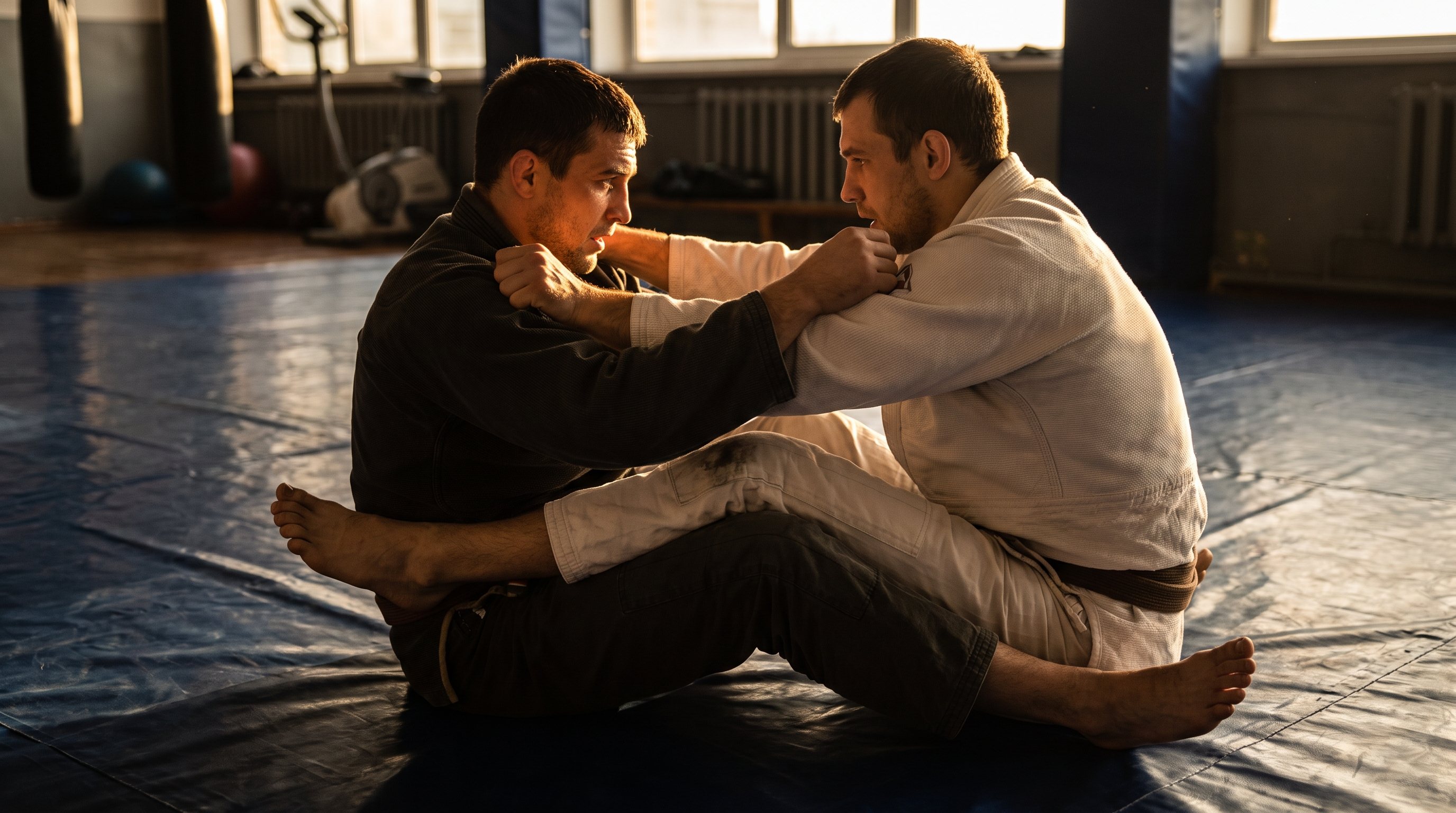
Butterfly Guard for Beginners: How to Hook, Elevate, and Sweep Bigger Partners
TL;DR. Butterfly guard is a seated open guard where your feet hook inside your partner's thighs so you can lift and off-balance them. For beginners, the highest-percentage move is the classic butterfly hook sweep: get an underhook, load your partner's weight onto one of your hooks, angle out, and dump them to the underhook side. The sweep works because their base is broken first, not because you're stronger. Learn the three ingredients — posture, hooks, connection — then drill them together.
Butterfly guard is one of the first open guards a new grappler should actually invest time in. It's simple enough to grasp in a single class, it works in both gi and no-gi, and it gives you a real answer to the most frustrating scenario at white belt: a heavier training partner sitting on you and slowly grinding your knees to the mat.
This guide covers what butterfly guard is, why it works, and a simple system for the classic butterfly sweep against a bigger partner. It's written for people who train — no fluff, no promises that you'll be sweeping black belts by Friday. If you drill this cleanly for a few weeks and revise the details between sessions, you'll have a sweep you trust.
Key takeaways
- Butterfly guard is a seated open guard with your feet hooked inside your partner's thighs, used to elevate and sweep rather than to hold or stall.
- The three non-negotiable pieces are posture (chest up), an underhook or strong upper-body connection, and active hooks that lift — not just rest.
- The classic butterfly sweep works by loading your partner's weight onto one hook and dumping them to the underhook side.
- Bigger partners get swept when their base is broken first; against them, angle and timing beat trying to muscle the elevation.
- Beginners lose butterfly guard by lying flat, letting the head get pushed down, or crossing their feet — all fixable in one session.
- Drill the hook placement, the load, and the elevation as three isolated skills before you try to chain them into a full sweep.
- Revising the details between sessions is what turns a new sweep into a reliable one — write down or record the two cues you keep forgetting.
Why butterfly guard works (and why beginners struggle with it)
Most beginner guards are about holding — closed guard clamps them in, half guard traps a leg. Butterfly guard is different. You're sitting up, on offense, using your feet as levers under their thighs. The whole point is to move them, not hold them.
Here's why this is powerful, especially against a bigger partner:
- Their weight becomes your tool. When you hook their thigh and lift, their own base is what tips them over. You're not bench-pressing them; you're rolling them off a support point they didn't realize they had.
- It scales in no-gi. No sleeves, no lapels, no problem. Butterfly guard translates cleanly to no-gi grappling because it runs on hooks and connection, not fabric.
- It teaches posture and framing. You cannot play butterfly hunched over. Learning it fixes a lot of the bad postural habits new grapplers pick up in closed guard.
So why do beginners struggle? Usually one of three reasons: they lie flat instead of sitting up, they let their partner flatten their hooks (feet resting instead of lifting), or they try to force the sweep with the leg without first breaking their partner's base with an underhook or grip. Fix those three things and butterfly guard starts feeling completely different.
Remember. Butterfly guard is an active position. The moment you're just sitting there with your feet under someone's legs and no plan, you're about to get passed.
The three ingredients of a working butterfly guard
| Ingredient | What it looks like | What breaks if it's missing |
|---|---|---|
| Posture | Chest up, spine tall, head above hips | Partner drives you flat and starts passing |
| Connection | Underhook, collar tie, wrist grip, or 2-on-1 | You have no way to move their upper body when you elevate |
| Active hooks | Insteps under their thighs, knees pointing slightly out, feet ready to lift | Sweep has no engine; you can lift a leg but not the person |
Think of these as a tripod. Lose one leg, the whole thing collapses. Every problem you'll have in butterfly guard maps back to one of these three going missing.
A simple system: the classic butterfly sweep, step by step
Before you learn ten variations, learn one sweep well. The one below — sometimes called the classic butterfly sweep or the hook sweep — is the base every other butterfly attack branches off of.
Set it up from seated butterfly guard, with your partner on their knees in front of you.
- Sit up and get posture. Chest up, back straight-ish, head above your hips. If your head is below your hips, reset before you do anything else. This is the single most common mistake and it's fixable immediately.
- Place your hooks. Slide your insteps under your partner's thighs, roughly halfway between their knee and hip. Knees point slightly outward, not straight up. Feet are alive — imagine you could wiggle their thighs upward at any moment.
- Get your connection. Dig an underhook on one side (say, the right). Your right arm goes under their left armpit, palm cupping their shoulder blade or upper back. In gi, you can add a same-side sleeve grip or cross-collar; in no-gi, an underhook plus a wrist tie is enough.
- Kill the far-side base. With your free (left) hand, grab their far sleeve, wrist, or triceps — whatever stops them from posting out to the underhook side. If that post is available to them, the sweep won't finish.
- Load and angle out. Fall to your underhook-side hip (right hip), turning your shoulders so you're perpendicular to your partner. As you fall, your right (underhook-side) hook stays under their thigh and lifts — this loads their weight onto that hook.
- Elevate and dump. In one motion, kick your loaded hook up toward the ceiling while pulling their upper body down and across with your underhook. They tip over your hook and land on their back, with you already turning up into the top position.
- Come up on top. Follow the sweep — don't just watch them fall. Post your free hand, drive your hips forward, and land in either knee-on-belly or a solid side control. Sweeps only count in real rolling if you finish on top.
Drill it slowly. Reps 1–20 should feel almost boring: no explosiveness, just clean mechanics. Once the shape is right, add pace.
Remember. If a bigger partner isn't moving, it's almost never your hook that's weak — it's your angle or your grip stopping their post. Fix the setup, not the strength.
Why this sweep works on bigger partners
Heavier training partners like to smash forward. Butterfly guard uses that. When they push into you and you fall to your underhook-side hip, their forward pressure becomes forward momentum in the direction you already want them to go. You're not sweeping straight up against their weight; you're redirecting them across the hook that's now under their thigh.
Against a much bigger partner, don't try to elevate them straight up in the air like a highlight reel. Use a lower, more diagonal elevation — a controlled tip, not a launch. The finish looks less dramatic but works far more consistently.
Common mistakes (and how to fix them tonight)
Almost every butterfly guard problem falls into one of these buckets. Skim the list before your next training session.
- Lying flat. If you're on your back, you're not in butterfly guard, you're in trouble. Sit up first, always.
- Head below hips. Even if you're seated, a bowed spine and dropped head let your partner pressure you forward. Chin up, chest tall.
- Passive hooks. Feet resting under their thighs do nothing. Your hooks must be alive, ready to lift.
- No underhook or connection. Trying to sweep with only the leg means you're rowing a boat with one oar. Get the upper-body grip first, then use the leg.
- Crossing your feet. Never cross your ankles under your partner in butterfly — it kills your ability to lift, and worse, it exposes you to leg attacks. Keep them independent.
- Ignoring the far post. If you don't kill their far-side hand or arm, they'll post and you'll fall to your back with them still on top. Take the post away before you elevate.
- No follow-through. The sweep isn't the sweep — the finish on top is the sweep. Turn up and pressure into side control immediately.
A useful drill: pick just one of these mistakes each session, and consciously fix only that one for the whole class. This is far more effective than trying to fix all seven at once and fixing none of them.
A minimal weekly drilling plan
| Session | Focus | Time |
|---|---|---|
| Session 1 | Hook placement + posture from seated | 10 min drilling |
| Session 2 | Add underhook and far-arm control | 10 min drilling |
| Session 3 | Full sweep, slow reps on a compliant partner | 15 min drilling |
| Session 4 | Sweep against light resistance, focus on finishing on top | 15 min rolling reps |
Four focused sessions on the same sweep will do more for your game than four random techniques from four random YouTube videos.
Where BJJ Memo fits in
Most people don't forget techniques because they're bad students. They forget because they never revise. You watch a great butterfly guard breakdown on Sunday, learn a variation in class Monday, and by Thursday the details are gone — the grip, the angle, the tiny cue your coach mentioned.
BJJ Memo is built for exactly this. Paste a butterfly guard YouTube video into the app, and it generates a structured technique card — steps, key details, and tappable timestamps of the important moments — that gets filed into your personal library. Before your next training session, you review the card in a couple of minutes and walk onto the mat with the details fresh. It doesn't replace your coach. It just makes sure the work you already did doesn't quietly disappear between sessions.
If you're serious about building a butterfly guard game, keep a small library of cards on the position — the sweep, one counter to the knee cut, and one arm drag to the back — and revise them the day before you train. That's it. Explore more on the BJJ Memo blog or read about how to remember BJJ techniques and how to learn BJJ from YouTube for the full retention system.
Remember. The best sweep is the one you actually recall under pressure. Small, consistent revision beats another new technique.
Frequently asked questions
What is butterfly guard in BJJ?
Butterfly guard is a seated open guard where you place your insteps (the tops of your feet) underneath your partner's thighs. From there, you use those hooks together with an upper-body connection — an underhook, collar tie, or wrist grip — to lift and off-balance your partner into a sweep. It's used in both gi and no-gi and is a foundational open guard for beginners.
Is butterfly guard good for beginners?
Yes. Butterfly guard forces you to sit up, keep posture, and stay active — three habits new grapplers desperately need. The classic butterfly sweep is beginner-friendly because the mechanics are simple: hook under thigh, get an underhook, angle out, elevate. It also works against larger partners, which is a huge confidence boost early on.
How do I stop a bigger partner from smashing my butterfly guard?
The short answer: don't try to hold the position, use their pressure. When a bigger partner drives forward, fall to your underhook-side hip and let their momentum load your hook. Also make sure your posture is tall, your head is above your hips, and you've killed their far-side post before you elevate. If any of those three are missing, they'll flatten you.
Do I need the gi to play butterfly guard?
No. Butterfly guard is one of the guards that translates most cleanly between gi and no-gi. In no-gi, replace sleeve or collar grips with underhooks, wrist ties, and 2-on-1s. The hook mechanics and the elevation are identical in both.
How long does it take to get a working butterfly sweep?
With focused drilling — three or four sessions of slow, deliberate reps — most beginners can start hitting the classic butterfly sweep on training partners at a similar level. Making it work against advanced grapplers takes much longer, because they'll shut down your hooks, underhook, or angle. Consistency and revision matter more than talent.
Is it safe to cross my feet in butterfly guard?
No. Never cross your ankles under your partner in butterfly guard. It kills your ability to elevate each leg independently and, more importantly, it makes you vulnerable to certain leg attacks. Keep your feet separate and active at all times.
Get on the mat — and remember what you learn
Go drill this. Grab a training partner this week, walk through the seven steps slowly, and only speed it up once the shape is right. Then save the technique card in BJJ Memo so it's fresh in your head next time you roll — capture it before you lose it.
Teacher disclaimer: This article is a study aid, not a replacement for coaching. For real feedback, correct positioning, and safe practice, train the technique at a legit academy under a qualified coach. BJJ Memo helps you remember and revise what you learn — it doesn't replace mat time.
Last updated 2026-08-25.