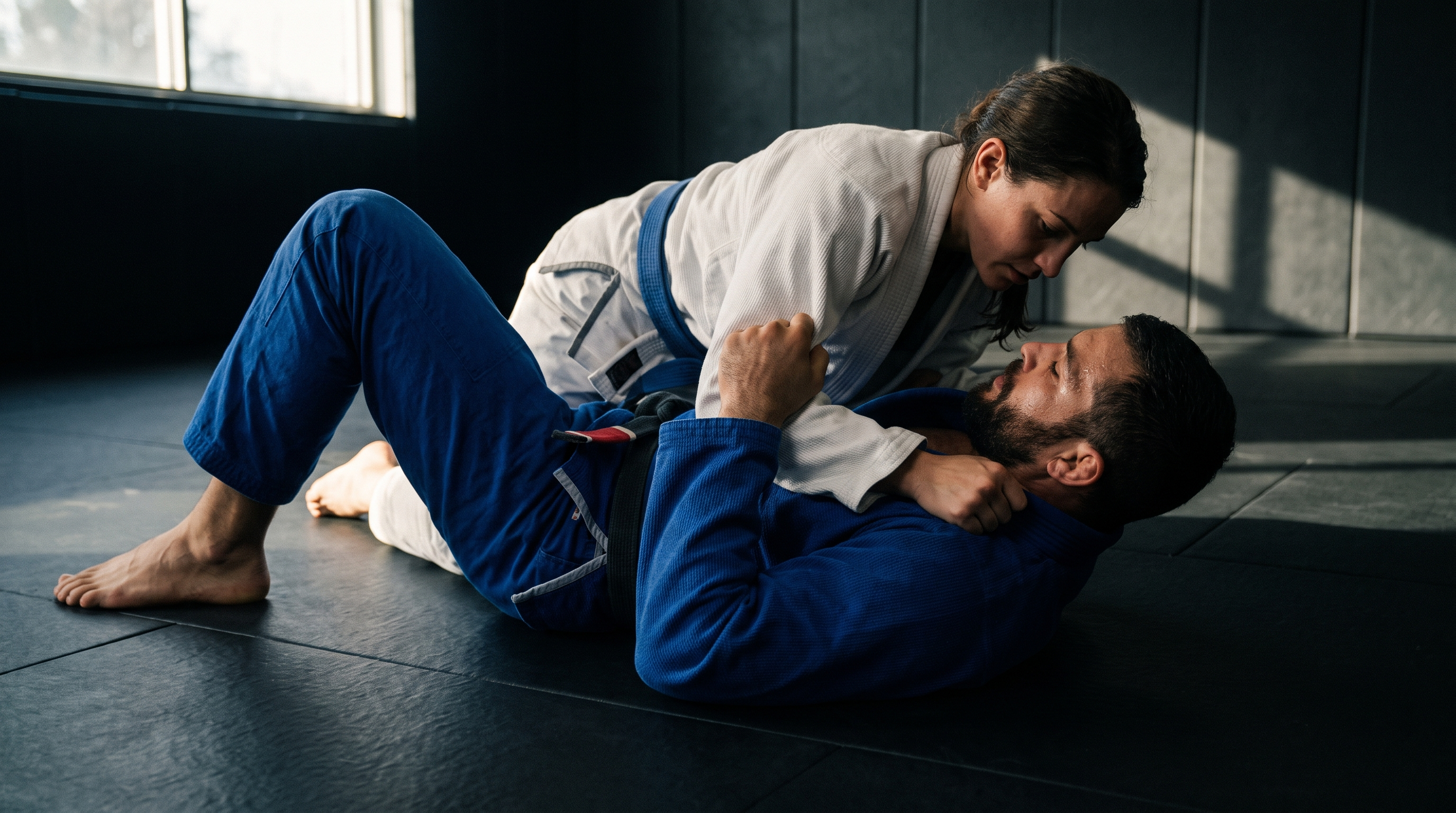
Closed Guard Basics: 4 Attacks Every White Belt Should Chain Together
TL;DR. Closed guard is the friendliest position in BJJ for a white belt because you control distance and posture with your legs. Instead of memorizing dozens of moves, learn four attacks that flow into each other: the cross choke, hip-bump sweep, kimura, and armbar. Each attack sets up the next when your partner defends, which means you're never stuck. Drill the chain, not the isolated moves, and you'll have a real closed guard game inside a few months.
Closed guard is usually the first "real" position a white belt gets to spend time in. Your legs are locked around your partner's waist, you have your hands free, and — if you know what you're doing — you can attack their posture, their balance, and their arms all from the same spot. The problem is that most beginners are taught closed guard as a graveyard of isolated techniques: an armbar one week, a scissor sweep the next, a triangle the week after. They never learn how those pieces fit together.
This guide gives you a small, honest system: four attacks that link into each other so you always have a next move. You don't need to be flexible, fast, or physically imposing to make it work. You need posture control, grips, and a bit of patience.
Key takeaways
- Closed guard basics come down to posture control, angle, and grips — not fancy submissions.
- A working white-belt system needs only four linked attacks: cross choke, hip-bump sweep, kimura, and armbar.
- Every attack in the chain feeds the next when your partner defends, so you always have a plan B.
- Break your opponent's posture down before you attack — a straight-postured guard passer is nearly impossible to submit.
- Off-angle beats brute force: shift your hips off-center before every submission attempt.
- The most common white-belt mistake is holding closed guard passively; use your legs actively.
- Drill the chain in reps with a compliant partner before trying it in live rolls.
Why this happens: closed guard is powerful, but only with a system
Closed guard works because the person on top has to solve three problems at once: your legs squeezing their hips, your hands controlling their upper body, and your ability to shift angles underneath them. If they focus on any one of those, you attack the other two.
The reason white belts struggle is not the position — it's the approach. Most beginners:
- Wait for their partner to "do something" instead of attacking first.
- Try one submission, fail, and reset back to a neutral closed guard.
- Keep their partner's posture upright, which kills every attack in the book.
- Attack straight on, hips squared, giving the top player perfect base.
A system fixes this. When you know that a failed submission leads directly into the next attack, closed guard stops feeling like a stalling position and starts feeling like a funnel. Your partner is forced to defend one thing while you're already setting up the next.
Remember. Position before submission. If your partner is sitting straight up with good posture, do not attack — break them down first.
A simple closed guard system: 4 attacks, 7 steps to chain them
Here is the sequence. Learn it in this order, drill it in this order, and use it in this order when you roll. All four attacks share the same starting grips, which is what makes the chain work.
Step 1 — Establish the starting position
Sit up briefly to get a collar grip with your dominant hand (deep, four fingers inside the collar, thumb out) and a sleeve grip with your other hand at your partner's opposite wrist. In no-gi, replace these with a strong collar tie and a two-on-one wrist grip. Lie back down and close your guard tight, feet crossed.
Step 2 — Break their posture down
Pull with both hands while pulling your knees toward your own chest. Your partner should come chest-to-chest with you. Do not let them re-post. If they push back up, pull again. This is the single most important skill in closed guard.
Step 3 — Attack #1: the cross choke
With your partner broken down, feed your second hand into their opposite collar, palm up, deep. Your two forearms cross under their neck. Pull your elbows down and to the sides while flaring your knees. If it's there, they tap. If they defend by posting a hand on the mat or driving up to relieve pressure, you go to step 4.
Step 4 — Attack #2: the hip-bump sweep
When your partner drives up and posts a hand behind them (or resists the choke by straightening), release your legs, sit up on your dominant elbow, and reach over their same-side shoulder. Bump your hips forward and up while pushing them over the posted arm. You land in mount. If they base out wide with the far hand and stop the sweep, that far arm is now isolated — go to step 5.
Step 5 — Attack #3: the kimura
As the sweep stalls, grab their wrist with your near hand (thumb-less monkey grip), feed your other hand under their arm and grab your own wrist. That's a kimura grip. Sit back down, throw a leg over their back to trap them, and rotate their arm behind them. If they clamp their hand to their own belt or thigh and defend the finish, keep the grip and go to step 6.
Step 6 — Attack #4: the armbar
Still holding the kimura grip, use it to control their posture and swing your bottom leg across their face. Angle your hips 90 degrees, pinch your knees, and extend. This is the classic armbar from guard, arrived at through the entire chain instead of forced cold.
Step 7 — Reset and repeat
If the armbar fails or they stack you, use the space to recover closed guard and start again at step 1. Every rep of this chain — successful or not — teaches you the reactions your partner gives, which is the real skill you're building.
The chain at a glance
| Step | Attack | Trigger to move on |
|---|---|---|
| 3 | Cross choke | They post up or defend the collar |
| 4 | Hip-bump sweep | They base out with the far hand |
| 5 | Kimura | They clamp their arm to their body |
| 6 | Armbar | Kimura defense exposes the straight arm |
Remember. You are not trying to force any single attack. You are trying to make your partner defend so much that the next attack becomes free.
Common mistakes white belts make in closed guard
Almost every white belt struggling with closed guard is making one of these mistakes. Fix them and everything above starts working.
- Holding guard passively. Closed guard is not a rest position. If you're not gripping, breaking posture, or setting up an attack, you're just waiting to get passed.
- Never breaking posture. Attacking a partner who is sitting straight up is a waste of energy. Break the posture first, always.
- Attacking square. Every submission from closed guard needs an angle. If your belly button is pointed at their belly button, your armbar and triangle are not there.
- Grip amnesia. Losing your grips means restarting the whole system. Fight to keep the collar/sleeve or collar-tie/wrist grip through the entire exchange.
- Opening guard too early. Don't open your legs unless you are actively sweeping or submitting. An open guard by accident is a passed guard waiting to happen.
- Chasing every submission you know. Four attacks, drilled to death, will beat twenty attacks you half-remember. Pick the chain, stick with it for months.
Remember. A small game, drilled deeply, is what makes belts move. Collecting techniques is not the same as building a game.
Where BJJ Memo fits in
The reason white belts forget closed guard details — grip depth, elbow position, which hand posts where — is not lack of intelligence. It's that a technique shown once in class, or watched once on YouTube, is not something the brain hangs onto. Much of what you learn on Monday is fuzzy by Wednesday.
BJJ Memo is built for exactly this. Paste a YouTube URL of a closed guard instructional — a Danaher breakdown, a John Danaher DLR guard clip, a Lachlan Giles cross choke tutorial — and the app turns it into a Technique Card with the steps, key details, and tappable timestamps of the important moments. You file it into your personal library and revise it before training, so the details you learned this week are still there next week when you're actually rolling.
It doesn't replace mat time or a coach. It just makes sure that when you show up to class, the four attacks in the chain above are fresh in your head instead of half-remembered.
Frequently asked questions
Is closed guard still worth learning in modern BJJ?
Yes. While competition trends move toward open guards and leg entanglements, closed guard is still the safest position for a beginner to develop grips, posture control, and submission mechanics. Every high-level grappler learned closed guard first for a reason.
How long should it take a white belt to get good at closed guard?
With consistent training two to three times a week and focused drilling of a small system like the one above, most white belts start hitting sweeps and submissions from closed guard in live rolls within a few months. Getting genuinely dangerous from there is a longer road, but the foundation comes quickly.
Should I learn closed guard in the gi or no-gi first?
Gi first, if you have the choice. The collar and sleeve grips make it easier to feel the mechanics of posture-breaking and off-angle attacks. The same system translates to no-gi with collar ties and wrist control, but the gi teaches the details more clearly.
What if my partner is much bigger than me?
Closed guard rewards technique over strength, but not infinitely. Against a much larger, stronger partner, focus on breaking their posture with your legs — pulling knees to chest — rather than only your arms. If they stand up in your guard, open the guard on your terms and transition to an open guard rather than fighting to hold them.
Why does my closed guard get passed so easily?
Usually one of three things: your feet aren't crossed and squeezing, you let your partner sit straight up, or you kept your hips square to theirs. Fix your posture-breaking first, then your grips, then your angles.
Do I need to learn the triangle before the armbar?
Not for this system. The four-attack chain above works without the triangle. Once the chain is solid in live rolling, adding the triangle as a fifth option — usually off the hip-bump sweep or the cross choke defense — is a natural next step.
Drill it, revise it, and get on the mat
A four-attack closed guard system is enough to keep you dangerous from bottom for your entire white belt. Drill the chain in reps with a compliant partner, then a semi-resisting one, then live. Keep your grips, break the posture, use the angle, and let each defense feed the next attack.
For real feedback, corrections, and safety, train these attacks at a legit academy with a qualified coach — nothing you read online replaces mat time. What you can do between classes is make sure the details stick. Save the closed guard videos you like into BJJ Memo, turn them into technique cards, and revise the chain the morning of training. You'll show up knowing exactly what you're trying to hit — which is the whole difference between drifting through rolls and actually improving.
- Explore more beginner guides on the BJJ Memo blog.
- Learn how to remember BJJ techniques between sessions.
- See how to study instructionals more effectively.
- Download BJJ Memo on iOS and Android.
Last updated 2026-08-17.