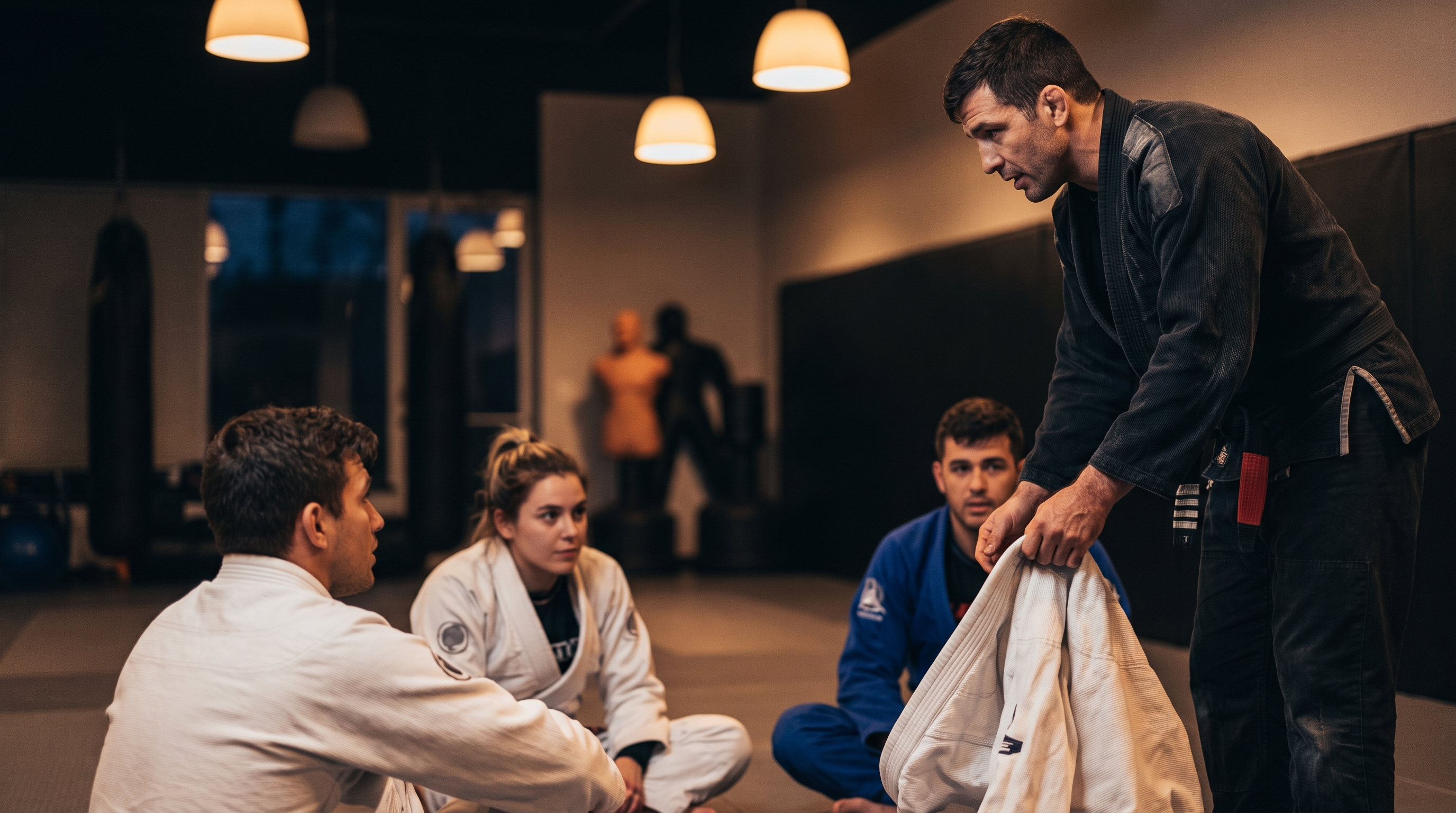
The Coach's Guide to Getting Students to Review Class: How Modern Academies Use Technique Apps
TL;DR. Most students forget the details of class within days, not because they're lazy but because they have no system to revise. As a coach, you don't need more mat time to fix this — you need a lightweight review workflow: post one anchor cue per class, ask students to save it as a technique card, and open the next session with a 3-minute recall. A tool like BJJ Memo turns any YouTube reference or your own posted clip into a revisable card, so students walk in already warm on last week's material.
You've had this conversation. You spent twenty minutes breaking down the underhook escape from side control on Monday. On Wednesday, a blue belt asks you the exact same question. Not because they weren't paying attention — they were. But between Monday's class and Wednesday's warm-up, life happened, and the details quietly evaporated.
This guide is for BJJ coaches and academy owners who want a simple, low-effort way to help students actually revise class. No new app your students have to be forced onto. No spreadsheets. Just a workflow — and one honest recommendation for the tool that fits it.
Key takeaways
- Retention is a coaching problem, not a student problem — if there's no review system, most of what you teach fades before the next class.
- A daily 5–15 minute review habit outperforms occasional long study sessions for technique recall.
- The most reliable class review workflow is: one anchor cue per lesson, one saved card per student, one recall drill at the start of the next class.
- The common failure pattern is coaches teaching too many details per class; the fix is picking one "must-remember" detail and reinforcing it everywhere.
- A technique app like BJJ Memo lets students turn any BJJ YouTube video (including clips you share) into a structured, searchable card they revise before training.
- You don't need to force adoption — model it, do a 60-second review at the top of class, and the habit spreads.
- Coaching software should support mat time, not replace it: real feedback still comes from you on the floor.
The coach's specific constraint: you teach live, but retention happens off the mat
A coach's problem isn't the same as a student's. Your students have to remember one game — theirs. You have to teach a curriculum to a rotating room of white, blue, and purple belts, most of whom will train two or three times that week and then sit at a desk for the other 100+ waking hours.
That off-the-mat time is where techniques die. You can't be there. You can't force a review session. And if you build something too heavy — mandatory notes, a private forum, a course platform — you become the librarian instead of the coach, and adoption craters.
The constraint is real:
- You have ~60–90 minutes with them per class.
- You can't drill anything into long-term memory in a single session.
- Whatever review system you build has to be almost invisible — measured in minutes, not homework.
- It has to work for the beginner who needs a survival cue and the competitor building a game.
Everything below is designed around that constraint. The goal is not to turn your students into scholars. It's to make sure the one thing you most wanted them to remember from Monday is still in their head on Wednesday.
Remember. You are not competing for your students' study time. You are competing with the fact that, by default, they will do zero structured review. Even a two-minute habit is a massive upgrade.
A daily 5–15 minute review structure students will actually do
The review system that works is the one your students don't have to think about. Here's the shape of it, from the student's side — this is what you're asking them to do:
The 5-minute version (minimum viable)
- Right after class (2 min): open their technique app, pull up the position you drilled, and either save a card from a reference video or add a short note to an existing card — "knee shield, thumb-down grip on the collar, hip escape before framing."
- Before the next class (3 min): open the card, read the cue, mentally walk through the sequence once.
That's it. Five minutes total. Most students can do it in the parking lot and on the couch the next day.
The 15-minute version (for the serious ones)
- After class (5 min): save or update the card, add the specific detail that clicked (or didn't).
- Mid-week (5 min): shadow-drill the move on a couch cushion or in front of a mirror, using the card as a cue.
- Before the next class (5 min): re-open the card, then also open one related card from the same position tree (side control escapes → mount escapes) to build a chain.
Both versions share the same skeleton: capture → cue → recall. You don't need more than that.
What you do as the coach
- End every class with a single anchor cue — one sentence, one detail, said out loud twice. "If you remember one thing: your top elbow lives on your ribs."
- Open the next class with a 60-second recall: "Last time — side control escape. What was the cue? Show me the grip."
- Reference the card, don't reinvent it: "If you saved this in your app, go back and look at step three."
That's the whole loop. It costs you two minutes of class time and gives your students a genuine chance to remember.
The common failure pattern (and how to fix it)
Almost every coach who tries to build a review culture runs into the same wall. It looks like this:
Failure pattern: you teach a rich, layered class — main technique, two variations, a common counter, and a follow-up. Students leave inspired. By Wednesday, they remember roughly one detail, and it's often not the one you cared most about.
The instinct is to blame retention. The real cause is upstream: too much per class to review. If you give someone six things to remember, they will save none of them, because saving all six feels like a chore. If you give them one, they'll save one.
The fix in three moves
- Pick a "must-remember" per class. Before you walk on the mat, decide: if my students only remember one thing from today, it's ______. Everything else is texture around that.
- Say it, drill it, repeat it, close with it. The must-remember appears at the intro, during positional sparring, and in your final huddle. Repetition inside class is what makes review outside class possible.
- Give it a card-friendly form. A single sentence. A single grip. A single foot position. Something a student can screenshot in their head. "Under-hook deep, thumb up, hip out first." That fits on one card. "Systematic knee-shield retention framework" does not.
Remember. The bottleneck isn't your students' memory. It's the number of items per class you're asking their memory to hold.
What to do about the students who don't review
Some won't. That's fine. Model the behavior, keep the 60-second recall at the top of class, and let peer pressure do the rest. When one student clearly walks in warm on last week's material and another doesn't, the second one will start asking what the first is doing. The culture spreads on its own if you seed it.
The one BJJ Memo feature that solves this: YouTube-to-technique-card capture
If you're going to recommend one tool to your students, it should do one thing exceptionally well: turn a video into a revisable card, fast, with no friction.
That's the core of BJJ Memo. A student pastes a BJJ YouTube URL — an instructional they liked, a competition breakdown, or a clip you shared in your group chat — and the app builds a structured technique card with the key steps, details, and tappable timestamps of the important visual moments. The card lives in a personal, searchable library organized by position, and there's a built-in review flow that surfaces cards before training.
Why this feature specifically fits a coach's workflow:
- It uses video your students already watch. No new content to produce. You can send them the same YouTube link you'd send anyway, and their end of the pipeline is one paste.
- It produces a card, not a bookmark. Bookmarks are graveyards. A structured card is something a student can actually re-read in three minutes before class.
- It's built around revision, not consumption. The review flow is the point. That's the exact behavior you're trying to install.
- It doesn't ask you to become a tech admin. Your students run it on their phones. You stay a coach.
You don't have to endorse it, host on it, or manage anything. You can simply say: "If you want to actually remember what we did today, save it in something like BJJ Memo before you go to bed."
For more on how retention works from the student side, see our guide to how to remember BJJ techniques and our breakdown of how to study BJJ instructionals on YouTube.
A sample 7-day plan for your academy's class review
Here's a full week you can hand to a student — or run as a coach-side rhythm across your class schedule. This assumes a typical hobbyist training two to three times per week.
| Day | Coach action | Student action | Time |
|---|---|---|---|
| Mon | Teach class. End with one anchor cue said twice. | Save a card for today's technique after class. Add the anchor cue. | 3 min |
| Tue | Rest day (or open mat). | 3-min card review before bed. Shadow-drill the grip on the couch. | 3–5 min |
| Wed | Open class with 60-sec recall of Monday's cue. Teach today's technique as a chain from Monday. | Update Monday's card with what worked in sparring. Save Wednesday's new card. | 5 min |
| Thu | Rest. | Open both cards. Compare the two positions in the same tree. | 5 min |
| Fri | Teach class. Anchor cue #3. Reference Monday and Wednesday explicitly. | Save Friday's card. Tag all three under the same position. | 5 min |
| Sat | Optional open mat — drill the week's chain. | Skim all three cards before showing up. | 3 min |
| Sun | Off. | 10-min review: read all three cards, mentally rehearse the chain once. | 10 min |
Total student time across the week: under 40 minutes. That is less than one round of hard sparring. And unlike sparring, it directly addresses the memory gap.
If you run a competition team, you can lengthen the Sunday session and add a Thursday video-study block — but the base rhythm above is enough to move the needle for a general class.
Remember. Consistency beats intensity. Three minutes every day is worth more than one two-hour "study session" every other week.
Frequently asked questions
How do I get students to actually use a review app without making it feel like homework?
Don't mandate it. Model it. Reference cards out loud in class ("if you saved this, look at the second timestamp — that's the detail"), and do the 60-second recall at the top of every session. Students who care about progress will adopt it on their own once they see the difference between showing up warm on last week's material and showing up cold.
Does a technique app replace taking notes by hand?
No — it replaces the notes that never got taken. Most students will not sit down and write a paragraph after class, but they will paste a link. A tool like BJJ Memo lowers the effort floor enough that review actually happens. Students who love handwritten notes should keep doing them; the app just catches everyone else.
What if I don't want my students watching random YouTube instructionals from other coaches?
Send your own links. You can share a curated YouTube playlist — or a link to a clip you filmed and uploaded — and your students save those into their app. The tool doesn't care whose video it is; it just structures whatever you point it at. You stay the source of truth for your curriculum.
How much class time should I actually spend on review?
Two to three minutes at the top is enough to change behavior. A 60-second cue recall ("what was Monday's detail?") plus a 60-second live demonstration of the move by a student, before the day's warm-up. If you have a longer class, you can extend it, but the point is consistency, not duration.
Will this actually help beginners, or just the serious competitors?
Beginners benefit the most, because they're the most overwhelmed. A white belt with three saved cards — one guard retention cue, one escape, one submission — has a survival kit. A purple belt building a game will use it differently, saving deeper detail per card. Same tool, different depth.
Do I need to build custom content or maintain anything as the coach?
No. That's the point. Your job stays the same: teach, coach, correct on the mat. The app runs on your students' phones. Your only lift is the 60-second recall at the start of class and picking a clear anchor cue at the end.
Wrap-up: make review the default, not the exception
You don't need a new curriculum. You don't need to become a tech company. You need three habits: one anchor cue per class, one saved card per student, one 60-second recall at the start of the next session. Do that for a month and your room will look different.
If you want to point students at a tool that fits this workflow, BJJ Memo turns any BJJ YouTube video — including clips you share — into a structured technique card they can revise in a few minutes before training. It's on iOS and Android. Send them there once, and let the review habit build itself.
For real feedback and safety, students should always train the technique at a legit academy with a qualified coach — the app helps them remember and revise, it doesn't replace mat time.
Last updated 2026-09-17.