The Coach's Guide: How to Get Your BJJ Students to Actually Review Class Material at Home
TL;DR. Most BJJ students forget class material by the next session because no one gave them a review system. As a coach, you don't need to record everything or build a curriculum PDF — you need a short, repeatable home-review habit your students can actually do. This guide gives you a 5-15 minute daily structure, the most common failure pattern (and the fix), and a 7-day sample plan you can hand to any student tomorrow.
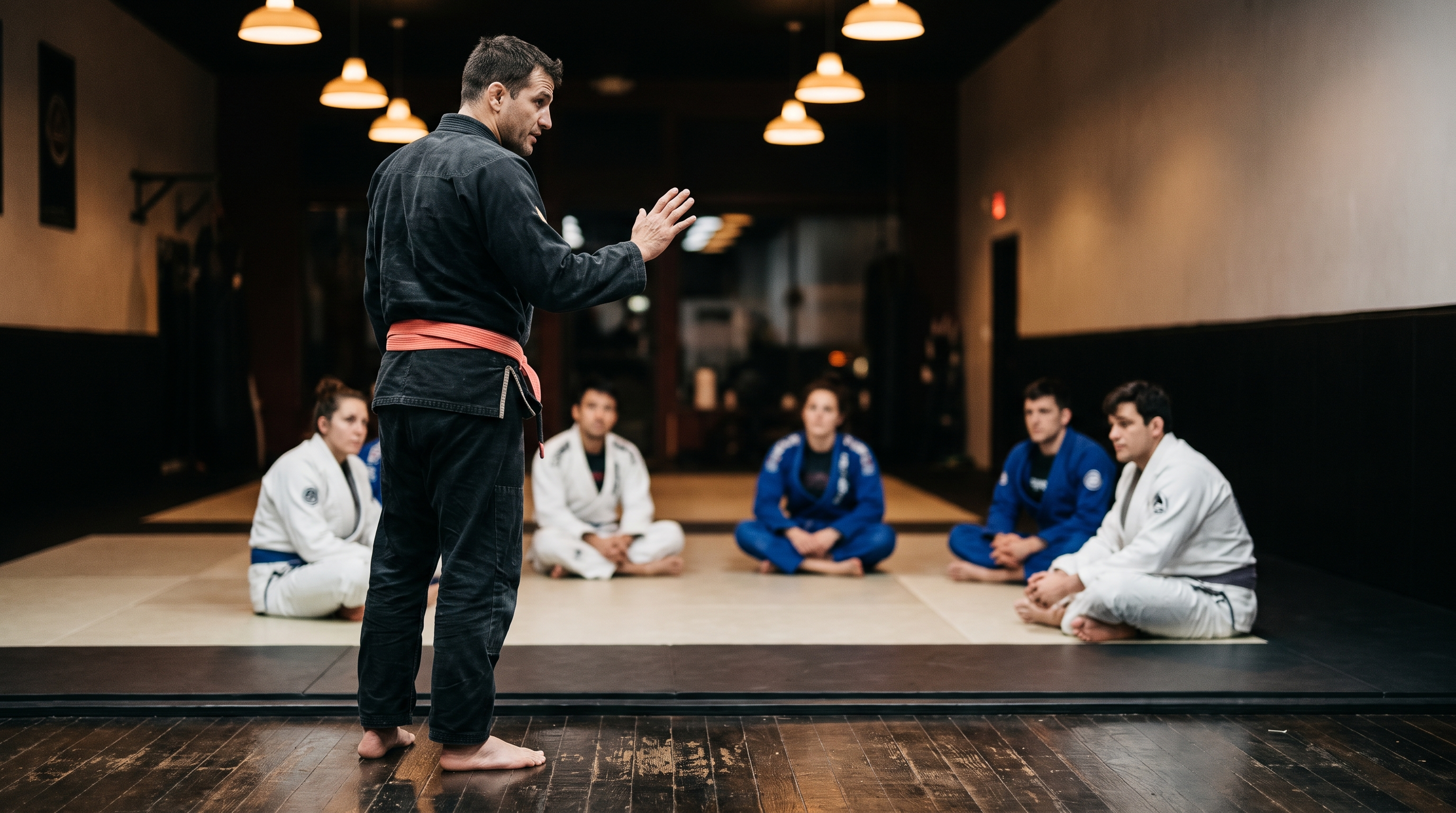
You've had this conversation more times than you can count. You teach a clean guard pass on Monday. Wednesday, half the room is doing it wrong. Friday, most of them can't remember what you taught. It's not that they weren't paying attention. It's that nobody ever showed them how to review.
This is a coach-facing guide. It's built around one specific constraint you have that a hobbyist doesn't: you can't force your students to study at home, and you can't afford to burn 20 minutes at the end of every class walking them through notes. Whatever system you use has to be short, honest about their motivation level, and self-sustaining once you set it up.
Key takeaways
- Students forget techniques not because they lack talent, but because there is no structured review between sessions.
- The most effective home-review window is 5-15 minutes, done the same day as class while the details are still fresh.
- A single end-of-class ritual (name the technique, one key detail, one common mistake) is the highest-leverage change most coaches can make.
- Students who try to review "everything" usually review nothing — cap it at one or two techniques per class.
- Written or card-based notes beat mental notes almost every time, because BJJ has too many small details to hold in working memory.
- Pairing class techniques with a matching YouTube instructional turns passive video-watching into targeted revision.
- Coaches don't need to build the system from scratch — pointing students to a lightweight tool like BJJ Memo removes the friction.
The coach's specific constraint: you can't do the reviewing for them
Every other article on retention is written for the student. This one isn't. You have a different problem.
You probably teach several classes a week, across mixed belt levels, with wildly different attendance patterns. Some students come three times a week and roll like they mean it. Others show up on a Tuesday, disappear for ten days, come back and ask you to "reshow that leg-drag thing." You are not going to fix that by handing everyone a 40-page curriculum binder — most of them won't open it.
What you can do is design a system that:
- Fits in under 15 minutes a day. If it takes longer, only your most obsessive students will use it.
- Runs on the student's phone, not your labor. You should not be the bottleneck.
- Requires almost nothing at the end of class. A minute of structured recap, tops.
- Works even if the student skips a few days. BJJ students are not full-time athletes. Assume inconsistency and design for it.
Everything below is built around those four constraints.
Remember. Your job isn't to force retention. It's to remove the friction that's stopping the students who want to remember from doing it. Most of them are trying — they just don't have a system.
The daily 5-15 minute home-review structure
Hand this to any student and it will outperform 90% of what they're doing now (which is usually "nothing" or "I'll re-watch the whole seminar someday"). It has three parts and it scales down to five minutes on a busy day.
1. Name and recall (1-2 minutes)
Same day as class, before bed, the student writes down — from memory — the technique(s) taught. Not the details yet. Just: "Knee-slice pass from combat base, right side." If they can't name it, that's the coaching signal you both needed. It means the technique never landed in the first place.
2. Detail dump (3-8 minutes)
They list the key details they remember. Grips. Angle. Weight distribution. What the training partner was doing to defend. What went wrong when they drilled it. Anything the coach specifically corrected. Bullet points, ugly notes, phone typos — none of that matters. Structure matters more than prose.
A reasonable format:
- Setup: where you start, how you engage.
- Steps: 3-5 numbered actions.
- Key detail: the one thing the coach kept repeating.
- Common mistake: what you (or your partner) got wrong.
- Follow-up: the next position or submission.
3. Visual anchor (2-5 minutes)
They find a short YouTube video showing the same technique — from any credible instructor — and watch two or three minutes of it. Not the full 45-minute seminar. Just enough to see the movement one more time so their memory of it is visual, not just verbal. This is the step almost every student skips, and it's the one that makes techniques actually stick.
| Time available | What to do | What to skip |
|---|---|---|
| 5 minutes | Name + rough detail dump | Video, formatting |
| 10 minutes | All three steps, quick pass | Deep video study |
| 15 minutes | All three steps + rewatch a specific instructional clip | Nothing |
That's the whole thing. It's short on purpose. A student who does this for even three of the four classes they attend in a month is dramatically ahead of one who did nothing.
The most common failure pattern (and how to fix it)
Here is the pattern you will see in almost every student who tries to build a review habit and quits within two weeks:
They try to capture the entire class. All four techniques. Every drill. Every detail from the warm-up flow. They spend 40 minutes on it the first night, feel proud, and then never do it again — because it was exhausting, and because the notes were so long they were useless to review later.
The fix is a one-line rule you can put on the wall of your academy:
Remember. One class = one technique reviewed. If you review one technique properly, you're winning. If you try to review four, you'll review zero next week.
When you introduce the system, tell them explicitly: "Pick the technique from tonight that you're most likely to actually use in a roll. That's the one you review. The others go into your general library, but you don't sweat them."
This single instruction — cap it at one — solves the biggest reason home-review systems collapse. It also happens to align with how BJJ actually gets absorbed: not by memorizing everything, but by owning a small, deliberate set of positions.
The second most common failure is more subtle: students write notes and then never re-read them. Notes without a revision loop are journaling, not learning. Your system has to have a moment where they pull the old note back up — ideally the day before or the morning of their next class. That's when the recall actually happens.
The one BJJ Memo feature that fixes this
We make an app called BJJ Memo that a lot of coaches point their students at. It does several things, but for this exact problem — students not reviewing class material — there is one feature that matters more than the rest:
Turning a YouTube video into a structured, timestamped Technique Card.
Here's why this is the fix for the failure pattern above. The reason students don't review is friction. Writing structured notes from memory is hard. Finding the right video, scrubbing through a 40-minute instructional to the 12-minute mark where the detail actually is, then trying to remember what your coach said — that's four separate tasks, and any one of them is enough to make a tired hobbyist skip the whole thing.
BJJ Memo collapses that into: paste a YouTube URL of the technique your coach taught tonight → the app generates a card with structured steps, key details, and tappable timestamps → save it to a personal library → the app surfaces it again before your next session. The student's job shrinks to finding a video that matches what was taught, which takes about a minute.
For you as a coach, this means you can literally say at the end of class: "Tonight's technique was the knee-slice pass from combat base. Go home, find any short video of it on YouTube, save it as a card, review it before Wednesday." That's a one-sentence homework assignment your students will actually do.
We are deliberately not claiming this replaces mat time or coaching. It doesn't. It replaces the forgetting between sessions, which is where most learning goes to die. For more on the retention side of things, see our guide on how to remember BJJ techniques and our breakdown of how to study BJJ instructionals effectively.
Remember. You are not asking your students to become academics. You are asking them to spend ten minutes on their couch turning tonight's class into a card they can look at again on Wednesday. That's it.
A sample 7-day plan you can hand to a student tomorrow
This assumes a student who trains three times a week (Mon / Wed / Fri) — the most common hobbyist schedule. Adjust freely.
| Day | Trained? | Home review (5-15 min) | What they should feel |
|---|---|---|---|
| Monday | Yes | Same evening: pick ONE technique from class. Name, detail dump, save a matching YouTube video as a card. | Tired but organized. Not overwhelmed. |
| Tuesday | No | 5 min: reopen Monday's card. Reread the steps. Watch the video clip once more. | Details from Monday are noticeably sharper. |
| Wednesday | Yes | Before class (2 min): glance at Monday's card. After class (10 min): repeat the Monday process for Wednesday's technique. | Walking into Wednesday's roll actually remembering Monday. |
| Thursday | No | 5 min: reopen Wednesday's card. Optional — reread Monday's if it's related. | Two techniques starting to feel like yours, not the coach's. |
| Friday | Yes | Before class (2 min): glance at both prior cards. After class: repeat for Friday's technique. | Class stops feeling like isolated events. Positions start connecting. |
| Saturday | Optional roll | 10 min: quickly review the week's three cards. Note which technique came up in a roll and how it went. | First honest sense of "I have a game." |
| Sunday | Rest | 5 min: skim the week. Pick the ONE technique to prioritize drilling next week. | Ready for Monday. |
Total time investment: roughly 45-60 minutes across the week. In exchange, three techniques get reviewed multiple times, connected to video, and actually retained.
If a student follows this for a single month, you will see the difference on the mat. They will hit techniques you taught two weeks ago. They will ask you deeper questions — about the why of details, not the what. That's the sign the system is working.
How to introduce this to your academy without it feeling like homework
Don't announce it as a curriculum change. Don't email a PDF. Do this instead:
- Add a 60-second end-of-class ritual. After the last drill, before rolling, gather the class and ask two students to name the technique and one key detail. That's it. This alone starts building the recall habit inside the class itself.
- Tell them the one-technique rule. Mention it casually two or three classes in a row: "Pick one thing from tonight and review it before you come back."
- Point them at a tool. Once the habit exists, tell them the tool that makes it easy. If you use BJJ Memo yourself, show them your own library for 30 seconds. Coaches modeling the behavior is worth more than any instruction.
- Follow up on the mat, not off it. In the next class, ask the students who bought in what they reviewed. Roll with them. When their reviewed technique shows up in a live roll, call it out. Positive reinforcement is the whole game.
You will not convert every student. You don't need to. If a third of your room builds a real review habit, the culture of the academy shifts on its own — the newer white belts will ask the reviewers what they're doing, and the system spreads without you having to sell it.
For deeper reading on the learning side, we've written about how to take notes in BJJ and why students forget techniques and how to fix it.
Frequently asked questions
How much should I be recapping techniques at the end of class?
A minute, maybe two. Name the technique, restate the one key detail, and name the most common mistake you saw during drilling. Any longer and students tune out. The point isn't to reteach — it's to give them a clean, memorable summary they can carry home and put in their notes.
Should I be filming my own classes for students to review?
Generally no, unless it's a private or a small competition-focused group. The overhead is high, video hosting is a hassle, and most students won't watch a 45-minute class recording anyway. It's more effective to point them at existing high-quality YouTube instructionals that cover the same technique, and let them turn those into structured notes.
What if my students already train at a school with its own curriculum?
Even better. A review system doesn't compete with a curriculum — it makes the curriculum stick. Whatever the technique of the day is, the same 5-15 minute home routine applies. Cards can even be organized by curriculum module so students can see their progress through the syllabus.
How do I get older, less tech-savvy students to use any of this?
Give them the paper-and-pen version. The three-step home review (name / details / rewatch) works fine with a physical notebook and any YouTube app. The digital tool is a convenience for people who want less friction, not a requirement. What matters is the habit, not the format.
Does reviewing at home replace drilling?
No, and don't sell it that way. Drilling builds the physical pattern; reviewing keeps the mental map of the technique clear so the next drilling session goes deeper instead of restarting from zero. Both are needed, and reviewing takes minutes while drilling takes hours — that's the whole reason to add it.
How long before I see a difference in my students?
Realistically, three to four weeks for the students who actually adopt the habit. You'll see it first in questions — they'll start asking about details, not just "can you show that again?" You'll see it next in rolling — techniques from prior weeks starting to appear in live sparring. That's the payoff.
Bringing it back to your mat
Student retention isn't a mystery and it isn't a talent gap. It's a systems gap. Your students are trying. They're just running on mental notes and hoping — and that has never been enough for a sport with this much detail. Give them a 15-minute-a-day structure, cap it at one technique per class, and remove the friction of turning video into notes.
If you want to point them at a tool that does the friction-removal for them, that's what we built BJJ Memo for — paste a YouTube URL, get a structured technique card, review it before the next session. It's on iOS and Android, and it's specifically designed so a tired hobbyist will actually use it after a hard class.
For real feedback and safety, students should train the technique with you at the academy — the app helps them remember and revise, it doesn't replace mat time or your coaching. That's the honest pitch, and it's the one your students will trust.
Last updated 2026-09-09.