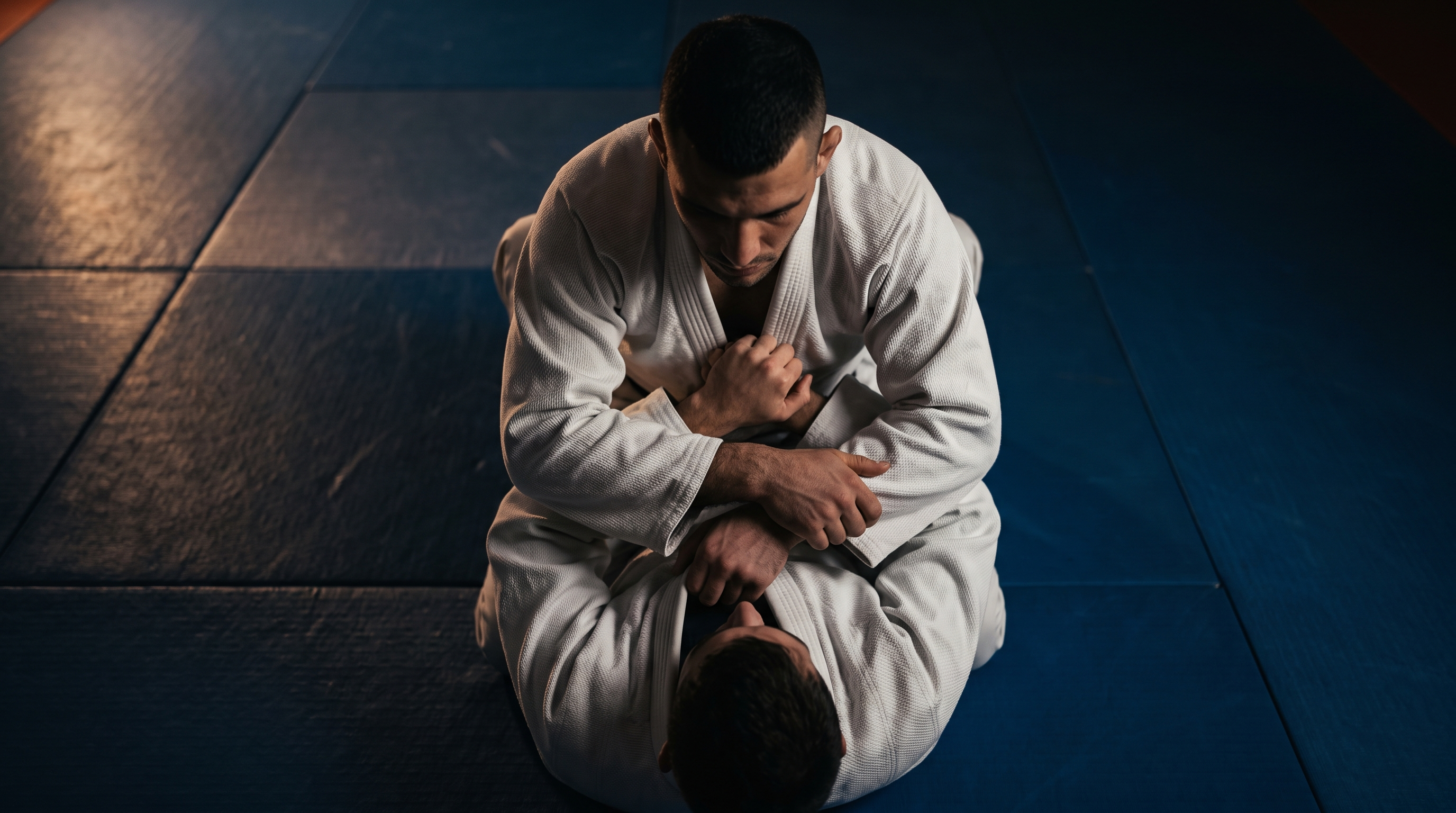
Cross Collar Choke from Mount: The Grip Sequence Most Beginners Get Backwards
TL;DR. The cross collar choke from mount fails for most beginners because they lead with the wrong hand and grip too shallow. The reliable sequence is: climb to a high, chest-on-chest mount, feed your dominant hand deep first (thumb inside the collar, fingers out is fine too — pick one and stay consistent), then thread the second hand across so both palms rotate toward the ceiling. The finish is not a bicep curl; it is elbows down, chest forward, and a small rotation that turns your fists into a scissor across the carotids. Get the grips right and the tap comes fast.
The cross collar choke from mount is usually the first submission you learn in a gi class, and it is often the first one you can't finish in live rolling. That is not because the technique is bad — it is because most beginners are taught the shape of the choke and not the sequence. You end up gripping in the wrong order, grabbing the collar too far down, and trying to muscle the finish with your biceps. Your training partners escape by turning, bridging, or simply waiting you out.
This guide fixes the three parts of the choke that get taught backwards or skipped entirely: the mount position itself, the grip order and depth, and the actual finishing mechanic. Read the whole thing, then drill the sequence on a compliant partner before you try to hunt for it live.
Why beginners get this choke backwards
There are three reasons the cross collar choke goes wrong for most white belts, and they compound.
First, the position is usually wrong. A low mount — where your hips are near your partner's belt line — gives you no leverage over the collar and lets the person under you bridge and roll. The cross collar choke lives in high mount, chest to chest, with your knees near their armpits.
Second, the grip order gets scrambled. Instructionals show the finished picture — both arms crossed, both hands deep in the collar — but not always which hand goes in first. If you feed the shallow hand first, your deep hand has nowhere to go, and you end up with a soft frame that doesn't cut into anything.
Third, the finish is misunderstood. The cross collar choke is not a squeezing motion. Your arms are already crossed and rigid; the pressure comes from your elbows dropping toward the mat and your chest driving forward, which pulls the collar tight against both carotid arteries at once. Trying to curl your fists toward your face is a common beginner mistake that produces zero pressure and telegraphs the choke.
Remember. A cross collar choke that doesn't work is almost always a grip problem, not a strength problem. Fix the hand order and the depth before you touch anything else.
A simple system: the 6-step grip sequence
Here is the sequence, in the order it should actually happen. Practice it slowly, without resistance, until the hand order becomes automatic.
- Climb to high mount. Start from a stable mount, then walk your knees up until they are pinned against your partner's armpits. Post a hand on the mat above their head to stop them from bridging you off. Your chest should be close to their chest.
- Break their posture and clear the arms. If their elbows are guarding their neck, you cannot get grips. Use your shoulder or a quick hand-fight to move one elbow across their body, then commit to the choke side.
- Feed the first (deep) hand. With your dominant hand, reach across and grip the far collar as deeply as you can — ideally behind the neck, palm up (thumb inside the collar). This is your power hand. If this grip is shallow, the choke will not finish.
- Thread the second hand under. Bring your second hand under the first arm and grip the opposite collar, palm up as well. Some coaches teach this hand palm-down; both work. What matters is that both hands are on the collars, not the shoulders.
- Set the frame. Bring both elbows in tight and rotate your wrists so your palms face you. Your forearms should form an X against the sides of their neck. There is no gap between your chest and your hands.
- Finish with structure, not strength. Drop both elbows toward the mat, drive your chest forward over your grips, and let your body weight do the work. Your head can go down toward theirs to add pressure. The tap usually comes in one to three seconds — if it doesn't, your first grip is too shallow.
Grip depth reference
| Grip location | Result |
|---|---|
| Shoulder / lapel edge | No choke, easy to escape |
| Halfway down the collar | Weak pressure, needs strength |
| Behind the neck, deep | Correct — carotid pressure both sides |
| Under the ear | Deepest, hardest to establish |
Common mistakes and how to fix them
These are the mistakes that show up over and over in beginner rolls. If your choke isn't working, one of these is almost certainly the reason.
- Riding too low on the mount. Your hips are down by their belt, so your grips are far from their neck and they can bridge you off. Fix: knees to armpits, chest to chest, before you reach for the collar.
- Grabbing the shoulder instead of the collar. A shoulder grip feels secure but produces no choke. Fix: slide your grip up the lapel until you feel the seam behind the neck.
- Wrong hand first. Feeding the shallow hand first blocks your power hand from getting deep. Fix: always deep hand first, then thread the second under.
- Elbows flared out. Wide elbows create a loose frame that pulls the collar across the throat instead of the sides of the neck — uncomfortable but not a choke. Fix: elbows tight, then drop them toward the floor.
- Curling the fists. Trying to bicep-curl the choke tells your partner exactly what you're doing and produces almost no pressure. Fix: freeze your arms, move your chest.
- Chasing the choke when they turn. If your partner turns to their side, the angle for the cross choke disappears. Fix: follow to S-mount or switch to an armbar attack; the collars are already yours.
- Ignoring the free hand. Their free hand will fight your first grip. Fix: post your head or shoulder to pin their arm before you feed the deep grip.
Remember. Two deep grips finish the choke. One deep grip and one shallow grip almost never do. If your first grip isn't behind the neck, reset it — do not try to rescue the sequence with the second hand.
Where BJJ Memo fits in
The cross collar choke is a technique you will drill dozens of times across your first year, and every good coach will layer new details onto it — a different first-hand orientation, a knee-slide detail, a way to trap the far arm. Those details are easy to lose between sessions.
BJJ Memo is a mobile app that lets you paste a BJJ YouTube URL — an instructional, a competition breakdown, a coach's clip — and turns it into a structured Technique Card with steps, key details, and tappable timestamps. You file it into a personal library and revise it before your next class. If you're building a submission game around the mount, saving a card for every cross-choke variation you see (and comparing them side-by-side) is one of the fastest ways to make the details stick. Learn more on the BJJ Memo blog.
Frequently asked questions
Is the cross collar choke a blood choke or an air choke?
Done correctly, it is a blood choke — the forearms and collar compress both carotid arteries on the sides of the neck, cutting blood flow to the brain. If it feels like a throat crush and your partner is coughing rather than tapping, your elbows are flared and the choke is sliding across the windpipe. Reset the grip and drop the elbows.
Can I do the cross collar choke without a gi?
No — this specific choke needs the collar. In no-gi, the equivalent attacks from mount are the arm triangle, the ezekiel with a wrist grab, or hand-fighting into an armbar. If you train mostly no-gi, the cross choke is still worth learning: it teaches you the mount pressure and posture you'll use for everything else.
How deep does my first grip need to be?
Far enough that your thumb (or fingers, depending on the variation you're taught) is behind the neck, not on the shoulder or the front of the collar. A useful test: if you can pull the collar and feel the fabric slide against the back of the neck, you are deep enough.
Why do I get bridged off when I try this choke?
Almost always because you sat up to reach for the deep grip. When you sit up, your weight leaves their chest and they can bridge and roll. Feed the deep grip with your chest still low, or post your head on the mat to keep pressure while your arm reaches.
What should I do if my partner defends by grabbing my sleeve?
That's a good sign — it means you have committed enough that they are worried. Use your free hand to strip the grip before you thread the second collar, or transition. Common transitions are the armbar (if their far arm is extended defending), the S-mount, or a step-over to take the back if they turn.
How long does it take to make this choke reliable?
Honestly, months of consistent drilling and live attempts. It's a technique you land more often as your mount pressure and hand-fighting improve, not because you finally learned a secret grip. Drill the sequence in every warm-up if you can, and try to attempt it at least once every roll from mount — even if it fails.
Final thought and a note on training
The cross collar choke rewards patience. Get the mount right, feed the deep hand first, thread the second under, and finish with structure. Once the hand order is automatic, the rest becomes about timing — spotting the moment their arms are out of position and committing before they recover.
For real feedback and safety, drill this technique at a legit academy with a qualified coach — a black belt watching you set the grips will fix things no article can. BJJ Memo helps you remember and revise between sessions; it doesn't replace mat time. Next time your coach shows a variation of this choke, save it as a Technique Card in BJJ Memo so it's still there when you need it three weeks later.
Last updated 2026-09-18.