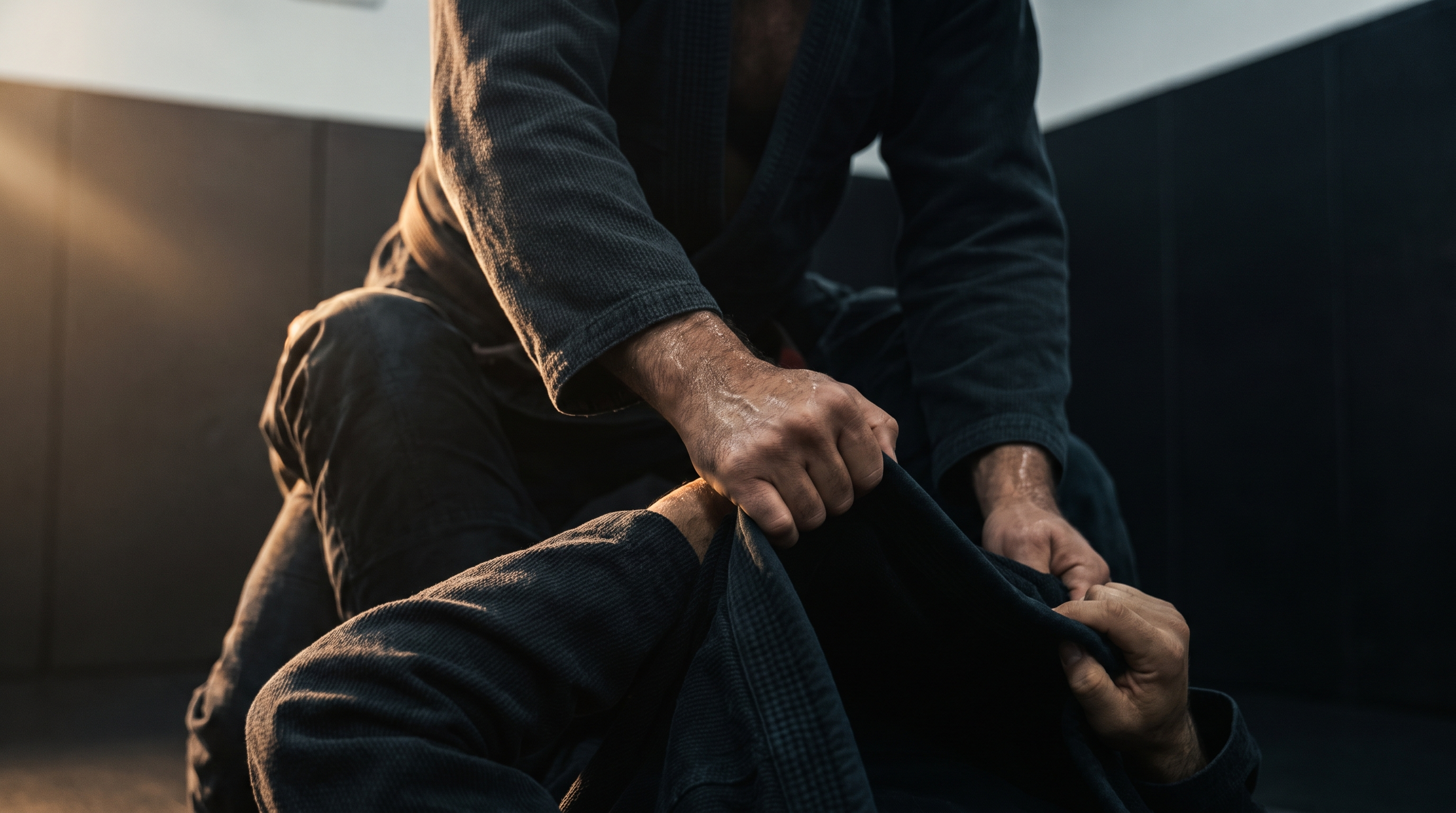
Cross Collar Choke from Mount: The Grip Order Beginners Get Wrong
TL;DR. The cross collar choke from mount fails for most beginners because they grab both collars at the same time, or lead with the shallow hand. The reliable order is: post, feed the deep hand thumb-in high behind the neck, then thread the second hand four-fingers-in on the opposite collar. Finish by pulling elbows to the mat, dropping your chest, and driving your head past their ear — not by yanking your hands apart.
The cross collar choke from mount is often the first real submission a gi practitioner learns, and it's usually the first one they stop hitting once training partners get slightly more experienced. The technique itself isn't the problem — it's a submission that's been finishing people since the very first jiu-jitsu academies opened. The problem is that almost every beginner learns the shape of the choke without learning the order of operations. You watch a black belt do it and see two hands go into the collar. You copy the picture. You get bumped, elbow-escaped, or stalled out on grip two.
This article breaks down why the grip order matters, gives you a simple step-by-step system to install it in your game, and walks through the common mistakes that quietly steal the submission from you.
Key takeaways
- Grip order matters more than grip strength: the deep hand goes first, thumb-in, high behind the neck near the far ear.
- The second hand is four-fingers-in on the opposite collar, threaded under the first arm — not on top of it.
- The choke tightens by pulling elbows down to the mat and dropping your chest, not by pulling your hands apart.
- A strong base in mount (knees wide, hips heavy, head forward) is a prerequisite.
- Bait a defensive frame or elbow escape to create the collar opening.
- The cross collar from mount is one of the safest, most technical submissions for beginners to learn early.
- Drill the grip sequence solo and with a compliant partner before hunting it live.
Why beginners miss this choke
When you watch someone finish the cross collar from mount, both hands are already deep in the collars. That final frame is what most people try to reproduce, and it's the wrong thing to copy. What you don't see is the two or three seconds before that frame — the base, the bait, the post, and the specific order in which those hands arrived.
Here are the real reasons the choke fails for white and blue belts:
- Both hands moving together. The moment you commit both hands to the collars, you have nothing posting on the mat and nothing controlling the frame. Your partner bridges, you post to catch yourself, both grips die.
- Shallow hand first. If your first grip is on the near collar with the pinky-in, you've told your partner what's coming. Their far arm has time to get in the way, and you can never get the deep grip because your first arm is blocking the lane.
- Steering-wheel finish. Beginners think the choke tightens by pulling the two hands apart across each other. It doesn't. That motion is weak, telegraphed, and easy to defend.
- Losing mount to hunt the grips. A high mount hunter with light hips gets bumped every time. The choke lives on top of a heavy, structured mount — not a floating one.
- No setup. In free rolling, opponents don't just leave their collar open. Without a bait — a fake armbar, a chest press, a hand-on-hip — the collar lane never appears.
Remember. You are not trying to reproduce the finish picture. You are trying to arrive at it in a specific order, from a specific base, against a specific reaction.
A simple system: the correct grip order
Use this sequence every single time. Do it slow in drilling. Speed comes free once the order is automatic.
1. Establish a heavy, wide mount
Before you touch a collar, check your base. Knees wide and pinched to their ribs. Hips low and heavy. Head forward, over their sternum, so a bridge sends you into a post-able direction, not off the top. If you have to fight for the mount, you're not ready to choke.
2. Post the far hand and open the collar lane
Bring one hand — the hand that will become your deep grip — up near their far shoulder. Use the other hand to lightly press their chest or trap a wrist. The goal is to make their far collar visible and reachable. A common way to open the lane is to threaten a light chest press or a shoulder pin so their near arm rises to frame — which pulls their collar tight and away from their neck.
3. Feed the deep hand: thumb-in, high behind the neck
This is the grip that everything hinges on. Your thumb goes inside their far collar, four fingers outside. Slide the grip as deep as you can, aiming behind the neck on the far side, roughly behind the far ear. If you can pull the collar tight to the near side of their neck as you feed, the finishing angle is already halfway there. This hand does the choking. Everything after this is just closing the scissors.
4. Post before the second grip
Most people rush here. Before your second hand moves, make sure your first elbow is heavy and your head is forward. A common trick: press your first-grip elbow down toward the mat on their far shoulder. This kills their bridge and buys you the time to thread the next hand.
5. Thread the second hand: four fingers in, under the first arm
The second hand goes into the near collar (the collar on the same side as your first arm's shoulder). Four fingers inside the collar, thumb outside. Crucially, this hand threads underneath the first arm, not on top of it. Under-threading is what makes the choke tight; over-threading gives you a loose, awkward grip that never finishes.
6. Kill the space: elbows to the mat, chest down
This is the mechanic that actually chokes. Do not pull your hands apart. Instead:
- Pull both elbows down toward the mat, as if you were trying to touch your elbows to the floor on either side of their head.
- Drop your chest onto your own fists.
- Drive your head forward past their ear on the deep-grip side.
The collar edges are now cutting into the carotids on both sides. The tap comes fast.
7. Finish or transition — don't stall
If they defend well by turning in, ride the turn: the choke often finishes even better as they roll to their side, because the far collar tightens further. If they buck hard, the same grips set up an armbar or a mounted triangle. Never abandon deep gi grips for nothing.
Remember. Deep hand first, thumb-in, high behind the neck. Post. Then thread the second hand four-fingers-in under the first arm. Elbows to the mat.
Grip-order cheat sheet
| Step | Hand | Grip type | Where it goes |
|---|---|---|---|
| 1 | Deep hand | Thumb inside collar | Behind the neck, near far ear |
| 2 | Support hand | Palm on chest or wrist | Kill their frame, open the lane |
| 3 | Second hand | Four fingers inside collar | Near collar, threaded under first arm |
| 4 | Both | Pull elbows to mat, drop chest | Chest presses onto own fists |
Common mistakes and how to fix them
Mistake: grabbing both collars simultaneously
Fix: Slow down. Say the order out loud in drilling: "deep, post, thread." You want the first grip so deep and so tight that even if the second grip never comes, you can still transition to another attack.
Mistake: leading with the shallow (four-fingers-in) hand
Fix: The choking hand is always the thumb-in hand, and it always goes first. If you lead shallow, you block your own lane. Retrain the motor pattern in solo shadow drills — literally mime the thumb-in grip first, every rep.
Mistake: threading the second hand over the top
Fix: Look at your arms after gripping. If they form an "X" with the deep arm on the bottom, you're right. If the deep arm is on top, the choke is loose and the finishing angle disappears. Re-thread.
Mistake: pulling hands apart to finish
Fix: Cue yourself with "elbows down, chest down." Better yet, imagine trying to put both elbows on the mat on either side of your partner's head. The choke tightens automatically.
Mistake: getting swept while setting the grips
Fix: You're floating in mount. Widen the knees, drop the hips, put your forehead near theirs during grip two. If they can bridge you off, your base was wrong, not your choke.
Mistake: hunting the choke from a passive mount
Fix: Bait a reaction. Light pressure on the chest, a fake armbar step, or a shoulder pin usually pulls a frame — and a frame pulls the collar tight. A passive top game rarely finds the collar lane.
Where BJJ Memo fits in
Most of what breaks the cross collar isn't strength — it's forgetting the order under fatigue. That's exactly the gap BJJ Memo is built to close. When you watch a technique breakdown on YouTube, you can save it into BJJ Memo and it becomes a structured technique card with tappable timestamps for the grip, the post, the thread, and the finish. Before your next class, you scroll your library, revise the three key details, and step onto the mat with the sequence already loaded. Learn more about how to remember BJJ techniques and how to study instructionals effectively on the blog.
Frequently asked questions
Is the cross collar choke from mount safe for beginners to drill?
Yes — it's one of the safest submissions in the gi curriculum when applied slowly and with a controlled tap-out. It's a blood choke, not a crank, so there's no torque on joints. Always release immediately on the tap, and drill with partners who tap early while you're learning.
Which hand should go in first, palm-up or palm-down?
The deep hand goes in thumb-in — meaning your thumb is inside the collar and your four fingers are on the outside. That's the hand that finishes the choke. The second, shallow hand goes in four-fingers-in, thumb outside.
Can I do the cross collar choke without a gi?
No — this specific choke requires the lapels of the gi. In no-gi, the equivalent conceptual submissions are things like the arm-in guillotine or the mounted ezekiel-style attacks with the arm, but they use different mechanics.
Why do I keep getting bumped off before I finish?
Almost always a base issue. Knees too narrow, hips too high, head too far back. If your mount can be bridged, your choke will never land. Fix the mount first, then hunt grips.
How do I set it up in live rolling when nobody leaves their collar open?
Use a bait. A light chest press, a wrist trap, or a fake step to S-mount usually causes the bottom player to frame — and framing exposes the collar. You're not looking for an open collar; you're looking for a reaction that opens one.
How long does it take to feel comfortable finishing this in rolling?
Honestly, it varies. Most beginners can drill the grip sequence cleanly within a few sessions. Finishing on resisting training partners takes longer because it requires reading reactions in real time. Consistent drilling and revising the details between classes speeds it up considerably.
Train it, revise it, then trust it
The cross collar choke from mount is one of the highest-percentage beginner submissions once you install the grip order and stop trying to force a steering-wheel finish. Drill the sequence slow. Say it out loud. Get honest feedback from a qualified coach at a legitimate academy — no article replaces mat time and a black belt watching your grips.
Between sessions, save the instructionals you're studying into BJJ Memo so the grip order is one tap away before class. Turn what you watch into something you can actually use on the mat.
Last updated 2026-09-27.