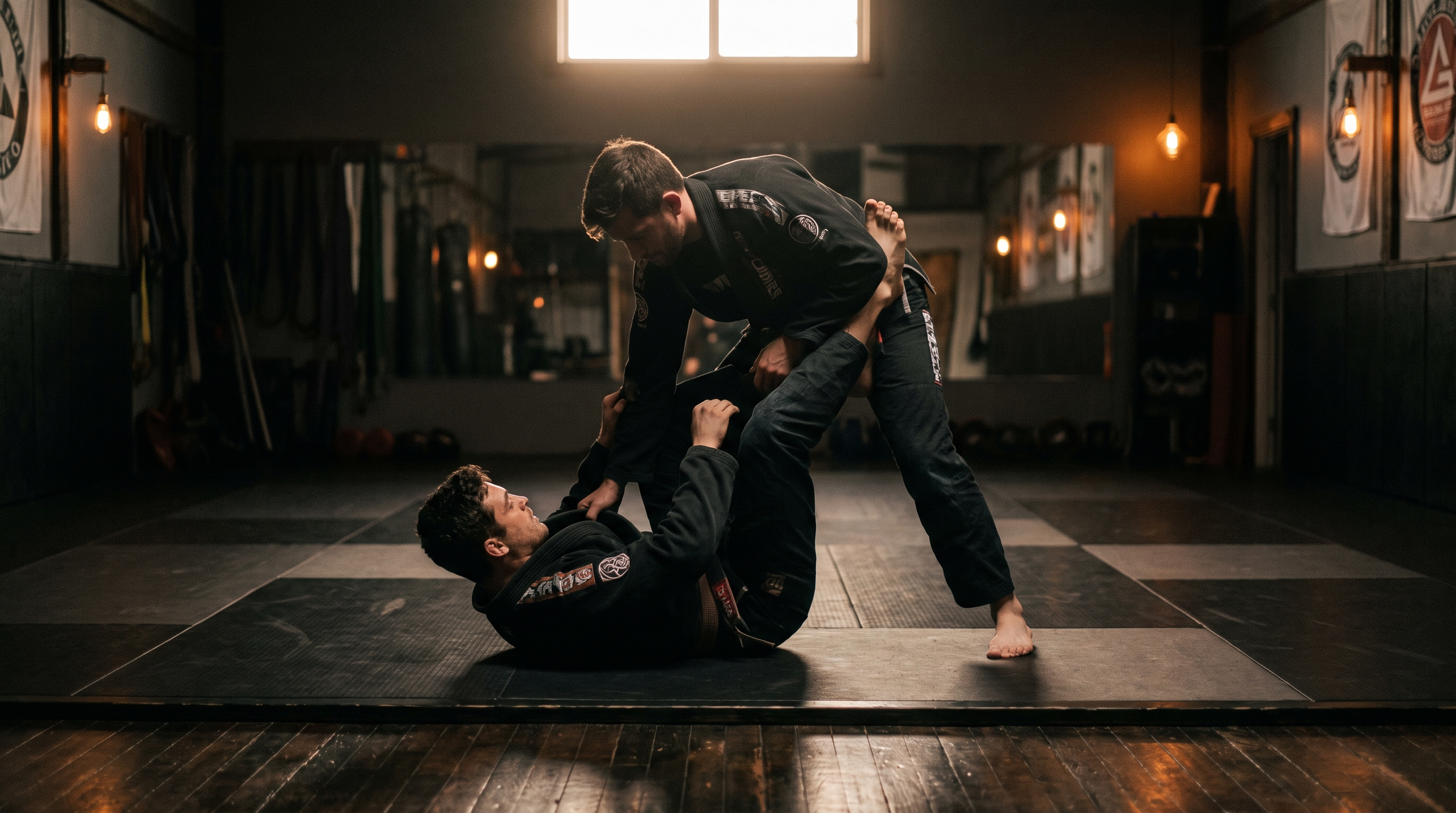
De La Riva Guard for Beginners: The Hook, the Grip Fight, and Your First Two Sweeps
TL;DR. De La Riva (DLR) is an open guard where your outside leg hooks behind your opponent's lead leg while your other foot manages their hip or biceps. The position lives or dies on three things: a deep hook behind the knee, a strong grip on the same-side sleeve or ankle, and constant off-balancing. Learn the hook, win the grip fight, and drill two beginner-friendly sweeps — the back-take off the DLR hook and the tomahawk (kiss-of-the-dragon) sweep — and you have a real open guard game.
De La Riva guard is one of those positions white belts see everywhere in competition footage and instructionals, then completely fail to play in live rounds. It looks like a tangle of legs and grips, and the entries feel awkward if nobody has broken them down for you. This guide is the beginner's version — no invisible details assumed. You'll learn what the DLR hook actually is, how to win the same-side grip fight, how to keep from getting your guard passed while you're setting up, and two sweeps that work at the white and blue belt level. If you train two or three times a week, you can drill this system in a couple of sessions and start using it in rolls next week.
Why this happens: what De La Riva actually is
De La Riva is an open guard named after Ricardo de la Riva, a Brazilian black belt who built a whole game around one specific hook: your outside foot wraps around the front of your opponent's lead leg and hooks behind their knee, with your toes pointed and your shin controlling the outside of their thigh. Your free leg — the inside one — either posts on their hip, their biceps, or their far knee to manage distance.
What makes DLR work is a combination of three things:
- The hook disrupts their base on one side.
- The grip (usually same-side sleeve or ankle) lets you pull them toward the hooked leg.
- The free leg frames or pushes to control the direction they can move.
When all three are working together, your opponent has almost nowhere to go. If they step back, you follow. If they posture up, they fall backward. If they try to pass, the hook drags their leg out of alignment. That's why it shows up so often at the highest levels — it's a control position that constantly threatens sweeps and back-takes.
But here's the beginner reality: most white belts try to "play DLR" by wrapping the leg and lying on their back. That's not DLR — that's a bad open guard with an extra leg in the way. The position only works when you're on your side, hip off the mat, actively fighting for grips.
Remember. DLR is a side-lying, active position. If your shoulder blades are flat on the mat, you're not in De La Riva — you're in the process of getting your guard passed.
A simple system: seven steps from entry to sweep
Here's the system to drill. Do these in order every rep until they become one motion.
1. Get to open guard
Start from closed guard or seated guard. Open your knees, bring your feet to your opponent's hips, and let them stand up (or stand them up by pushing with your feet). You need them upright and posted on both feet for DLR to make sense.
2. Insert the hook
As they stand, pick a leg — usually the leg on your strong side. Bring your same-side foot around the outside of their lead leg, and hook behind their knee. Your shin should be against the outside of their thigh, your instep pulling their knee toward you. Point your toes. A flexed foot slips off; pointed toes lock the hook in.
3. Frame with the free leg
Your other foot goes on their opposite hip, on their biceps (same side as the hook), or on their far knee. This is what stops them from stepping through and passing. Pick one for now — same-side biceps is the most versatile for beginners.
4. Win the grip fight
With the hand on the hooked-leg side, grab their same-side sleeve at the wrist (in gi) or their same-side ankle (in no-gi). This is your "anchor" grip — it's what pulls them off balance in the direction of the hook. Your other hand can control their collar, their far sleeve, or post on the mat.
5. Get on your side
Roll onto the hip on the hooked-leg side. Your bottom shoulder should come off the mat. This single detail separates a real DLR from a bad flat guard. From your side, you can extend the hook, load their weight, and threaten the sweep.
6. Off-balance before you sweep
Before committing, test their base. Pull the sleeve grip toward your hip. Extend the hook to push their knee away. Feel where they're weak — most opponents will either post their far hand down (setting up the back-take) or posture up hard (setting up the tomahawk). You are not guessing which sweep to hit; their reaction tells you.
7. Finish with the right sweep
Based on their reaction, hit one of the two sweeps below.
The DLR system at a glance
| Element | Where it goes | Common beginner mistake |
|---|---|---|
| Outside hook | Behind their lead knee, toes pointed | Hook too low on the calf, foot flexed |
| Free leg | Same-side biceps or opposite hip | Leg dangling, no frame |
| Anchor grip | Same-side sleeve (gi) or ankle (no-gi) | Cross-gripping and losing the pull |
| Body position | On the hooked-leg side hip | Lying flat on back |
| Head | Slightly off the mat, chin tucked | Head glued to floor |
Sweep #1: The back-take when they post
When you pull the sleeve grip and extend the hook, most opponents instinctively post their far hand on the mat to catch their balance. This is your invitation to take the back. Release the biceps frame, pass their posting arm across your body with your free hand, and use the DLR hook to scoot your hips under them. As they collapse forward, come up on the far side and take the back with both hooks in. This is the highest-percentage entry to back control from any open guard.
Sweep #2: The tomahawk (kiss-of-the-dragon) sweep when they posture
When they instead posture up tall and try to break your grip, use their upright momentum against them. Keep the sleeve grip, kick the DLR hook up hard, and roll toward your hooked-leg side, tucking your head. Their leg gets swept out from under them and they cartwheel over the top. You end up in top position, often facing their back. It looks flashy — it's actually simple mechanics: their base is on one leg, you sweep that leg, they fall.
Remember. You don't pick the sweep — the opponent picks it. Your job is to threaten, feel the reaction, and finish whichever one they gave you.
Common mistakes and how to fix them
Even with the right steps, most beginners lose the position for the same handful of reasons. Fix these and your DLR gets dramatically better without learning anything new.
Lying flat on your back. The single biggest one. If you're flat, they can drive their weight down, kill the hook, and start their pass. Fix: from the moment the hook goes in, roll onto the hip on the hooked-leg side and stay there.
Weak or shallow hook. If your hook is on their calf or ankle instead of behind their knee, you have no leverage. Fix: crawl the hook up until your shin is high on their thigh, then point your toes.
No grip, or the wrong grip. DLR without a grip is just a leg. Cross-gripping (grabbing the opposite sleeve) makes off-balancing hard. Fix: same-side sleeve or same-side ankle first. Add secondary grips later.
Free leg doing nothing. If your inside leg is just floating, they will step over it and pass. Fix: plant it — on the hip, biceps, or far knee — and use it as an active frame.
Rushing the sweep. Most white belts try to sweep before they've off-balanced. The opponent is still square and heavy, so nothing moves. Fix: pull, extend, feel the reaction, then commit.
Head glued to the mat. Keeping your head down flattens you out. Fix: pick your chin up slightly. It engages your core and helps you stay on your side.
Trying to memorize instead of drill. Reading five DLR articles doesn't build a hook. Ten focused reps of the entry with a compliant partner does.
Where BJJ Memo fits in
Open guard systems have a lot of small details — hook depth, toe position, grip choice, frame placement, and reactions to each opponent response. It's exactly the kind of material you understand in class, then completely forget by the next session. This is where a technique-capture habit changes your learning curve. When you find a De La Riva breakdown you like on YouTube, save it as a technique card in BJJ Memo so the steps, the details, and the timestamps are one tap away before your next open mat. Build a small library of your DLR entries and sweeps, revise them the morning before you train, and the position stops feeling like a maze. See our guide to studying instructionals effectively for how to break down a technique video without losing the important cues.
Frequently asked questions
What is the De La Riva guard, in one sentence?
It's an open guard where your outside foot hooks behind your opponent's lead knee while your other foot frames on their hip, biceps, or far knee, allowing you to off-balance, sweep, or take the back.
Is De La Riva only for gi, or does it work in no-gi too?
Both. In gi, the standard anchor grip is the same-side sleeve. In no-gi, you grip the same-side ankle or the back of the knee. The mechanics of the hook, the frame, and the sweeps are identical — only the grip changes.
Should white belts learn De La Riva or stick to closed guard?
Learn closed guard first for control, then add DLR as your first real open guard. DLR teaches the fundamentals every open guard shares — hooks, frames, off-balancing, grip fighting — so it transfers well as you branch into other guards later.
What's the difference between De La Riva and reverse De La Riva?
De La Riva hooks the outside of your opponent's lead leg. Reverse De La Riva (RDLR) hooks the inside of their leg with your foot behind their far leg. Different position, different sweeps. Learn standard DLR solidly before touching RDLR.
How do I stop getting my guard passed while trying to enter DLR?
Get your frames in before you commit to the hook. Foot on the hip, foot on the biceps — those come first. Then insert the DLR hook. If your frames are strong, you buy the time to build the position instead of getting smashed.
How long does it take to feel comfortable in De La Riva?
With focused drilling — the entry, the hook, and one sweep at a time — most people feel functional in DLR within a few weeks. Feeling truly comfortable in live rolling takes longer because it requires reading opponents. Consistent revision between sessions speeds this up significantly.
Take it to the mat
Pick one training session this week. Warm up, then drill the entry (steps 1–5) fifteen times with a compliant partner. Add the back-take sweep for another ten reps. Next session, add the tomahawk. By the end of the week you'll have functional De La Riva — not fancy, not comp-ready, but real.
Next time you watch a De La Riva instructional, save it as a technique card in BJJ Memo so the details are there before your next open mat. Build your own open guard library and revise before training — BJJ Memo on iOS and Android.
Teacher disclaimer. BJJ Memo helps you remember and revise techniques — it doesn't replace mat time or coaching. For real feedback on your hook depth, grip fight, and sweep timing, drill this at a legit academy with a qualified black belt. Get their eyes on the position before you take it into hard sparring.
Last updated 2026-08-28.