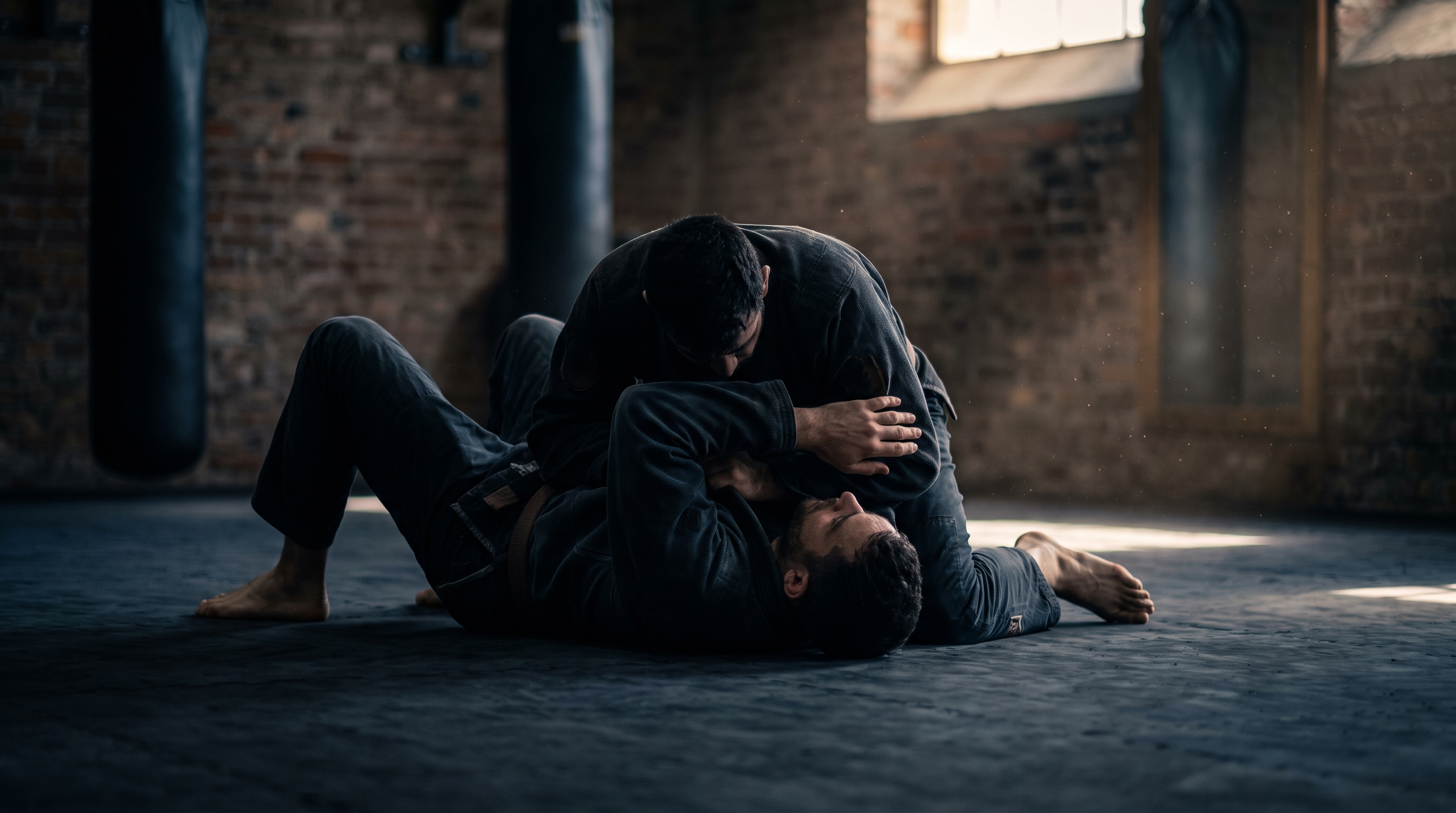
How to Escape Full Mount Without Bridging Yourself Exhausted: A Smarter Framework for White Belts
TL;DR. Most white belts try to escape mount by bridging as hard as possible until their arms shake and their lungs quit. That is not a system, it is a panic reflex. A working mount escape is a small decision tree: protect your neck, connect your elbows to your knees to kill their base, then choose the upa (bridge and roll) when your partner posts high, or the elbow escape (shrimp to guard) when they ride low and heavy. Train the choice, not just the technique, and mount stops feeling like a death sentence.
If you've been training Brazilian Jiu-Jitsu for less than a year, mount probably feels like the worst place on the mat. You bridge, you buck, you strain, and thirty seconds later a heavier training partner is still sitting on your sternum while you gasp at the ceiling. The problem is almost never that you don't know the techniques. It's that you're running one escape at full intensity and hoping something breaks. This article gives you a repeatable, low-gas framework: what to check first, which of the two core escapes to choose, and the specific mistakes that quietly cost you every roll. It's written for white and new blue belts who train two to four times a week and want to stop being a floor mat under mount.
Why this happens (and why you're so tired)
Under mount, gravity is doing all the work for your partner and none of it for you. Every time you bridge, you're lifting their entire bodyweight off the ground while your own hips are pinned. If your training partner is even a little heavier than you and knows how to base out with their hands and knees, one all-out bridge burns a huge chunk of your anaerobic gas tank. Do that three or four times in a row and your arms feel like rubber — not because you're unfit, but because you picked a fight with physics.
The second problem is decision-making. Most beginners have been shown both the upa (bridge and roll) and the elbow escape, but nobody ever told them which one to use when. So under pressure they default to whichever one they learned most recently, force it into the wrong position, and get punished. Escaping mount well is less about strength and more about reading two or three cues from your partner and matching the response.
The third problem is panic breathing. When someone's weight is on your chest, your first instinct is to hold your breath and grunt. That spikes your heart rate, tightens your shoulders, and makes every movement heavier. Learning to exhale slowly under mount — even for one or two seconds between attempts — is a genuine, unglamorous skill.
Remember. You do not need to escape immediately. You need to survive, gather information, and escape on the second or third attempt when you've felt where their weight is committed.
A simple system: the 5-step mount escape framework
This is the sequence to run every single time you find yourself flattened out under mount. Do it in order. Do not skip step 1 to rush to step 4.
1. Protect your neck and hide your arms
Before you do anything else, tuck your chin, bring both hands to your collar or the sides of your neck (elbows tight), and eliminate any straight arm they could isolate. Most submissions from mount — collar chokes, arm triangles, americanas, straight armbars — need either exposed neck or extended arms. Take those away and your partner has to reposition, which buys you time and information.
2. Connect elbows to knees and shrimp your hips slightly
Bring your elbows down toward your hip bones and pull your knees up toward your elbows. This does two things: it shortens your torso so they can't ride high on your chest, and it forces their weight forward. If you can bump your hips an inch or two to one side while doing this, even better — you've already started the elbow escape without them realizing.
3. Read where their weight is
This is the step almost every white belt skips. Before you commit to an escape, feel where their hands and hips are.
- Are their hands posted high (grabbing your collar, reaching for your neck, or based out above your shoulders)? → Their base is forward. Go to step 4: upa.
- Are their hands low (on your belt, hips, or based out by your ribs) and their hips heavy on your belly? → Their base is back and wide. Go to step 5: elbow escape.
Mount escape choice cheat sheet:
| Their weight / hand position | Best escape | Why it works |
|---|---|---|
| Hands posted high, leaning forward | Upa (bridge and roll) | Their weight is already tipping over your head — you just help it |
| Hands low, hips heavy, sitting upright | Elbow escape (shrimp to guard) | You can't roll a low, wide base; you have to sneak your knee back in |
| Attempting a collar choke | Trap the choking arm, then upa to that side | Their arm is committed and can't post — perfect for a roll |
| Grapevining your legs, chest-to-chest | Break the grapevines first, then reassess | Neither escape works clean until you free your legs |
4. The upa (bridge and roll) — done correctly
When they post high or reach for a choke:
- Trap the arm on the side you want to roll — overhook it with your same-side arm, pin their wrist to your chest with both hands. No trap, no roll.
- Trap the leg on the same side by stepping your same-side foot over their foot, hooking your instep behind their heel. Their arm and their leg on one side are now dead posts.
- Plant your other foot flat, close to your butt.
- Bridge up and slightly over the trapped shoulder — not straight up. Think of driving your hip toward the ceiling and your shoulder toward the mat on the trapped side.
- Land in their closed guard. Post up, break their posture, and breathe.
The upa fails almost every time because people either don't trap the leg or bridge straight up instead of over the trapped side.
5. The elbow escape (knee-to-elbow shrimp to guard)
When they sit heavy with a low base:
- Bump your hips straight up once — small, sharp, not a full bridge — to create a sliver of space between their hips and yours.
- As you land, shrimp your hips to one side (say, your right), turning slightly onto your right side.
- Slide your right knee in between their body and your own hip. Your right elbow stays glued to your right knee — no gap for them to re-mount.
- If you got the whole knee through, you're in half guard on that side. Frame on their hip, get to your side, and rebuild.
- If only a little space appeared, repeat the shrimp on the same side or switch to the other side. Two or three patient shrimps beat one desperate one.
6. Reset, breathe, repeat
If the escape didn't finish, don't spiral into panic bridges. Go back to step 1 (neck safe, elbows in), exhale, and re-read their weight. Most successful mount escapes in real rolls are the second attempt, not the first.
7. Prevent the remount
Even a clean escape is wasted if they immediately remount you. As you land in guard or half guard, get an underhook or a strong frame on their far hip before you try to sit up or sweep. Escape and then secure the position.
Remember. One patient upa beats five panic bridges. Your goal per attempt is to spend about half the energy you're spending now.
Common mistakes that keep you stuck under mount
These are the recurring errors that turn a workable escape into a gas leak.
- Straight-arm pushing on their hips or chest. This is a free armbar for anyone who knows what they're doing. Keep your elbows bent and tight.
- Bridging without trapping. A bridge with no arm-and-leg trap is just a hip thrust. They post a hand and ride it out.
- Turning to your knees. Turning belly-down under mount hands them your back. Do not do this unless you are actively finishing an escape you already committed to.
- Only ever attempting the upa. Higher belts learn to sit low and wide the moment they feel you loading up a bridge, which kills the upa. If you have no plan B, you have no escape.
- Only ever attempting the elbow escape. If they're already posted high and hunting a choke, shrimping just delays the submission. Match the escape to the position.
- Holding your breath. Panic breathing burns oxygen without delivering any. Practice slow nasal exhales even under pressure — it is a trainable skill.
- Not drilling the escape from a real, live start. Escapes drilled from perfect setups don't transfer. Ask a partner to actually pin you and hunt submissions, then work through the framework at 50–60% resistance.
Where BJJ Memo fits in
Here is the honest truth: reading this article once will not make you escape mount tomorrow. You will forget half the cues by your next session. That gap between watching / reading and remembering on the mat is exactly why we built BJJ Memo. Paste a mount escape video from YouTube — an upa breakdown, an elbow escape detail from your favorite instructor — and the app turns it into a structured Technique Card with the steps and key details, filed into your personal library. Before class, you flick through the card, see the cues ("trap arm, trap leg, bridge over"), and walk onto the mat with the details fresh. It is a retention tool for the learning you're already doing, not a replacement for a coach.
If you're building a mount defense game, start a folder in your library for "bottom mount" and add every solid video you watch this month. Revising three cards for two minutes before training will do more for you than passively rewatching an hour of instructional.
Frequently asked questions
Why can't I escape mount even though I know the techniques?
Almost always because you are running one technique at full effort instead of choosing between two based on your partner's weight and hand position. Learn the decision — high hands → upa, low hands → elbow escape — and your success rate jumps without any new physical skill.
Is the upa or the elbow escape better for beginners?
Neither is universally better; they solve different problems. The upa handles a partner who leans or reaches forward. The elbow escape handles a partner who sits heavy with a wide, low base. A complete white belt game has both, plus the ability to switch mid-attempt.
How do I stop getting so tired under mount?
Three fixes: keep your elbows tight and knees high so you're not lifting their full weight, exhale slowly between attempts instead of holding your breath, and stop throwing max-effort bridges. Aim for controlled, well-timed attempts rather than continuous struggle.
What if my training partner is much heavier than me?
Size amplifies every mistake, so technique matters more, not less. Focus even harder on connecting elbows to knees to prevent them from riding high, and prioritize the elbow escape — shrimping requires less raw power than bridging a much heavier person off you.
How long until mount escapes actually work in live rolling?
Expect months of losing the exchange against more experienced partners while your reads and timing sharpen. That is normal. Treat each pin as data — what did they do, what did I miss — and the frequency of successful escapes will climb steadily over your first year.
Should I tap early or fight to escape under mount?
Always tap early to any legitimate submission — chokes and joint locks are not the moment to prove toughness. Escape work happens in the positional phase, before they've locked in the finish. Learning that difference is one of the most important white-belt skills.
Train it, capture it, revise it
Mount escapes are a lifetime skill — the framework in this article is the starting point, not the finish line. Watch instructionals from coaches you trust, drill the two core escapes at your academy with a resisting partner, and get real feedback from a black belt whenever you can. For real technical corrections and safety, train at a legitimate academy with a qualified coach — BJJ Memo helps you remember and revise what you learn, it doesn't replace mat time. If you want your future self to actually remember the details from every mount escape video you watch, save them as technique cards in BJJ Memo and flick through them before your next session. Build the library once, revise for two minutes before class, and stop losing the same escape twice.
Related reading on the BJJ Memo blog: guard retention basics, how to remember BJJ techniques, and how to study a YouTube instructional without wasting the hour.
Last updated 2026-09-04.