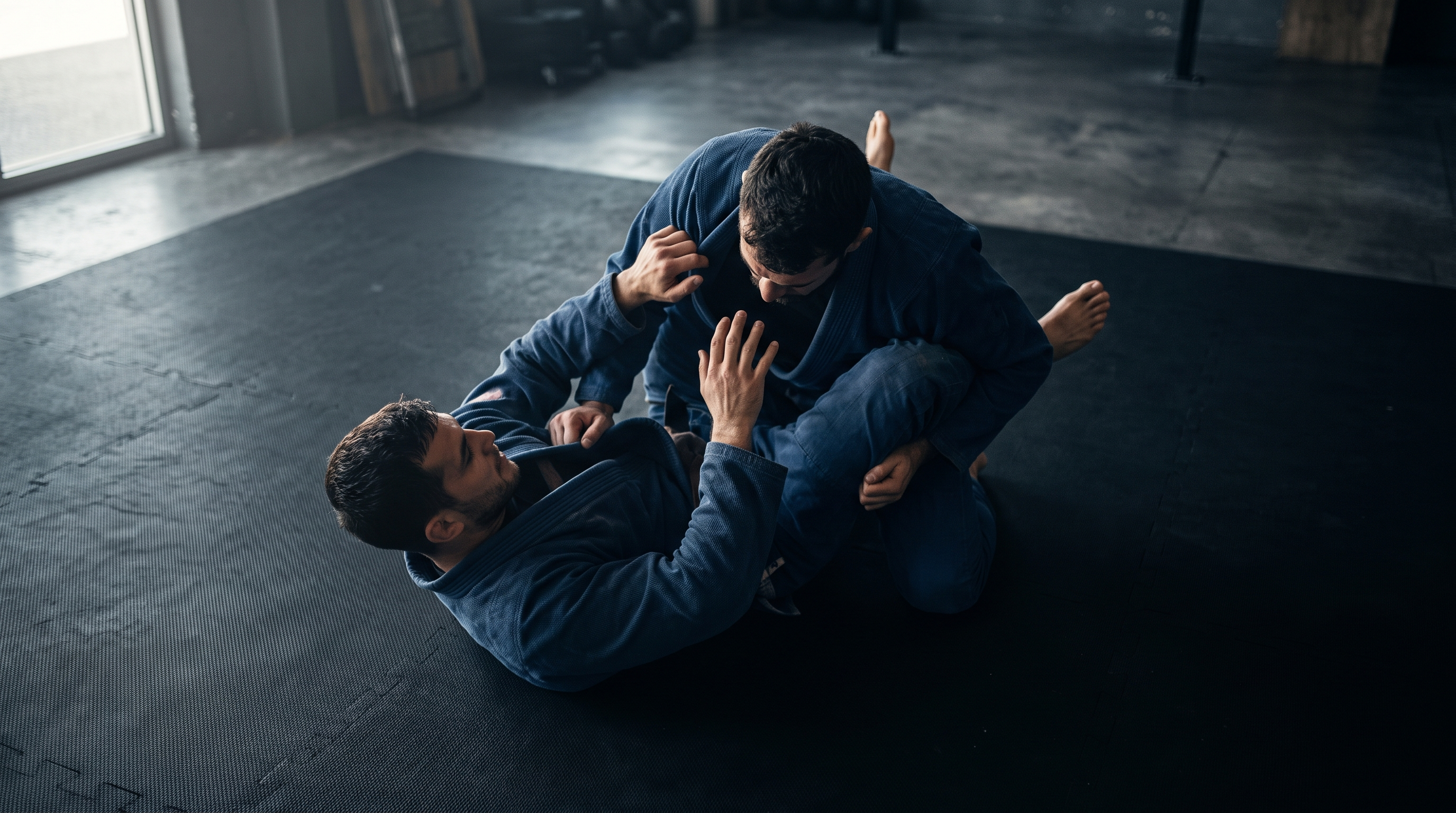
Escaping the Knee Cut Pass: How to Frame, Underhook, and Recover Guard Before You Get Flattened
TL;DR. The knee cut pass wins because your partner controls your head, kills your underhook, and drags his shin across your thigh before you react. The fix is a simple sequence: block the cross-face early with a strong frame, fight for the underhook on the cutting side, hip escape away from the pressure, and either recover half guard with an underhook or shrimp back to open guard. Drill the reactions in this order every round and the pass stops feeling inevitable.
If you train Brazilian jiu-jitsu long enough, you'll notice a pattern: whether the room is full of hobbyists or competitors, the knee cut (also called the knee slice) is one of the passes that catches everyone. It's simple, it's mechanical, and it punishes lazy hips. The good news is that the defense is equally mechanical. Once you understand the three things the pass needs to succeed, you can build a short reaction chain that stops it at any stage — before the shin cuts, while it's cutting, or even after your partner is halfway to side control. This article gives you that chain, the common mistakes that break it, and a way to actually remember it before your next training session.
Why the knee cut pass keeps working on you
The knee cut isn't a mystery move. It works because it stacks three advantages on top of each other, and most guard players only try to solve one at a time.
First, the passer establishes a cross-face or a strong head control on your far side. That kills your ability to turn into him and take away the space you need to shrimp. Second, he pins or removes your near-side underhook, usually by pummeling his arm inside or by trapping your arm across your own chest. Without the underhook, you can't threaten to come up, and you can't wedge him off. Third, he slices his lead knee across your near thigh while his other foot posts wide. The moment that shin crosses the centerline of your leg, gravity does the rest — he's already three-quarters of the way to side control.
Most people only start defending at stage three, when the knee is already cutting. By then it's too late. Real knee cut pass defense starts at stage one, the instant you feel weight coming over your near hip.
Remember. You don't lose to the knee cut because your escape is bad. You lose because you started escaping one beat too late.
A simple system to stop the knee slice pass
Here's the chain. Learn it in this exact order, drill it in this exact order, and use it in this exact order when someone tries to pass. Skipping steps is what gets you flattened.
1. Get the frame on the cross-face shoulder
As soon as you feel your partner's chest coming toward your face, put your near-side forearm across his collarbone or bicep — whichever you can reach first. Elbow tight to your own ribs, wrist strong. This frame isn't there to push him away; it's there to preserve the small pocket of space between his chest and your chin. If you lose that pocket, you get flattened and every other step fails.
2. Fight for the underhook on the cutting-knee side
This is the grip that decides the whole exchange. As his knee starts to slide, pummel your arm underneath his armpit on the same side as the cutting knee. You're not trying to sweep him yet — you're just claiming inside space. If he already has your arm trapped, use a small hip bump to create room, then swim the arm through.
3. Turn onto your side, not onto your back
A huge number of guard retention errors come from lying flat. The instant you feel the pass coming, roll a few degrees onto your cutting-side hip. This shortens the distance his knee has to travel and puts your bottom leg in a position where you can knee-shield or recover half guard.
4. Hip escape away from the pressure, at an angle
Don't shrimp straight backward — that just lengthens his cut. Escape your hips diagonally, roughly toward the direction his cutting knee came from. You're trying to put your near hip back underneath his hip so your leg has room to slip through.
5. Insert the knee shield or recover half guard
If you're early, you can wedge your top knee across his belly and reestablish an open guard (knee shield / z-guard). If you're a beat late, accept half guard: trap his cutting leg between your knees, keep your underhook, and stay on your side. Half guard with an underhook is a fighting position — flat half guard is a losing position.
6. Rebuild from half guard or return to open guard
From deep half or standard half with the underhook, you have real options: come up to the dogfight, sweep to the back, or use a knee-lever to kick your leg free and re-enter open guard. Pick one path and commit — hesitation is what turns half guard into side control.
7. If everything failed, granby or turtle before side control locks
If his shin has already crossed and his hips are settling, don't lie there and hope. Either granby roll away from the pressure (belly-down for a second, then re-face him from turtle or open guard) or turn to turtle and defend from there. Losing guard is bad; giving up side control without a fight is worse.
Remember. Frame first, underhook second, hips third. Any other order and you're doing someone else's escape.
Quick reference: which defense fits which stage
| Stage of the pass | What you feel | Right response |
|---|---|---|
| Passer is grip-fighting, no cross-face yet | Weight on your legs, hands on your knees | Break grips, keep feet on hips, don't let him get the head |
| Cross-face is on, shin hasn't cut | Chest coming toward your face | Frame the shoulder, fight the underhook |
| Shin is cutting across your thigh | Pressure sliding across your near leg | Turn on your side, angled hip escape, knee shield |
| Shin has crossed, hips settling | You feel flat, weight over your chest | Recover half guard with underhook |
| Half guard slipping, side control near | Underhook lost, head being crushed | Granby or turtle before he locks side control |
Common mistakes that keep the pass working
Even people who know the theory make the same handful of errors. If you keep getting cut through, one of these is almost certainly the reason.
- Framing on the face instead of the shoulder. Face frames slip and get you cranked. Frame the collarbone, shoulder, or bicep — bone on bone, not palm on cheek.
- Chasing the underhook after you're already flat. Once your back is glued to the mat, the underhook race is over. Fight for it before you get flattened.
- Shrimping straight back. This is the single most common mistake. Straight-line shrimping just lets him keep cutting. Angle your escape.
- Giving up on half guard. A lot of white and blue belts treat half guard as a lost position. It isn't. With the underhook and a knee shield, half guard is a legitimate starting point.
- Trying to sweep before you've stopped the pass. Sweeps come after you've stabilized. If you go for the sweep while he's still cutting, you feed him the pass.
- Reacting only to the leg. The knee cut looks like a leg move, but it's really a head-and-arm move. If you fix the cross-face and the underhook, the leg has nowhere to go.
- Not drilling the sequence in order. Random escapes in random rounds give random results. Pick the chain, drill it every round for a week, and it starts firing on its own.
How BJJ Memo fits into this
Here's the honest problem: you'll read this article, nod along, and by Thursday's class you'll only remember two of the seven steps. That's not a discipline issue — it's how learning works when you consume a lot of instructional content. The techniques that stick are the ones you revise a few times between sessions.
BJJ Memo is built for exactly that gap. Paste a knee cut defense video from YouTube — your favorite coach's breakdown, a competition clip, whatever — and the app turns it into a structured technique card with the steps, key details, and tappable timestamps of the moments you actually want to rewatch. File it in your personal library under "guard retention" or "knee cut defense" and the review flow surfaces it again before your next training day. That's it. The mat time and the coaching are still where the real learning happens — the app just makes sure the details from this article don't quietly disappear before you can use them.
Frequently asked questions
Is the knee cut the same as the knee slice pass?
Yes. "Knee cut," "knee slice," and "knee slide" all refer to the same family of passes: the passer drives one knee diagonally across the guard player's near thigh while controlling the upper body. The defense is the same regardless of the name you use.
What's the single most important grip to stop a knee cut pass?
The underhook on the cutting-knee side. If you get it early, you can prevent the pass entirely or convert straight into a sweep. If you lose it, your escapes become significantly harder. Prioritize this grip over almost everything else once the pass starts.
Should I use a knee shield or recover full guard?
It depends on how early you react. If you catch the pass early and still have space, a knee shield or z-guard is the cleanest recovery. If you're already late, half guard with an underhook is more realistic than trying to force full guard. Chasing full guard from a bad position usually costs you the position entirely.
Why do I keep getting flattened even when I frame?
Usually because the frame is on the face or the neck instead of the shoulder or bicep. Face frames collapse the moment your partner drives forward. Move the frame down onto bone — collarbone, shoulder joint, or bicep insertion — and keep your elbow tight to your own ribs so it can't be pushed through.
Can I stop the knee cut pass without a strong underhook?
Rarely. You can stall it with frames and hip movement, but a committed passer will eventually cut through if you never claim inside space. Treat the underhook as non-negotiable and drill pummeling under pressure until it becomes automatic.
How long does it take to actually defend the knee cut consistently?
Realistically, it takes weeks of focused reps — not one class. Isolate the position in positional sparring: start with your partner already mid-cut and only your job is to recover. Do that a few rounds per session for a month and the reactions will show up in live rolling.
Wrap-up and a note on training
The knee cut pass isn't unbeatable — it just punishes hesitation. If you commit to the chain (frame, underhook, angled hip escape, half guard or knee shield, then rebuild), you'll notice partners who used to walk through your guard suddenly stalling on the way in. The last thing worth saying: this article gives you a map, but a map isn't a training session. Train the technique at a legitimate academy with a qualified coach who can watch your body and correct the small details — BJJ Memo is built to help you remember and revise what you learn, not to replace the mat.
Next time you watch a knee cut defense breakdown on YouTube, save it as a technique card in BJJ Memo so it's waiting for you before your next roll. Build the personal technique library you always meant to keep, and revise a card or two the morning of training — that's how the details from this article actually make it onto the mat.
Last updated 2026-09-15.