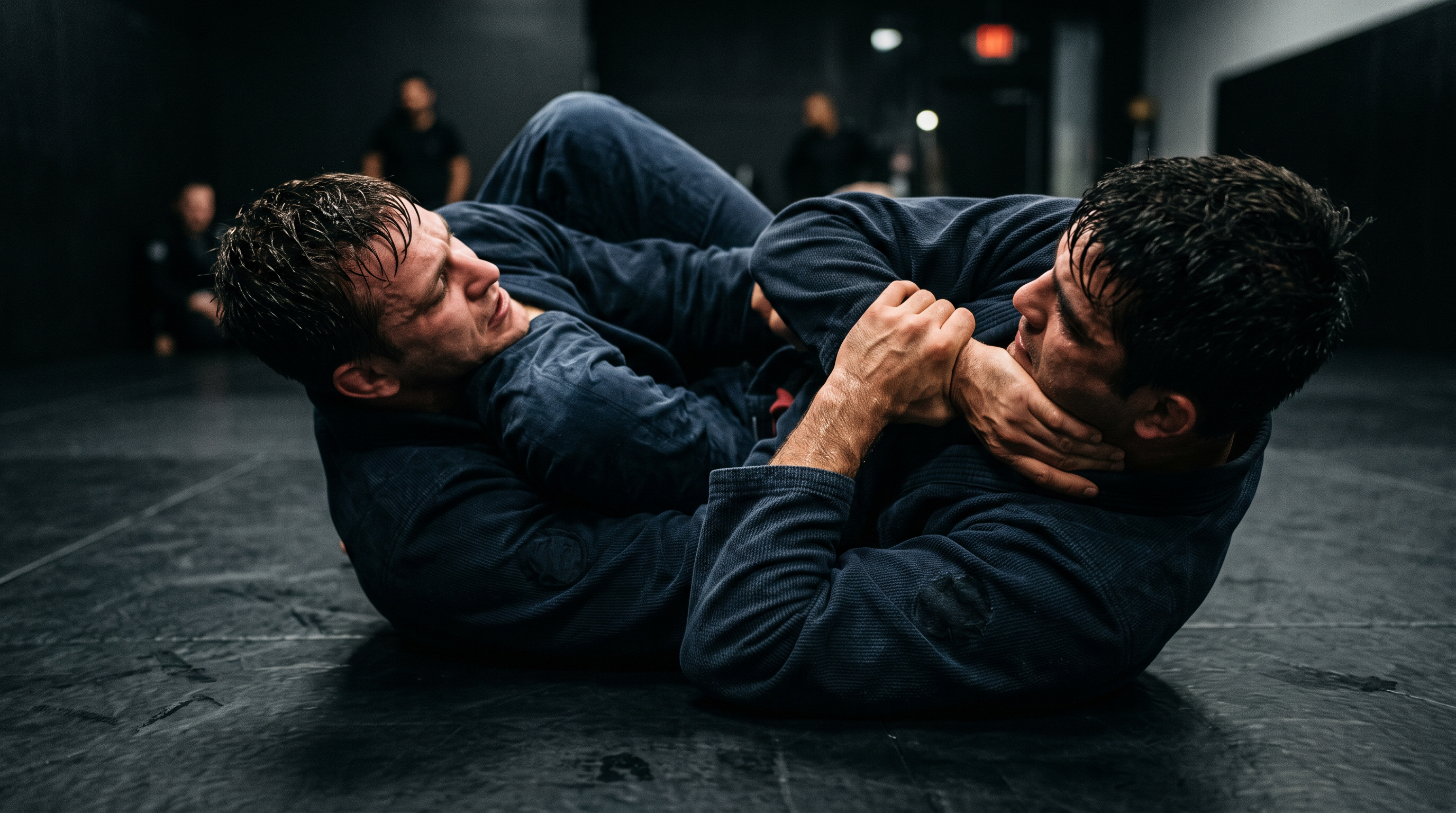
Guillotine Choke from Guard: The Grip, the Angle, and the Finish Most White Belts Miss
TL;DR. The guillotine choke from closed guard fails for most beginners because they try to muscle it with their arms. The submission is really a system: a deep grip under the chin, a small angle off your partner's centerline, closed guard positioned high on their back, and a finish driven by your choking shoulder and hips — not your biceps. Get those four pieces right and the tap comes without a fight. This guide walks through the mechanics step by step, the common mistakes to fix, and how to drill it safely so it becomes a real weapon in your closed guard game.
The guillotine is often the first "real" submission a white belt lands in live rolling. It shows up naturally: someone drops their head to pass, you wrap the neck, close your guard, and squeeze. Sometimes it works. Usually it doesn't. The reason is almost always the same — you are pulling with your arms instead of choking with your shoulder, your hips, and your legs.
This article breaks the guillotine choke from guard into the three details that actually decide whether it finishes: the grip, the angle, and the finish. We will focus on closed guard because that is where most beginners have the position and the time to hunt for it. You will also learn the difference between the classic guillotine and the high elbow guillotine (often called the Marcelotine), when to use each, and how to keep training partners safe while you learn.
Why the guillotine fails for most white belts
Before fixing the technique, it helps to understand why it usually breaks down. The guillotine is deceptive. It looks like a headlock, so beginners default to squeezing the head with their arms. But a headlock is not a choke — it just makes your partner uncomfortable while they pass your guard.
A real guillotine is a blood choke (or a combined blood/air choke, depending on the variation) that compresses the neck against a hard structure — your forearm bone, wrist, or the crook of your elbow. To get compression, three things have to line up:
- The neck has to be trapped so your partner cannot posture up or slide their head out.
- The choking arm has to be deep enough that the blade of your forearm is under the chin, not on the face or the top of the skull.
- Your body has to generate the finishing pressure — shoulder driving one way, hips driving the other, legs pulling their back down onto you.
When any of those pieces are missing, the choke turns into a stalling position. Your partner postures, peels the grip, and starts passing. The good news: once you understand the system, the fix is mechanical, not physical.
Remember. If you are red in the face and your partner is calm, you are doing it wrong. The guillotine should feel like leverage, not effort.
A simple system: 6 steps to the guillotine choke from guard
Here is a clean, drillable sequence for the classic (palm-up) guillotine from closed guard. Learn this first, then layer in the high elbow variation later.
1. Bait or catch the head
Most guillotines start when your partner drops their head — a lazy posture, a bad guard-pass attempt, a stand-up in your guard where they let the head come forward. From closed guard, you can encourage this by breaking their posture down: pull on their sleeves and collar, elbow-bump their arms in, sit up briefly to force them to react. The moment their head crosses over your chest, the window opens.
2. Snake the arm deep under the chin
Slide your choking arm around their neck so the blade of your forearm is under the chin, not across the mouth or over the top of the head. Depth is everything. Your armpit should ideally reach the back of their head so the neck is fully wrapped, not just "caught." Thumb points down or to the side — never up (thumb up costs you depth).
3. Grip: hand-to-wrist or S-grip
Bring your free hand up to meet the choking hand. Two reliable grips:
- Palm-to-wrist: the free hand cups the wrist or forearm of the choking arm.
- S-grip: hands hook together like two Cs.
Avoid the Gable grip (palm-to-palm) for this variation — it tends to let the elbow flare and the neck slip. Keep both elbows tight to your ribs. If your elbows are floating out to the sides, you have already lost most of the choke.
4. Cut a small angle
This is the step almost every white belt skips. From flat-on-your-back closed guard, the guillotine is very hard to finish because your partner can drive their forehead into the mat and stack you. Shrimp your hips slightly to the side opposite your choking arm — if the choking arm is your right, your hips slide slightly to your left. You are looking for maybe a quarter turn, just enough that your choking shoulder is now pointed at their far ear. This angle takes the escape route away.
5. Close your guard high on their back
As you cut the angle, walk your closed guard up their back — feet crossed high, around the mid-back or shoulder blades, not down at the hips. High feet let you pull their upper body down onto you, which loads the choke. Low feet let them posture straight up and rip their head free.
6. Finish with shoulder and hips, not arms
Here is the finish nobody teaches clearly. To tap the choke:
- Drive the choking shoulder toward your own hip on the same side. Imagine trying to touch your right shoulder to your right hip.
- Pull down with your legs so their back curls onto you.
- Lift your hips slightly off the mat to add compression.
- Keep your choking elbow glued to your centerline so the forearm bone stays under the chin.
Your arms barely move. The tap comes from the shoulder-to-hip crunch plus the leg pull. If you feel yourself curling your bicep, stop and reset the grip — you are muscling it.
| Detail | Do this | Not this |
|---|---|---|
| Arm depth | Blade of forearm under the chin, armpit near back of head | Forearm across the mouth or on top of the skull |
| Grip | Palm-to-wrist or S-grip, elbows tight | Gable grip with flared elbows |
| Hip position | Slight angle off-center, opposite the choking arm | Flat on your back, square to partner |
| Guard height | Closed guard high on the back or shoulder blades | Guard low on the hips |
| Finish direction | Choking shoulder to your own hip | Bicep curl, pulling the head with your arms |
The high elbow guillotine (Marcelotine) variation
The high elbow guillotine — popularized by Marcelo Garcia and often called the Marcelotine — is a slightly different animal. Instead of finishing with the classic palm-up grip and a shoulder-to-hip crunch, the choking elbow rides high above your partner's shoulder, and the blade of the wrist attacks the side of the neck (the carotid area) rather than the front of the throat.
Why it matters for beginners:
- It works well against partners who tuck their chin aggressively to defend the classic guillotine.
- It is more of a pure blood choke, so it can finish even when the trachea is well protected.
- The grip is usually a palm-to-wrist grip with the choking-hand fingers pointing toward your own opposite shoulder.
Mechanically, everything else is the same: deep wrap, angle off-center, guard high, finish with shoulder and hips. Learn the classic first, then add the high elbow as a Plan B when the chin is buried.
Remember. The guillotine is not one submission — it is a family. Same grip mechanics, different angles for different defenses.
Common mistakes and how to fix them
Most failed guillotines from guard trace back to a short list of errors. Run through this checklist any time the choke stalls out.
- Elbows flared out. Your choking arm's elbow drifts away from your centerline, and the neck slips through the gap. Fix: elbows glued to your ribs, both hands driving toward your sternum.
- Shallow grip. The forearm sits across the mouth or nose. Painful, not chokey. Fix: re-snake the arm and don't grip up until your forearm is fully under the chin.
- Flat on your back. Being square with your partner lets them stack and posture. Fix: shrimp a quarter turn off-center before you commit to the finish.
- Guard too low. Feet crossed at the hips let them posture straight up. Fix: walk the guard up to the mid-back or shoulder blades.
- Pulling with the biceps. You feel your arms burning and your partner is fine. Fix: freeze the arms, drive the choking shoulder toward your same-side hip, and pull down with your legs.
- No head trap. If they can turn their chin over your choking forearm, they will slip out. Fix: use your free hand and shoulder to keep their head glued to your chest before you finish.
- Squeezing too early. You clamp before the grip is set and the angle is cut, which telegraphs everything. Fix: set the position first, then finish in one smooth motion.
If you cannot finish after 5–10 seconds of pressure with the position set, let it go and flow to your next attack — sweeping to mount, hunting an armbar, or resetting your closed guard. A stalled guillotine is a great sweep entry because your partner is already leaning forward.
Drilling the guillotine safely
Neck submissions carry real risk. A guillotine done wrong — cranked instead of choked — can strain the cervical spine. A few drilling rules that keep training partners healthy:
- Tap early. Especially when learning, tap the moment you feel pressure, not when it hurts. Necks are not a good place to test your toughness.
- Finish slowly in drilling. Set the grip, cut the angle, apply pressure smoothly. No jerky, explosive finishes with a training partner.
- Don't crank the head sideways. The guillotine should compress the neck against your forearm, not twist it.
- Communicate. Tell your partner what you are working on. Ask them to give you the head at first, then gradually add resistance.
- Check your grip depth before you squeeze. If the forearm is on the face, reset — don't try to "make it work."
A good progression: positional drilling with 25% resistance → light situational rolling from closed guard → live rolling. Skip steps and you either injure a partner or learn a sloppy version of the technique.
Where BJJ Memo fits in
The guillotine is a good example of a technique with a lot of small details — arm depth, elbow position, angle, guard height, finish direction — that are easy to lose between one class and the next. Most people learn it, tap someone in the next roll, and then forget half the details a week later when they can't finish it anymore.
That is exactly the gap BJJ Memo is built for. Paste a guillotine instructional from YouTube — a breakdown from a black belt you trust — and the app turns it into a structured technique card with the key steps, common mistakes, and tappable timestamps for the important visual moments. It saves into your personal library and surfaces for revision before your next training session, so the details are fresh when you hit the mats.
You can also browse related closed guard content on the BJJ Memo blog, including our beginner-focused guides to closed guard fundamentals and how to remember BJJ techniques.
Frequently asked questions
Is the guillotine choke legal at white belt in IBJJF competition?
Yes. The standard guillotine (front headlock choke) is legal at every belt level in IBJJF competition, including white belt. Twisting neck cranks are not — if your "choke" is really wrenching the head sideways, it may be illegal and it is definitely unsafe. Focus on compressing the neck against your forearm, not turning it.
What is the difference between a guillotine and a headlock?
A headlock traps the head with the arms and creates pressure, but it does not compress the arteries or airway enough to force a tap from a trained grappler. A guillotine uses a deep grip under the chin, an angle off-center, and body pressure (shoulder, hips, legs) to actually cut off blood flow or air. A headlock is annoying; a guillotine finishes the fight.
Why can't I finish the guillotine when I get the grip?
Almost always one of three things: the grip is not deep enough (forearm is on the face instead of under the chin), you are square with your partner instead of cutting an angle, or you are pulling with your biceps instead of driving your shoulder to your hip and pulling their back down with high closed guard. Fix those three and the finish shows up.
Should I learn the classic or the high elbow guillotine first?
Learn the classic palm-up guillotine first. It is the foundation — deep grip, angle, high guard, shoulder-to-hip finish. Once those mechanics are solid, add the high elbow (Marcelotine) as your answer to partners who tuck their chin and defend the classic version. Trying to learn both at once usually leaves you good at neither.
Is the guillotine dangerous to train?
Done correctly, no more than any other choke — tap early and let go quickly. Done incorrectly (cranking the head, jerking the finish, or twisting the neck), it can strain the cervical spine. Drill slowly, tap the moment you feel pressure, and never finish explosively in practice.
How do I stop forgetting all these details next week?
Write them down or record them in a system you will actually revisit. Most people forget technique details quickly if they never review them between sessions. A dedicated review flow — whether it is a notebook, a private note, or a tool like BJJ Memo that turns instructional videos into revisable technique cards — is what turns "I learned this once" into "this is part of my game."
Wrap-up and next steps
The guillotine choke from guard is one of the highest-percentage submissions available to a beginner — if you treat it as a system instead of a squeeze. Get the grip deep under the chin, cut a small angle off-center, walk your closed guard high on their back, and finish by driving your choking shoulder toward your own hip while your legs pull them down. Skip the muscle, respect the mechanics, and it starts to tap people who are much bigger and stronger than you.
For real feedback and safety, train the technique at a legit academy with a qualified coach — this article helps you understand and remember the mechanics, it doesn't replace mat time. Next time you watch a guillotine breakdown on YouTube, save it as a technique card in BJJ Memo so the grip, the angle, and the finish are all there waiting for you before your next roll.
Last updated 2026-09-07.