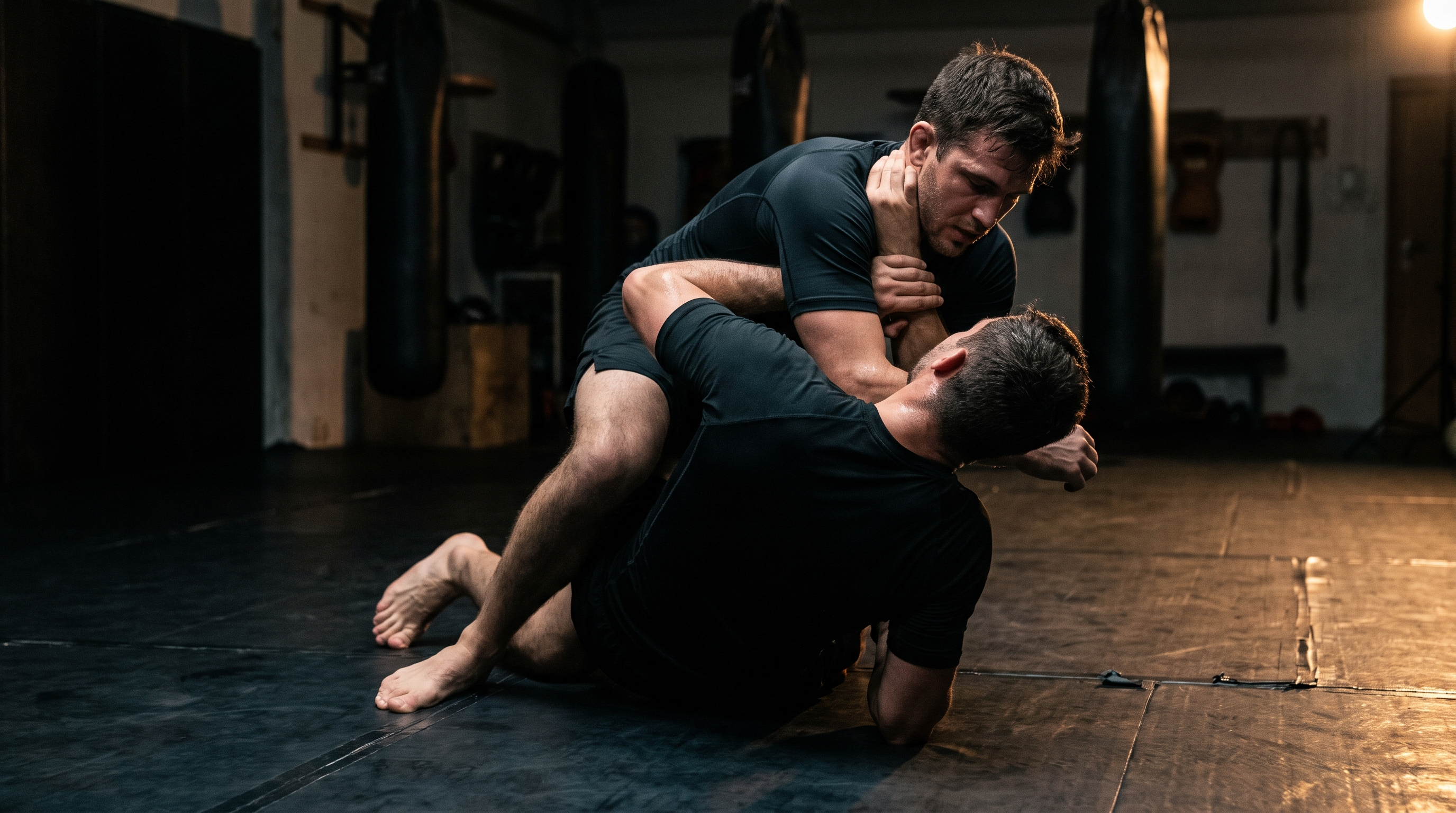
Guillotine Choke from Standing: How to Catch It Clean Without Getting Taken Down
TL;DR. The standing guillotine is a high-percentage answer to a bad shot — if your elbow line, posture, and hips are right. Read the level change, snap the head down, cut the forearm across the throat, and finish either from the feet or by pulling closed guard. Get any piece wrong and you're on your back defending a takedown. This guide breaks down the setup, a seven-step system, the common failures, and how to remember the details before your next roll.
Key takeaways
- The standing guillotine works when you react to the level change, not the finish of the shot.
- Elbow line matters more than grip strength — the forearm bone must cut across the throat.
- Posture stops the takedown while you finish: chest up, hips back, head over the hips.
- High-elbow, arm-in, and 10-finger variations each solve a different problem.
- Closed guard is your safe reset — pulling guard kills the takedown and preserves the choke.
- Drill the entry more than the finish; most people lose the sequence at the catch.
- Train it with a qualified coach — a bad guillotine is a free takedown for your partner.
Every white belt who wants to learn "the choke that stops wrestlers" tries the standing guillotine and immediately gets dumped. That isn't the technique's fault. The guillotine from the feet is a real, reliable submission and one of the cleanest answers to a shot in Brazilian Jiu-Jitsu — but it punishes bad posture, bad elbow position, and slow decisions instantly. This guide is written for white and blue belts who feel the shot coming, reach for a neck, and keep ending up flat on their back. We'll cover why the catch usually fails, a simple seven-step system to land it clean, the common mistakes that keep it from finishing, and a way to actually remember the details before your next session. Train it with a real coach — this article helps you revise and understand, not replace mat time.
Why the standing guillotine usually fails
The guillotine is a race. The moment you commit a hand to the neck, you're deciding to defend a takedown with your posture and hips instead of with your hands. If any one of three things is off — the timing, the elbow, or the hips — the choke turns into a scramble you already lost.
Timing is the first failure. Beginners react to the finish of the shot, not the level change. By the time your partner's head is in your hip and their arms are locking, you're too late — you're reaching down at a lower level than the neck, and your posture is already broken. The catch has to start when you see the shoulders dip.
Elbow line is the second failure. A guillotine that only wraps the neck without cutting across the trachea and carotid line is a neck ride. Your forearm bone (the ulnar edge) has to sit across the front of the throat, elbow pointing down and tight to their spine. If your elbow drifts wide or high, you have a headlock, not a choke.
Hips are the third failure. Every standing guillotine attempt is also a sprawl. If your hips move forward with the wrap — a very natural instinct when you're reaching for a neck — you feed your legs directly to your partner. Hips move back, chest crushes down, head stacks over the neck. That posture is what buys you the seconds to finish or to transition.
Remember. The guillotine punishes a hand that moves before the hips do. The sprawl feeds the choke; the choke doesn't replace the sprawl.
A simple system: seven steps to a clean standing guillotine
This is a general framework. Every coach has details of their own — this is the skeleton you can hang those details on.
- Read the level change. The catch starts before contact. When you feel your partner's weight drop or their lead shoulder dip, your near-side hand should already be tracing an arc toward their neck, not waiting to react.
- Snap the head down. As they shoot, use your same-side hand or a collar/nape tie to break their posture down. Their forehead should be pointed at the mat, not driving into your hip. No snap-down, no clean neck.
- Sprawl and load the chest. Hips back, weight down on their upper back and neck. Your chest replaces where their head wanted to go. You are now heavier than the shot and lower than a stack.
- Cut the forearm across the throat. Slide the wrapping arm through so the ulnar edge of your forearm sits on the front of their neck. Elbow tight to their spine, thumb pointing down. This is the choke — the grip only helps.
- Clasp the wrist. Free hand grabs the wrist of the choking arm — a plain wrist clasp works for most setups. Pull that grip into your chest, not out into space. Palms in, elbows in.
- Decide: feet or guard. If your partner is stalled and heavy on your hips, jump up, close the legs around the waist, and pull them into your closed guard. If you have the angle and the sprawl is solid, step your leg across their body and finish standing. Indecision is what loses the choke.
- Finish. From closed guard: hips up into their throat, shoulders curl, wrist grip tight to your sternum. Standing finish: turn the elbow of the choking arm skyward, shoulder into their throat, and squeeze while walking your hips away from their base.
Remember. The choke isn't a grip — it's a shape. The wrist clasp only holds the shape while your chest and hips finish the work.
Grip and variation reference
Different situations call for different guillotines. Here's a quick reference:
| Variation | Grip | Best when… | Common failure |
|---|---|---|---|
| High-elbow / arm-out | Wrist clasp, elbow up and forward | Their arm is not around your waist; head is snapped down early | Elbow drops, becomes a neck crank instead of a choke |
| Arm-in | Wrist clasp, one of their arms trapped inside the wrap | They shoot with an underhook or waist tie | Not enough forearm pressure across the neck |
| Marcelotine (10-finger) | 10-finger grip, no thumbs | You lost the wrist clasp and need to keep the choke alive | Grip fatigues quickly and needs a precise angle |
| Power / high-elbow finish | Wrist clasp, chin over their far shoulder | You have closed guard and a strong angle | Squeezing without lifting the hips — leg pressure doing nothing |
The variation matters less than the fundamentals: elbow line, posture, and where their arm is. Pick one, drill the entry patiently, and let the others come later.
Common mistakes that cost you the choke
- Neck-only wrap. Your forearm is on the back of the neck, not across the throat. This is a headlock, and your partner will drive through it every time. Cut the forearm through until you feel the ulnar edge on the front of the neck.
- Elbow pointing sideways. The elbow of the choking arm should point at their spine, not out to the side. A wide elbow gives their head an escape route down and out.
- Hips folded forward. You're bent at the waist, chin near their spine, no sprawl. This is a free double-leg for them. The catch and the sprawl happen at the same time, not one after the other.
- Waiting too long to pull guard. If they've re-based and are driving forward, standing finishes get harder every second. Pulling closed guard early preserves the choke and eliminates the takedown threat.
- Squeezing before shaping. Beginners try to muscle the choke before the forearm is in the right place. If it isn't a choke at zero effort, it isn't going to become one at full effort.
- Ignoring the chin. They will tuck their chin, look up, and hunt for space. Get the chin trapped before you commit to the squeeze — a shoulder into their forehead or a small head-tilt handles this.
- No plan B. Every good standing guillotine attempt has a backup: front headlock, snap-down to back, or a guard pull. If you commit fully to the finish with no plan B, a smart partner will invert the exchange on you.
Remember. If the choke isn't there in a few seconds, it usually isn't coming — transition to front headlock, back-take, or a scramble. Holding a dead guillotine is how you feed rides and takedowns.
Where BJJ Memo fits in
The standing guillotine has more moving parts than most beginners realize — elbow line, hip position, chin control, grip choice, and the decision to stand or pull. If you study it from YouTube (Lachlan Giles, Danaher-style breakdowns, competition footage), a lot of those details fade quickly. BJJ Memo turns any YouTube instructional into a structured technique card with the steps, common mistakes, and tappable timestamps of the exact moments you want to review. Save your favorite guillotine breakdown, revise it on the drive to the academy, and you'll drill with a specific detail in mind instead of a vague memory. Browse the BJJ Memo blog for more retention-focused guides.
Frequently asked questions
Is the standing guillotine legal at white belt in IBJJF? Yes. The guillotine, including from standing, is legal at every belt level in IBJJF rules. Reaping and heel hooks are the main lower-belt restrictions — the guillotine is not among them. Always double-check the specific ruleset of the competition you enter.
Why does my guillotine feel like a neck crank instead of a choke? Your forearm bone is not across the front of the neck. If the elbow drifts up or the wrap sits on the back or side of the neck instead of the throat, you're compressing the cervical spine instead of blocking blood flow. Fix the elbow line before adding any squeeze.
Should I finish the guillotine standing or pull closed guard? It depends on your posture and their base. If your sprawl is solid and their weight is on the mat, standing finishes work. If they've stalled and are driving forward with a strong base, pulling closed guard is the higher-percentage answer for most people, especially at lower belts.
Is a gable grip fine for the standing guillotine? It works, but a wrist clasp is generally more secure at lower belts. A gable grip can slip when your partner posts and pressures out; a wrist clasp keeps the shape of the choke intact under load. Try both and keep the one that survives full-resistance rolls.
How do I stop them from stacking me when I pull guard? Get your hips out (angle off) as you close the legs, keep the head and chin trapped, and finish before they can walk their hips up your body. If you feel your knees coming toward your face, break the grip and switch to a back-take or front headlock rather than eating a stack pass.
How long should I drill the guillotine before using it in rolls? Drill the entry — level change, snap-down, sprawl, wrap — far more than the finish. The catch is where the sequence lives or dies. Once you can hit a clean catch on a compliant partner from various shots, start using it in positional sparring against increasing resistance.
Add it to your library before you forget it
Standing guillotines live in the small details — the elbow angle, when to sprawl, when to pull guard. Those details fade fast if you don't revise them. Next time you watch a guillotine breakdown on YouTube, save it as a technique card in BJJ Memo so it's waiting for you before your next roll. Build your own technique library on the BJJ Memo blog and review before training — BJJ Memo on iOS and Android.
For real feedback and safety, train the choke at a legit academy with a qualified coach — BJJ Memo helps you remember and revise, it doesn't replace mat time.
Last updated 2026-09-11.