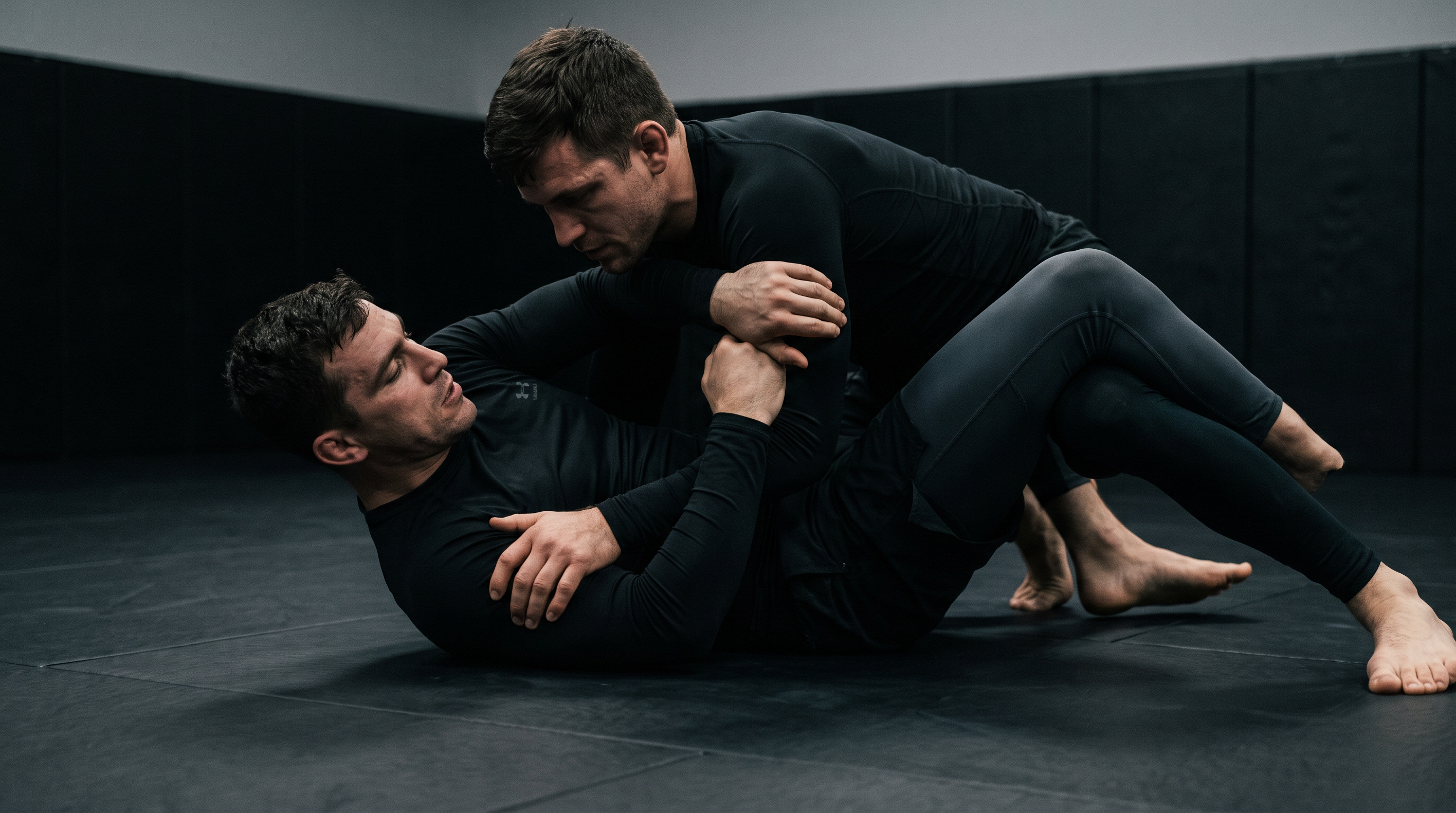
Half Guard for Beginners: How to Sweep, Recover, and Stop Getting Smashed
TL;DR. Half guard bottom is a survival position first and an attacking position second. Beginners get smashed because they lie flat, give up the underhook, and let the top player crossface and pressure pass. Your simple system: turn on your side, get the underhook, block the crossface, kick your bottom leg free, then either sweep with the old-school underhook sweep or recover full guard. Drill this loop until it is automatic — then start layering knee shield and deep half.
If you have been training a few months, you already know the feeling: your opponent passes to combat base, you scramble, and somehow you end up under half guard with a heavy shoulder in your jaw. You can't breathe, you can't move, and thirty seconds later you're in side control. Half guard bottom is one of the most common positions in beginner rolling — and one of the most misunderstood. It is not a bad position. It becomes a bad position when you don't have a plan. This guide gives you that plan: the exact posture, frames, and sequence of steps you need to either sweep the person on top or recover full guard cleanly. Learn this loop first. Everything else — knee shield, deep half, lockdown — is a variation on top of it.
Key takeaways
- Half guard bottom is safe when you are on your side with the underhook — it is dangerous when you are flat on your back.
- The two threats you must neutralize first are the crossface and the whizzer; without those, the top player cannot pass or smash.
- A beginner only needs one sweep (the underhook sweep) and one recovery (back to full guard) to survive most rolls.
- Framing with your top-side forearm on the biceps or shoulder buys the space you need to turn, hip out, and breathe.
- Kicking your bottom leg free is what actually finishes a half guard sweep — most beginners forget this step and get stuck.
- Knee shield and deep half are useful, but only after you can consistently get the underhook and control head posture.
- Consistent drilling of the same loop beats learning ten new techniques you cannot recall on the mat.
Why this keeps happening to you
Most beginners end up in half guard for a boring reason: they retreat there. Your guard gets passed, you turn on your side to defend, one leg traps a leg, and you exhale. That's half guard. The problem is what happens next. If you stay flat on your back with your head glued to the mat, the top player will:
- Crossface you — pinning your head away from them with their shoulder or forearm. This kills your ability to turn toward them.
- Get the underhook themselves — sliding their arm under your armpit on the trapped-leg side. This lets them pull you flat and start passing.
- Free the trapped leg — usually by pummeling to knee cut or backstepping.
Once all three of those things happen, you are in side control. Everything in this article is designed to stop that chain before it starts. The rule to memorize: if you are flat, you are losing. If you are on your side with the underhook, you are working.
The two threats that decide everything
| Threat from top | What it does | Your answer |
|---|---|---|
| Crossface (their shoulder/forearm across your jaw) | Turns your head away, flattens your torso, kills the underhook race | Frame on their biceps, tuck your chin, keep your head off the mat |
| Whizzer (their overhook on your underhook arm) | Stops your sweep, sets up their pass | Drive the underhook deep to the back, not up to the ceiling |
| Underhook to you | Lets them pull you flat and pass | Win the underhook first — pummel the moment you land in half guard |
| Freeing the trapped leg | Their pass finish | Kick your bottom leg out and hook their leg with your top leg |
Remember. Half guard is a race for the underhook and control of the head. Whoever wins both, wins the position. Everything else is detail.
A simple system: the five-step half guard loop
You don't need ten sweeps. You need one clean loop that gets you out of trouble every time. Drill these five steps in order until you can do them without thinking.
1. Turn on your side
The instant you land in half guard, turn onto your trapped-leg side hip. Your bottom shoulder points toward the mat, your top shoulder points at the ceiling. Head off the mat. This is the single most important position in the entire sequence — from here you can defend; flat on your back, you cannot.
2. Get the underhook
Pummel your top-side arm under their armpit on the trapped-leg side. Aim the underhook deep and low, so your hand comes out near their lower back or belt, not up by their neck. A deep underhook beats a whizzer. A shallow underhook gets whizzered every time.
3. Block the crossface
With your bottom-side arm, frame across their biceps or into the crook of their elbow. This stops their crossface arm from getting to your face. If they already have the crossface, you need to strip it — hand-fight their wrist away from your head before you do anything else.
4. Kick your bottom leg free
This is the step everyone skips. Your bottom leg (the one that's fully trapped) needs to slide out and hook over their leg. As you shrimp your hips away from them, kick your bottom foot out to the outside and re-hook. Now you have a butterfly-style hook on the inside of their thigh. Without this step, no sweep works and no full-guard recovery works.
5. Choose: sweep or recover
Now you have a fork. Both options are legitimate.
- Sweep (old-school underhook sweep): Come up onto your bottom elbow, then your bottom hand. Walk your hips backward, drive your underhook to their far hip, and lift them over your inside hook. You end up in top half or side control.
- Recover full guard: If you can't get the angle to sweep, use the same underhook and hip position to slide your knee across their belly, hook their far side with your foot, and close guard.
Either answer is a win. Pick whichever the top player gives you. If they are heavy and forward, sweep them. If they are posted and stiff, recover guard.
Remember. The five-step loop is one continuous motion, not five separate techniques. Turn, underhook, frame, kick, decide. Drill it slowly until it feels like one movement.
Common mistakes (and the fixes)
Even with a clean system, there are a handful of habits that will keep you stuck. Watch for these.
Lying flat and "waiting"
The most common mistake. You land in half guard, feel relieved, and stay flat because it feels safer. It isn't. Flat is where the pass starts. Fix: the moment your knee touches theirs, turn on your side.
Underhook to the ceiling
Many beginners shove the underhook straight up under the armpit. That's a free whizzer for the top player. Fix: drive the underhook diagonally down toward their opposite hip. Think "reach for their back pocket."
Chasing the sweep with no hook
You get the underhook, you try to come up, and you fall right back down. The reason is almost always that your bottom leg is still trapped. Fix: kick the bottom leg free and hook the inside of their thigh before you attempt anything.
No frame on the crossface
You fight for the underhook but ignore their crossface arm. They flatten your head and pull you back down. Fix: your bottom arm always has a job — frame on the biceps, strip the wrist, or hand-fight. Never let it hang.
Learning too many variations too early
Knee shield, lockdown, deep half, coyote, John Wayne. All great. All useless if you can't hit the basic loop. Fix: for at least a month, only use the five-step loop. Once it's automatic, add one variation at a time.
Turning your back to escape
When the pressure gets heavy, beginners often roll to their knees. Sometimes that works. Often it gives up the back. Fix: escape forward (sweep) or backward (recover guard), not by turning away.
How BJJ Memo fits in
Here is the honest problem: you can read this article, nod along, and remember roughly none of it by the time you're rolling on Thursday. Techniques fade fast when you only see them once. That's exactly why we built BJJ Memo — paste a half-guard instructional from YouTube and the app turns it into a structured technique card with the steps, key details, and tappable timestamps of the important moments. Your cards live in a searchable personal library, and a simple revision flow surfaces them again before your next session so the details actually stick. It's a retention tool, not a coach. Use it to keep the loop in this article fresh in your head between classes.
Frequently asked questions
Is half guard a good position for beginners?
Yes, once you understand it as a survival-first position. It is one of the most-used positions in modern jiu-jitsu at every level. For a beginner, it's a place where your guard has been partially passed but you still have tools — the underhook, frames, and the trapped leg give you real options to sweep or recover.
Should I learn deep half or knee shield first?
Neither. Learn the basic underhook half guard first — turn on your side, get the underhook, frame the crossface, kick the leg free, sweep or recover. Once that is automatic, knee shield is the natural next step because it prevents the crossface before it happens. Deep half is a more advanced variation and works best once you already understand hip position on the bottom.
What do I do if they get the crossface before I can turn?
First, get your head off the mat by pushing into their shoulder with your bottom-side frame. Then hand-fight their crossface wrist away from your face. You often need to give up on the underhook race for a moment, strip the crossface, and then re-pummel. Don't try to sweep while flat with a crossface on you.
How do I stop getting smashed by bigger training partners?
Space and angle, not strength. Stay on your side, keep your head off the mat, and use frames on their biceps and hip to prevent chest-to-chest pressure. If you're flat, you'll get smashed regardless of size. If you're on your side with the underhook, size matters much less.
How long should I drill this before it starts working?
Give it consistent reps over several weeks. Drill the five-step loop slowly with a compliant partner, then at increasing resistance. Most beginners feel a real difference once they've done positional sparring from half guard bottom repeatedly — probably a handful of focused sessions rather than a single class.
Can I use this in gi and no-gi?
Yes. The underhook, crossface, and hip mechanics are the same. No-gi is slightly faster because there are no grips to slow the pummel, so the race for the underhook happens quicker. In the gi, you can also use grips on their sleeve and collar to help control the crossface arm.
Train it, then remember it
Half guard bottom stops being scary the moment you have a simple, repeatable plan. Turn on your side. Get the underhook. Frame the crossface. Kick the bottom leg free. Sweep or recover. Drill that loop until it's the first thing your body does when you land there. For real feedback and safe reps, train it at a legit academy with a qualified coach — this article helps you understand the position, but your instructor and your training partners are the ones who will make it work.
Next time you watch a half-guard instructional on YouTube, save it as a technique card in BJJ Memo so it's in your library before your next roll. Build a small collection of half-guard details you actually revisit, and the position will start to feel like home. Download BJJ Memo for iOS and Android and turn what you watch into something you can use on the mat.
Last updated 2026-08-15.