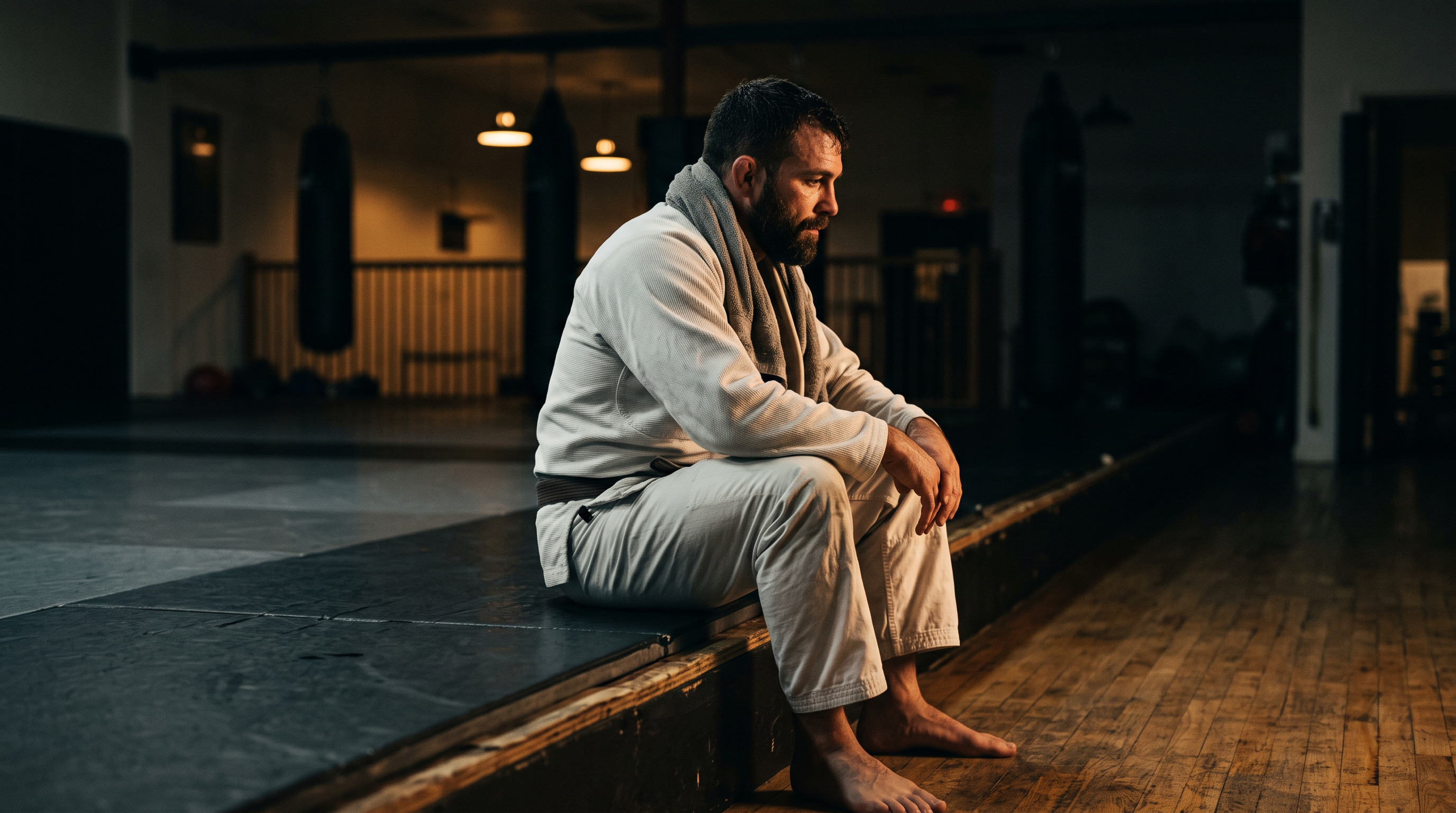
The Hobbyist BJJ Practitioner's Guide: Training 2–3 Times a Week and Still Improving
TL;DR. Most BJJ practitioners are hobbyists training 2–3 times a week around jobs, kids, and life. You can absolutely keep improving on that schedule, but only if the time off the mat is used with intent. This guide gives you a daily 5–15 minute structure, the single most common failure pattern that stalls hobbyists (and how to fix it), and a sample 7-day plan built around real-life constraints.
If you train Brazilian Jiu-Jitsu twice a week, you are the norm — not the exception. The full-time competitor with two-a-days is loud on Instagram, but the average person in your gym has a job, a commute, maybe a family, and a body that needs to recover. The good news is that steady, thoughtful hobbyist BJJ training compounds over years. The bad news is that most hobbyists sabotage that compounding by treating the seven days between classes as dead time.
This guide is written for the person who wants to improve at BJJ without quitting their job.
Key takeaways
- The hobbyist's real bottleneck is not lack of mat time — it is loss of information between sessions.
- A focused 5–15 minutes per day off the mat can compound faster than adding a fourth class you cannot sustain.
- Pick a narrow game (one guard, one pass, one submission chain) instead of chasing every technique your instructor shows.
- Review the last class within 24 hours; that is when most of the useful detail is still recoverable.
- Track a small number of positions rather than every roll — quality of notes beats quantity.
- Use YouTube instructionals as revision, not as your primary teacher.
- Consistency across months matters more than intensity across weeks.
The hobbyist's real constraint
When a busy adult says they are stuck at blue belt or feels like they have been doing the same thing for a year, the assumption is usually "I need more mat time." Sometimes that is true. Much more often, the constraint is different: the information from class is leaking out before the next class arrives.
Look at a typical week for someone doing BJJ 2 times a week:
- Tuesday, 7pm — class. Instructor shows a knee-cut pass with three key details.
- Wednesday–Sunday — no BJJ contact at all. Work, life, other training, sleep.
- Monday, 7pm — next class. Different topic. You have no memory of the three details from Tuesday.
By the time you touch the technique again, the specific grip, the shoulder pressure, the head position — the parts that actually make it work — are gone. You are effectively learning the same move for the first time, over and over. That is not a mat-time problem. That is a retention problem, and it is the single biggest reason hobbyists feel stuck.
Once you accept that, the solution stops being "train four times a week" (which usually leads to burnout or injury) and becomes "protect what you already learned." This is the entire premise of part time BJJ training done well.
Remember. Adding a fourth class is expensive in time, recovery and family goodwill. Adding fifteen minutes of focused review is cheap. Do the cheap thing first.
A daily 5–15 minute structure that actually fits a real life
You do not need a training plan that looks like a professional athlete's. You need a small, boring routine you will still be doing in six months. Here is a structure that fits into a lunch break, a coffee, or the time before bed.
The 5-minute version (minimum viable)
On any non-training day, spend five minutes doing exactly one thing: re-read (or re-watch) the last class in your head. No notes, no video, no drilling. Just close your eyes and try to walk through the technique step by step. Where does the tape go blank? Those blank spots are your homework for the next class — write them down as questions for your coach.
The 10-minute version
Add a short review of one saved technique from your library. Pick a position you actually get to on the mat (not the flashy stuff). Watch or re-read the key details, then mentally rehearse hitting it against your usual training partners. Visualization is not magic, but for a movement-based skill it is a real, well-documented rehearsal tool.
The 15-minute version
Add 5 minutes of solo movement: a couple of hip escapes, a technical stand-up, a granby, a sit-out. Nothing intense — think of it as brushing your teeth for your hips. This is how bjj for busy adults stays technically sharp without adding mat time.
Stack these into a small daily habit and you build something most white and blue belts never build: a standing relationship with the material. That is what separates hobbyists who improve from hobbyists who plateau.
The common failure pattern (and the fix)
Almost every stalled hobbyist we hear from is doing some version of the same thing:
They try to learn everything.
Instructor shows a De La Riva sweep on Monday? They watch three YouTube videos on De La Riva that night. Instructor shows a darce on Wednesday? Now they are watching darce tutorials. On the weekend they see a highlight of a heel hook and suddenly they want to add leg locks. Nothing sticks because nothing gets repeated enough to actually be theirs.
The fix is not more discipline — it is a smaller surface area.
The narrow-game rule for hobbyists
Pick, and commit to for at least one training cycle:
- One guard you play (e.g. closed guard, or half guard).
- One passing style you use when you are on top (e.g. knee cut, or over-under).
- One escape you drill from your worst position (usually side control or mount).
- One submission chain of 2–3 linked attacks you understand deeply.
That is it. Four things. Everything your coach shows either fits into one of those buckets and gets studied, or gets acknowledged and let go. This is how you improve BJJ without training more — by finally training the same thing twice.
Remember. A hobbyist with a narrow, well-drilled game beats a hobbyist with a Pinterest board of techniques every time.
Related reading: our guide on how to build a personal BJJ game walks through how to pick your four buckets without changing your mind every week.
The one BJJ Memo feature that helps the most
There is a whole app behind this, but for the 2–3x/week practitioner, one feature does the heavy lifting: turning a YouTube instructional into a structured technique card, saved to your library, that you can revise in one click before class.
Here is why it matters specifically for hobbyists. When you watch a 20-minute Lachlan Giles breakdown on the bus, you will not remember the setup by Tuesday. If instead you save it as a card — steps, key details, tappable timestamps of the visual moments — you now have a 60-second review you can open in the car outside the gym. That is the exact moment the information needs to be sharp.
Everything else in the app (library, search, spaced review) exists to support that one loop: capture from a video, revise before you train. If you only use BJJ Memo for this and nothing else, you will get most of the benefit. You can start at bjjmemo.com.
A sample 7-day plan you can actually follow
Assume classes on Tuesday and Thursday. Adjust to your own schedule; the principle is what matters — a short daily touchpoint plus one longer study block on the weekend.
| Day | Mat time | Off-mat work (5–15 min) | Purpose |
|---|---|---|---|
| Monday | — | 5 min mental walkthrough of last week's best roll | Prime the brain for tomorrow's class |
| Tuesday | Class (60–90 min) | 10 min post-class: capture 1–2 techniques as a card | Lock in what was shown while it is fresh |
| Wednesday | — | 10 min review of Tuesday's card + 3 questions for coach | Turn confusion into specific questions |
| Thursday | Class (60–90 min) | 10 min post-class: capture 1 technique + note one roll pattern | Build the library and self-scout |
| Friday | — | 5 min mental walkthrough only (recovery day) | Protect sleep and recovery |
| Saturday | Optional open mat / rest | 15 min: watch 1 short instructional, save it as a card | Study day — but focused, not endless scrolling |
| Sunday | — | 10 min review of the week's cards, pick 1 focus for next week | Weekly planning, not weekly overload |
That is roughly 60 minutes of off-mat work per week, on top of your two classes. It is a small ask, and it is the difference between spinning in place and slowly, obviously getting better.
What to stop doing
Just as important as what to add:
- Stop watching instructionals you will not review. A watched video you cannot recall is worse than nothing — it makes you feel productive without actually being productive.
- Stop trying to fix everything in one roll. Pick one thing per training session ("today I only work on getting to underhook from half guard"). Everything else is bonus.
- Stop comparing your progress to full-timers or competitors. Different sport, different life.
- Stop skipping the warm-up drills. For hobbyists, the class warm-up is often your only solo movement work of the week.
When to actually add a third or fourth class
Add mat time only when the retention side is handled. If you can honestly say:
- You remember the main technique from your last two classes.
- You have a defined narrow game you are working on.
- Your body is recovering well from your current schedule.
- Your life outside BJJ is not being squeezed by it.
…then adding a third class per week is a real upgrade. Adding it before those conditions are true usually just means more forgotten techniques, more soreness, and more frustration.
Frequently asked questions
Can you actually get good at BJJ training only 2 times a week?
Yes — plenty of long-term hobbyists reach purple, brown and even black belt on roughly this schedule. Progression is slower than a full-timer's, but "slower" over a decade still produces a very capable grappler. The people who stall on 2x/week are almost always the ones who do zero focused off-mat work, not the ones who lack a third class.
How long does it take to notice improvement on a hobbyist schedule?
Expect noticeable technical improvement in months, not weeks, on 2–3 sessions per week. What you can change quickly is your retention of what your coach shows — that shift usually shows up within a few weeks of starting a proper review habit.
Is it better to train two long classes or three shorter ones?
For most busy adults, three shorter sessions beat two long ones because BJJ is a skill sport — frequency of contact with the material matters more than total minutes on a given day. But the best schedule is the one you will actually keep for a year without burning out.
Should I drill at home if I have no partner?
Yes, but keep expectations realistic. Solo movement drills (hip escapes, technical stand-ups, granbys, guard retention shells) are genuinely useful. Trying to "drill" a submission on a pillow is mostly theatre — better to spend that time reviewing a technique card and mentally rehearsing it.
How do I stop forgetting techniques between classes?
Review within 24 hours of learning, then again a few days later, then again just before the next class. This is the entire point of a technique library — see our take on how to remember BJJ techniques for the full method.
I only have 5 minutes a day. What is the single highest-value thing?
Mental walkthrough of your last class. Close your eyes, replay the technique step by step, and note where the memory goes blank. Those blanks are exactly what to ask your coach next time.
Closing thought
Being a hobbyist is not a lesser version of BJJ — it is the version most of the sport is actually made of. You do not need to train more to keep improving; you need to stop losing what you already learn. Small, consistent reps beat marathon sessions.
Next time you watch an instructional or leave class with a new detail, save it as a technique card in BJJ Memo so it is there — organized, revisable, one tap away — before your next roll. That single habit, done for a year, is what quietly separates the hobbyists who get good from the hobbyists who just keep showing up.
For real feedback and safety, train the techniques you are studying at a legit academy with a qualified coach — BJJ Memo helps you remember and revise, it doesn't replace mat time. Explore more guides on the BJJ Memo blog.
Last updated 2026-08-19.