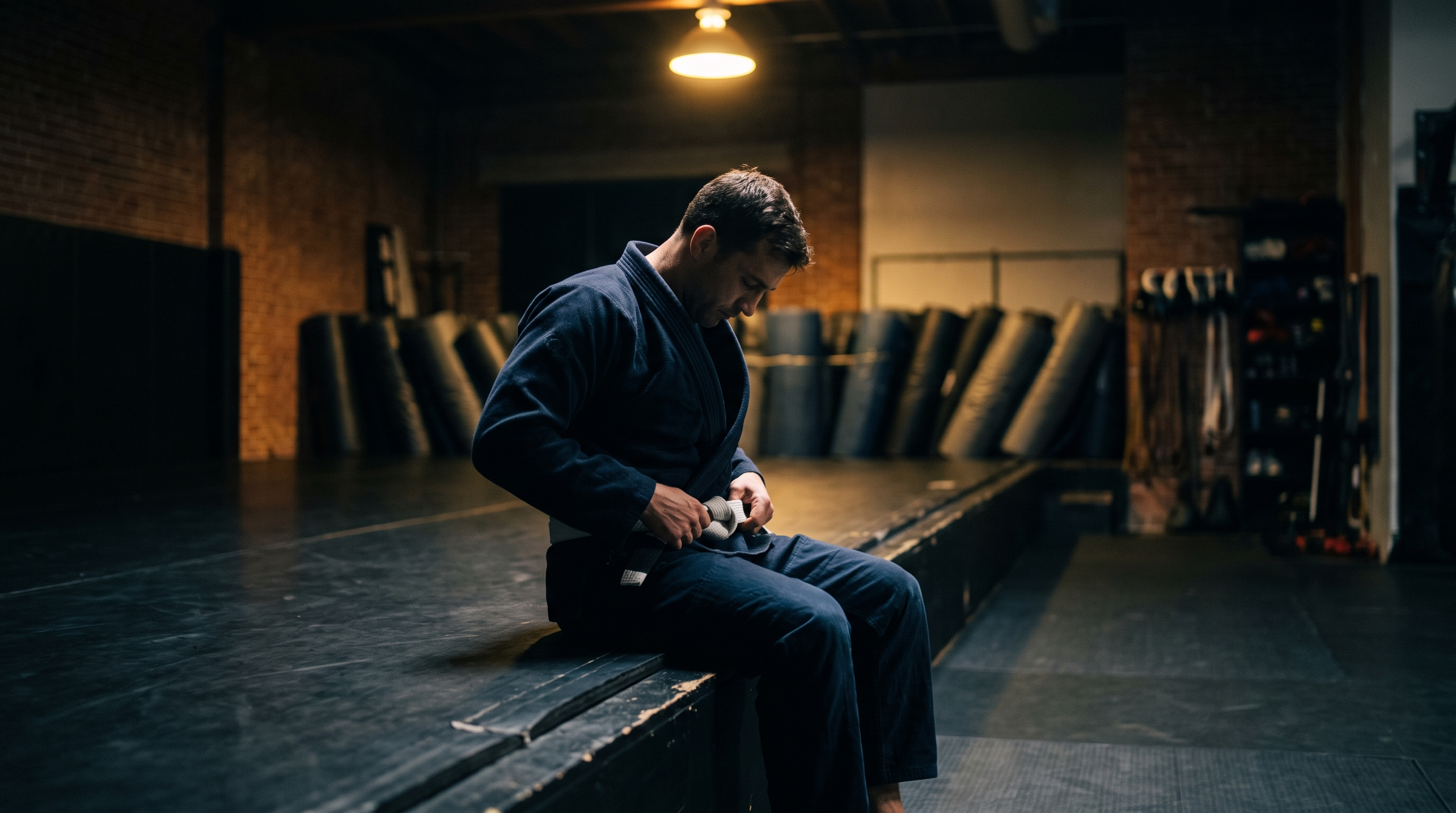
How Often Should You Train BJJ? A Realistic Guide for Hobbyists
TL;DR. For most working adults, two to four BJJ sessions per week is the sweet spot: enough to progress steadily, few enough to recover, hold down a job, and avoid injury. Beginners usually do best starting at two sessions and adding a third once the body adapts. Consistency over months matters far more than any single big week. Off the mat, short daily review (five to fifteen minutes) is what actually turns class reps into remembered techniques.
Everybody who starts Brazilian Jiu-Jitsu eventually asks the same question: how many times per week do I actually need to train? Instagram tells you to train every day. Your coach tells you to train as much as possible. Your knees tell you something completely different. This guide is written for the real hobbyist — the person with a job, a commute, maybe kids, definitely bills — who wants to keep progressing without wrecking their body or their life.
Key takeaways
- Two to four sessions per week is the realistic range for most hobbyists with jobs and families.
- Beginners should start with two sessions and add a third only after the body adapts, usually after four to eight weeks.
- Recovery is part of training — sleep, protein, and at least one full rest day per week protect your progress.
- Skipping weeks because "you can't do five sessions" is worse than doing two calm ones consistently.
- Short daily review (5–15 minutes) of what you learned in class does more for retention than adding a fourth mat session.
- Signs of burnout include dread before class, poor sleep, nagging joint pain, and a plateau — treat them as data, not weakness.
- A sustainable weekly plan mixes technique-heavy classes, controlled rolling, and one recovery or mobility day.
The hobbyist's real constraint: recovery, not motivation
Most articles about BJJ frequency assume you have the schedule of a full-time athlete. You don't. You have a job that stresses your nervous system, a body that's older than you'd like to admit, and a training partner pool where the twenty-year-olds want to spar like it's a world final.
Your real constraint isn't motivation. It's recovery capacity — how much stress your body, sleep, and nervous system can absorb before performance drops and injury risk climbs. Every session you add costs recovery. Every night of bad sleep, every stressful deadline, every skipped meal costs recovery too. When the total demand exceeds what your body can repair, you don't gain fitness or skill; you accumulate damage.
This is why the honest answer to "how often should you train BJJ" is not a single number. It's the frequency you can sustain for months and years without breaking down. For most working adults, that sits between two and four sessions a week.
What each frequency actually gets you
| Sessions per week | Realistic outcome | Best for |
|---|---|---|
| 1 | Slow progress, high forgetting between sessions | Very busy weeks; better than zero |
| 2 | Steady progression, low injury risk | Beginners in the first months, parents, high-stress jobs |
| 3 | Sweet spot: real skill gain, still sustainable | Most hobbyists at any belt |
| 4 | Strong progression if recovery is dialled in | Serious hobbyists, some competitors |
| 5+ | Diminishing returns unless you're young, coached, and recovering well | Full-time athletes and competition camps |
If you're a beginner reading this, don't skip straight to four. Your joints, grip strength, and neck have not yet adapted to the specific demands of grappling. Start with two, add a third when two feels easy, and only then consider a fourth.
Remember. The best training frequency is the one you can hold for a year, not the one that looks best on a weekly plan.
The daily 5–15 minute off-mat structure
More mat time is not the only lever. For hobbyists, the highest-leverage habit is a short daily review of what you learned in class. Grapplers watch and drill huge amounts of material and then forget most of the detail within days. A few focused minutes a day, done consistently, does more for your game than a random extra open mat.
Here's a simple daily structure you can fit into a lunch break or the ten minutes before bed:
- Minute 0–2 — Recall the technique. Without looking at anything, write or say out loud what you drilled today. Grip? Angle? First step? If you can't recall it, that's the point — you just discovered the hole.
- Minute 2–7 — Check your notes or the source video. Fill in what you missed. Note the one small detail that made it click: the frame, the head position, the timing.
- Minute 7–12 — Visualize one rep. Close your eyes and walk through the technique from start to finish, in first person. Slow. Deliberate.
- Minute 12–15 — Note your next question. What would you ask your coach next class? Write it down so you actually ask.
Do this on the days you train and on the days you don't. Fifteen minutes is a ceiling, not a target — five minutes done every day beats an hour done once.
The common failure pattern (and how to fix it)
The classic hobbyist failure loop looks like this:
- Motivation spikes. You commit to training five days a week.
- Weeks one and two are great. You feel like a killer.
- Week three: sleep tanks, a rib gets tweaked, work explodes.
- You miss two sessions, feel guilty, skip a third.
- You return two weeks later, sore, deconditioned, and demoralized.
- Repeat every few months. Net progress: minimal.
The fix is boring and it works: set your minimum, not your maximum. Decide the number of sessions you can absolutely hit every week even on a bad one — usually two. That's your non-negotiable floor. Anything above is a bonus. On a great week you might hit four; on a rough week you hit two. You never break the streak because the streak is defined by a number you can actually keep.
Other fixes that matter:
- Protect one full rest day. No lifting, no running, no rolling. Your tissues need it.
- Prioritize sleep over the extra class. Seven to eight hours beats a fifth session almost every time.
- Manage rolling intensity. You do not need to spar every partner like it's the finals. Flow rolls count as training.
- Warn your ego. Missing a week does not undo your belt.
Remember. Skipping training because you can't do "enough" is the single most damaging habit in adult BJJ. Two calm sessions this week is a win.
The BJJ Memo feature that helps here
All the recovery advice in the world doesn't help if you show up to class next week having forgotten the details you drilled last week. That's where BJJ Memo comes in — specifically, the Technique Card feature.
When you watch a YouTube instructional or breakdown, you can paste the link into the app. It pulls the transcript and generates a structured card with the steps, key details, and tappable timestamps of the important visual moments. The card goes into your personal library, sorted by position, and shows up again in your review flow before you need it.
For a hobbyist training two or three times a week, this closes the biggest leak in your progress: the gap between what you learned and what you remember. Instead of adding a fourth exhausting session, you spend five minutes revising the card on the train to work, and walk into class already knowing the shape of the technique you want to drill. It's not a replacement for mat time or coaching. It's the memory layer around it.
A realistic 7-day plan for a working adult
Below is a sample week for a hobbyist training three times, with an optional fourth session. Adjust days to your schedule; the shape is what matters.
| Day | Session | Focus | Off-mat |
|---|---|---|---|
| Monday | BJJ class (60–90 min) | Technique + light positional sparring | 10 min review of today's technique |
| Tuesday | Rest or 20 min mobility | Hips, neck, shoulders | 5 min recall of Monday's detail |
| Wednesday | BJJ class (60–90 min) | Technique + rolling (choose partners) | 10 min review + note one question for coach |
| Thursday | Optional strength (30–45 min) | Squat, hinge, pull, carry | 5 min visualization of a go-to technique |
| Friday | Rest | Sleep priority | 5 min review of the week's techniques |
| Saturday | BJJ class or open mat | Positional sparring, flow rolling | 10 min log of what worked and what didn't |
| Sunday | Full rest | Walk, family, food | 5 min plan for next week's focus |
If you can only train twice, drop Wednesday or Saturday. If you can train four times, replace Thursday's strength with a fourth mat session — but keep the two full rest days.
If you compete
Competitors will push toward four or five sessions in the six to eight weeks before an event. That's fine, but it's a camp, not a lifestyle. After the event, come back to your sustainable frequency. Riding a camp intensity year-round is how hobbyist grapplers end up with chronic knee, neck, and back issues.
Practical guardrails so you actually stick with it
- Book classes in your calendar like meetings. If it's not scheduled, it won't happen.
- Prep your gi bag the night before. Zero decisions in the morning.
- Don't roll with the maniac when you're tired. Politely tap out of the round or pick a technical partner.
- Cut your session short if something feels wrong. One skipped roll beats six weeks off with an injury.
- Track sessions somewhere. Even a simple count per month tells you the truth about your training year. See our guide on BJJ progress tracking for a lightweight system.
For more on the surrounding habits, our articles on how to remember BJJ techniques, taking notes in BJJ, and learning BJJ from YouTube all plug into the same principle: use your off-mat time to protect and multiply the value of your on-mat time. If you're brand-new, start with our first six months of BJJ guide.
Remember. Sessions per week is the input people obsess over. Sessions per year is the number that actually determines your belt.
Frequently asked questions
How often should a beginner train BJJ?
Start with two sessions per week for the first four to eight weeks. Your body needs time to adapt to grip work, being folded up, and the specific soreness of grappling. Once two sessions feel easy and you're not walking around wrecked, add a third. Jumping to five sessions in month one is the fastest route to an injury or an early quit.
Is training BJJ three times a week enough to progress?
Yes. For the vast majority of hobbyists, three sessions per week is a genuinely strong training load and will produce steady progression at every belt. Progress at three sessions plus consistent recall and review off the mat will out-pace five chaotic sessions with no review.
Can I train BJJ every day?
You can, but most hobbyists shouldn't. Daily training only works when the intensity is carefully managed, sleep and nutrition are dialled in, and at least some sessions are light drilling or flow. Without those, daily training turns into daily damage.
How do I know if I'm burning out?
Common signs include dread before class, unusual soreness that doesn't go away, poor sleep, irritability, a stalled game, and small injuries stacking up. If two or more of those show up together, take a full rest week. You will not lose your skill. You will very likely come back sharper.
What should I do on rest days?
Actually rest. Walk, sleep, eat well, do some easy mobility if you like. Rest days are when your body actually builds the adaptations from training. Filling them with hard lifting or long runs defeats the point.
Should I lift weights alongside BJJ?
One or two short strength sessions per week — focused on basic patterns like squat, hinge, pull, and carry — will support your BJJ, protect your joints, and keep you training longer. More than that, and the two disciplines start to compete for your recovery.
Wrap-up: pick a frequency you can hold
How often should you train BJJ? Often enough to progress, rarely enough to recover, and consistently enough to still be doing it in five years. For most working adults, that means two to four sessions a week, one or two full rest days, and a short daily habit of reviewing what you learned.
Next time you finish a class or watch an instructional, save the technique as a card in BJJ Memo so it's waiting for you — organized, timestamped, and ready to review — before your next session. Build your library on iOS and Android, and let the memory layer do the work while you focus on training.
For real feedback and safety, keep training the technique at a legit academy with a qualified coach — BJJ Memo helps you remember and revise, it doesn't replace mat time.
Last updated 2026-08-11.