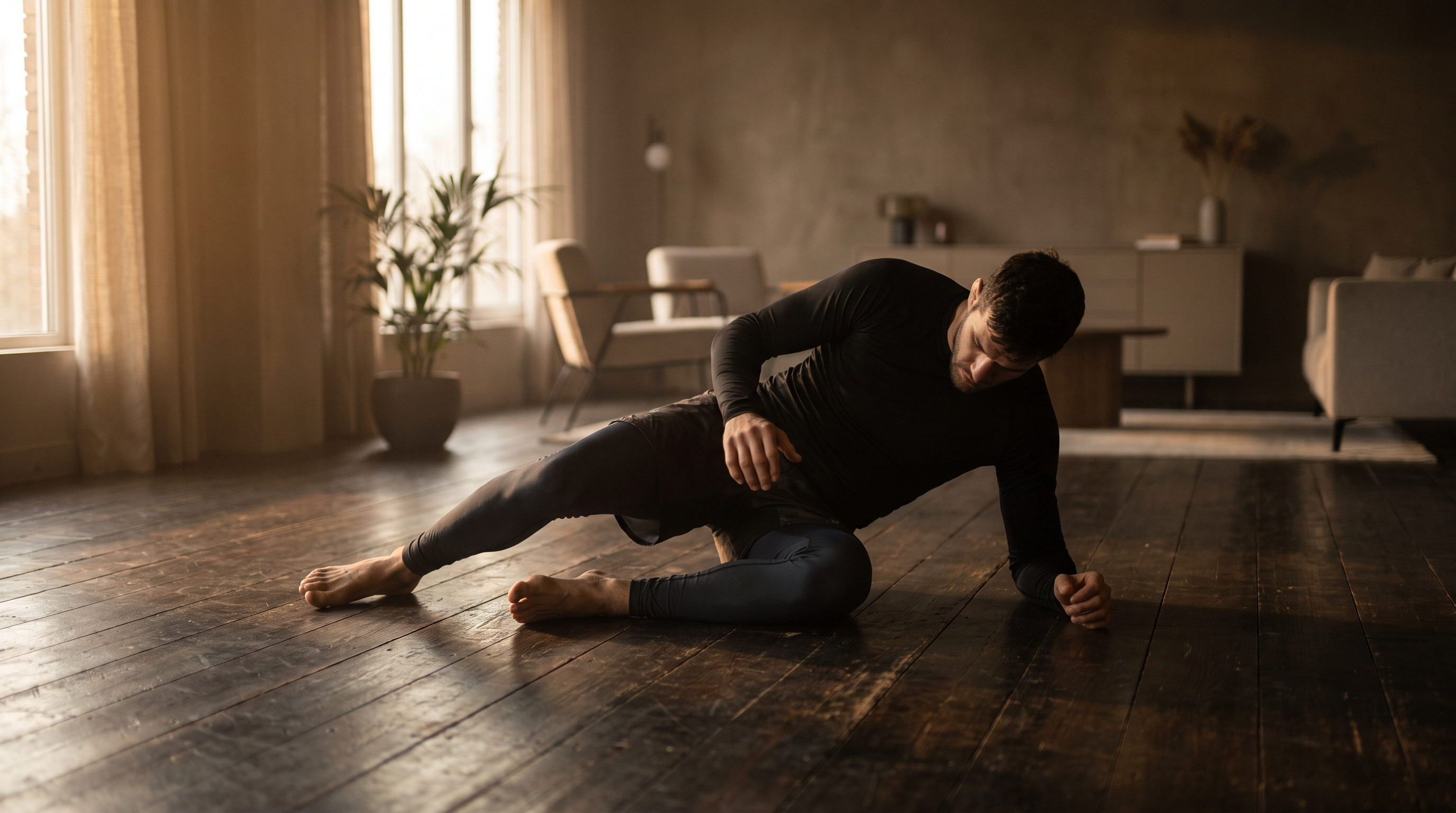
How to Drill BJJ Alone at Home: 12 Solo Movements That Actually Transfer
TL;DR. You can build real BJJ attributes at home without a partner by drilling the movement patterns that underpin guard, passing and escapes. Focus on hip mobility, shrimping, technical stand-ups, bridges, sit-outs and guard retention footwork — not random calisthenics. Keep sessions short (10–20 minutes), consistent (3–5×/week), and film yourself so you can compare against instructionals. Solo work does not replace live training with a coach, but it fixes the movement leaks that show up on the mat.
Most grapplers only touch the mats two or three times a week. In between classes, life gets in the way and technique fades. Solo drilling at home is the cheapest, most flexible way to close that gap — but only if you drill the right things. Endless burpees and yoga flows will not fix your side control escape. Shrimping badly for ten minutes a day will not fix it either. What actually transfers is a small menu of BJJ-specific movement patterns, drilled with the intention of a position, repeated often enough that your hips stop asking your brain for permission. This guide gives you twelve of those movements, a simple weekly system, and the honest limits of what solo work can and cannot do.
Key takeaways
- Solo BJJ drills work when they target the exact movement patterns you use in rolling: shrimping, bridging, standing in base, inverting and hip switching.
- Short, frequent sessions (10–20 minutes, 3–5 times per week) build more skill than long, occasional grinds.
- Film every session from the side — most solo drilling looks worlds better in your head than it does on video.
- Pair each solo movement with the position it belongs to (shrimp = escape side control, technical stand-up = self-defense and stand-up out of guard).
- Rotate a small menu of 6–8 movements per week; adding too many at once dilutes reps and reinforces sloppy patterns.
- Solo drilling is a supplement to mat time, not a substitute — you still need live resistance and coaching to make it real.
- Turn instructionals into short, revisable notes so your at-home reps actually match what you're trying to learn.
Why this happens: solo drilling gets a bad rap for good reasons
Ask a room of black belts whether you should drill at home and you will get very split answers. The reason is simple: most people who drill alone are drilling the wrong things, in the wrong way, and getting no return on that time. They shrimp with their shoulders instead of their hips, they bridge without turning, they invert into a shape they will never use in guard, and they call it "training."
BJJ is a partner sport. You cannot learn timing, pressure, grip fighting or reactions without another human trying to beat you. That is why nothing replaces class. But BJJ is also a movement sport, and movement patterns are trainable in your living room. If your hip escape is weak, your side control escape will be weak too — no matter how good your understanding of the position is. Solo work is where you rebuild those primitives so class time can be spent on the things only class can teach: connection, timing and problem-solving under pressure.
The trick is to stop thinking of solo drills as "working out" and start thinking of them as rehearsing a position without a partner in the way. Every rep should look like a fragment of a real technique.
Remember. A movement drill is not a workout. If you are gassed after ten minutes of shrimping, you are moving with your abs and shoulders instead of your hips. Slow down.
A simple system: 12 movements, 5 sessions a week
Below is a menu of twelve solo movements grouped by the position they belong to. You do not do all twelve in one session. Pick 4–6 per session, keep the total under 20 minutes, and rotate through the menu across the week.
The 12 movements
| # | Movement | Position it feeds | Focus point |
|---|---|---|---|
| 1 | Hip escape (shrimp) | Escaping side control, mount, half guard | Push off the far foot, land on your side, not your back |
| 2 | Reverse shrimp | Retaining guard, recovering after a pass attempt | Drive the elbow-side hip back, keep the far knee inside |
| 3 | Bridge and turn | Escaping mount, upa | Bridge over the shoulder, not straight up |
| 4 | Technical stand-up | Self-defense, standing up in open guard | Post hand and post foot on the same side, other leg through |
| 5 | Sit-out | Turtle, front headlock defense | Long, low sit-out — hip and shoulder facing the ceiling |
| 6 | Granby roll | Guard retention, back escape | Roll over the shoulder, not the neck |
| 7 | Forward and backward rolls | Inversions, scrambles | Land soft, protect the neck, breathe out on impact |
| 8 | Leg pummels (seated) | Half guard, guard recovery | Slow, deliberate inside-outside changes |
| 9 | Hip switch / knee slide shadow | Passing, top pressure | Feel the knee-line change on the floor |
| 10 | Solo invert (candle) | Guard retention, berimbolo family | Chin tucked, weight on the upper back, not the neck |
| 11 | Base circles on all fours | Bottom turtle, top pressure | Move around a fixed knee like it is a leg you are trapping |
| 12 | Sprawls | Takedown defense, guillotine defense | Hips to the floor, head up, weight forward |
The weekly system
- Pick a theme for the week. For example: "escapes from the bottom." Choose 5–6 movements that feed that theme.
- Warm up for 3–5 minutes. Easy hip circles, spinal rotations, neck mobility. You are drilling technique, not doing CrossFit.
- Drill each movement for 60–90 seconds. Not for reps — for time, at a controlled pace. Quality first.
- Do 2–3 rounds with 30 seconds of easy breathing between movements.
- Film one round from the side. Watch it back the same day.
- Note one thing to fix next session. Just one. Write it down.
- On rest days, replace the drill session with a 10-minute mental review of a technique you learned that week.
That is it. Twenty minutes, five times a week, targeted at the movements that actually show up in your rolls. It is boring on paper and devastatingly effective on the mat.
Remember. The goal of solo drilling is not to become good at solo drills. It is to make the movement invisible when you need it in a live position.
Anchor each drill to a real position
A shrimp in a vacuum is a shape. A shrimp with the intention of "my opponent is crossfacing me from side control and I need to get my knee in" is a technique. Every time you drill a movement, imagine the opponent, the pressure, the frame. Look at your hands: are they where they would be in the real position, or are they flopping on the floor?
This is the single biggest difference between grapplers who improve from solo work and grapplers who do not. Same drill, different intent, wildly different results.
A useful loop is:
- Watch a short piece of an instructional on the position (a 3–5 minute clip is enough).
- Extract the core movement pattern from it.
- Drill that pattern solo for a week.
- Test it in live rolling next class.
- Revise it before your next session so you do not forget the detail.
If you want a system to capture and revisit those clips so you actually remember the details a week later, that is exactly what BJJ Memo is built for — more on that below.
Common mistakes that kill your solo drilling
Most people do not fail at solo drilling because they lack discipline. They fail because they are drilling in a way that reinforces bad habits. Watch for these:
1. Shrimping off your shoulders instead of your hips
If your shoulders slide down the floor and your hips stay put, you are not shrimping — you are wriggling. Push off the foot, lift the hip, land on your side. Slow it down until you can feel the hip do the work.
2. Bridging straight up
A bridge that goes straight up and comes straight down is a glute exercise, not an escape. Real bridges go over the shoulder, loading one side to create the angle you need to turn into.
3. Doing too many movements per session
Twelve drills, 30 seconds each, three rounds — that is a workout, not learning. Pick four or five per session and give them real attention.
4. Never filming yourself
What you feel and what you look like are almost always different. A single clip from the side, watched once, will do more for your drilling than another twenty minutes of unfilmed reps.
5. Copying random Instagram flows
A lot of viral "BJJ solo drill" videos are choreography, not technique. If you cannot name the position each movement belongs to, do not add it to your menu.
6. Skipping the review step
Drilling without reviewing what you learned in class is like reading a book and never opening it again. The movement pattern sticks; the technique it belongs to fades. Both need to be revised, not just the physical rep.
7. Treating solo work as a replacement for class
You cannot learn to grapple without grapplers. If you are training zero times a week and drilling at home five times a week, you are building a beautiful movement library for a sport you are not actually playing.
How BJJ Memo fits in
Most of the value of solo drilling comes from matching the movement to a specific technique you are trying to remember. That is where things fall apart for most people: you watch an instructional on Sunday, forget the key detail by Wednesday, and drill something vaguely similar on Friday.
BJJ Memo turns any BJJ YouTube video into a structured technique card — the steps, the key details, and tappable timestamps on the visual moments — and files it into a searchable library you can revise before class or before a solo session. Paste a link on Sunday, get a clean card, revise it in a minute on Friday, drill the actual detail — not your best guess at it.
It is a retention tool, not a coach. Combined with consistent solo movement work and real mat time, it closes the loop between what you watch, what you drill, and what you can actually do.
Frequently asked questions
How often should I drill BJJ alone at home?
Three to five short sessions per week (10–20 minutes each) is a sustainable range for most hobbyists. Consistency beats duration. A daily 10-minute session will do far more for your movement than one 90-minute grind on the weekend.
Can I get good at BJJ just by drilling at home?
No. BJJ requires live partners, resistance, timing and coaching. Solo drilling builds the movement primitives (shrimping, bridging, standing up, inverting) that make your mat time more productive, but it cannot teach you connection, grip fighting or timing. Use it as a supplement to at least one or two classes a week.
What is the single most important solo drill for beginners?
The hip escape (shrimp), done slowly and correctly. It is the foundation of every bottom escape and most guard retention. If you only had time for one movement, that would be it — followed closely by the technical stand-up.
Do I need any equipment to drill BJJ at home?
No. A patch of clear floor and enough space to lie down and roll is enough. A yoga mat helps if your floor is hard. A phone on a small tripod (or leaning on a shoe) for filming is the only real "gear" worth buying.
How do I know if my solo drilling is actually working?
Two tests: (1) film yourself and compare against a reference clip from a black-belt instructional — the movement should look like theirs, not a rough sketch of theirs; (2) notice whether the position feels less panicky in live rolling. If your escape from side control is happening on reflex instead of thought, the drilling is transferring.
What is the best way to remember techniques I learn in class or from YouTube?
Write them down the same day and revisit them at least once before your next session. A short structured note (position → steps → key detail → common mistake) beats trying to memorize a full video. BJJ Memo does this from any YouTube link and gives you a revision flow before training.
The bottom line
Solo drilling works when you treat it like rehearsal for a real position, not a workout. Twelve movements, five short sessions a week, filmed and reviewed, anchored to techniques you are actively trying to learn — that is the entire system. Everything else is noise.
Next time you watch an instructional, save it as a technique card in BJJ Memo so the key detail is still there on Friday when you unroll the mat in your living room. Available on iOS and Android.
A note on safety and coaching. These drills are movement patterns — safe to practice alone at a controlled pace. But BJJ is a contact sport with real technical depth. For real feedback, timing and safety, train the techniques at a legit academy with a qualified coach. BJJ Memo helps you remember and revise what you learn; it does not replace mat time or a good instructor.
Last updated 2026-08-22.