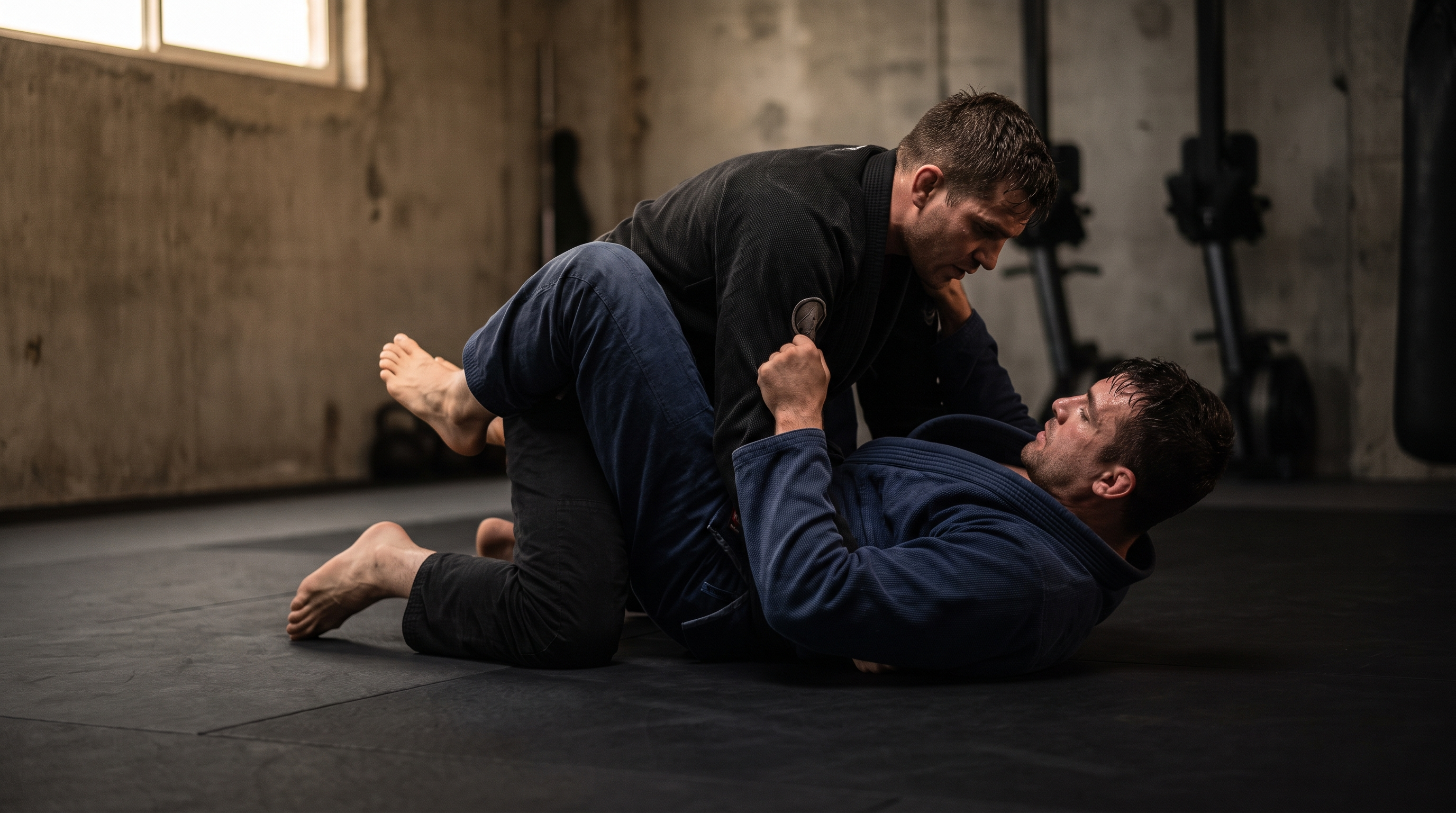
How to Escape Half Guard Bottom When You're Getting Flattened: A White Belt Framework
TL;DR. Getting flattened in half guard usually means you lost your inside space, your head is pinned, and your top hand is trapped. The fix is a repeatable sequence: create frames, turn onto your side, dig the underhook or crossface answer, pummel to inside space, then rebuild guard or hit a sweep. Don't panic-bridge — earn the position back in order.
If you've been training for a few months, you already know the feeling: you shot for a sweep, the top player based out, and now you're flat on your back with a knee wedged between your legs, a heavy chest on yours, and a forearm pressing into your jaw. Every time you try to move, you feel yourself sliding closer to mount. This article walks through why you get flattened in half guard and gives you a simple, ordered framework you can use in live rolls tonight. It's written for white and early blue belts who want a system, not a highlight reel.
Why you get flattened in the first place
Half guard bottom is a fight for three things: your inside shoulder, your head position, and your hips. When you lose any two of them, you get flattened. When you lose all three, you're one small mistake from side control or mount.
Here is what usually happens, in order:
- You attempted a sweep or entry and your top shoulder touched the mat.
- The top player felt that shoulder drop and immediately drove their crossface into your far cheekbone, turning your head away from them.
- Their underhook arm slid under your armpit before you could pummel back.
- Their hips dropped low and heavy, killing your ability to shrimp.
- Your bottom leg loosened, and now they're threatening the knee slide or back step to mount.
Once your head is turned away and their underhook is in, you can't just muscle your way back up. Bridging harder makes it worse — you're literally lifting them into a better pass. The escape has to happen in the right order.
Remember. You don't escape flat half guard by getting stronger. You escape it by getting on your side again. Everything else follows from that.
A simple system: five steps from flat to recovered
Think of this as a checklist. Don't skip steps. If you can't complete a step, that's your problem to solve before moving on.
Step 1 — Frame first, don't fight
The instant you feel flat, plant your near-side forearm across their collarbone or bicep and your far-side hand under their crossfacing elbow. This isn't an escape — it's a pause button. You are buying yourself two seconds to think.
Step 2 — Turn onto your side
Use your frames to walk your shoulders — not your hips — toward the top player's hips. The goal is to get your bottom shoulder off the mat. Even 30 degrees of turn changes everything. Your head should be looking at them, not away.
Step 3 — Answer the crossface
Before you dig for the underhook, you have to deal with the crossface. Two clean answers for beginners:
- Head post: cup the back of their crossfacing tricep and post their arm up and over your head.
- Chin tuck + shoulder shrug: tuck your chin toward your near shoulder and shrug — this collapses the space they were using to twist your neck.
If you skip this step, they will keep steering your head, and any underhook you win will get stripped.
Step 4 — Pummel to the underhook
Now, and only now, do you fight for the underhook. Snake your near-side hand along your own ribs, palm up, and swim it under their arm until your hand comes out behind their shoulder. Lock your bicep tight to their armpit. Don't lace your hands behind their back yet — that's how you get flattened again.
Step 5 — Restore inside space and exit
With the underhook in and your head clear, drive your top-side knee across their hip. This creates the wedge you need to either:
- Rebuild to knee shield / Z-guard,
- Come up on the underhook to a dogfight,
- Hit an old-school shoulder-of-Justice sweep,
- Or recover full guard by threading your free leg over their back.
The key insight: you don't choose the exit until you have the position back. Choosing the finish while still flat is what gets you passed.
The framework at a glance
| Step | What you're doing | What breaks if you skip it |
|---|---|---|
| 1. Frame | Forearm on collarbone, hand on elbow | You have no time; you get smashed |
| 2. Turn to side | Shoulders rotate toward their hip | You can't fight the crossface |
| 3. Kill the crossface | Post the head or shrug/tuck | Any underhook you win gets stripped |
| 4. Pummel underhook | Palm up, hand behind shoulder | You stay pinned |
| 5. Restore inside space | Knee across their hip line | You have no exit, only survival |
Remember. The order is Frame → Turn → Head → Underhook → Knee. If a step fails, go back one — don't skip forward.
Common mistakes that keep you stuck flat
Even students who "know" the escape get flattened over and over. Nine times out of ten, one of these is the reason.
- Bridging early. A big bridge without frames just launches the top player into a better pass. Frame first, then use small bridges to turn, not to buck.
- Reaching for the underhook with your head still turned. If your ear is on the mat and your chin is pointing away, you've already lost the underhook race.
- Flat, straight bottom leg. A dead bottom leg is a free knee slide for the top player. Keep some tension and a slight bend so you can shrimp.
- Grabbing the belt or the gi behind their back. You feel connected; you're actually helping them stay tight. Stay on the underhook — nothing else.
- Panicking and giving up the back. Turning your belly to the mat before you have the underhook is how white belts feed the back take. Stay on your side.
- Trying to sweep before recovering. You can't sweep a mountain you're pinned under. Recover first, sweep second.
Remember. Almost every "my half guard doesn't work" problem is really "I never got off my back in the first place."
How to actually build this into your game
This framework is worthless if you only read it once. A few practical suggestions:
- Positional sparring: start every round already flat, with a good training partner in a smashing top pressure position. Reset when you recover or get passed. Ten focused rounds beats an hour of "just rolling."
- Slow reps: in drilling, work each step at 30% speed. If you can't do the turn slowly, you can't do it against resistance.
- Film your rolls: even a phone on a gym bag will show you exactly when your shoulder hit the mat and why.
- Ask your coach. Nothing beats a black or brown belt watching your bottom half guard for two minutes and pointing at the one thing you're doing wrong. Read our guide on getting the most from your first BJJ classes for more on this.
Where BJJ Memo fits in
Half guard is the classic position where students forget the details. You get shown a beautiful underhook recovery on Monday, and by Friday you can only remember "something with the elbow." The whole point of BJJ Memo is to fix exactly that gap.
When you find a good half guard instructional on YouTube — a Lachlan Giles breakdown, a Bernardo Faria fundamentals video, your coach's own channel — paste the link into the app. It builds a structured technique card with the steps and the timestamps of the important visual moments, and files it into your personal library. Before class, you flip through your "half guard bottom" cards for two minutes and walk in with the details fresh. That's it. It doesn't replace your coach, your training partners, or mat time; it just makes sure the reps you're already doing don't disappear from your memory by the weekend. See how the technique card system works if you want the full picture.
Frequently asked questions
Why do I always end up flattened in half guard even though I know the escape?
Usually because you're trying to execute the escape after the crossface and underhook are already in. The escape starts the instant your bottom shoulder starts to drop — not thirty seconds later when you're already pinned. Train the reframe as a reflex, not as a decision.
Do I have to get the underhook, or can I use the knee shield?
Both are valid, but they answer different situations. The underhook is your primary answer when you're already flat. The knee shield is a preventive frame you use before you get flattened. If your knee shield collapsed, you're in underhook territory.
Is bridging bad in half guard?
Not inherently — but big, vertical bridges while flat are counterproductive. You want small, diagonal hip movements that help you turn onto your side. Save the big bridges for elbow escapes from mount.
How long does it take to make half guard bottom actually work?
Honestly, months of consistent, focused reps — not a week. The good news is that the framework above is the same framework used at every level; you're just refining details. Track your reps in your technique library and revise before every class so the details stick.
Should white belts even be playing half guard bottom?
You don't really get to "choose" — you'll end up there constantly. Rather than avoiding it, learn to survive and recover from it early. It's one of the most valuable positions to understand as a beginner.
What if my opponent is much bigger and stronger?
The framework matters more, not less. Big, strong opponents will win any strength contest, so you have to win with position. Frame early, protect your head, and don't give them the underhook race. Read our beginner survival guide for more on rolling with heavier training partners.
Wrap-up
Getting flattened in half guard is not a sign you're bad at BJJ — it's a sign you're actually training with people who know how to pass. Use the framework: Frame → Turn → Head → Underhook → Knee. Drill it slow, spar it in positional rounds, and review the details between sessions so they're loaded in your head when the whistle blows.
Next time you watch a half guard instructional, save it as a technique card in BJJ Memo so it's there before your next roll — iOS and Android.
Coach disclaimer: This article is for study and revision, not a substitute for coaching. For real feedback, corrections, and safe drilling, train these techniques at a legitimate academy with a qualified instructor. BJJ Memo helps you remember and revise — it doesn't replace mat time.
Last updated 2026-09-02.