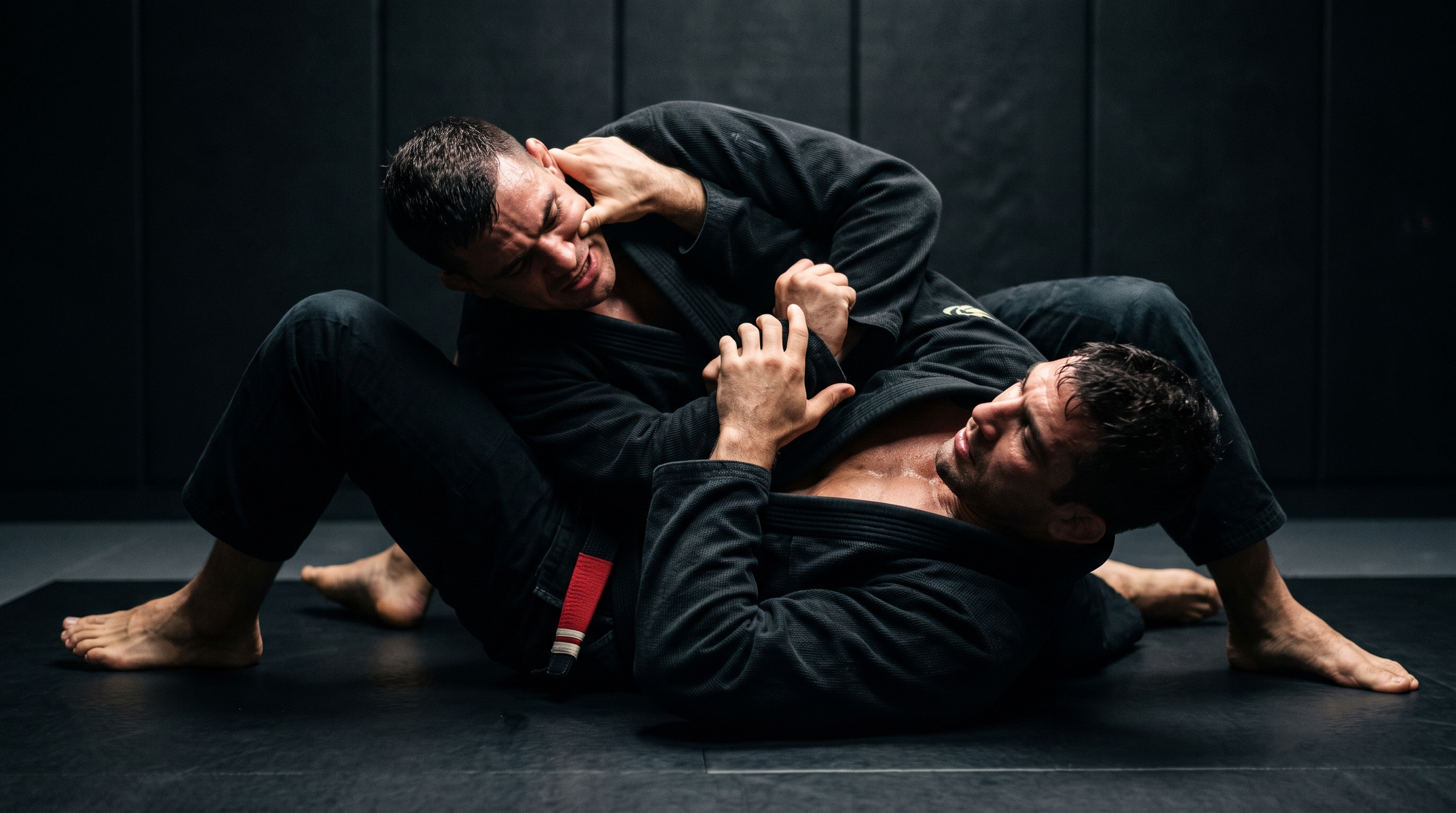
How to Escape Half Guard Bottom When You're Getting Flattened
TL;DR. Getting flattened in half guard bottom is one of the worst feelings in BJJ — you can't breathe, can't move, and every second you waste there drains your gas tank. The escape isn't a single move, it's a sequence: survive the crossface, rebuild your inside frames, get to your side, fight for the underhook, and only then work a knee shield or dogfight. Skip a step and you'll stay stuck.
If you've been training for more than a few weeks, you already know the feeling. Someone passes to half guard, drops their chest onto your face, threads a crossface, and suddenly you're flat on your back with all their weight on your sternum. Your legs are trapped, your arms are pinned inside, and every attempt to move seems to make it worse. This is the flattened half guard — a position where beginners lose matches and even solid blue belts panic.
The good news: getting out is a repeatable process, not a scramble. Once you understand the order of operations — crossface first, frames second, side third, underhook fourth — the escape becomes almost boring. This guide breaks down why you get flattened, a simple 6-step system to rebuild, the common mistakes that keep you stuck, and how to actually retain what you learn between sessions.
Why you get flattened in half guard
Flattened half guard is not one problem; it's a stack of small problems that compounded. Understanding the chain is what lets you break it.
You lost your side
Half guard only works when you're on your side, facing your opponent, with your bottom shoulder off the mat. The moment your back goes flat, your hip mobility disappears, your knee shield collapses, and every frame becomes shorter and weaker.
You lost the underhook (or never had it)
In bottom half, whoever controls the underhook controls the position. If your opponent has a strong overhook and a crossface on the same side, they can walk their hips around and start hunting the pass to mount or side control.
The crossface pins you
The crossface — their forearm or biceps pressed across your jaw, turning your head away from them — is the tool that keeps you flat. As long as it's locked in, you physically cannot turn back onto your side. Fix the crossface and you unlock every other step.
Your frames are gone
When you're flat, your hands are usually stuck inside, palms up, doing nothing useful. Without frames on their hip and shoulder, you have no leverage to create the small space you need to shrimp.
Remember. You didn't get flattened in one moment. You got there because three or four small mistakes stacked. That means the escape is also three or four small corrections — not a single miracle move.
A simple system to escape flattened half guard
This is the order. Do it in this order every time, even when it feels slower than a scramble. Rushing steps is what got you flattened in the first place.
1. Protect the neck and breathe
Before you try to escape, make sure you can survive. Tuck your chin toward the shoulder they're crossfacing from. Bring your near-side elbow tight to your ribs so they can't slide it up for an arm-triangle setup. Take one deliberate breath. Panic-breathing burns oxygen you need.
2. Kill the crossface
Bring your far-side hand (the one furthest from their crossface arm) up to their biceps or wrist and post firmly. At the same time, shrug your near-side shoulder up toward your ear. This combination creates a wedge that stops them from stapling your head to the mat. Do not skip this. If the crossface is live, no other step works.
3. Rebuild your inside frames
Once the crossface is weakened, slide your near-side forearm across their hip or into their bottom rib. Your other hand should still be controlling their crossfacing arm. Now you have two frames — hip and shoulder — which is the minimum you need to move.
4. Shrimp and turn onto your side
Using your frames, push your hips away and turn to face them. Even a small angle is enough. The goal is to get your bottom shoulder off the mat and your knee back in front of their hip. If your leg is still trapped, that's fine — you just need to be facing them, not the ceiling.
5. Fight for the underhook
As you turn onto your side, drive your near-side arm under their armpit and lock your palm on their upper back or shoulder blade. If you can't get deep, a shallow underhook and a head position that presses ear-to-chest is enough to stall their momentum. Whoever wins this grip usually wins the exchange.
6. Choose an exit
With the underhook and your side back, you have real options:
| Exit | When to use it | Risk |
|---|---|---|
| Knee shield | You have space and your top leg is free | Low, but easy to get smashed again if lazy |
| Dogfight / wrestle-up | You have a strong underhook and good head position | Medium — expect scrambles |
| Old-school (deep underhook, hip out) | You've drilled it and have the underhook deep | Medium — leg is still trapped |
| Recover full guard | Their pass is loose and you can hip-escape | Low if space is real, high if you force it |
7. Reset your posture
If the exchange settles and you're back in half guard with your side, underhook, and knee shield, stop and breathe. Do not immediately attack a sweep. Establish the position, then work.
Remember. The escape sequence is neck → crossface → frames → side → underhook → exit. If you skip an early step, the later steps won't work — no matter how many YouTube videos you've watched.
Common mistakes that keep you flattened
These are the mistakes coaches see over and over, especially in white and blue belts.
Bridging straight up
Bridging into their chest without first killing the crossface just resets you flatter. Bridging works only when you're already partially on your side and can turn into the bridge.
Reaching for the underhook first
The underhook is step five, not step one. If you dive for it while flat, they'll whizzer, drive their hips down, and pass to mount. Get your side first, then the underhook comes cheaper.
Trying to recover full guard immediately
Half guard exists because full guard was already lost. Trying to force the trapped leg back around before you've fixed your posture usually gives up the pass entirely.
Ignoring the head
If your head is being pushed away, everything else fails. Head position (chin tucked, ear looking at them, not the ceiling) is a huge part of framing.
Holding the breath
Under pressure, people freeze their diaphragm. Frozen diaphragm equals frozen hips. Exhale slowly while you frame — it actually helps you turn.
Fighting grips instead of position
Beginners obsess about hand-fighting. Grips serve position. Get your side back first; the grips become easier to win once your structure is correct.
Where BJJ Memo fits in
Here's the honest problem: you'll read this article, drill the sequence in class next week, and by the following week you'll have forgotten step three. That's not a failure of effort — it's how memory works. Techniques you learn once fade unless you deliberately review them.
BJJ Memo is built for exactly this. Paste the YouTube instructional you're learning from (a Lachlan Giles half guard breakdown, a Bernardo Faria classic, your coach's own channel) and the app turns it into a structured Technique Card — steps, key details, tappable timestamps of the important moments. Save it to your library, then review the card the morning of training so the sequence is fresh when you hit the mat.
For a wider look at building this habit, see our guide on how to remember BJJ techniques and our breakdown of how to study BJJ instructionals effectively. Retention is the difference between a technique you've seen and one you can actually hit.
Frequently asked questions
What's the first thing I should do when I get flattened in half guard?
Protect your neck, tuck your chin, and take one controlled breath. Then attack the crossface — that single grip is what's keeping you flat. Trying to escape before neutralizing the crossface is why most beginner attempts fail.
Do I need the underhook to escape half guard bottom?
In most cases, yes. The underhook is the single most important grip in bottom half guard. That said, if you can't get it, the dogfight (double unders on the leg and wrestling up) and the knee shield are legitimate paths out, provided you've first gotten back to your side.
Why does bridging not work when I'm flattened?
Bridging works when you have somewhere to turn to. If the crossface is locked and your frames are gone, bridging just lifts your opponent slightly and drops you back into the same pin. Fix the crossface and rebuild a frame first, then a small bridge becomes a real turn.
How long should it take to escape half guard bottom?
There is no fixed number. In a hard roll it might take several exchanges — you attack the crossface, they re-establish it, you frame, they cut through. Treat it as a series of small wins rather than one big escape. Each inch of space you earn is progress.
Is it safe to drill this at home without a partner?
Solo drills for shrimping, framing, and hip mobility are useful, but the escape itself needs a live partner to feel the pressure. Drill the movement patterns solo, then practice the full sequence with a training partner at the academy. Don't try to invent details from feel alone — get eyes on it from a coach.
Can I use this against a much heavier training partner?
Yes, but expect the timing to be tighter. Against heavier partners the crossface hits harder and your frames get compressed faster, so the earlier you attack step one, the better. If you're consistently getting flattened by the same partner, ask your coach to watch a round and correct your posture.
Build the escape, then keep it
The flattened half guard is beatable. It just requires that you respect the order: neck, crossface, frames, side, underhook, exit. Drill it slowly enough that your body knows the sequence before your brain has to think about it. In a live round, that's the difference between panicking and problem-solving.
For real feedback and safety, train the technique at a legit academy with a qualified coach — this article and BJJ Memo help you remember and revise, they don't replace mat time.
Next time you watch a half guard instructional, save it as a Technique Card in BJJ Memo so the details are there before your next session. Build your personal half guard library, review it the morning of training, and you'll stop losing the same position twice.
Last updated 2026-09-27.