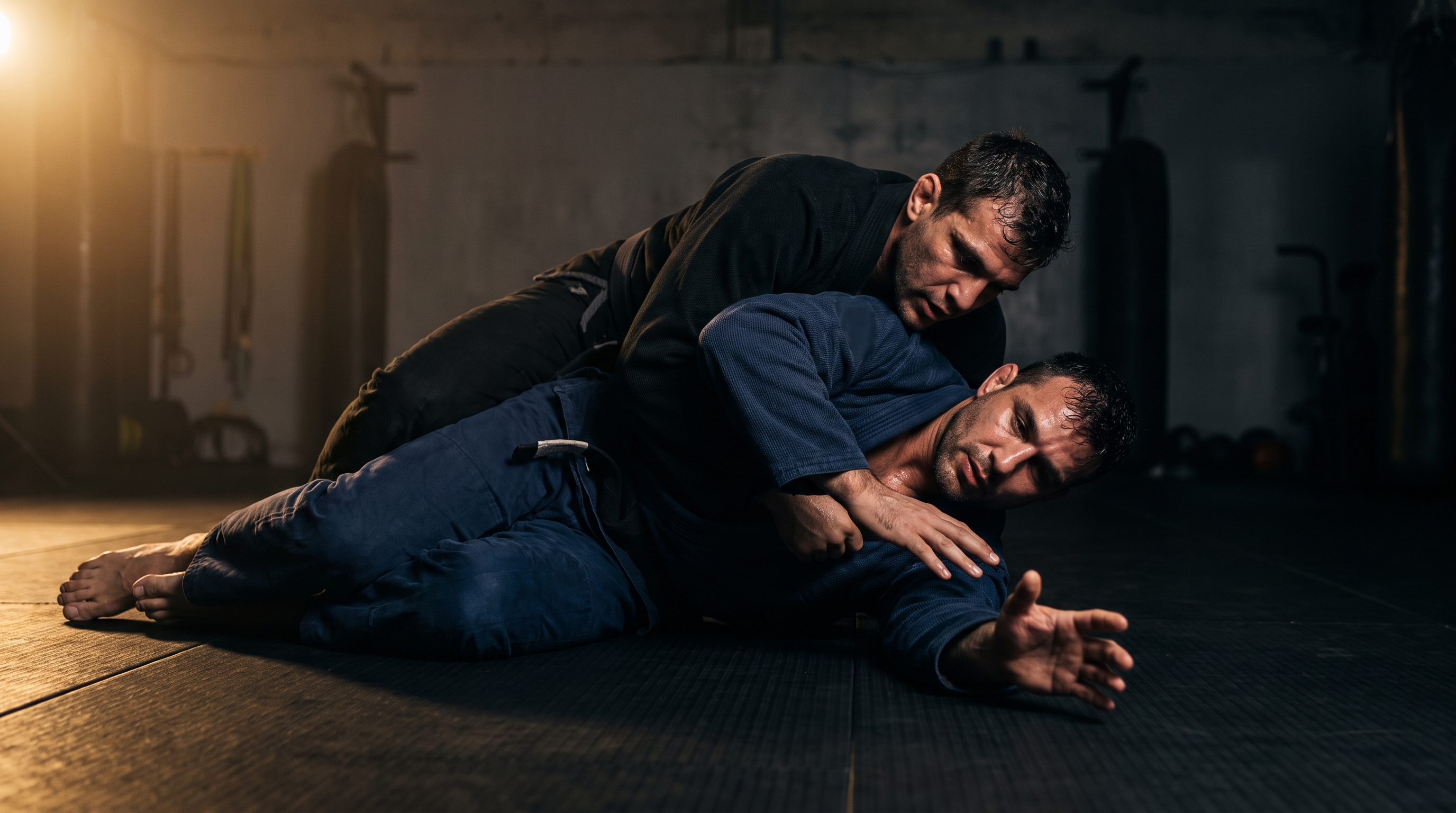
How to Escape Half Guard Bottom: A White Belt's Framework for Getting Back to Guard
TL;DR. Half guard bottom feels awful because you're carrying weight and losing the underhook race. The fix is a sequence, not a scramble: build a strong frame, win the underhook, get to your side, and choose one of three exits — recover full guard, come up on a single, or take the back. Drill the sequence in that order and most bad half guards become workable.
Most white belts end up in half guard bottom by accident: someone starts to pass, you catch a leg on the way through, and now you're pinned with one of their knees between yours, an arm across your chest, and no clear plan. Panic sets in, you hold your breath, and thirty seconds later you're flat, arm-triangled, or getting passed to mount. This article gives you a clean framework you can use every roll — build frames, win the underhook, get to your side, then pick one of three exits. It won't turn you into a half guard specialist. It will stop you from drowning down there.
Why this happens
Half guard bottom is uncomfortable for a reason: your opponent is chest-to-chest, driving weight into you through the crossface, and your only real defensive tool is the leg you're trapping. When they get the crossface (their arm across your jaw or shoulder, turning your head away) and the underhook (their arm under yours on the far side), the position is essentially lost — they'll either flatten you and pass, or step over into mount.
White belts get stuck for three predictable reasons:
- They stay flat on their back. Escapes almost always require getting to your side. Flat = pinned.
- They lose the underhook race. Whoever secures the underhook first controls the position. If they get it, you're defending. If you get it, you're attacking.
- They try to force the trapped leg free. The leg is the last thing to come out, not the first. You free it by first getting your hips and shoulders in the right place.
Remember. Half guard is a fight for two things: the underhook and your head position. Everything else is a consequence of those two.
If you're brand new to positional vocabulary, our overview on BJJ positions for beginners will help you place half guard inside the bigger positional map.
A simple system: the four-phase escape
Don't memorize a single "move". Memorize a phase order you run every time. When one phase fails, you loop back — you never abandon the sequence.
Step 1 — Frame and turn on your side
Before anything else, get your inside elbow (the one closest to your opponent's hip) glued to their hip or thigh, and your outside forearm across their neck/shoulder to fight the crossface. Turn your top shoulder off the mat. If your shoulder blades are stuck to the floor, you have zero leverage.
Step 2 — Fight the crossface
Your opponent wants to turn your head away from them. Don't let them. Use your outside hand (a stiff-arm frame into their bicep or shoulder) to keep your head neutral. If your face is turned to the ceiling, you can breathe and see. If it's turned into the mat, you're already losing.
Step 3 — Win the underhook
Drive your inside arm — the one nearest their far hip — under their armpit on the far side. This is the single most important detail in the entire escape. A common way in: dig your inside elbow deep, then pummel the hand through as they adjust their weight. Once your underhook is chest-deep, connect your hand to their back or lat and pull them tight to you. Yes — pull them closer. That kills their weight and steals their base.
Step 4 — Get to your knees, hip, or the "dogfight"
With the underhook and your head up, walk your hips away from them (a small shrimp) and post on your outside elbow. You'll end up either up on your side facing them, or in the "dogfight" position — both of you on your knees, chest-to-chest, fighting for the underhook.
Step 5 — Pick your exit
From here you have three good options. Choose based on what your partner gives you:
| Exit | When to use | Rough mechanic |
|---|---|---|
| Recover full guard | Their weight is high, head is up | Kick your bottom leg free, hook their far leg with your top leg, replace closed or open guard |
| Come up on a single leg | Their base is wide, they're square with you | Drive off the underhook, grab the far leg, come up with your head inside |
| Take the back | They post their far hand on the mat and reach across | Rotate behind them off the underhook, hunt hooks |
Step 6 — Reset if it fails
If they crossface you again or flatten you, don't invent something new. Loop back to Step 1. Frame, fight the crossface, re-pummel the underhook. Rolls are won by people who calmly re-run the sequence, not by people who scramble harder.
Step 7 — Breathe
Beginners hold their breath in bad positions. That's how a 90-second round feels like five minutes. Breathe out through the crossface. Breathe in when you frame. If you're breathing, you're thinking.
Remember. "Position before submission" applies to escapes too — get your frame, underhook, and side before you try to sweep or come up.
Common mistakes
Almost every stuck half guard traces back to one of these:
- Squaring your hips to the ceiling. You need to be on your side. Squared hips = stuck.
- Hunting the underhook with your fingers. Deep underhooks come from driving your elbow in first, then the hand.
- Bridging into their chest. You're not benching them off — you're moving your own hips.
- Reaching over their back with your outside arm. You'll give up an arm triangle. Keep that arm as a frame.
- Trying to kick the trapped leg free before you're on your side. The leg comes last.
- Giving up when the crossface lands. The crossface is fightable — turn your head and frame into their bicep before you re-pummel.
For a wider look at how to think about escapes in general, see our guide on how to escape side control — the framing principles overlap heavily.
Where BJJ Memo fits in
Most white belts don't get stuck in half guard because they lack techniques — they get stuck because they forget the ones they've already been shown. You'll drill this escape in class, watch a YouTube breakdown, and by next week the details have faded. That's normal, and it's fixable.
BJJ Memo turns any BJJ YouTube video into a structured technique card — steps, key details, tappable timestamps — and files it into a personal library you can revise before training. Paste an instructional on the underhook half guard escape, get a clean card, and glance at it in the car on the way to class. It's a small habit, but it's the difference between "I know that move" and "I hit that move."
Remember. You don't forget techniques because you're bad. You forget because you never revise them.
Our write-up on how to remember BJJ techniques goes deeper on the retention side.
Frequently asked questions
What's the fastest way to escape half guard bottom as a white belt?
There isn't a fast escape — there's a correct sequence. Frame, fight the crossface, win the underhook, get to your side, then pick an exit (recover guard, single leg, or back take). Skipping steps is what makes it feel slow.
Should I always try to recover full guard from half guard bottom?
No. Recovering guard is one of three good exits. If your partner is square and heavy-based, coming up on a single leg is often easier than reguarding. If they reach across you, taking the back is best. Choose based on what they give you.
What if my opponent gets the crossface and underhook first?
Then the escape gets much harder — that's why the underhook race matters. Turn your head, get your outside hand framing into their bicep, and try to insert your inside underhook while they adjust weight. If you can't, protect your neck, don't give up the far-side arm, and wait for them to shift so you can pummel back in.
Do I need to be flexible to escape half guard?
No. You need to be on your side, connected with frames, and patient. Half guard escapes are about angle and timing, not flexibility.
How long should I drill this before it works in rolls?
Most white belts start hitting pieces of it within a few weeks of focused reps — usually the frame and the underhook first, then the exits. The framework is designed to work at any level; the polish comes with mat time and honest feedback from a coach.
Is half guard bottom actually a good position?
At higher levels, yes — it's a full offensive system (deep half, Z-guard, lockdown, etc.). At white belt, treat it as a workable position, not a comfort zone. Escape first, specialize later.
Next steps
Pick this sequence up in your next open mat: from the knees, start in half guard bottom and run only steps 1-3 (frame → crossface fight → underhook). Don't try to finish an escape yet. Just win the underhook every rep. Once that's automatic, add the exits.
For real feedback and safety, drill this at a legit academy with a qualified coach — BJJ Memo helps you remember and revise the details between sessions; it doesn't replace mat time or a good instructor. If you want a running library of the escapes you're learning so they're one tap away before your next roll, save your first card in BJJ Memo tonight.
Last updated 2026-09-11.