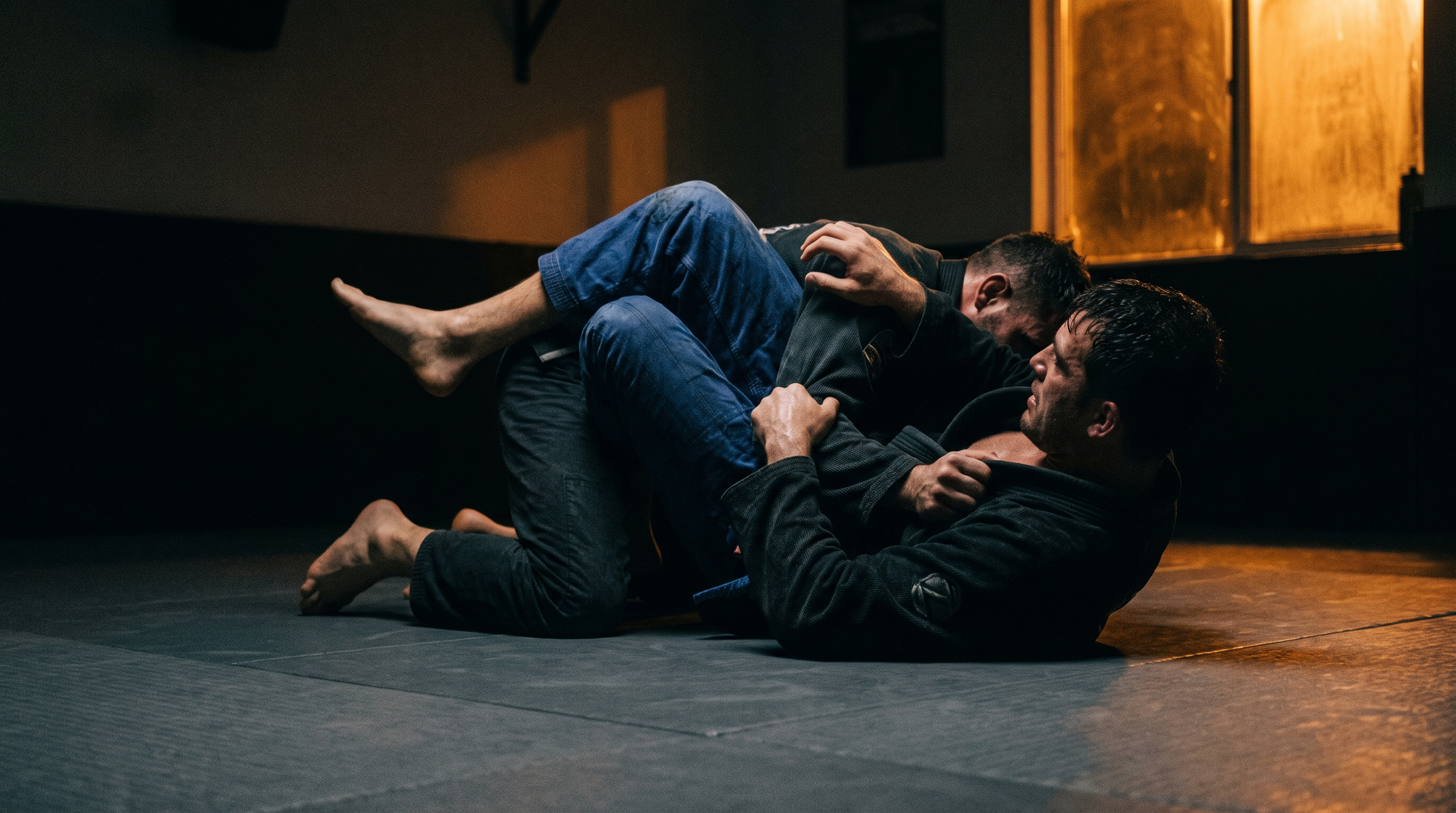
How to Escape Half Guard Bottom: A White Belt's Guide to Getting Back on Top
TL;DR. Half guard bottom is one of the most common positions white belts get stuck in — usually because they lie flat, lose the underhook, and let their top shoulder get pinned. The fix is a repeatable system: get to your side, win the underhook, frame on the far shoulder, insert a knee shield, then choose between an old-school shoulder-drive sweep or a hip-bump to knee tap. Drill the transitions, not just the finish, and you'll start ending rolls on top instead of surviving underneath.
Half guard bottom is one of those positions where a whole roll can quietly get away from you. You started in guard, they passed halfway, you clamped their leg between yours — and now you're pinned, your near arm is dead, and the crossface is grinding into your jaw. Sound familiar?
The good news: half guard bottom is not a bad place to be. It's actually one of the most offensive positions in modern jiu-jitsu. But before you learn the deep half sweeps you see on YouTube, you need a simple, boring, repeatable system for the basics — one you can actually drill in class and pull off on someone the same size as you.
This guide is written for white belts and one-stripes who keep getting stuck under half guard and want a clear plan for their next roll. We'll cover why you keep ending up flat, the five-step escape system, the mistakes that quietly ruin all of it, and how to make it stick between sessions.
Key takeaways
- Half guard bottom is a defensive-to-offensive position, not just survival — your goal is a sweep or a counter, not staying flat.
- The single biggest mistake is lying flat on your back; you must turn to your side to have any leverage.
- Winning the underhook on the trapped-leg side is the master key that opens almost every half guard sweep.
- A knee shield across your opponent's hip buys you space, blocks the crossface, and lets you attack their base.
- The old-school sweep and the hip-bump-to-knee-tap are the two escapes every white belt should own first.
- Drilling the frame-and-underhook entry matters more than drilling the finish.
- Chin tuck and an active near arm are what buy you the time to work the escape.
Why you keep getting stuck under half guard
Before we fix the escape, it helps to be honest about why the position is going wrong. Almost every white belt who says "I just can't get out of half guard" is making some combination of the same handful of mistakes.
You're flat on your back. If your two shoulder blades are on the mat, you have zero leverage. Your hips can't move, your arms can't frame properly, and your opponent's weight settles directly onto your chest. The very first move in every half guard escape is to turn onto your side — usually the side of the trapped leg.
You lost the underhook. In half guard, whoever wins the underhook (the arm that threads under the opponent's armpit on the trapped-leg side) usually wins the exchange. If your opponent has a strong crossface and a whizzer on your other arm, you're being flattened out and controlled. If you have the underhook, you can lift, sweep, or take the back.
Your leg lock on their leg is lazy. Half guard works because you've trapped one of their legs. If your figure-four (or basic scissor grip) on their leg is loose, they'll simply pass their knee across, flatten you, and settle into side control before you can even start.
You're chasing submissions before position. A lot of beginners see a kimura or a Darce and reach for it. From flat half guard bottom, most of those attacks just help your opponent pass. Position first, then submission.
Remember. Half guard bottom is a fight for two things: your side (versus flat on your back) and the underhook (versus a crossface). Win those two, and the sweep is a formality.
A simple 5-step system to escape half guard bottom
This is the sequence to drill until it's boring. It's not the flashiest half guard game in the world, but it works at every level and it's the foundation everything else builds on.
Step 1: Get to your side
The moment you feel your opponent settle into top half guard, roll onto the side of the trapped leg. If your right leg is trapping their leg, roll onto your right hip. Your bottom shoulder comes off the mat, your top elbow tucks tight to your ribs, and your chin tucks toward the same-side shoulder to defend the crossface.
If you do nothing else, do this. Rolling to your side turns half guard from a pin into a position.
Step 2: Win the underhook
With your top arm (the one furthest from the mat), dive for the underhook. You want your armpit to swallow their shoulder on the same side as your trapped leg. Common mistake: reaching too high or too shallow — you end up in a whizzer war and lose.
Aim for the underhook deep enough that your hand can reach their far shoulder blade or their belt. Keep the elbow tight so they can't peel it off with a crossface.
Step 3: Frame and create space
Once the underhook is in, use your bottom arm as a frame. Your bottom forearm goes across their hip or their far shoulder — whichever they've given you. This isn't a push; it's a wedge. It stops them from sliding into a tighter crossface and gives your hips somewhere to travel.
At the same time, angle your body away from them. Think of your head sliding away from their head so you're building a small angle rather than lying square underneath them.
Step 4: Insert a knee shield (or commit to the underhook)
Here's where you branch. Two options:
- Knee shield route: Slide your top knee (the one on the trapped leg) so the shin crosses their belly or hip. This creates a barrier, defends the crossface further, and sets up sweeps like the knee-shield-to-old-school.
- Deep underhook route: Keep both legs on their leg, drive the underhook shoulder into their armpit, and dip your head under their chest to load them up.
As a white belt, get comfortable with the knee shield first. It's more forgiving and it turns half guard into a legitimate guard rather than a survival position.
Step 5: Choose your sweep
With the frame, the underhook, and either a knee shield or deep-half entry, you now have two beginner-friendly finishes:
Old-school sweep (a.k.a. the shoulder-drive sweep). With the underhook deep, drive your underhook-side shoulder into their armpit and roll them over your body toward the underhook side. As they tip, your trapped leg kicks free and you come up on top in a leg-drag or side-control-ish position.
Hip bump to knee tap. From your side with a frame, post your top hand on the mat behind you, hip-bump into them, and reach across with your bottom hand to grab the outside of their far knee. Drive your shoulder into their chest as you pull that knee in — they collapse forward and you come up on top.
Here's a quick comparison of the two so you can pick which one to drill first:
| Sweep | Best when… | Main grip | Common failure |
|---|---|---|---|
| Old-school | You have a deep underhook and they're posturing forward | Underhook to far shoulder or hip | Rolling before you clear the trapped leg |
| Hip bump to knee tap | You have a knee shield and they're based wide | Bottom hand on outside of far knee | Not driving your shoulder forward as you pull |
Remember. Every sweep in this system depends on the same two things: side + underhook. If those aren't in, don't bother finishing — reset and re-earn them.
Common mistakes that keep white belts stuck
Even with the right system, small errors quietly kill your escapes. If half guard bottom still feels impossible, one of these is probably the culprit.
- Reaching for the underhook with your bottom arm. Only the top arm can attack the underhook. If you reach with the bottom one, you've just fed them the crossface.
- Flat back, tight hips. If your shoulders return to the mat during the escape, restart from Step 1. Do not try to sweep from flat.
- Loose leg trap. If your ankles aren't crossed or your figure-four is lazy, they'll knee-cut before you finish anything.
- No angle. Escaping half guard is not a straight-up bench press. You need your hips to travel away from theirs so you can come up at an angle.
- Rushing the sweep, ignoring the setup. If your training partner keeps stuffing your sweeps, the fix is almost never a better sweep — it's a better frame or a deeper underhook.
- Neglecting the crossface defense. Chin tuck, near-shoulder shrug, and an active near arm. Without those, they'll flatten you no matter what.
- Only drilling one side. Half guard has a strong and a weak side for everyone. Drill both, especially the ugly one.
Remember. "I keep getting stuck" is almost never a technique problem. It's a position problem — flat back, no underhook, no angle. Fix the position, and the technique you already know starts working.
Making it stick between classes
Here's the honest part: you'll learn this in class, roll once or twice, then forget the details by next week. That's normal — it's how everyone loses techniques. The fix is boring but it works: capture what you learn, and review it before you train.
That's exactly why we built BJJ Memo. When your coach shows a half guard sequence, or you find a good YouTube breakdown from someone like Lachlan Giles or Craig Jones, paste the video into the app. It builds a structured Technique Card with the steps and tappable timestamps, files it into your personal library, and surfaces it for a quick review before your next class.
The app doesn't replace mat time or a coach — nothing does. But if the reason your half guard escape isn't working is that you can never remember which arm gets the underhook or which leg kicks out, it fixes exactly that.
For more foundations, our white belt survival guide and our how to remember BJJ techniques piece pair well with this one.
Frequently asked questions
What's the difference between half guard bottom and quarter guard?
Half guard bottom means you've trapped one of your opponent's legs between both of yours, usually with a figure-four or scissor grip on their knee. Quarter guard is a shallower position where you only have their foot or ankle trapped — you have less time and fewer sweep options, and you're usually working to recover half guard proper or turtle up.
Should I learn deep half guard as a white belt?
Probably not as your first move. Deep half is powerful but it puts you underneath your opponent with your head off to one side, and the entries and exits take time to feel natural. Master the underhook, knee shield, and old-school sweep first. Once those are reliable, deep half becomes a great addition rather than a crutch.
How do I stop the crossface in half guard?
Three things stacked together: tuck your chin toward your near-side shoulder, shrug that shoulder up toward your ear, and keep your near-side arm active — either framing on their bicep or fighting for an inside position. If any one of those is missing, the crossface flattens you.
My opponent always gets the whizzer — what do I do?
A strong whizzer means they've felt your underhook and are countering. Two options: switch to a knee shield and shrimp out to recover full guard, or drive the underhook deeper and go for the old-school sweep with commitment. Half-committing to the underhook against a good whizzer is what usually gets you passed.
How often should I drill the escape to actually get it?
Most coaches will tell you it takes hundreds of clean reps before a technique becomes reflexive. Practically, that means drilling the entry (side + underhook + frame) for a few minutes every session, on both sides, for several weeks — and revisiting the details between classes so you don't relearn the same thing every Monday.
Is half guard bottom viable in no-gi and MMA?
Yes — arguably more than in the gi. Without collar grips, the crossface and underhook fight becomes even more central, and the old-school sweep, knee shield sweeps, and shot-defense entries into half guard all work well. The system in this article works in both gi and no-gi with minor grip adjustments.
Get back on top — starting next class
Half guard bottom stops being a nightmare the moment you have a system. Get to your side, win the underhook, frame, insert the knee shield, and pick your sweep. Drill the setup more than the finish, defend the crossface, and be honest about which side is your weak one.
And for the part that trips everyone up — actually remembering all of this between classes — save the moves you learn as technique cards in BJJ Memo and revise them for two minutes before you train. Small, consistent reps beat marathon sessions.
For real feedback and safety, train these techniques at a legit academy with a qualified coach — BJJ Memo helps you remember and revise, it doesn't replace mat time.
Last updated 2026-09-21.