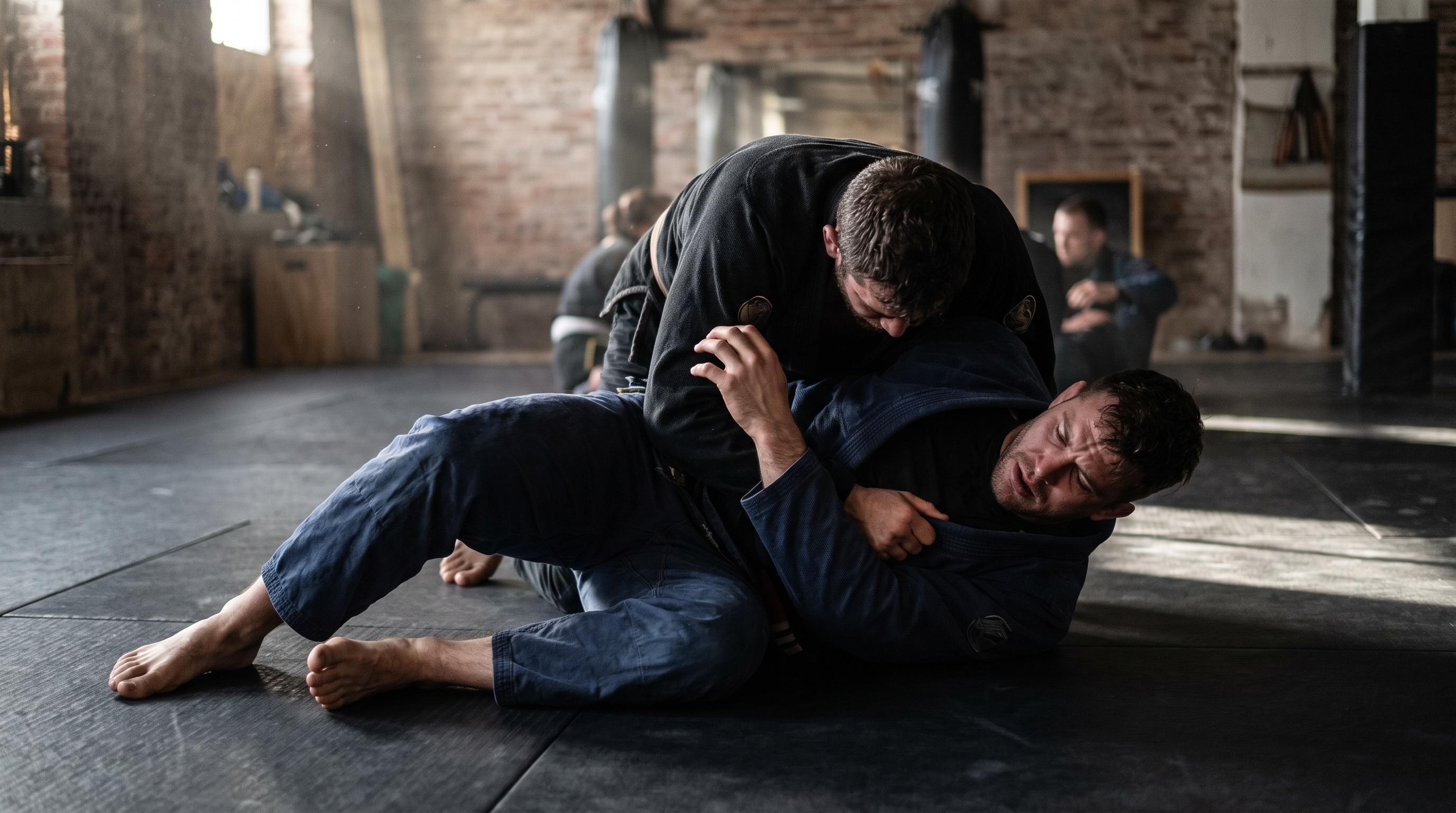
How to Escape Half Guard Bottom: A White Belt's Guide to Getting Back to Guard or Sweeping
TL;DR. Bottom half guard is only a losing position when you stay flat. To escape, get on your side, win the underhook, kick your inside leg free, and either sweep with an old-school or knee-tap or recover full guard. The two non-negotiables are the underhook and framing on the far shoulder — everything else follows from there. Drill the sequence slowly with a partner before trying it live.
If you've been training a few months, you already know the feeling: your opponent passes to half guard, drops their weight, crossfaces you, and suddenly you can't breathe, can't move your hips, and can't even remember what your coach told you to do. You bench-press for a minute, get tired, and then they mount you. Sound familiar?
Here's the good news: bottom half guard is one of the most offensive positions in Brazilian Jiu-Jitsu — but only if you know the framework. Once you understand the two or three positions the top player wants and how to deny them, you'll stop surviving half guard and start sweeping from it. This guide is written for white and early blue belts who keep getting flattened, and it lays out a simple system you can drill tomorrow.
Why you keep getting flattened in half guard
Before you can escape, you need to understand what your opponent is doing to shut you down. Most white belts think they're losing half guard because they're weaker or less flexible. That's almost never it. You're losing because the top player is doing three things well, and you're not stopping any of them.
1. The crossface
The crossface is the top player's arm driving across your jaw and far shoulder, turning your head away from them. This one detail does more damage than anything else on top. When your head is turned away, your shoulders follow, your hips follow, and you end up flat on your back. Once you're flat, you have no leverage — you're just holding weight.
2. The underhook (theirs, not yours)
Whoever wins the underhook wins half guard. If the top player gets a deep underhook on you, they can flatten you, block your hip escape, and set up the pass. If you get the underhook first, the position flips — suddenly you're the one attacking sweeps and back-takes.
3. Chest-to-chest pressure
The top player wants to be chest-to-chest, with their hips low and their weight on your sternum. Every second you spend in that position, you're getting tired and they're not. Framing, shrimping, and turning to your side all fight this pressure.
Remember. The mistake isn't being in bottom half guard — the mistake is being flat in bottom half guard. Turning to your side is the entire game.
A simple system: 6 steps to sweep or recover
This is the sequence I'd teach a brand-new white belt who has one week to stop getting flattened. Do these steps in order. If a step isn't available, back up and re-establish the previous one before moving forward.
Step 1 — Turn to your side (immediately)
The moment your opponent lands in half guard, you turn onto the side of your trapped leg. If your right leg is trapping their leg, you turn onto your right shoulder. This does two things: it stops them from getting fully chest-to-chest, and it puts your left shoulder in the air where you can start framing and underhooking.
Step 2 — Frame on the far shoulder or biceps
Before you even think about attacking, kill the crossface. Place your top-side forearm (the one that's in the air) across their far shoulder, biceps, or the side of their neck. You're not pushing — you're framing. Your elbow stays connected to your ribs, and your forearm acts as a wedge that keeps their head from crossing over yours.
Step 3 — Fight for the underhook
With the crossface neutralized, dive your bottom-side arm (the one on the mat) under their armpit. Aim to get your hand to the back of their shoulder blade. This is your underhook. If they sprawl their hips back to defend, that's fine — you'll use it. If they let you get it deep, even better.
Step 4 — Kick your inside leg free (or don't)
Here the road forks. Look at where your opponent's weight is:
- Weight forward, posting on their hand → knee-tap or come up. They've given you the space to sit up.
- Weight back, sprawling → old-school sweep is open. You have the underhook and they're light on your top side.
- Weight stalled, neither → recover full guard. Free your inside leg by kicking it through, put your knee across their belly, and re-establish closed or open guard.
Step 5 — Execute the sweep (old-school) or the recovery
For the old-school sweep: with the underhook, hook their far ankle with your top-side hand or grip the pant cuff. Bump your hips into them, drive with the underhook, and roll them over your trapped-leg side. You end up on top in half guard or side control.
For guard recovery: keep the frame, kick your inside leg backward through their legs, and shrimp your hips out. As soon as your knee comes free, thread it across their hip and close guard or transition to open guard.
Step 6 — Come up to your knees (knee-tap variant)
If they post on their hand to stop the old-school, use that hand's absence against them. Come up onto your bottom elbow, then to your hand, keep the underhook, and reach for their far knee or ankle. Drive your shoulder into their chest and tap the knee — they fall to the side and you finish on top.
Remember. You're not choosing one escape and hoping. You're reading the top player's weight and picking the escape they've made available. This is why drilling all three (old-school, knee-tap, recovery) matters more than mastering one.
Half guard escape decision table
| Top player's reaction | Your escape | Key grip |
|---|---|---|
| Sprawls back, weight low | Old-school sweep | Underhook + far ankle |
| Posts on the hand, weight forward | Knee-tap / come-up | Underhook + far knee |
| Squares up, weight neutral | Recover full guard | Frame + inside-leg pummel |
| Drives crossface hard | Frame + re-shrimp first | Forearm on far shoulder |
| Attacks the kimura on your underhook | Hide the elbow, re-pummel | Elbow to your own ribs |
Common mistakes white belts make
Even with the right framework, most white belts sabotage themselves with the same handful of habits. Fix these and half guard will feel completely different within a month.
Bench-pressing instead of framing
If your elbow is straight and you're pushing with both arms extended, you're using your triceps against their entire bodyweight. You'll lose that fight every single time. Keep your framing elbow bent and connected to your ribs so you're using skeletal structure, not muscle.
Turning your head away from them
This is subtle but huge. When the crossface comes in, most beginners let their head go with it. Fight to keep your chin tucked and your eyes on your opponent. If you can see them, you're not fully flattened yet.
Giving up the underhook to try to sweep
A lot of white belts get the underhook, then let go of it the moment they start moving because they need the hand for something else. Never trade the underhook for anything less valuable than the sweep itself. If you lose it mid-scramble, the top player will pass.
Trying to sweep before turning to their side
You can't sweep from flat. If you're not on your side with the underhook, you're not sweeping — you're just wiggling. Get to the side first. Every time.
Forgetting the trapped leg
Your bottom half guard exists because you've trapped one of their legs between yours. Squeeze your knees, cross your ankles (in no-gi it's called a Z-guard or knee-shield if you knee-shield), and don't let them free the leg. The moment your legs open, they pass to mount or side control.
Panicking on the crossface
If they land the crossface before you frame, don't fight it head-on. Bring your bottom hand across your own face to protect it, hip-escape a few inches away, and re-frame. You can always rebuild — but only if you stay calm.
How BJJ Memo fits into your half guard learning
Here's the honest truth about escaping half guard: reading this article once won't fix your bottom game. You'll be back on the mat in three days, someone will crush you, and you'll forget most of what you just read. That's how BJJ learning works — you watch, you drill, you forget.
BJJ Memo is a mobile app built specifically for this problem. When you find a good half guard breakdown on YouTube — say, a Lachlan Giles or Bernardo Faria instructional — you paste the URL into the app and it turns the video into a structured technique card: the steps, the key details, the common mistakes, and tappable timestamps for the visual moments. The card lives in your personal library, and the app surfaces it for revision before your next training session so the details are actually in your head when you tie your belt.
It's not a replacement for your coach or mat time. It's the layer between watching and remembering that most grapplers are missing. You can learn more about the app or browse the BJJ Memo blog for more technique breakdowns and retention guides.
Frequently asked questions
What's the single most important thing to remember in bottom half guard?
Get to your side and win the underhook. Everything — old-school sweep, knee-tap, guard recovery, back-takes — flows from those two things. If you're flat and without an underhook, you're not in half guard, you're in a slow-motion pass.
Is half guard bad for white belts?
No. Half guard is one of the most productive positions for a white belt to learn precisely because you'll end up there constantly whether you like it or not. Learning to sweep and recover from bottom half guard will improve your overall guard retention and your understanding of frames, underhooks, and hip movement — concepts that transfer everywhere.
Should I learn deep half guard as a white belt?
Probably not yet. Standard bottom half guard (with the knee-shield or Z-guard variant) covers most situations you'll face. Deep half is a more specialized position that works better once you already understand the framing and underhook fundamentals covered here. Get the basics locked in first.
How do I stop the crossface if I'm already flat?
Bring your bottom-side hand across your own face to create a small frame, then hip-escape (shrimp) a few inches to create space. As soon as you have space, replace that internal frame with an external one on their shoulder or biceps and start turning to your side again. You're not trying to escape in one motion — you're clawing back one inch at a time.
What if my opponent is much heavier than me?
Frames beat weight. If you're bench-pressing a heavier partner, you'll lose. If you're framing with connected elbows, using their crossface momentum against them, and staying on your side, weight matters much less. Technique-wise, prioritize the frame-and-underhook sequence even more strictly — you have no margin for bench-pressing errors against a heavier training partner.
How long until half guard escapes feel automatic?
Honestly, months of consistent drilling. The good news: you don't need it to be perfect to see results. Even a rough version of "turn to your side + get the underhook" will make you noticeably harder to pin within a few weeks. Drill the sequence in positional rounds — start in bottom half guard, work only the escape, reset, repeat.
Wrap-up and next steps
Bottom half guard isn't a survival position — it's an attacking position with a bad reputation among beginners. The framework is small: get on your side, frame the crossface, win the underhook, read the top player's weight, and pick the sweep or recovery they've handed you. Six steps. That's the whole game at the white belt level.
Next time you're rolling and someone passes to half guard, don't panic. Turn to your side. Get the underhook. Then look at what they've given you. You'll be surprised how often the sweep is right there.
A note on learning from articles: this guide is a framework, not coaching. For real feedback on your framing, hip positioning, and timing, train the technique at a legit academy with a qualified black belt who can see what you're doing wrong. BJJ Memo helps you remember and revise — it doesn't replace mat time.
Ready to stop forgetting techniques you already learned? Download BJJ Memo on iOS or Android, save your next half guard video as a technique card, and revise before your next training session. For more beginner breakdowns, check out the BJJ Memo blog.
Last updated 2026-09-19.