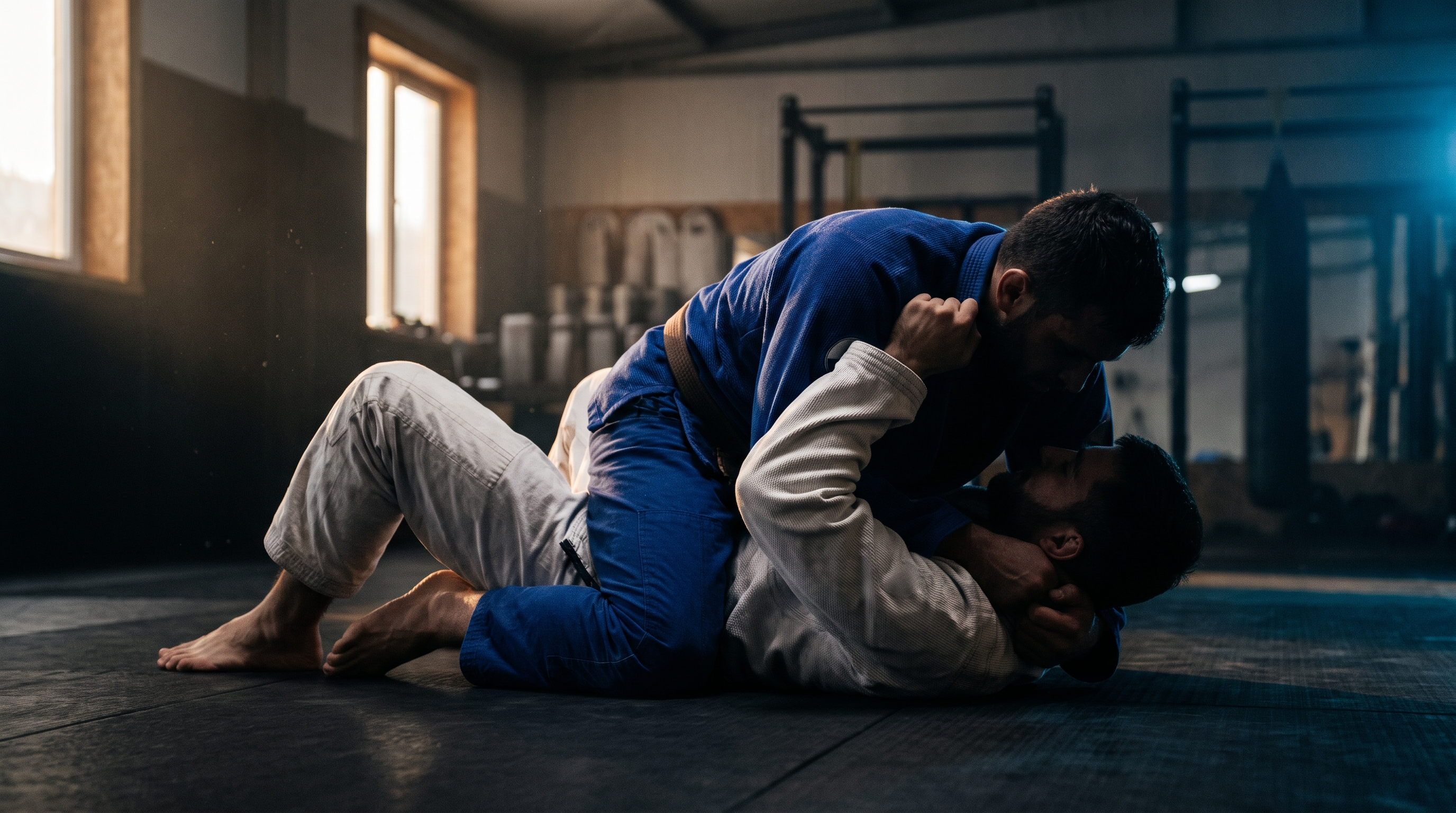
How to Escape Kesa Gatame (Scarf Hold): 3 Framework Escapes for White Belts
TL;DR. Kesa gatame (scarf hold) is a Judo-derived side control variation where your partner traps your near arm and puts full head-and-shoulder weight on your chest. The escape is not about strength — it's about turning into your opponent, killing the pressure line, freeing your trapped arm, and using your legs to bridge, hip out, or trap a leg. This guide gives you three framework escapes (bridge-and-turn, leg-trap recovery, and hip-out to knees), the mistakes that keep you flat, and a simple decision tree you can drill in class tonight.
If you have been training a few months, there is a good chance a heavier training partner has already crushed you in kesa gatame. It feels different from a normal side control: your near arm is trapped under their armpit, their head is heavy on your chest, and every time you bridge you seem to make it worse. Most white belts respond by pushing on the head with their free hand and burning out their shoulder in ninety seconds.
The good news is that scarf hold responds beautifully to structure. Once you understand where the pressure comes from and where your partner's base is weak, you stop reacting and start solving. This article gives you three repeatable escape frameworks, the common mistakes that keep the position glued to you, and a way to remember what you learned so it is still there next week.
Key takeaways
- Kesa gatame traps your near-side arm and stacks your opponent's head-and-shoulder weight directly on your sternum — brute force will not move them.
- The universal principle is to turn your chest toward your partner (not away) so their weight falls off the pressure line onto their own base.
- Escape #1 (bridge-and-turn) works when your partner is high and heavy on your chest.
- Escape #2 (leg trap) works when your partner posts a leg or drops their hip low near your hip.
- Escape #3 (hip-out to turtle or knees) works when you cannot free your trapped arm but can create space under your shoulder.
- Freeing the trapped arm is a milestone, not the finish — you still have to bridge, hip out, or trap a leg to actually recover guard.
- A qualified coach on the mat will fix the details a written guide cannot see — use this as a study aid, not a substitute.
Why kesa gatame is so heavy (and why it feels stuck)
Kesa gatame — literally "scarf hold" — is a pin from Judo that BJJ inherited as a side control variation. In classic kesa, your partner sits perpendicular to you, wraps their near arm around your head like a scarf, traps your near arm against their ribs or under their armpit, and posts their legs wide (one leg extended forward, one bent behind) for base.
Three things make the position miserable:
- Weight stack. Their head, shoulder, and upper chest are pressed onto your sternum. Every gram of their upper body is aimed at your ribcage.
- Trapped arm. Your near arm is neutralized. You cannot frame with it, cannot post with it, and cannot shrimp effectively while it is glued.
- Wide base. Their legs form a tripod. Bridging directly "up" just launches you into their base, which is exactly where they want you.
Once you name these three problems, the escapes become obvious: each one takes at least one of those problems away.
Remember. You are not trying to lift your partner off you. You are trying to make the ground under them uneven so their own weight rolls them off the line.
A simple system: 3 framework escapes
Think of these as a decision tree, not three separate techniques. Try #1 first. If your partner defends by posting a leg, you are handed #2. If you cannot free the trapped arm at all, you go to #3.
Framework 1 — Bridge-and-turn (chest-to-chest)
Use this when your partner is high on your chest and their weight is stacked forward toward your head.
- Free your near arm first. Pin their trapping arm to your ribs with your free hand, then walk your trapped elbow down toward your hip until the hand pops out. No pop, no escape.
- Post your free hand on their far hip or lower back. This becomes your steering wheel.
- Plant both feet flat, close to your butt. Feet under knees, not stretched out.
- Bridge diagonally toward their head, not straight up. You are aiming your hip into the empty space in front of their posted leg.
- Turn into them chest-to-chest, coming to your side. Your freed arm now underhooks their far armpit.
- Come up to your knees or a combat base, driving into where they used to be.
- Recover guard or stand up, depending on what is available.
The key detail: you turn toward your partner, not away. Turning away puts your back on the ground and gives them the pin they wanted.
Framework 2 — Leg trap (uchi-mata counter)
Use this when your partner extends their near leg forward for base, or when they drop their hip low next to yours. Judokas often give you this because it is legal to post the leg for balance in a pin.
- Hook their near leg with your near-side leg. Your foot goes over the top of their thigh, then hooks underneath at the knee, like a figure-four in the air.
- Free your trapped arm using the same elbow-to-hip walk as before, or use the leg trap first to change their base and pop the arm free after.
- Bridge up into them — because their leg is trapped, they cannot post to catch themselves.
- Roll them over your trapped leg in the direction of their extended (now trapped) side.
- Come up on top in a scramble. You will rarely land cleanly in side control; expect to fight for position.
This is the classic "scarf hold to mount reversal" that shows up in almost every Judo ne-waza clinic. It is high-percentage because it directly attacks their base rather than their weight.
Framework 3 — Hip-out to knees
Use this when their pressure is too tight to bridge and you cannot free the trapped arm.
- Frame with your free hand on their hip, not their face or head. Framing on the head just tires your triceps.
- Bring your far knee up across your own body so the sole of your foot is planted near your butt.
- Shrimp your hips away from your partner, creating a small pocket of space where their weight used to be.
- Slide your knee into that pocket, shielding your body.
- Turn to your knees or turtle with a strong tuck of the chin and elbows tight.
- Reset. You did not get guard, but you got out of the pin, avoided the choke, and now you are working from turtle where you have options.
Turtle is not a great BJJ position, but it is dramatically better than being pinned in kesa with a trapped arm and a heavy partner grinning at you.
Decision table
| Situation | Best framework | First move |
|---|---|---|
| Partner is high and heavy on your chest | Bridge-and-turn | Pop the trapped arm free |
| Partner posts a leg or drops hip low | Leg trap | Figure-four their leg |
| Partner is chest-heavy and arm is stuck | Hip-out to knees | Frame the hip, shrimp away |
| Partner is going for the near-arm lock | Roll toward them, hide the arm | Turn chest-to-chest fast |
Remember. In every framework, freeing the trapped arm is only half the job. You still have to bridge, trap a leg, or shrimp to finish the escape. Do not celebrate at step 3 of 7.
Common mistakes that keep you pinned
Most failed escapes are not caused by lack of technique — they are caused by one of these habits. Fix these and your escape percentage climbs before you learn any new moves.
- Pushing on the head with your free hand. Their neck is stronger than your arm. You will gas out and still be pinned. Frame on the hip instead.
- Turning your back to escape. Feels intuitive, gives them your back or a cleaner pin. Always turn into your partner.
- Bridging straight up. You are just doing a bench press with their bodyweight. Bridge diagonally, into their base.
- Trying to escape before freeing the trapped arm. With that arm trapped, you have no leverage on that side. Prioritize the arm.
- Feet too far from your butt. Long legs mean weak bridges. Feet close, knees high.
- Panic breathing. Fast, shallow breaths shrink your ribcage under their weight. Slow nasal breathing keeps the frame of your torso rigid.
- Ignoring the choke threat. Kesa often threatens a head-and-arm choke. Chin tuck, hide the near arm, escape with urgency but not panic.
Drilling this so you actually remember it
Here is where most people lose progress. You learn these three frameworks in class, feel like a genius for a night, and by next week you're stuck under the same white belt with a mind blank. This is the retention problem every grappler faces.
A simple approach that works: after class, write down the one detail that made the escape click for you tonight — the elbow-walk, the diagonal bridge, whatever it was. If you watch an instructional on kesa escapes on YouTube, capture the key steps and timestamps instead of just re-watching passively. Tools like BJJ Memo turn any BJJ YouTube video into a structured technique card with tappable timestamps and a revision flow, so the escape is still there in your head next Tuesday when a heavier partner puts you back in scarf hold. You can also browse related guides like our side control escapes overview and our white belt survival series for the full retention framework.
Remember. You do not forget techniques because you are bad. You forget because you never revised them. Capture it before you lose it.
Frequently asked questions
What is the difference between kesa gatame and regular side control?
In standard side control, your partner is roughly parallel to your body with their chest across yours and their hips low. In kesa gatame, they sit perpendicular, wrap your head like a scarf, trap your near arm against their ribs, and post their legs wide for base. The pressure feels heavier and more concentrated, and the trapped arm removes one of your usual framing options. Same family, different problem.
Why can't I just push their head off me?
Because your triceps are much weaker than their neck and back. Pushing on the head is the number one energy leak white belts have in kesa. Your free hand is far better spent framing on their far hip, gripping their belt, or posting to reverse them. Save the arm strength for popping your trapped elbow free.
Is kesa gatame legal in BJJ competition?
Yes. Kesa gatame is a legitimate side control variation and scores as side control (three points) in IBJJF and most rulesets, provided the position is held for the required time. The related head-and-arm choke and short-arm-lock finishes have their own legality depending on belt level and organization — check your specific ruleset.
Which escape should I try first when I get caught?
Start with framework #1 (bridge-and-turn) because it applies most often. If your partner defends by extending or posting a leg, you are handed framework #2 (leg trap). If neither works because their pressure is too tight and your arm stays stuck, fall back to framework #3 (hip-out to knees). Think decision tree, not memorized recipe.
How long will it take to escape kesa reliably?
Honestly, it takes weeks to months of drilling with progressively heavier partners. The first breakthrough usually comes when you stop panicking and start troubleshooting mid-position. Drill the escape cold two or three rounds a week, then have a training partner hold you in kesa with light-then-full resistance, and the timeline shrinks quickly.
Can I use these escapes in no-gi?
Yes. Kesa gatame appears in no-gi too, though grips shift from lapel-and-sleeve to overhook-and-underhook. The frameworks — turn into them, free the trapped arm, attack their base — are identical. Only the grip fighting differs.
Get on the mat, then revise before next class
Read this once, drill it three times, and it starts to stick. Read it once and never touch it again, and by Friday you will be flat on your back wondering what happened. That gap between learning and remembering is exactly the problem BJJ Memo was built to solve — capture instructionals you watch on YouTube as structured technique cards, file them in your personal library, and let the app surface them for a quick revision before your next session.
For real feedback and safety, train these escapes at a legit academy with a qualified coach — a black belt watching your hip position will fix in thirty seconds what a written guide takes a thousand words to describe. BJJ Memo helps you remember and revise what you learn there; it does not replace mat time.
Next time you watch a scarf hold escape breakdown on YouTube, save it as a technique card in BJJ Memo so it is there before your next roll.
Last updated 2026-09-18.