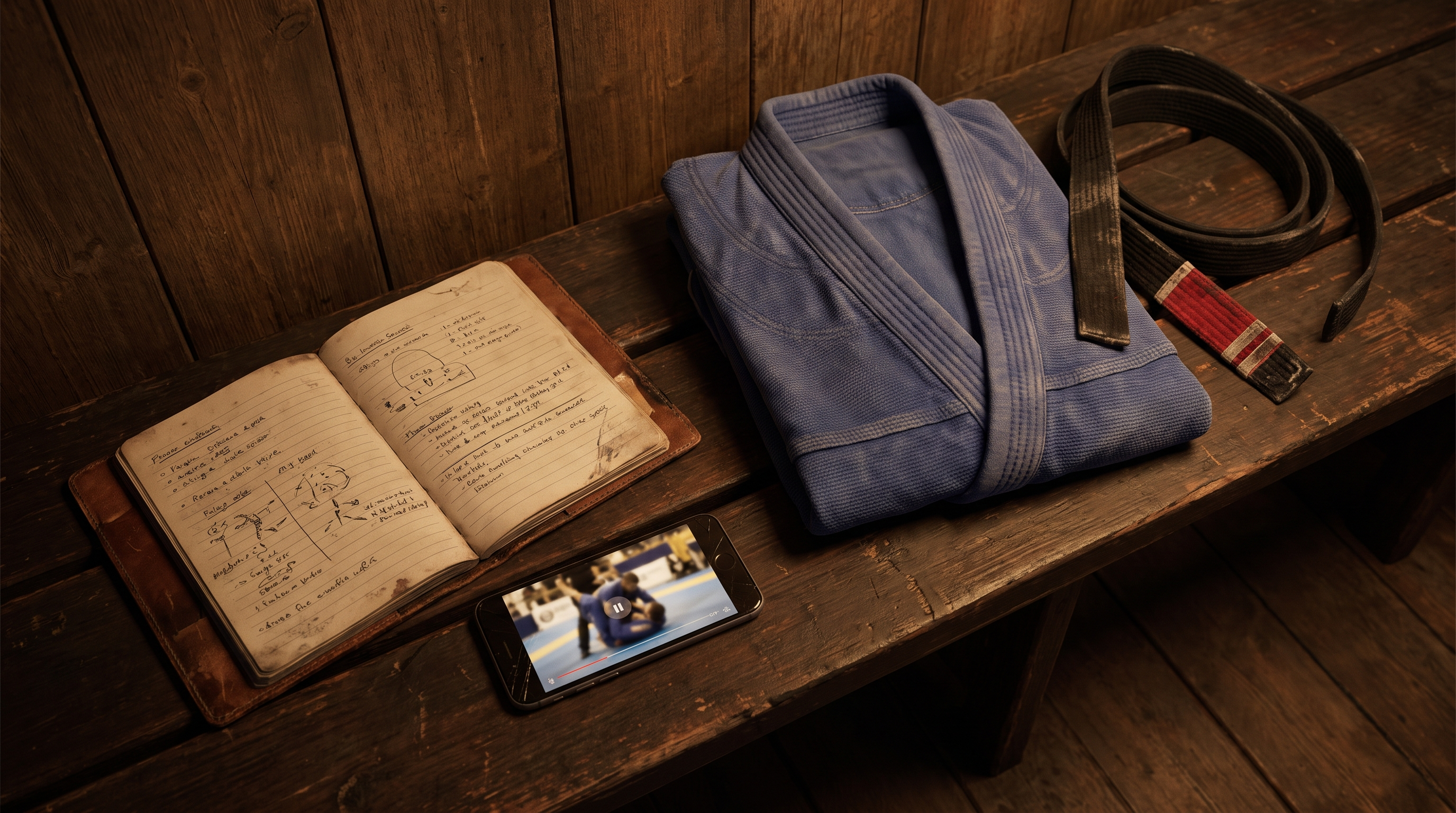
How to Learn BJJ Faster: A Weekly System That Combines Class, Video, and Revision
TL;DR. Learning BJJ faster is not about training more hours — it is about closing the loop between class, video study, and revision. Build a simple weekly rhythm: capture what you learn in class, pick one focused study topic from YouTube, drill it deliberately, and review your notes before every session. Pick one position to obsess over at a time instead of chasing every technique. Keep a single searchable library of your techniques so you can actually find and revise them.
Most hobbyist grapplers train two or three times a week, watch instructionals in bed, and still feel like they are barely improving. The problem is almost never talent, and it is rarely mat time. The problem is that class, video and drilling live in three separate worlds and none of them talk to each other. You learn a detail in class on Monday, watch something unrelated on YouTube Tuesday, and by Thursday's open mat both are gone. This article gives you a simple weekly system to fix that — a repeatable loop you can run for the next twelve months to actually retain what you are being taught. It works whether you train two days a week or five.
Key takeaways
- Progress in BJJ depends more on retention and focus than on raw mat hours.
- A weekly system with three roles — capture, study, revise — beats random training.
- Pick one position or problem per week and let everything (class, video, drilling) orbit around it.
- Write class notes within 30 minutes of leaving the academy or most detail is lost.
- Structured technique cards (steps, key details, common mistakes) are easier to revise than raw video.
- Review your notes for a few minutes before you step on the mat, not the night before.
- Consistency beats intensity: a small weekly loop repeated for months moves your game.
Why you are not learning as fast as you could
BJJ is unusually information-dense. A single technique like an armbar from closed guard can have a dozen small details — grip, hip angle, head position, leg pinch, thumb direction — and each detail is the difference between it working on a resisting partner or not. Multiply that by the number of positions in the game and you are trying to hold hundreds of moving pieces in your head.
A few things quietly slow most people down:
- No capture system. You learn a detail, do not write it down, and the memory fades quickly after class.
- Random YouTube study. You watch whatever the algorithm serves — a leg-lock breakdown one night, a lasso guard tutorial the next — with no thread connecting any of it to what you are actually working on.
- No revision. You never look at old notes, so techniques disappear the moment class moves on.
- Too many priorities at once. You try to learn side control escapes, De La Riva sweeps and rear-naked chokes in the same week and end up owning none of them.
- Confusing exposure with learning. Watching a technique is not the same as being able to hit it live.
Remember. You do not forget techniques because you are bad at BJJ. You forget because you never came back to them. Retention is a skill, and it is trainable.
The fix is not more training. It is a lightweight system that connects the three things you are already doing.
A simple weekly BJJ learning system
This is a repeatable seven-day loop. It assumes two to four classes per week and one or two short home study blocks. Adjust the days to your schedule — the sequence matters more than the calendar.
1. Pick one focus for the week
On Sunday (or whatever your week starts), choose one position or problem to obsess over. Examples:
- Escaping side control from the bottom
- Passing the closed guard
- Finishing the triangle choke
- Standing up in base against a seated guard
One. Not three. Every class question, every YouTube search, every drilling round for the week orbits that focus. This is the single highest-leverage habit in the entire system.
2. Capture what you learn in class
Within 30 minutes of leaving the academy, sit in your car or on the train and write down:
- The technique's name and the position it starts from
- Three to five key steps in your own words
- One or two details the coach emphasized ("elbow tight to the ribs", "step over the head, not the shoulder")
- One mistake you or your partners made
A short voice memo works if typing is slow. The point is not neatness — it is grabbing the details before they evaporate.
3. Study one video per week — related to your focus
Pick a single high-quality YouTube instructional that maps to your weekly focus. If your focus is escaping side control, watch one video on that specifically. Do not binge five. Watch it twice: once at normal speed, once pausing to note the key details.
Turn that video into the same kind of structured card you use for class notes — steps, key details, common mistakes, timestamps of the moments that matter. This is where a tool like BJJ Memo becomes useful, but a plain notebook works too.
4. Drill it deliberately
Before open mat or before class, spend 5–10 minutes drilling the specific technique from your weekly focus with a willing partner. Slow reps with attention to detail beat fast, sloppy volume. Ask your partner to give you the exact starting position from your notes.
5. Test it in rolling
When you spar, actively try to find your weekly focus. If it is a side control escape, let people pass and put you there. If it is a guard pass, pull the person's guard on purpose. You are not trying to win the round — you are trying to earn reps of the position you are studying.
6. Revise before every session
Spend five minutes in the changing room re-reading your notes for the week. Not the night before. Right before. This tiny habit is where retention actually lives.
7. Weekly review on Sunday
At the end of the week, look back at your notes and ask:
- What worked live?
- What kept failing and why?
- Should I stay on this focus another week or move on?
Most positions deserve two to four weeks, not one. Do not rotate for the sake of rotating.
The loop at a glance
| Day | Action | Time |
|---|---|---|
| Sunday | Pick weekly focus + review last week's notes | 15 min |
| Class day | Train, then capture notes within 30 min | 10 min after class |
| Home study day | Watch and card one video on the focus | 20–30 min |
| Any training day | Drill the focus 5–10 min before class | 5–10 min |
| Any training day | Test the focus in rolling | Live rounds |
| Every session | Re-read notes right before stepping on the mat | 5 min |
Remember. The magic is not any single step. It is that class, video and drilling all point at the same target for a whole week. That focus is what compounds into a real game.
Common mistakes that slow the system down
Even with a good framework, a few habits will quietly wreck your progress. Watch for these.
- Chasing shiny techniques. You saw a cool berimbolo entry on Instagram and suddenly your weekly focus is out the window. Finish the week you planned.
- Writing notes days later. If you wait until the weekend to write down Monday's class, most of the detail is already gone. Capture same day.
- Notes you never re-read. A beautiful notebook you open once a year is worse than three lines you actually revise before every class.
- Watching instructionals as entertainment. Passive video time feels productive. It is not. If you are not turning what you watch into notes, treat it as rest, not study.
- Trying to remember everything. Your library will grow into hundreds of techniques. That is fine — you do not need to hold them all in your head, you need to be able to find them quickly when a position becomes relevant again.
- Skipping the pre-class review. This is the smallest habit and the one people drop first. Do not.
- Rotating focus every week. Positions in BJJ have depth. Give each focus enough time to actually leave a mark on your game.
How BJJ Memo fits into the loop
You can run this whole system with a notebook and a folder of bookmarked YouTube links, and it will still work. What tends to break down over months is the library: notebooks get messy, YouTube playlists become dumping grounds, and finding "that side control escape my coach showed in April" turns into a lost afternoon.
BJJ Memo is built specifically for this loop. You paste a BJJ YouTube URL and the app generates a structured technique card — steps, key details, and tappable timestamps for the important moments — and files it into a searchable personal library organized by position. Your class notes and your video notes live in the same place, and the review flow surfaces cards so you can revise before training. It slots into steps 3 and 6 of the system above without changing anything else about how you train.
It is not a coach and it does not replace mat time. It is a place for what you have already learned to actually stay learned.
Frequently asked questions
How long does it take to see progress with this system?
Most hobbyists notice a difference within four to six weeks of running the loop consistently, because you finally stop losing the details from each class. Real, visible game changes — like reliably escaping a position that used to bury you — usually take a few months of staying on the same focus. Retention compounds; there is no shortcut.
How many techniques should I have on my weekly focus?
One position, one to three techniques from it. For example, a week on "escaping side control" might cover one frame-and-shrimp escape, one underhook escape, and one recovery to half guard. That is plenty. If you try to learn more than that in a week, you will retain none of them.
Should I train more days per week to learn faster?
Adding a fourth or fifth day helps up to a point, but a two-day-a-week grappler who runs a real capture-and-revise loop will out-learn a five-day-a-week grappler who never revises. Recovery matters and so does life. Fix your system before you add sessions.
Is YouTube a good place to study BJJ?
Yes, if you use it deliberately. There is world-class free instruction from serious black belts on YouTube. The trap is passive scrolling. Pick one video that matches your weekly focus, watch it actively, and turn it into a note or card you will actually revise. See our guide on how to study BJJ instructionals for more.
What if my coach teaches something different every class?
Common at hobbyist academies. Do not fight it — capture whatever is taught, but keep your personal weekly focus separate. Spend a few extra minutes on your focus during warm-ups, open mat and rolling. Over time your library will build in parallel to whatever the class curriculum is doing.
Do I need to write everything down? It feels like a lot of work.
Start with three lines per technique — name, position, one key detail. That is enough to jog your memory later. The habit matters more than the completeness. Voice memos work too if you hate typing.
Start your next week the right way
Progress in BJJ is not a mystery. It is a small loop: pick a focus, capture what you learn, study one video on it, drill it, test it live, and revise before every session. Do that for a year and you will barely recognize your game.
Next time you leave class or hit play on an instructional, save it as a technique card in BJJ Memo so it is there — organized, searchable, and ready to revise — before your next roll. Available on iOS and Android.
Coach disclaimer. For real feedback, corrections, and safety, train the techniques you study at a legit academy with a qualified coach. BJJ Memo helps you remember and revise what you learn; it does not replace mat time or coaching.
Last updated 2026-08-27.