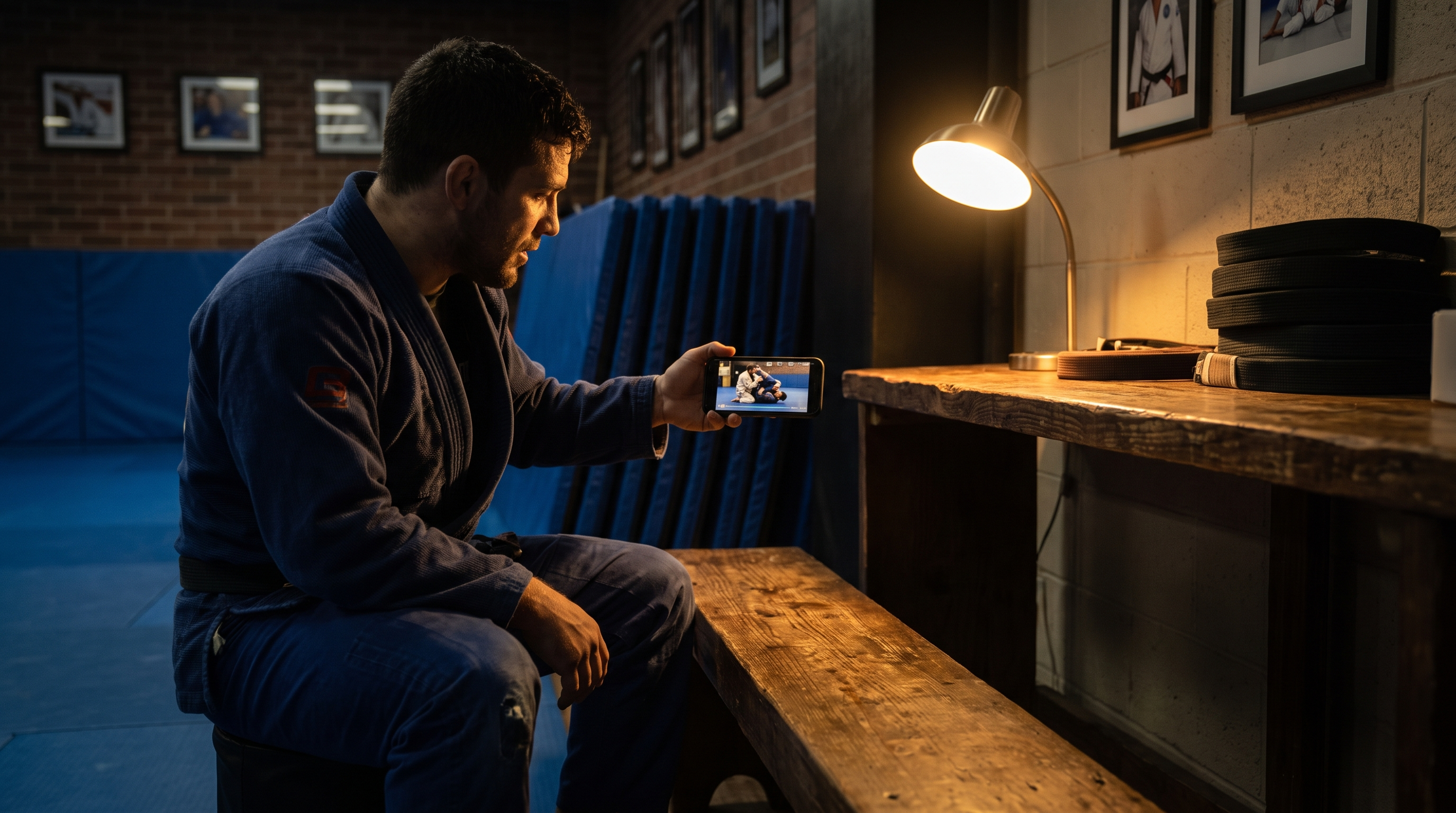
How to Learn BJJ from YouTube Without Wasting Hours
TL;DR. Most grapplers watch BJJ YouTube passively and forget almost everything by their next session. To learn from video, you need a repeatable loop: pick one problem, choose one credible source, extract the key details in your own words, drill it live, and revise before your next class. Treat instructionals as raw material, not entertainment. Focus on one position for weeks, not a new highlight every night. The mat is where the technique becomes yours — YouTube just shows you the shape.
YouTube is the biggest free BJJ university in history. World-class competitors and coaches publish detailed breakdowns of guards, passes, escapes, and submissions for anyone with a phone. And yet most hobbyists who "study" jiu-jitsu online walk into the gym next week and can't reproduce a single thing they watched. The problem is not the content — it's the workflow. Watching a black belt explain a triangle for eight minutes is not learning; it's spectating. In this guide you'll get a simple, repeatable system for how to learn BJJ from YouTube: what to watch, how to break it down, how to drill it, and how to revise it so it actually shows up when you roll.
Key takeaways
- Passive YouTube watching feels like studying but rarely transfers to live rolling.
- Pick one problem at a time (a bad position, a stuck escape) and only search instructionals for that.
- For every video, capture three things: the setup, the key detail, and the common mistake.
- Drill the technique in a positional round within a week of watching, or you'll lose it.
- Rewatch the same clip after training — you'll notice details you missed the first time.
- A short, revisable note beats a long, forgotten one every time.
- YouTube is a supplement to a real coach, not a replacement for mat feedback.
Why passive YouTube watching doesn't stick
Watching a technique and understanding a technique feel almost identical in the moment. That's the trap. Your brain recognizes the pattern, follows the coach's logic, and files it under "got it." A few days later, when your training partner posts up in half guard and you have three seconds to react, none of it is there.
There are a few reasons this happens:
- No encoding effort. You didn't wrestle with the material — you just consumed it. Information you don't rephrase or reproduce fades quickly.
- Too much volume, too little depth. A twenty-video binge on "guard passing" leaves you with a blur of grips and pressures, not a plan.
- No physical rep. BJJ is a motor skill. Watching is cognitive; the movement lives in your body, and only drilling puts it there.
- No revision. You watched it once, three weeks ago, and never came back to it. That is not studying — that is scrolling.
The fix isn't to watch less. It's to watch with intent and close the loop between video, mat, and memory.
Remember. If you can't teach the technique back to a training partner in one minute, you haven't learned it — you've only seen it.
A simple system to study BJJ instructionals
Here is a workflow you can run every week. It works whether you're following a full instructional series or just a random YouTube clip a training partner sent you.
1. Start with a specific problem, not a topic
Before you open YouTube, name the exact problem you want to solve. "I get flattened out under side control and can't recover guard." "I keep losing my closed guard to a standing pass." That single sentence is your search query. If you don't have a problem, don't watch — go train and let the mat tell you what's broken.
2. Pick one credible source and stop shopping
For any given problem, you'll find dozens of videos. Pick one from a coach with a clear reputation (a competitor you respect, a well-known academy, a coach your instructor references) and commit to it. Endless comparison-shopping between instructors is another form of procrastination. You can always revisit the topic later with a different voice.
3. Watch it twice, in two different modes
- First pass: watch it straight through, no pausing. Get the shape of the technique — the position it starts from, what it accomplishes, roughly how the coach gets there.
- Second pass: watch it with a pen (or notes app) open. Pause every time the coach says "the key detail is…", "the mistake most people make is…", or shows a grip or angle change. Those are the moments worth capturing.
4. Extract three things — no more
For every technique, write down only three things in your own words:
- Setup — when do I use this? What position am I in, what is my opponent doing?
- Key detail — the one grip, angle, or weight shift that makes the move work.
- Common mistake — what the coach explicitly warns against.
This is a huge upgrade over transcribing the whole video. Short notes get reread. Long notes don't.
5. Drill it live within a week
A technique you don't touch on the mat inside a week is gone. Bring it to open mat or ask your training partner for two rounds of positional sparring: they start in the position where your technique applies, and you try to hit it. Don't chain it into a whole game yet. Isolate it.
6. Rewatch the same clip after training
This is the step almost nobody does, and it is where the real learning happens. After you've tried the move against a resisting partner, watch the exact same clip again. You will suddenly notice details the coach mentioned that meant nothing before — because now you've felt why they matter.
7. Revise before your next class
Ten minutes before you leave for the gym, reread your three-line note or rewatch the key thirty seconds of the clip. This last-mile revision is the difference between "I saw that once" and "I can try that today."
The 7-step loop at a glance
| Step | What you do | Where it happens | Time cost |
|---|---|---|---|
| 1 | Name one specific problem | Off the mat | 1 min |
| 2 | Pick one credible source | YouTube | 5 min |
| 3 | Watch twice (overview + detail) | YouTube | 15–25 min |
| 4 | Capture setup / key detail / mistake | Notes app | 5 min |
| 5 | Drill in positional sparring | Gym | 1–2 rounds |
| 6 | Rewatch the same clip | YouTube | 5–10 min |
| 7 | Revise before class | Anywhere | 2 min |
Common mistakes when self-studying jiu-jitsu
Even with a workflow, most people fall into the same traps. Watch for these:
- Binge-watching a new topic every night. You end up with a shallow map of the whole ocean and no depth anywhere. Pick a position and stay with it for a few weeks.
- Collecting instructionals like Pokémon. A giant library you never revisit is a to-do list, not knowledge. Fewer sources, revisited often, beats more sources watched once.
- Trying advanced techniques out of context. A leg-drag entry from a specific De La Riva grip is not useful if you can't play De La Riva yet. Build the base first.
- Skipping the drill step. "I'll try it next time it comes up in rolling" almost never happens. Ask a partner directly and drill it.
- Ignoring your coach. If your academy is teaching guard retention this month and you're grinding leg locks off YouTube alone, you're fighting your own environment. Let class be the spine; use video to fill in gaps.
- Confusing highlights with instruction. Match footage is inspiration, not a lesson. When you want to learn, watch a slow, detailed breakdown, not a set-to-music highlight reel.
Remember. One technique you can hit on a resisting partner is worth a hundred you've only watched.
Where BJJ Memo fits in
The hardest part of this workflow is not the watching — it's the capturing and the revising. This is exactly the gap BJJ Memo is built to close. You paste a BJJ YouTube URL, and the app turns it into a structured technique card: the steps, the key details, and tappable timestamps for the moments that actually matter. Cards live in a searchable personal library you can filter by position or submission, and a review flow surfaces them for spaced revision before training.
In practice it lets you spend your study time on step 4 (extract) and step 7 (revise) — the two steps most self-learners skip. It doesn't replace watching, drilling, or your coach. It replaces the notebook you never open and the browser bookmarks you forget you saved.
If you want to learn more about the app before trying it, the blog has more on retention and study habits, or you can go straight to bjjmemo.com.
Frequently asked questions
How many BJJ YouTube videos should I watch per week?
Fewer than you think. One or two well-studied videos on a single problem, rewatched and drilled, will do more for your game than five new videos a night. Depth beats volume when you're trying to build motor patterns you can access under pressure.
Which BJJ YouTube channels are best for beginners?
Any channel run by a credentialed black belt with a clear teaching style you understand is a good starting point. More important than the channel is the filter: pick videos that solve a specific problem you actually have in class, and prefer slow, detailed breakdowns over highlight reels. Ask your coach who they recommend — a lot of great instruction lives on smaller channels.
Can I learn BJJ only from YouTube?
No. Jiu-jitsu is a contact skill that requires resisting partners, timing, and feedback from a qualified coach. YouTube is an excellent supplement — it can accelerate what you learn between classes and expose you to games you'd never see at your gym — but you need mat time and coaching to actually get good and to stay safe.
How do I remember techniques I learn from instructionals?
Write three lines per technique (setup, key detail, common mistake), drill it in a positional round within a week, and reread the note before your next class. If you want the process automated, saving techniques as revisable cards in an app like BJJ Memo removes the friction that stops most people from actually revising.
Should I take notes on paper or in an app?
Whichever one you'll actually reread. Paper notebooks are great until you need to find that armbar detail from three months ago. A searchable app wins on retrieval, which is when learning actually happens — right before you step on the mat.
How long before something I learn on YouTube shows up in my rolling?
Usually a few weeks of deliberate work: watch, extract, drill in positional sparring, then start hunting the position in live rounds. If you've watched something once and expect it to appear tonight, you'll be disappointed. Techniques you revisit repeatedly, in short doses, are the ones that eventually become instinct.
Bring what you watch to the mat
YouTube isn't the problem. Passive watching is. If you narrow your focus to one problem at a time, capture only what matters, drill it in the same week, and revise it before class, you'll get more out of a single instructional than most people get out of a month of binging.
Next time you find a video that solves a real problem in your game, save it as a technique card in BJJ Memo so it's there — three lines, one tap — before your next roll. Build a small library you actually revisit, and the game you're studying online will start to show up on the mat.
For real feedback and safety, train the technique at a legit academy with a qualified coach. BJJ Memo helps you remember and revise; it doesn't replace mat time or coaching.
Last updated 2026-08-11.