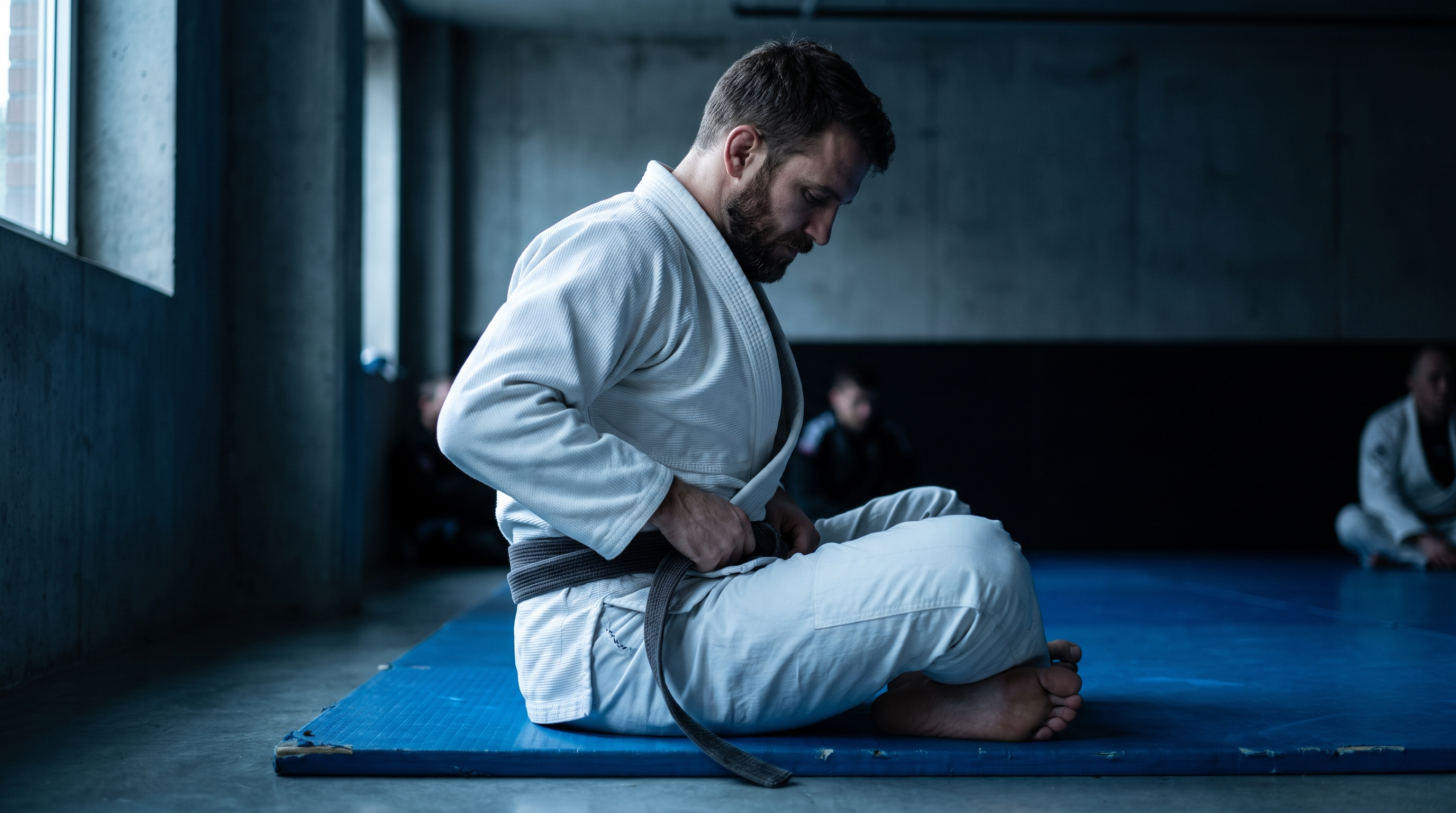
How to Learn BJJ as an Older Beginner: A Realistic Framework for Training in Your 30s and 40s
TL;DR. Starting BJJ in your 30s or 40s works when you train for longevity, not ego. Pick two to three sessions a week, prioritize recovery, roll with control, and revise a small set of techniques between classes so they stick. The main advantage older beginners have is patience and the ability to study — use it. Build a personal library of the moves your body actually likes, and drill them until they become reflex.
If you're reading this, you're probably a few weeks (or a few months) into your first BJJ journey and wondering whether you're too old, too stiff, or too slow to actually get good. You're not. But the way most white belts train — six days a week, hard rolls with 22-year-old wrestlers, no warm-up, no notes — is a fast track to a chronic injury and a quiet quit at blue belt.
This guide is a realistic framework for adult beginners who train because they love it, not because they're chasing a pro career. It's the plan I wish someone had handed me on day one.
Key takeaways
- Older beginners improve fastest when they train less often but recover better between sessions.
- Ego is the biggest injury risk — tap early, roll with intent, and pick training partners deliberately.
- Studying and revising techniques between classes matters more than adding a fourth session.
- A short daily review habit (5–15 minutes) compounds faster than binge-watching instructionals on weekends.
- Focus on a small number of positions instead of chasing every move you see on Instagram.
- Recovery — sleep, mobility, warm-ups — is part of training, not a luxury.
- Progress in BJJ over 30 is measured in months and years, not weeks.
The specific constraint of the older beginner
Older beginners aren't worse athletes than the 20-year-olds in your class. They have different constraints. Ignore them and you'll get hurt. Respect them and you'll pass a lot of younger training partners who never learn to train smart.
The three constraints that shape everything:
1. Recovery is slower. A hard roll on Monday can still be in your shoulders on Wednesday. If you train through it, small tweaks turn into three-week layoffs. Your training frequency has to match your recovery, not the schedule of the guy in his early 20s who trains twice a day.
2. Time is scarce. Most adults in their 30s and 40s have work, family, or both. You don't have four hours a day to drill. You have maybe 45 minutes of focused effort outside of class, if you're lucky. That means every minute has to count.
3. You forget faster than you'd like. This is nothing to do with age — everyone forgets techniques they don't revise. But when you only train two or three times a week, and a week between reps means the technique might as well be new, forgetting becomes the single biggest barrier to progress. Fixing this is where most of your gains will come from.
Remember. The goal isn't to train like a 20-year-old competitor. The goal is to still be training — and improving — ten years from now.
The advantages you actually have
Older beginners tend to underrate themselves. You have real advantages:
- Patience. You know that skill takes years. You won't quit at three months.
- Study skills. You can read, take notes, and structure your learning. Most kids can't.
- Emotional control. You can lose a roll without spiraling.
- Money for good coaching. You can pick the academy that matches your goals, not the cheapest one.
Lean into these. Don't try to out-athletic the 22-year-old blue belt. Out-think him.
A daily 5–15 minute structure that actually compounds
Most adult beginners fall into one of two traps: they either do nothing between classes, or they binge four hours of Danaher instructionals on Saturday and remember none of it by Tuesday.
The fix is a small, boring, daily habit. Five to fifteen minutes. Every day. Here's a structure that works:
Minute 1–3: Recall. Before you touch a video, close your eyes and try to describe — out loud or in writing — the last technique your coach showed. Steps, grips, common mistakes. This is the single most powerful learning tool in your kit and almost nobody does it.
Minute 3–8: Review one card. Open your notes (paper, app, whatever you use) and read through one technique you're working on. Not five. One. Read the steps, visualize doing them, then close the notes.
Minute 8–13: Watch one clip. Optional. If you're studying a specific position, watch a two- to three-minute segment of an instructional — not a full 40-minute video. Pause. Take one note. That's it.
Minute 13–15: Plan the next session. Write down one thing you want to try in your next roll. Just one. "Get to the underhook from half guard." "Frame the hip before I try to escape side control." This gives your training intent.
Do this six days a week and you'll retain more than someone training four times a week without it. That's not motivation — it's just how memory works.
Why short and daily beats long and rare
| Approach | What actually happens |
|---|---|
| 4-hour instructional binge on Sunday | Most of it fades before Tuesday's class. You remember a vague concept, not the details. |
| Two hours of "drilling" solo on a mat you don't have | Doesn't happen. You skip it after week two. |
| 10 minutes of recall + review, six days a week | The techniques become reflex. Your coach starts noticing. |
| Nothing between classes | You relearn the same moves every three months. |
The short-daily approach wins for one reason: repetition spaced over days is how your brain moves information from "I saw that once" to "my body knows this." A single long session doesn't do that.
The common failure pattern (and how to fix it)
Almost every adult beginner I've watched quit BJJ followed the same arc. It looks like this:
- Months 1–3: obsessed. Trains four to five times a week. Watches everything. Ignores warm-ups.
- Month 4: first tweak — usually a rib, a finger, or a knee. Trains through it.
- Month 5: the tweak becomes a real injury. Two to four weeks off.
- Month 6: comes back, tries to make up for lost time, gets hurt again.
- Month 9: "BJJ isn't for me right now, maybe when work slows down." Never comes back.
This is not a story about being too old. It's a story about training with no plan.
The fix has three parts:
Cap your frequency. Two to three sessions a week, forever, is better than five now and zero in six months. If you have the energy for a fourth session, make it open mat with light rolls or a positional drill session — not another all-out class.
Tap early. Always. Pride injuries account for a huge share of adult BJJ injuries. The tap is not a loss. It's how you get to train tomorrow. Learn to tap to positional dominance, not just submissions — if a bigger partner has a deep armbar setup, you don't need to test whether he can finish it.
Pick your rolls. As a white belt, you don't have to roll with everyone. If there's a spazzy new guy or an ex-wrestler who cranks everything, sit that round out. Politely say "I'll catch you next round" and drill instead. Your body will thank you in ten years.
Remember. "I trained through it" is the most expensive sentence in adult BJJ. A week off now is a month off avoided later.
A quick recovery checklist
- Sleep: the single biggest recovery variable. Seven to nine hours or your training quality drops.
- Warm-up: at least 5–10 minutes before class. Neck, wrists, hips, shoulders.
- Hydration and protein: obvious, but often skipped.
- A rest day between hard sessions: even if you feel fine.
- Mobility work: twice a week, not marathon yoga sessions — just enough to keep your hips and thoracic spine moving.
The BJJ Memo feature that helps most: your personal technique library
Older beginners lose most of their progress not on the mat, but in the gap between classes. You learn a sweep on Monday, don't touch it until Thursday, and by then it's a vague memory of "something with the underhook."
The single BJJ Memo feature that fixes this for adult learners is the personal Technique Library built from Technique Cards you generate from YouTube instructionals. Here's the workflow:
- In class, your coach shows a technique. You write two lines in your phone — enough to remember which move.
- That evening, you find a clean YouTube video of the same technique. You paste the link into BJJ Memo.
- The app generates a Technique Card with clear steps, key details, and tappable timestamps of the important moments.
- It gets filed into your library under the right position (side control, closed guard, half guard, etc.).
- Before your next class, you spend three minutes reviewing that card. Steps, details, one thing to try.
Over a few months you build a searchable library of the exact techniques your coach teaches — not a random collection of Instagram clips. When you get stuck in half guard for the third week in a row, you can pull up every half guard technique you've saved and pick one to focus on.
This is the entire reason we built the app. Not to replace your coach — mat time with a qualified black belt is irreplaceable — but to close the retention gap that costs older beginners most of their progress. Learn more on the BJJ Memo home page or read our guide on how to remember BJJ techniques.
A sample 7-day plan for an older beginner
This assumes three classes a week (Mon / Wed / Fri) and 5–15 minutes of daily review. Adjust to your schedule — the shape matters more than the specific days.
| Day | Mat time | Off-mat (5–15 min) | Focus |
|---|---|---|---|
| Monday | 60–90 min class | 5 min recall after class: write down the technique of the day | Learn / drill |
| Tuesday | Rest | Review Monday's card. Watch one 2–3 min clip. Note one thing to try. | Retention |
| Wednesday | 60–90 min class | 5 min recall after class | Learn / drill |
| Thursday | Rest or light mobility | Review Wednesday's card. Plan Friday. | Retention + recovery |
| Friday | 60–90 min class + light rolls | Recall + note what worked / what didn't | Apply |
| Saturday | Optional open mat (light) or full rest | 10 min: review the week's cards | Consolidate |
| Sunday | Full rest | 5 min: pick next week's focus position | Plan |
That's it. Three sessions on the mat, one focused position per week, small daily reviews. It looks like less than what other beginners are doing. In six months you'll be ahead of most of them.
What to focus on in your first year
Don't try to learn everything. Pick a small number of positions and get genuinely competent at them. A reasonable first-year menu:
- Escape from side control. You'll be here a lot. Learn to breathe and frame first, escape second.
- Closed guard basics. One sweep, one submission, one grip fight sequence. That's plenty.
- A pass you like. Toreando, knee cut, or over/under — pick one and stick with it for months.
- Back defense. How to hand-fight, hide your neck, and get to the ground.
- Standing basics. Enough to not get thrown on your head in the first exchange.
Everything else can wait. See our beginner-focused articles for deeper breakdowns of each of these.
Remember. A blue belt with three great sweeps beats a blue belt who "knows" thirty mediocre ones every single time.
Frequently asked questions
Am I too old to start BJJ at 40?
No. People start BJJ in their 40s, 50s, and even 60s and get to blue, purple, and beyond. The rules just change. You need to train two to three times a week instead of five, warm up properly, tap early, and recover deliberately. Your progress will be slower than a 22-year-old training every day — but if you're still training in a decade, you'll be better than most of them.
How often should an older beginner train per week?
Two to three focused sessions per week is the sweet spot for most adults with jobs and families. That's enough to build skill without outrunning your recovery. If you have the time and the body for a fourth session, make it a light open mat or a positional drilling session, not another hard class. Consistency over years matters far more than intensity in any single week.
Should I lift weights alongside BJJ if I'm over 30?
Yes, but keep it simple. Two short strength sessions a week focused on compound movements (squat, hinge, push, pull, carry) will make you more durable and less injury-prone on the mat. Avoid trying to hit personal bests in the gym the day before class. The goal of strength work for adult grapplers is longevity, not the numbers on the bar.
How do I actually remember techniques between classes?
The short answer: recall, review, and space it out. After every class, spend five minutes writing down or describing out loud what your coach showed. Then review that same technique briefly the next day and again a few days later. A dedicated system — a notebook, a doc, or an app like BJJ Memo where you save video-based Technique Cards to a searchable library — makes this dramatically easier than trying to hold everything in your head.
What if my academy trains hard and I'm the oldest person there?
Be honest with your training partners and your coach. Tell them you're training for the long haul and prefer flow rolls or positional work over all-out matches. Any good coach and any decent training partner will respect that. If they don't, that's information — it may be the wrong academy for what you want. There are legit gyms that welcome adult hobbyists at every level.
Is BJJ Memo a replacement for a coach?
No, and it isn't trying to be. Mat time with a qualified coach at a legit academy is irreplaceable — that's where you get real feedback, timing, and pressure-tested technique. BJJ Memo is a retention tool: it helps you capture, organize, and revise what you learn so it actually sticks between sessions. Think of it as the notebook that finally works.
Train for the next ten years, not the next ten weeks
Starting BJJ in your 30s or 40s is one of the best decisions you can make — provided you play a long game. Train less often than you think you should. Recover more than you think you need to. Study a small number of techniques deeply instead of chasing every new move you see online. And build a system for remembering what you learn, because the biggest gap in adult BJJ isn't talent or effort — it's retention.
Next time your coach shows a technique you want to keep, capture the concept, then find a clean video of it and save it as a Technique Card in BJJ Memo. Review it for three minutes before your next class. Do that for a year and you'll be a very different grappler.
For real feedback and safety, train the technique at a legit academy with a qualified coach — BJJ Memo helps you remember and revise, it doesn't replace mat time.
Last updated 2026-08-31.