How to Memorize BJJ Positions: A Mental Map Every White Belt Should Build
TL;DR. Techniques are easier to remember when they sit on top of a clear map of positions. Before drilling more moves, learn the core BJJ positions, rank them by who is winning, and understand how to move between them. Build a hierarchy (dominant → neutral → losing), memorize the standard transitions (escape, retain, advance), then attach one or two techniques per slot. This article gives you a step-by-step system to build that mental map — and shows how to keep it alive between training sessions.
Most white belts try to learn jiu-jitsu the same way they'd learn card tricks: one move at a time. They collect armbars, chokes, sweeps and escapes as isolated items, hope they'll show up when needed, and then wonder why nothing works in live rolls. The fix isn't more techniques — it's a mental map. Positions are the rooms of the house; techniques are the doors between them. Once you know the rooms and where the doors go, the whole game gets simpler. This guide walks you through a step-by-step system to memorize BJJ positions, rank them by dominance, and build the transitions in your head before you ever touch them on the mat.
Key takeaways
- BJJ has around a dozen core positions; most techniques are just transitions between them.
- A positional hierarchy (who is winning) makes it easier to know what to do in any moment on the mat.
- Learn positions before submissions — position before submission is the oldest rule in jiu-jitsu for a reason.
- Every position has three questions: how do I escape, how do I retain, and how do I advance?
- Drawing your mental map on paper and revising it before class dramatically improves recall.
- White belts forget techniques mostly because they have no framework to file them under.
- A personal library of technique cards, sorted by position, turns scattered video-watching into structured learning.
Why this happens: technique overload without a framework
A typical white belt watches an instructional on Monday, learns two new moves in class on Tuesday, sees a highlight reel on Wednesday, and by Friday can barely remember what any of it was. The problem isn't your memory. The problem is that you're stacking loose techniques with nothing to attach them to.
Human memory is much better at storing information that fits into an existing structure. If someone tells you a random seven-digit number, it fades quickly. If they tell you a phone number in the format you already recognize, it's easier to hold. Jiu-jitsu works the same way. When you learn an armbar without knowing which position it starts from, which grips lead to it, and what happens if it fails, it exists in your head as an isolated fragment — and fragments are the first thing your brain drops.
The mental map fixes this. Once you know the positions and how they connect, every new technique gets filed under a specific slot: "kimura from side control" isn't a floating move anymore — it's a submission attempt from a dominant top position, with a known escape, a known counter, and a known transition if it fails. That structure is what makes techniques stick.
Remember. You are not bad at memorizing jiu-jitsu. You are trying to memorize without a filing system. Build the system first, then fill the drawers.
A simple system: 7 steps to build your BJJ mental map
This is the sequence I'd give any newer grappler who wants a real framework before they drill more moves. Take a week. Do it on paper. Then keep updating it.
1. List the core positions
Start by writing every core BJJ position you can name. Don't worry about being exhaustive — cover the big ones you actually see in class and on video. A reasonable starting list:
- Back control (you have the back / opponent has your back)
- Mount / bottom mount
- Side control / bottom side control
- Knee on belly / bottom knee on belly
- North-south
- Turtle (top and bottom)
- Closed guard (top and bottom)
- Open guard variations (butterfly, half, spider, De La Riva)
- Half guard (top and bottom)
- Standing / clinch / takedown
Don't try to add every guard variation at once. Nail the categories first, then subdivide later.
2. Rank them by dominance
Now order the list from "best for you" to "worst for you". This is the classic BJJ position hierarchy. A simplified version looks like this:
| Tier | Position | Who is winning |
|---|---|---|
| Dominant | Back control, mount, side control, knee on belly | You |
| Neutral | Any guard (top or bottom), turtle exchanges, standing | Contested |
| Losing | Bottom side control, bottom mount, back taken | Opponent |
Getting this hierarchy in your head is the single most useful mental tool a white belt can install. It tells you what to fight for at every moment: escape if you're losing, retain or sweep if you're neutral, advance or submit if you're dominant.
3. Ask three questions at every position
For every position on your list, answer three questions:
- How do I escape if I'm in the bad version of this position?
- How do I retain or hold if I'm neutral?
- How do I advance (or submit) if I'm in the good version?
That's it. Three questions per position. You don't need ten techniques per slot — one solid answer to each question is enough to start rolling with intent.
4. Draw the transitions between positions
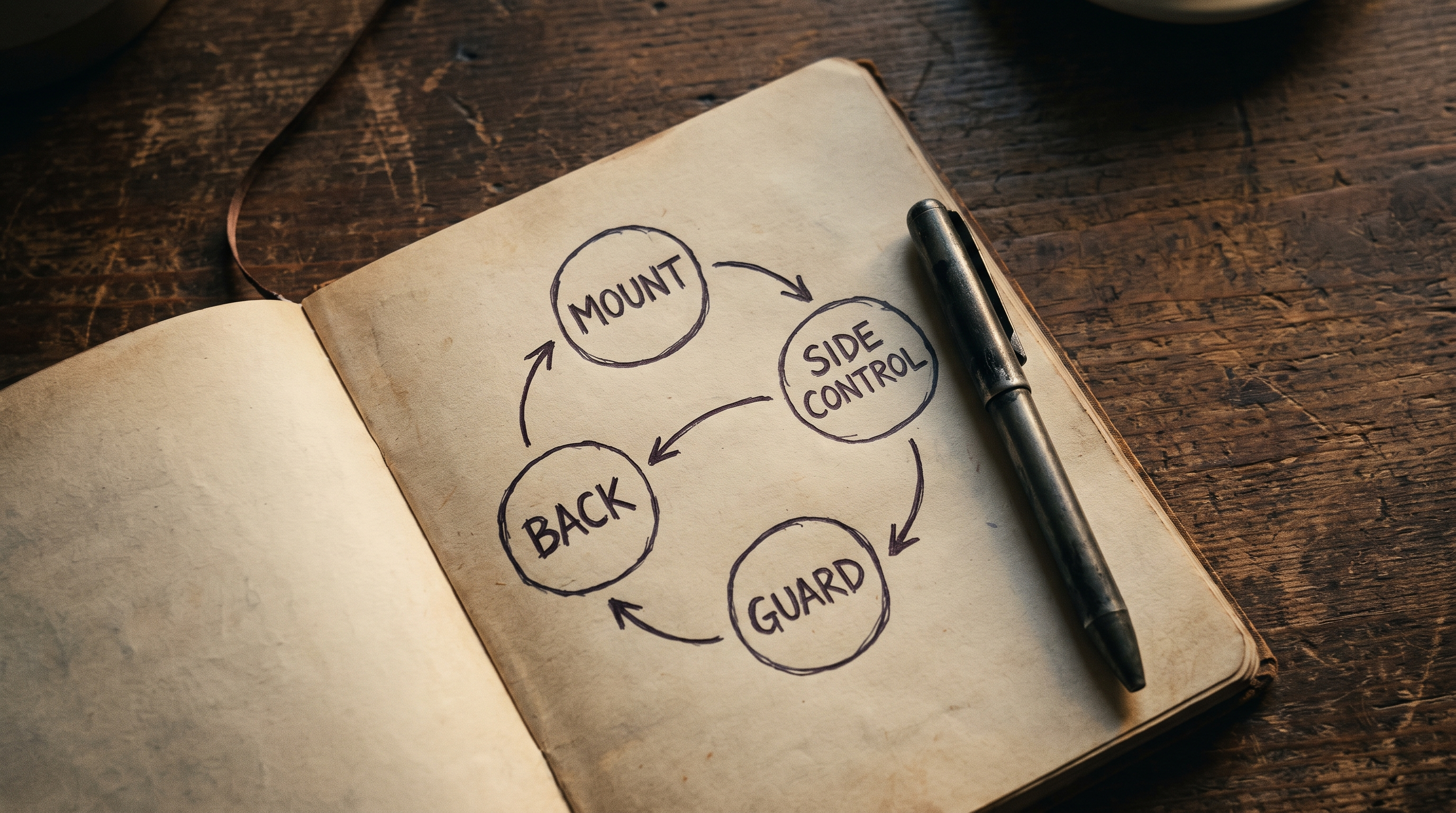
On a blank page, draw each position as a circle. Then draw arrows between them showing the standard transitions. Example arrows from bottom side control:
- Arrow to guard recovery (retain)
- Arrow to turtle (escape and stand)
- Arrow to bottom mount (opponent advances — you don't want this)
This is where your map becomes a map. You'll start to see that every roll is really a chain of position → transition → position. Submissions live on top of that chain, not underneath it.
5. Attach one or two techniques per slot
Only now do you start filling the map with named techniques. Under "escape side control", write "elbow-knee escape" and "underhook to knee shield". Under "submit from mount", write "cross-collar choke" and "armbar". Keep it minimal. Two techniques per slot you can actually pull off beats ten you've only seen on YouTube.
6. Revise the map before every class
Look at your map for two minutes before you leave for training. Pick one slot to focus on. "Today I'm working on retaining closed guard." That single decision transforms a random rolling session into a directed practice.
7. Update it after class
After training, spend another two minutes updating the map. Something didn't work? Note why. New position your training partner put you in? Add it. Coach showed a detail? Slot it in. The map is a living document — the more you revise it, the more your recall improves.
Remember. The goal isn't to have the most detailed map in the gym. The goal is to have a map you actually use every week.
Common mistakes when memorizing BJJ positions
A few traps to avoid while you build your map:
- Chasing submissions before you own positions. If you can't hold mount, learning a fancy mounted submission is wasted effort. Position before submission — always.
- Learning too many guards at once. Pick one guard to start with (closed or half are fine defaults) and get comfortable there before adding spider, De La Riva, X-guard, etc.
- Skipping the losing positions. White belts love learning attacks from mount and back. Almost no one drills bottom side control escapes enough. Guess where you're going to spend most of your early rolls.
- Confusing "watching" with "learning". Watching an instructional passively rarely creates recall. You need to translate what you saw into your own notes, on your own map, in your own words.
- Treating the map as fixed. Your map at three months should look different from your map at day one. If it hasn't changed, you haven't been paying attention.
- Ignoring the transitions. People memorize positions but forget the arrows between them. The arrows are where jiu-jitsu actually happens.
Where BJJ Memo fits in
A paper map is a great start, but paper doesn't remind you to revise, and it can't play the clip that made the technique click. This is the gap BJJ Memo was built for. Paste a BJJ YouTube URL and the app turns it into a structured Technique Card — clear steps, key details, and tappable timestamps to the important visual moments — and files it into your personal library by position. Your mental map, but searchable and revisable.
The review flow surfaces cards for spaced revision, so the closed-guard sweep you learned three weeks ago actually shows back up in your head before your next roll. It doesn't replace your coach or mat time — it just makes the learning between sessions stick. If you're already keeping a BJJ notebook, think of this as the digital version that never gets lost in your gym bag. You can also browse more retention-focused guides on the BJJ Memo blog or learn more about how the app works.
Remember. The app is a helper for retention. Real feedback still comes from rolling with training partners and a qualified coach.
Frequently asked questions
How long should it take a white belt to memorize the core BJJ positions?
Most newer grappliers can name and rank the core positions within a week or two of focused effort — writing them down, drawing the transitions, and reviewing before class. Truly owning those positions in live rolling takes much longer and depends on how often you train, but the mental map itself is a quick win you can build early.
What's more important: learning positions or learning submissions?
Positions, without question. Submissions live on top of positions — if you can't hold or advance a position, you'll rarely finish a submission from it. The classic phrase "position before submission" exists because it's true at every belt level, and especially at white belt.
Do I really need to write my BJJ mental map on paper?
Writing it out — on paper, in a notes app, or as technique cards — forces your brain to organize the information instead of passively storing it. That active step is a big part of why the map works. The specific medium matters less than the act of putting it in your own words.
How many techniques should I keep per position on my map?
At white belt, start with one or two per slot (one escape, one retain, one advance). It's much better to have a small number of techniques you can actually execute than a long list you've only watched. Add more as your existing tools become reliable.
Why do I keep forgetting techniques I learned in class?
Usually because there's no structure to attach them to and no revision after class. Techniques stored as isolated fragments fade quickly. Slot the technique into your positional map right after class, then review it before your next session — that combination is what makes it stick.
Can I build a mental map just from YouTube, without a coach?
YouTube is great for building the map and understanding concepts, but it can't correct your posture, your grips, or your pressure. Use video to build the framework, then bring it to the mat with a qualified coach who can give you real feedback.
Start building your map
Grab a blank page tonight. Write the core positions. Rank them. Draw the arrows. Add one technique per slot. Then keep it alive — revise it before class, update it after. That single habit will do more for your jiu-jitsu than any new instructional you buy this year.
When you're ready to move the map off paper, BJJ Memo turns the videos you already watch into structured technique cards, filed by position and surfaced for revision before you train. Available on iOS and Android.
For real feedback and safety, train the techniques on your map at a legit academy with a qualified coach — BJJ Memo helps you remember and revise, it doesn't replace mat time.
Last updated 2026-09-07.