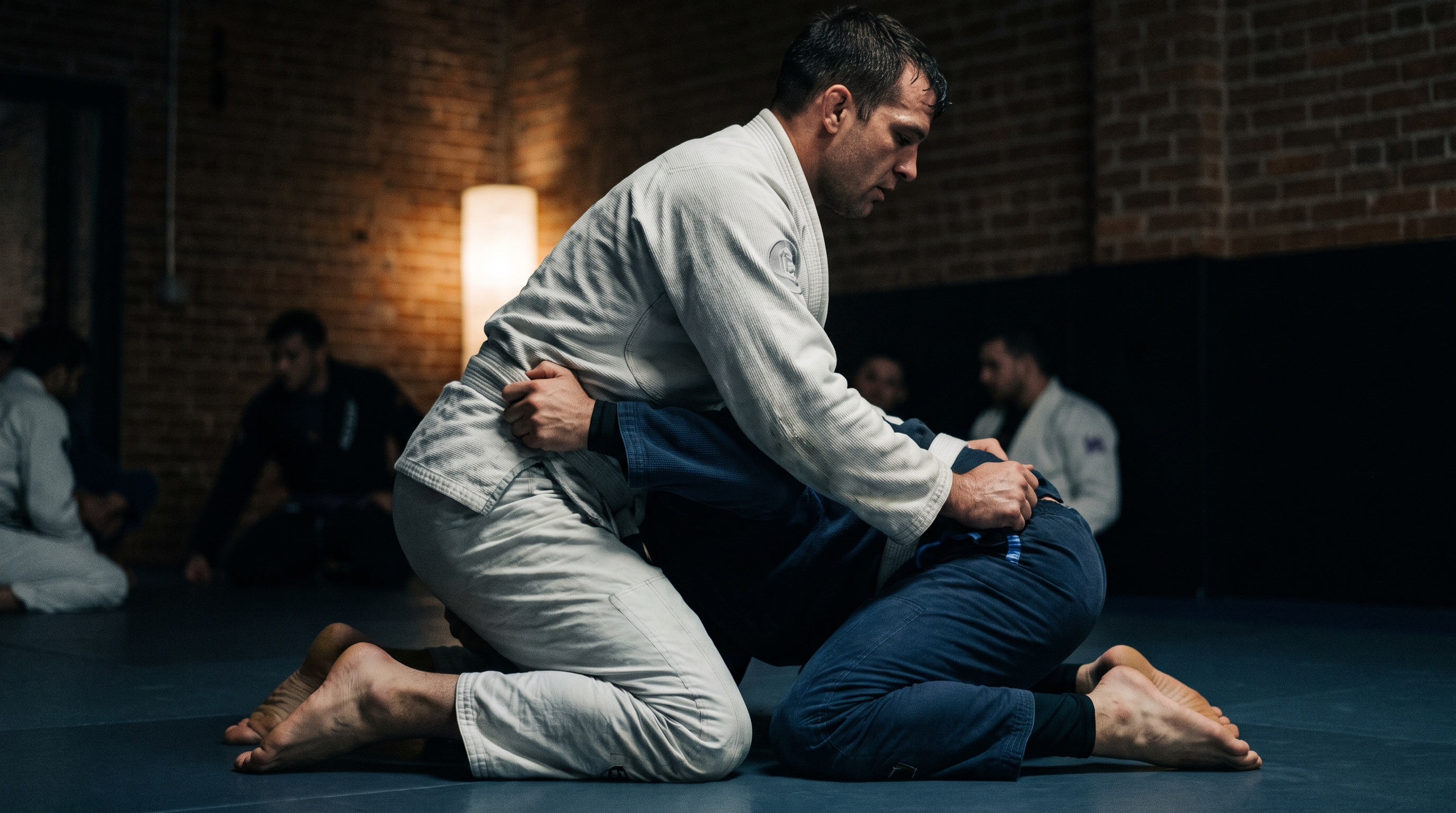
How to Pass the Guard: A Beginner's Roadmap from Posture to Pin
TL;DR. Passing the guard as a beginner is not about knowing twenty passes — it is about a repeatable sequence: get posture, kill the hips, open the guard safely, choose one pass (start with the knee cut), and finish by pinning weight above their chest line. Learn one closed-guard opener and one knee cut pass first, drill them until they feel automatic, and review the details before each class so they actually show up when you roll.
If you are new to Brazilian Jiu-Jitsu, guard passing probably feels like the hardest part of the whole game. Your partner is on their back — you are the one on top, in the "dominant" position — and yet somehow you keep getting swept, submitted, or stalled out. That is normal. The guard is designed to make the person on top uncomfortable, and passing it well is a skill built from small, connected details, not one magic move.
This is a roadmap for beginners. You will not find fifteen advanced systems here. You will find one clear structure, one reliable pass to focus on first (the knee cut), the mistakes that quietly ruin every attempt, and a way to actually remember what you learn in class. Position before submission, always — that starts with learning to pass.
Key takeaways
- Guard passing is a chain: posture, grips, open, pass, pin — skip a link and the pass falls apart.
- For beginners, one closed-guard opener plus the knee cut pass will cover the majority of situations you meet at white and blue belt.
- Weight, not speed, is what wins passes — heavy hips and forward pressure beat scrambling every time.
- Kill the far hip and control an inside space (usually the inside of a knee) before you try to move around the legs.
- Post your head and keep your elbows tight — most failed passes are triangles, armbars, or sweeps you gave up by leaning without base.
- Finish above the chest line: side control, knee on belly, or mount. If you land in half guard, keep pressure and treat it as a new starting position.
- Structured revision between classes is what turns "I saw this once" into a pass you can actually hit under resistance.
Why passing the guard feels so hard at the start
The guard is any position where your training partner has their legs between you and them. That includes closed guard (legs locked around your waist), open guard (feet on hips, knees, biceps), half guard (one of your legs trapped), and various "modern" guards you will meet later. Each one has different rules, so beginners quickly feel like they are learning a new language every class.
On top of that, the person underneath has three real threats: sweeping you (putting you on your back), submitting you (triangles, armbars, kimuras), and stalling you (using their frames to eat time). Any attempt to pass has to respect all three. That is why running around the legs never works — you are just handing them angles.
The fix is not to memorize more moves. It is to build a small, layered system that keeps you safe while you work, then commit to it every time you find yourself in someone's guard.
A simple system to pass the guard
Use this as a checklist. If a pass ever falls apart, back up in the chain and find the step you skipped.
1. Establish posture and base
Before you think about passing, do not get broken down. In closed guard, sit up tall, spine stacked over hips, chin off your chest. Widen your knees for base. Put one hand on their belt or hip and one on the sternum or lapel to prevent them from pulling you in. If you feel yourself getting bent forward, stand up or reset — you cannot pass anything from a broken posture.
2. Get grips that kill the hips
The hips are the engine of every sweep and submission. Control them and everything gets easier. Common beginner-friendly options: two hands on the belt/hips to pin them down, or one hand controlling a sleeve/wrist so they cannot two-on-one your arm. The rule is simple: before you break the guard, take away their ability to move their hips freely.
3. Open the guard safely
For closed guard, the classic beginner opener is the standing break: control both hips or sleeves, stand up one foot at a time, keep your hips forward, and drive your knee into their tailbone until their ankles unlock. Do not lean forward as you stand — that is a highway to a triangle. Keep your elbows tight to your ribs, head up.
4. Frame the legs and control an inside space
Once the legs open, immediately pin one leg down with your hand or shin and control the inside of the other knee. Your goal is to prevent them from re-guarding while you set up your pass. This "inside space" concept is the difference between a pass that flows and one that gets stuffed.
5. Commit to one pass — the knee cut
The knee cut (or knee slice) is the pass every beginner should learn first. From combat base (one knee up, one knee down, or both knees up), get a cross grip on their far sleeve and an underhook or collar grip. Slice your top-side knee across their thigh, driving your shin toward the mat on the far side. Head to the mat on the far side of theirs, hip heavy, and shuffle to side control.
It works because it uses the same shape against every kind of open guard, and it teaches you the fundamentals of pressure and inside control.
6. Prevent the reguard as you cut through
As your knee slides across, their bottom leg will try to come between your legs to recover half guard or reset to open guard. Kick your trailing leg back and away so they cannot hook it. If they do catch half guard, do not panic — freeze, get heavy, and pass from there.
7. Finish above the chest line
A pass is not complete when you get past the legs. It is complete when your weight is above your partner's chest line — side control, knee on belly, north-south, or mount. Establish a cross-face and underhook or hip control, then breathe. If your chest is still level with their hips, you are one shrimp away from being back in guard.
Remember. Weight is a weapon. If a training partner tells you "you are heavy," that is a compliment — it means you are passing with base instead of speed.
The beginner's guard-passing checklist
| Step | What you are doing | What you must avoid |
|---|---|---|
| Posture | Sit tall, hands on hips/sternum | Getting pulled forward, head down |
| Grips | Kill the hips or a sleeve | Reaching for grips with a broken posture |
| Open | Stand and drive the knee, or seated open | Leaning while standing (triangle bait) |
| Frame | Pin a leg, control inside knee | Standing tall over open legs |
| Pass | Commit to the knee cut | Switching passes mid-attempt |
| Prevent reguard | Kick trailing leg back | Letting them hook your leg |
| Finish | Get above the chest line | Celebrating too early in half guard |
Common mistakes that quietly ruin your passes
Beginners rarely fail a pass because they don't know it. They fail because of one of these:
- Passing with your arms, not your hips. If your elbows are away from your body and you are pulling on collars, you have already lost. Stay connected, use your bodyweight.
- Trying to be fast. Speed without base gets you swept. Move at the pace of your grips and your weight.
- Head down. Any time your forehead is below your hips, you are giving up your posture. Look forward, keep the chin off the chest.
- No plan for the reguard. They will always try to put the legs back in. If you do not have a step for it, you will get stuck cycling through open guards forever.
- Learning ten passes before mastering one. Depth beats breadth for the first year. Pick the knee cut, drill it every class, and only add a second pass once it is automatic.
- Stopping at the legs. Passing past the knees is not passing. Get above the chest, cross-face on, and settle.
Remember. Every pass you learn from a video needs to be pressure-tested with a resisting partner. Watching is not the same as knowing.
How BJJ Memo fits into your guard-passing progress
Most people don't forget guard passes because they are bad at BJJ. They forget because they see a detail once in class, get on the mat two days later, and half of it has faded. That is where a structured revision habit changes everything.
BJJ Memo lets you paste a BJJ YouTube URL — an instructional on the knee cut, a competition breakdown, a technique clip from your favorite black belt — and turns it into a Technique Card: clear steps, key details, and tappable timestamps of the visual moments. You save the card into your personal library and the review flow surfaces it before your next session so the details are fresh when you tie your belt. It is a helper for retention, not a replacement for mat time.
A good workflow: after class, drop the video your coach referenced into BJJ Memo, tag it "guard passing," and skim the card in the car before your next training. Learn more on the BJJ Memo homepage or browse the blog for more beginner-focused breakdowns.
Frequently asked questions
What is the easiest guard pass to learn first?
The knee cut (also called the knee slice) is the standard first pass for beginners. It teaches inside control, pressure, and the finishing shape you will use for many other passes. Learn one standing opener for closed guard and one knee cut, and drill them until they feel automatic before adding more.
How long does it take to get good at passing the guard?
Honestly, it takes years to become a real threat with your passing against equally skilled grapplers — that is normal in BJJ. The good news is you can become competent at one pass much faster if you drill the same sequence every week and revise the details between classes.
Should I learn to pass standing or on my knees?
Both. Kneeling passes teach you pressure, and standing passes teach you posture and mobility. Most beginner curricula start with a kneeling knee cut because it is safer for your posture and easier to control. Once you are comfortable, add standing passes and toreando-style passes to your game.
Why do I keep getting triangled when I try to pass?
Almost always because your posture broke or one arm was inside and one was outside while your head dropped. Fix it by keeping both elbows tight to your ribs, chin up, and never reaching across your partner's body without base. If in doubt, hide the elbows.
Do I need to know a lot of passes to be effective?
No. At white and blue belt, one deep, reliable pass beats a menu of shallow ones. Build your A-game first, then add options that solve the specific problems opponents give you.
How should I study guard passing between classes?
Pick one instructional video, break it into a technique card with steps and key details, and review it before your next session. Passive re-watching does very little — active review with a plan for what you will try in sparring is what makes techniques stick. This is exactly what BJJ Memo was built for.
Start passing with intent — and remember what you learn
The difference between a white belt who is stuck in guard forever and one who develops a real top game is rarely talent. It is a small system, drilled honestly, and revised often. Learn to hold posture. Take the hips. Open the guard safely. Commit to the knee cut. Get above the chest line. Then do it again next class.
When you find a coach or a video that finally makes one of these steps click, capture it before you lose it — save it as a Technique Card in BJJ Memo, and it will be waiting for you before your next roll.
Teacher disclaimer. This article is a study aid, not a coaching replacement. For real feedback, safe drilling, and personalized corrections, train the technique at a legit academy with a qualified black belt. BJJ Memo helps you remember and revise — it does not replace mat time.
Last updated 2026-08-14.