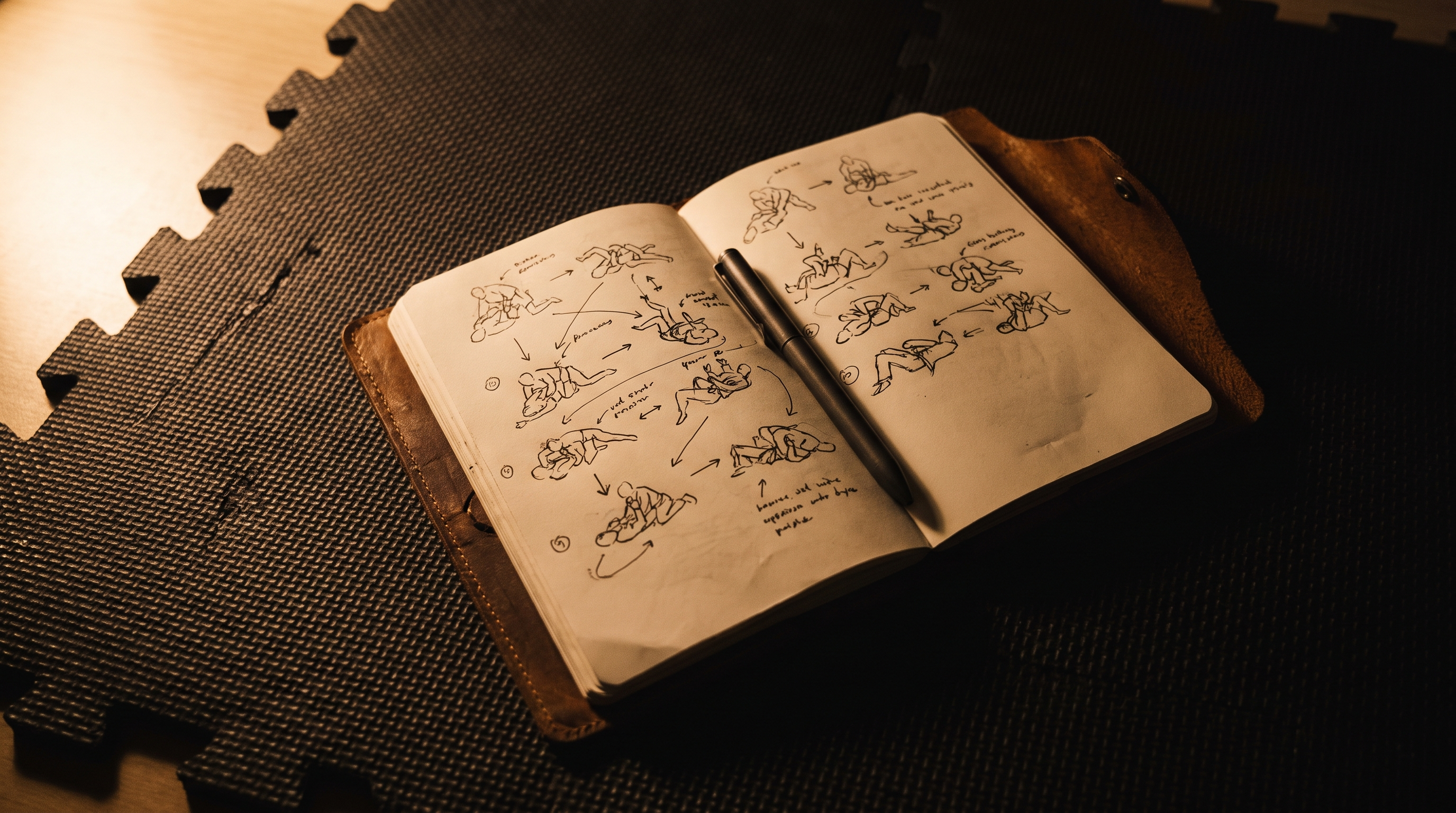
How to Remember BJJ Moves from Seminars: A Capture-and-Revise System That Works
TL;DR. Seminars dump a huge amount of detail on you in a few hours, and most of it fades within days if you don't capture it fast. Use a five-step system: rough capture during the seminar, a same-day brain dump, a structured technique card within 48 hours, a spaced review cycle, and targeted drilling in open mats. Prioritize the two or three moves you can actually plug into your current game rather than trying to save everything. Treat the seminar recording (when allowed) as raw material for revisable notes, not as a substitute for review.
You paid for the seminar. You showed up early, drilled with a partner you'd never met, and scribbled down details from a world-class black belt for three hours. A week later, you're rolling in class and realize you can't remember the grip sequence for that back take, let alone the follow-up. This is the norm, not the exception. Seminars are firehose events — the density of information is enormous, and human memory just isn't built to hold that much new motor detail without structured review.
The fix isn't a better memory. It's a capture-and-revise system that starts before you leave the mat and continues through your next few training sessions. This article walks through exactly what that system looks like: what to write down during the seminar, how to structure your notes the same day, and how to review them so the techniques actually show up in your rolls.
Key takeaways
- Seminars fail your memory not because you're bad at BJJ, but because you never revise what you learned.
- Capture rough notes during the seminar, then rewrite them structured within 48 hours while the movement is still fresh in your body.
- Pick two or three techniques per seminar to actually work on — trying to retain everything usually means retaining nothing.
- A good seminar note contains the position, the grips, the key details, the common mistake, and one line on how to enter the technique.
- Review your notes before every training session for the first two weeks, then space them out as they stick.
- Filming (when the instructor allows it) is useless without a system to convert the footage into structured, searchable notes.
- Drilling the new move in open mat within the first week is the single biggest factor in whether it stays with you.
Why this happens: the seminar retention problem
A typical BJJ seminar shows you a handful of related techniques with layers of detail — grip fights, angles, weight distribution, common counters, and follow-ups. In one afternoon you might see more nuance than you'd get from a month of regular classes. That's the value. It's also the problem.
Your brain encodes motor skills through repetition and context. In class, you drill a move dozens of times over several weeks; it slowly moves from conscious effort to something your body does on its own. In a seminar, you might get five or ten reps of a technique before the instructor moves on. That's enough to understand the move — not enough to own it. Without a capture step and follow-up drilling, most of that detail fades quickly.
There are three specific failure modes that hit almost every grappler after a seminar:
- The note-taking gap. You either don't write anything down ("I'll remember") or you scribble something so terse it's useless a week later ("back take from turtle — head position").
- The no-review trap. Even if you have decent notes, you never actually open them again until you're trying to write next month's notes.
- The drill vacuum. You don't test the new techniques in live rolls or drilling within the first week, so your body never links the details to real resistance.
Fix those three and seminar retention stops being a problem.
A simple system: five steps to actually remember what you learned
This is a workflow, not a life philosophy. It takes maybe thirty minutes of total effort per seminar, spread across a week. The payoff is that seminar techniques stop evaporating.
Step 1 — Rough capture during the seminar
Keep a small notebook or a notes app open between rounds of drilling. Do not try to write in full sentences. Between demonstrations, jot down:
- The position (e.g. "half guard bottom, underhook").
- The name or purpose of the move ("knee shield sweep").
- Two or three key details the instructor emphasized ("outside foot hooks knee", "head to the mat").
That's it. If filming is allowed, film the demonstration — but understand that video alone won't save you. Untagged, unstructured seminar footage is where techniques go to die. Also respect the instructor's rules on filming; many black belts are protective of their material, and a lot of them charge for the seminar precisely because you're not going to walk away with a free instructional.
Step 2 — Same-day brain dump
Before you go to bed on the day of the seminar, sit down for ten to fifteen minutes and dump everything you can remember. Do not organize it yet. Just write. Positions, details, entries, counters, off-hand comments the instructor made — anything. The goal is to catch the fast-fading working memory before it goes.
Do this while the movement is still in your body. If you wait until the next day, you'll already have lost a meaningful chunk of the detail.
Step 3 — Structured technique cards within 48 hours
Within two days, take your rough notes plus the brain dump and turn each technique into a proper card. A useful seminar card has six fields:
| Field | What goes in it |
|---|---|
| Position | Where the move starts (e.g. "closed guard, cross-collar grip") |
| Entry | How you get to the starting position in a real roll |
| Grips | Exact grips and where each hand goes |
| Key details | 2–4 details that make the move work (angle, weight, timing) |
| Common mistake | What the instructor called out as the usual error |
| Finish or follow-up | How it ends, or what you chain into if they defend |
The "entry" field is the one most people skip and the one that matters most. A technique you can't get to from an actual roll is not really in your game.
Remember. Do not try to write cards for every technique from the seminar. Pick the two or three that fit what you're already working on. The rest can live in your rough notes as reference — if they become relevant later, promote them to cards then.
Step 4 — Spaced review before training
This is where the retention actually happens. For the first two weeks after the seminar, read your cards for five minutes before every training session. That's it. Just read them. You are not trying to memorize — you are keeping the movement patterns near the surface so they show up in drilling and rolling.
After two weeks, drop to reviewing before every second session for another two weeks. After that, review the card any time you know you'll have open mat or partner drilling time.
This is the same principle as spaced repetition for language learning, applied to motor skills: short, frequent reviews beat one long cram session every time.
Step 5 — Targeted drilling in open mat
Within the first week, get a partner in open mat and drill the technique cold. Ten to fifteen reps each side. Then try to hit it in specific sparring from the position, then in live rolls. If you can't force yourself into the starting position in a roll, the entry field on your card is wrong or missing — go back and fix it.
The combination of a card you reviewed that morning plus live-resistance reps is what converts a seminar move into part of your actual game. Skip either and the technique stays theoretical.
Remember. Retention is not a memory problem — it's a reps problem plus a review problem. Notes on their own don't stick a move. Reps on their own don't either. You need both, and you need them within the first week.
Common mistakes people make after seminars
Almost every retention failure falls into one of these categories:
- Trying to remember everything. A three-hour seminar with a dozen techniques and forty details is not going to fit in your brain. Choose a small number of moves you can realistically integrate.
- Waiting to write notes. If you write your notes three days later, you've already lost most of the specific details — grip angles, weight shifts, the exact hand position that made it click.
- Filming without processing. A phone full of seminar videos you never rewatch is worse than no video at all — it gives you a false sense that the information is "saved."
- Reading notes once and never again. One review does almost nothing for motor memory. Frequent short reviews beat one long one.
- Not drilling with resistance. Cooperative reps at half speed will not carry over to a live roll. You need at least some specific sparring from the starting position.
- Ignoring the entry. A submission you can't set up is a party trick. Always note how the instructor entered the position in the first place.
- Copying the black belt's game. The instructor's move works partly because their whole game supports it. Adapt the technique to your body type, flexibility, and current game — don't try to become them.
Where BJJ Memo fits in
If you already keep a paper notebook that works for you, keep using it. The system above is agnostic to the tool. BJJ Memo is built for grapplers who prefer a structured digital library: you can paste any BJJ YouTube URL and the app turns it into a Technique Card with steps, key details, and tappable timestamps on the important moments, then files it into a searchable personal library. If the seminar instructor has related material on YouTube, that's a fast way to build a card you can revise before training. Read more about our approach to remembering BJJ techniques and how the review flow surfaces cards on a spaced schedule so you actually see them before you hit the mat.
Frequently asked questions
How soon after a seminar should I write proper notes?
Do a rough brain dump the same evening and structured technique cards within 48 hours. Beyond that window, specific details like grip angles and weight distribution start slipping fast because you can no longer feel the movement in your body.
Should I film everything at seminars?
Only if the instructor explicitly allows it. Many black belts don't permit filming, and you should respect that — you're at their seminar. When filming is allowed, treat the footage as raw material for structured notes, not as a substitute for review. Unwatched seminar footage is a common trap.
How many techniques from a seminar should I actually try to keep?
Two or three, chosen to fit your current game. Trying to integrate a dozen new moves at once usually means none of them get enough reps to survive. The rest can stay in your rough notes as a reference if they become relevant later.
Do I need to memorize the whole technique card?
No. The point of the card is that you don't have to memorize it — you just re-read it briefly before training so the pattern is fresh. Spaced review beats memorization for motor skills.
What if I can't get to open mat within the week?
Ask a training partner to stay ten minutes after regular class and drill the technique with you, or set up a short drilling session at home with a willing partner. Even light cooperative drilling in the first week helps the details survive.
How is this different from just watching instructionals on YouTube?
Seminars give you in-person feedback, energy, and details the instructor might not put on camera. The retention problem is the same though — without capture, review, and drilling, both seminar and YouTube content fade. The system above works for both.
Next steps
Seminars are one of the best investments you can make in your BJJ, but only if the techniques survive the week. Build the habit: rough notes on the day, structured cards within 48 hours, review before training, drill in open mat. Do that for your next three seminars and you'll notice the difference in what actually shows up in your rolls.
Next time you attend a seminar or watch an instructional, save the key techniques as structured cards in BJJ Memo so they're there before your next roll. Build your own technique library and revise before training — available on iOS and Android.
For real feedback and safety, drill and pressure-test seminar techniques with a qualified coach at a legit academy. BJJ Memo helps you remember and revise; it doesn't replace mat time or coaching.
Last updated 2026-09-30.