How to Remember BJJ Techniques After Class: A Simple 3-Step System
TL;DR. Most grapplers forget techniques not because they lack talent, but because they never revise them. To remember what you learn in class, capture the detail immediately (within an hour), structure it into a short technique card with 3–5 clear steps, and revise it briefly before your next session. Pair this with focused drilling and light live application, and retention compounds fast. BJJ Memo automates the capture-and-revise part so the details survive to your next roll.
You walk out of class feeling like you finally understood the arm drag. Two days later, you're on the mat, someone posts up, and… nothing. The setup, the grip, the angle — gone.
This is the most common frustration in Brazilian Jiu-Jitsu, and it has almost nothing to do with talent. It's a memory problem, and memory problems have systematic solutions. In this article, you'll get a repeatable 3-step system for retaining techniques from class, plus the common mistakes that quietly sabotage most people's retention. It's the exact loop we built BJJ Memo around, but the system works whether you use an app, a notebook or a voice memo.
Key takeaways
- Forgetting BJJ techniques is normal — human memory fades quickly without deliberate review.
- The single biggest fix is capturing the details of a technique while it's still fresh, ideally within the hour after class.
- A useful technique note has three parts: the position, 3–5 key steps, and the common mistake that kills it.
- Brief revision the day before or the morning of your next class beats long, one-off study sessions.
- Drilling turns a memory into a motor pattern; without reps, even perfect notes stay theoretical.
- Trying to remember every detail from class is a losing game — pick one or two priorities per session.
- Tools like BJJ Memo remove the friction of writing notes so you actually keep the habit.
Why you forget BJJ techniques after class
A typical class dumps a lot of information on you at once: a warm-up flow, a specific position, two or three technique variations, coaching corrections, then live rounds. By the time you drive home, most of the fine detail has already faded. That's not a personal failing — it's how memory works. New information decays quickly unless you revisit it.
BJJ makes this worse in three specific ways:
- Volume. Each class introduces multiple details (grip, angle, weight, hip position, timing). You cannot hold all of them in working memory.
- Similarity. Techniques overlap. This week's underhook pass looks a lot like last week's, and the small differences are exactly what matters.
- No natural cue. Outside of class, nothing prompts you to revisit an armbar from mount. If you don't set up a cue yourself, you won't think about it until it fails you in a roll.
The fix isn't to be smarter or take a photographic memory pill. It's to build a simple loop that reintroduces the information before it disappears.
Remember. You don't forget techniques because you're bad at BJJ. You forget because nothing in your week is asking you to remember them.
A simple system: 3 steps to actually remember techniques
The system has three phases: Capture → Structure → Revise. Each one takes only a few minutes if you keep it small. Below is a step-by-step version you can start using after your next class.
1. Pick one thing to remember before class ends
Don't try to remember the whole class. Before you shake hands and leave, decide on the one technique or one detail you actually want to keep. It can be a full move ("knee cut from the underhook") or a single correction ("drive the far shoulder into the mat before I pass"). One deep memory beats five shallow ones.
2. Capture it within the hour
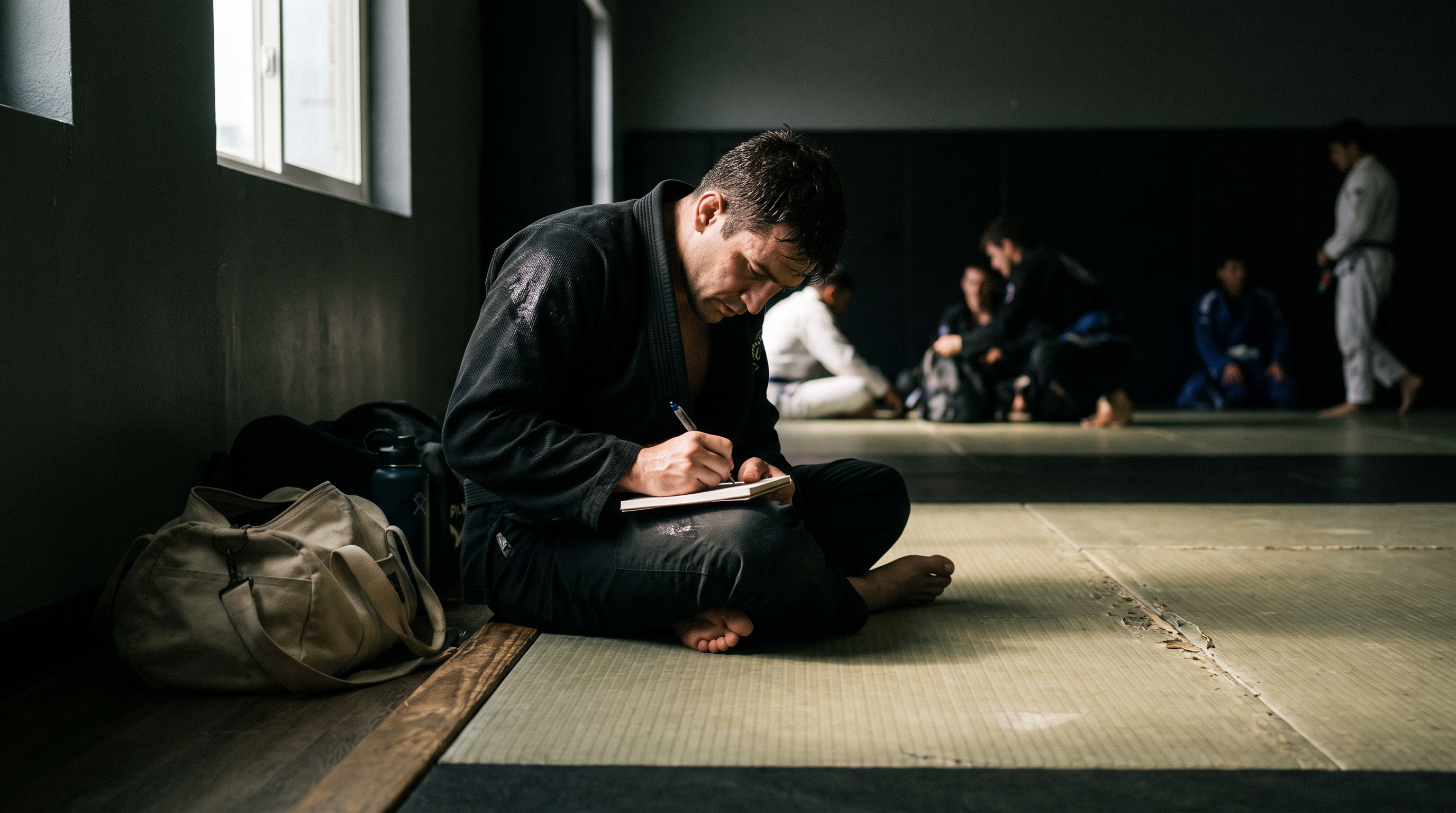
The faster you write it down, the more detail survives. Aim for within an hour of class — in the car (voice memo), on the bus, or as soon as you get home. Don't wait for the perfect moment; the memory is decaying while you wait.
Use whatever medium is fastest for you:
- Voice memo on your phone.
- Two-line note in your phone's notes app.
- A physical notebook by your gym bag.
- A technique card in BJJ Memo, especially if the technique came from or matches a YouTube instructional.
3. Structure it into a technique card
Raw notes fade because they're hard to reread. Convert your capture into a small, standard structure. This makes it scannable later.
A good technique card has four fields:
| Field | What goes here |
|---|---|
| Position | Where does this start? (e.g. "closed guard, cross-collar grip") |
| Steps | 3–5 numbered actions, in order |
| Key detail | The one thing that makes it work (grip, angle, timing) |
| Common mistake | The failure mode your coach corrected |
Keep it short. If your card is longer than a screen, you won't reread it.
4. Revise it briefly before your next session
Revision is where retention actually happens. The night before class, or on the way to the gym, spend 2–5 minutes rereading yesterday's card. You are not studying — you are reminding your brain that this information matters.
A rough rhythm that works well for hobbyists training 2–4 times a week:
- Same day: capture + structure (5–10 min).
- Before next session: quick reread (2–5 min).
- One week later: reread again.
- One month later: reread once more, and mark whether you've actually used it in a roll.
5. Drill it, even briefly
A note is not a technique. Before or after class, grab a partner for two minutes and run the move 5–10 times slowly. Focus on the key detail from your card. This is where the memory turns into a movement pattern your body can access under pressure.
6. Try it in live rounds — on purpose
Pick one round per session where you deliberately hunt for the position from your card. You'll fail more than you succeed at first. That's the point: failed reps are how you learn what the card was missing.
7. Update the card
After you try the technique live, go back and update your card with what you learned. "Grip breaks if I don't get the head control first." "Only works when they post the far foot." This is the difference between a static notebook and a living technique library.
Remember. Capture, structure, revise, drill, use, update. Small loops, done consistently, beat one perfect study session.
Common mistakes that kill BJJ retention
Even grapplers who start a note-taking habit usually quit within a few weeks. Almost always for the same reasons:
- Trying to write everything down. If your notes take 30 minutes per class, you'll stop. Cap yourself at one technique per session.
- Writing too late. Notes written three days after class are guesses. Capture the same day or don't bother.
- No structure. A wall of text is unreadable a week later. Use the position / steps / key detail / mistake format.
- Never rereading. Notes you never open are just a diary. The revision step is non-negotiable.
- Skipping the drill. Reading about an armbar is not the same as feeling one. Even two minutes of slow reps before class helps.
- Hoarding techniques. A library of 200 half-remembered moves is worse than 15 you can actually hit. Prune ruthlessly.
- Chasing new content. New YouTube instructionals feel productive but often replace revision of what you already learned. Revise before you consume more.
A useful gut check: if you can't describe the last technique your coach showed in three sentences and one key detail, your capture step is broken.
Where BJJ Memo fits in
The 3-step system works with pen and paper. The reason we built BJJ Memo is that most people quit note-taking because the friction is too high — especially when the technique came from a YouTube instructional they wanted to study.
BJJ Memo lets you paste a BJJ YouTube URL and get a structured technique card automatically: position, steps, key details and tappable timestamps on the important visual moments. The card lands in a personal, searchable library, and a revision flow surfaces cards before your next session so the capture-and-revise loop actually happens.
It doesn't replace class, a coach or drilling. It removes the excuse of "I'll write it down later" — because later never comes.
Remember. The best retention system is the one you'll still be using in three months. Choose the lowest-friction option you'll stick with.
Frequently asked questions
How long does it take to remember a BJJ technique?
There's no fixed answer, but for most hobbyists a technique starts to feel reliable after several exposures spread over weeks: seeing it, drilling it, revising the notes, and attempting it live. A single class almost never sticks by itself, which is why the revision step matters so much.
Is it better to take notes during class or after?
After class, almost always. Taking notes on the mat pulls your attention away from the demonstration and from your drilling partner. Watch, feel, ask questions in class — then capture within the hour once you're off the mat.
How many techniques should I focus on at a time?
Fewer than you think. For most people training 2–4 times a week, one to three "live" techniques you're actively trying to hit in rolls is plenty. Everything else can sit in your library until you're ready to promote it.
Do I need a special app to remember BJJ moves?
No. A notebook or a notes app works if you actually use it. Apps like BJJ Memo help because they lower the friction of capturing structured notes — especially from YouTube — and they remind you to revise. The tool matters less than the habit.
What if I forget the technique before I can write it down?
Write down whatever you remember, honestly labelled. Even "knee cut pass, something about the underhook, I forgot the grip" is useful — it flags the gap for next class, when you can ask your coach or a training partner to walk you through it again.
Should I revise techniques I've already learned or focus on new ones?
Revise first, consume second. Most grapplers over-invest in new instructionals and under-invest in the techniques they've already been shown. A quick reread of last week's card before class will do more for your game than another hour of YouTube.
Start remembering what you learn
Pick one technique from your next class. Capture it within the hour. Structure it into a small card with position, steps, key detail and the common mistake. Reread it before your next session, drill it briefly, and try it live on purpose. Update the card afterwards. That's the whole system.
If you want the capture-and-revise loop handled for you — especially when you're learning from YouTube instructionals — BJJ Memo turns any BJJ video into a structured technique card and surfaces it before your next roll. You can start with the blog for more retention and learning guides.
Teacher disclaimer. BJJ Memo helps you remember and revise techniques between sessions. It does not replace mat time or a qualified coach. For real feedback, safe execution and honest correction of your technique, train regularly at a legit academy under a qualified black belt.
Last updated 2026-08-10.