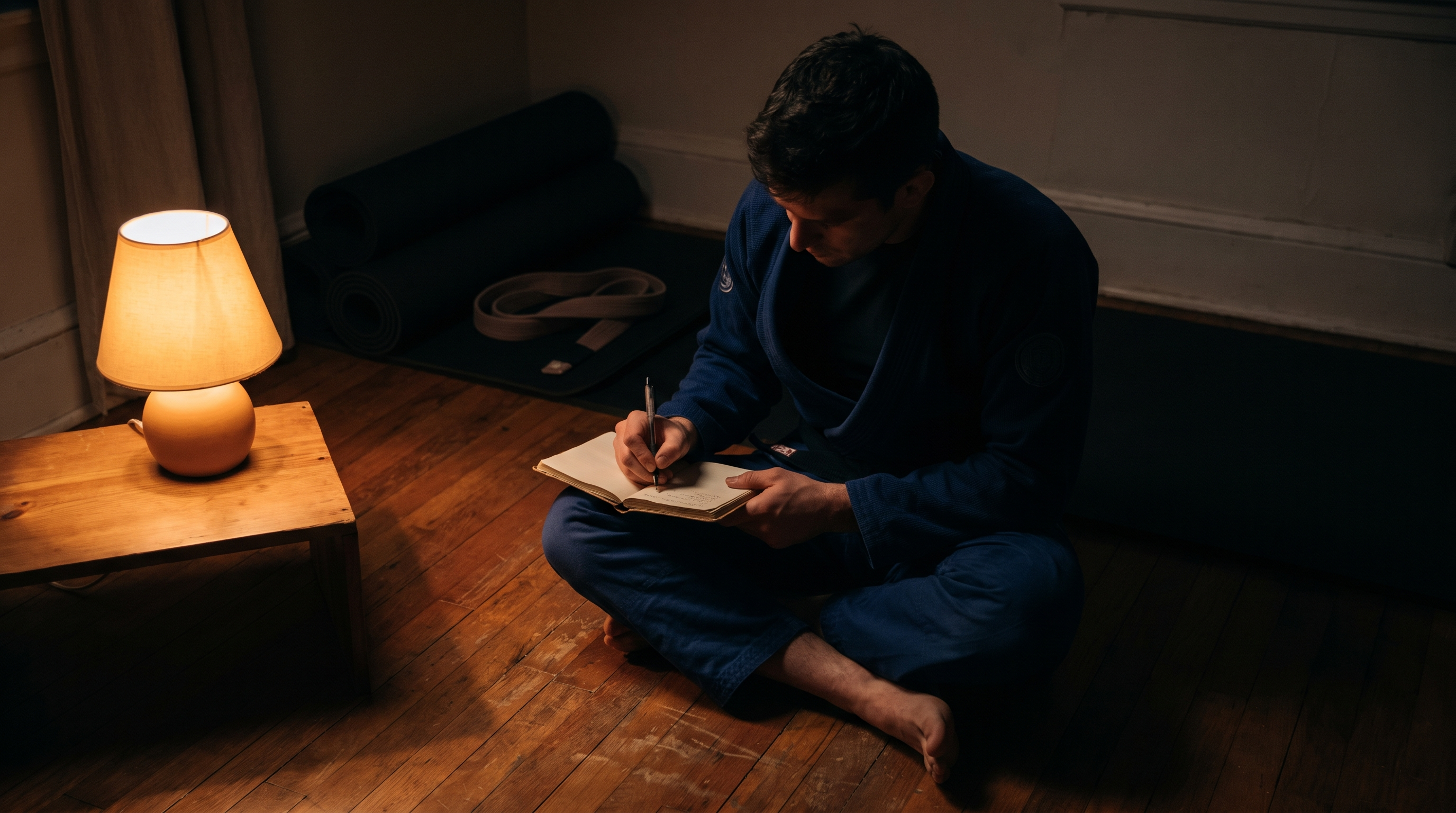
How to Review a BJJ Class the Same Night: A 10-Minute Post-Training Routine
TL;DR. Most of what you learn in a BJJ class fades quickly if you never revisit it. A short review the same night — while the details are still fresh — is the highest-leverage habit a hobbyist can build. Spend about 10 minutes: dump the class from memory, name the technique clearly, break it into 3–5 steps, note the one detail that made it work, mark what to try next roll, and cue a quick revision before your next session. Do this after every class and your game compounds instead of leaking.
If you train two or three times a week and feel like you're constantly re-learning the same techniques, you're not slow — you're just skipping the step between class and your next session. Watching an instructional, drilling in class, and rolling are all inputs. Without a short review, those inputs never fully consolidate. This routine takes about ten minutes and fits between shower and sleep. It doesn't replace mat time and it doesn't turn you into a black belt overnight. It just makes sure the details a coach handed you tonight are still there next week, when you actually need them.
Key takeaways
- Reviewing a BJJ class the same night, before sleep, captures the details that would otherwise blur by morning.
- Ten minutes is enough — the goal is capture and clarity, not a perfect essay.
- Write from memory first, then check a video only if you're stuck; recall is what strengthens memory.
- Every note should include the technique name, the setup, the key detail, and one thing to try next class.
- A single "key detail" per technique is more useful than a wall of text you'll never re-read.
- Revisit the note briefly before your next session so the technique is loaded, not buried.
- A structured library beats scattered notes — organize by position (guard, side control, mount, back).
Why this happens: you don't forget because you're bad
A typical BJJ class throws a lot at you in a short window: a warm-up movement, a positional context, one or two techniques with several details, a drill, then live rolling. By the time you're changing back into your clothes, the coach's small correction — the one that made the move actually work — is already competing with everything else in your day.
This isn't a beginner problem. Higher belts forget too. The difference is that they usually have deeper reps, a mental map of positions, and often some form of note-taking. If you're a hobbyist training two to three times a week, you don't get enough raw reps to force retention through volume alone. You have to close the loop deliberately.
The good news: recall is trainable. The act of trying to remember a technique — before you check anything — is what builds the memory. That's why the same-night review works so well. You're still close enough to the class to remember something, and far enough that you're actually retrieving, not copying.
Remember. Recall builds memory. Re-reading builds the illusion of memory. Always write from your head first.
A simple system: the 10-minute post-training routine
Here is the exact process. Keep it in your notes app, a physical notebook, or a dedicated tool — the medium matters less than the consistency.
1. Sit down within a few hours of class (2 minutes)
Do the review the same night if at all possible, ideally before bed. Sleep helps consolidate what you just captured, so the closer to bedtime, the better. Don't wait until "tomorrow morning" — by then the small details are gone.
Open your notes. New entry. Date, gym, coach if you want. Move on.
2. Brain-dump the class from memory (2 minutes)
Before you look at anything, write down everything you remember, in any order:
- Which position(s) did we work?
- What technique(s) did the coach show?
- What did they emphasize? (grip, angle, weight, timing)
- What went well when you drilled it?
- What did your partner catch you with in rolls?
Messy is fine. This step is the workout for your memory — don't cheat by opening YouTube yet.
3. Name the technique clearly (30 seconds)
Use the actual BJJ vocabulary. "Underhook escape from side control" is useful. "That thing where you shrimp" is not. If you don't know the name, describe it as starting position → what you do → finishing position. For example: "Closed guard → hip-bump sweep → mount."
Clear names are what make your notes searchable in three months.
4. Break it into 3–5 numbered steps (2 minutes)
More than five steps and you'll never re-read it. Fewer than three and you probably skipped something. Aim for the minimum viable sequence a training partner could follow.
Example structure:
- Starting position and grips
- First movement (frame, angle, hip movement)
- Key mechanical action (sweep, pass, submission entry)
- Finish and follow-up
5. Write the ONE key detail (1 minute)
This is the most important line in the whole note. Every technique has a detail that makes it work — the elbow position, the grip depth, the direction of the pressure, the timing off your partner's reaction.
Write it as a single sentence you could say out loud in class. If your coach said something specific ("drive with your near shoulder, not your hand"), quote it. This one sentence is what you'll re-read before your next session.
6. Mark what to try next roll (1 minute)
Retention only matters if it hits the mat. Close the note with a concrete intention:
- "Next open mat: hunt for this from bottom side control."
- "Play closed guard on purpose to set up the hip-bump."
- "Ask a training partner to feed me this pass so I can drill the counter."
One technique, one intention. Don't try to reintegrate ten things at once.
7. Cue a quick pre-training revision (1 minute)
Set yourself up to actually see this note before your next class. Options:
- A calendar reminder an hour before training.
- A pinned note in your phone.
- A dedicated review flow in an app like BJJ Memo that surfaces recent techniques on a schedule.
Without this step, the notes just sit there. With it, you walk into class already primed.
What the 10 minutes actually look like
| Minute | Action | Output |
|---|---|---|
| 0–2 | Sit down, open notes, date it | Blank entry ready |
| 2–4 | Brain-dump from memory | Rough recall of class |
| 4–5 | Name the technique | Searchable title |
| 5–7 | 3–5 numbered steps | Clean sequence |
| 7–8 | The ONE key detail | Quotable coaching cue |
| 8–9 | "Try next roll" line | Concrete intention |
| 9–10 | Set a pre-training cue | Reminder scheduled |
Remember. A short, honest note you actually re-read beats a beautiful one you never open again.
Common mistakes when reviewing a class
Waiting until "tomorrow"
The curve of forgetting is steep in the first day. If you push the review to the morning, you're mostly writing down the shape of the technique, not the details. Same night, close to sleep, is the sweet spot.
Writing too much
A three-page note is a note you'll never re-read. Cap yourself at a short, structured entry. If you feel the urge to write more, add it as a separate "deep dive" note later — don't bloat the class recap.
Copying an instructional instead of recalling
Going straight to YouTube or an online instructional short-circuits the memory work. Recall first, then use video only to fill genuine blanks. Otherwise you're building a nice-looking archive and a weak memory.
No organization
A hundred scattered notes titled "Tuesday class" are almost as bad as no notes. Organize by position — guard, side control, mount, back, standing, submissions — so future-you can actually find the escape you learned two months ago. Our guide to organizing your BJJ techniques covers a simple structure that scales.
Skipping the "try next roll" line
Without an intention, techniques stay in the notebook. You want each note to have a clear next contact with the mat. That's what turns a recap into a game.
Doing it once and quitting
One review is nothing. The habit is the point. A short, imperfect note after every class for a month will change your game more than a perfect note once.
Remember. Consistency beats craft. Ten okay reviews are worth more than one perfect one.
Where BJJ Memo fits in
You can absolutely run this routine with a paper notebook or a plain notes app — many good grapplers do. BJJ Memo is built to make the same routine faster and more consistent.
The workflow is designed around exactly this problem: you paste a BJJ YouTube URL (the instructional your coach referenced, a competition clip of the position, or a technique breakdown), and the app turns it into a structured Technique Card with steps and tappable timestamps on the key visual moments. You file it into your personal library by position, add your own "key detail" and "try next roll" notes from class, and the app surfaces cards for revision before your next session.
If you'd rather build the habit on paper first, do that — then let a tool like BJJ Memo handle the video capture and revision cues when you're ready. Either way, the underlying routine is what matters.
Frequently asked questions
How long should a post-BJJ class review actually take?
Around ten minutes is the sweet spot for a hobbyist. Long enough to name the technique, capture 3–5 steps, and write the key detail — short enough that you'll actually do it after every class instead of skipping it.
Should I review the class the same night, or the next morning?
The same night, ideally close to bedtime. The small details a coach emphasizes fade quickly, and sleeping shortly after capturing them helps consolidation. Next-morning reviews are better than nothing, but you'll usually have lost the finer points.
Should I write notes during class instead?
Generally no. In class, your job is to pay attention, drill, and get corrections. Scribbling mid-class usually means missing the next detail. The review happens after class — that's what this routine is for.
What if I forget most of what we did by the time I sit down?
Write down whatever you have. Even a fragment ("we worked side control escapes; underhook on the far side; something about a hip switch") is enough to jog your memory tomorrow. Then, if you really need to, look up the technique to fill blanks — but only after you've tried to recall it yourself.
How is this different from just watching more YouTube?
Watching is a passive input; reviewing is active recall. Passive input feels productive but doesn't stick. Active recall — even a rough, imperfect one — is what actually builds the memory you'll use in a roll.
Do I really need an app for this?
No. A notebook or notes app works. An app helps if you're capturing a lot from video, want your notes organized by position automatically, and want reminders to review before class. Start simple; upgrade the tool once the habit is real.
Close the loop, then get on the mat
The reason most hobbyists plateau isn't talent or genetics — it's that class-to-class, the details leak. A ten-minute review the same night plugs the leak. Do it after your next class, then the one after that, and give it a month. Your rolls will start to feel less random.
When you're ready to make the routine effortless, BJJ Memo turns any BJJ YouTube video into a structured technique card and helps you revise it before training — so what you learned tonight is still there next week. Available on iOS and Android.
Coach disclaimer: This article is about reviewing what you already learned. It is not a substitute for coaching. Learn and refine technique at a legit academy with a qualified black belt or coach — the mat, the reps, and the feedback are irreplaceable. BJJ Memo helps you remember and revise; it doesn't replace training.
Last updated 2026-08-30.