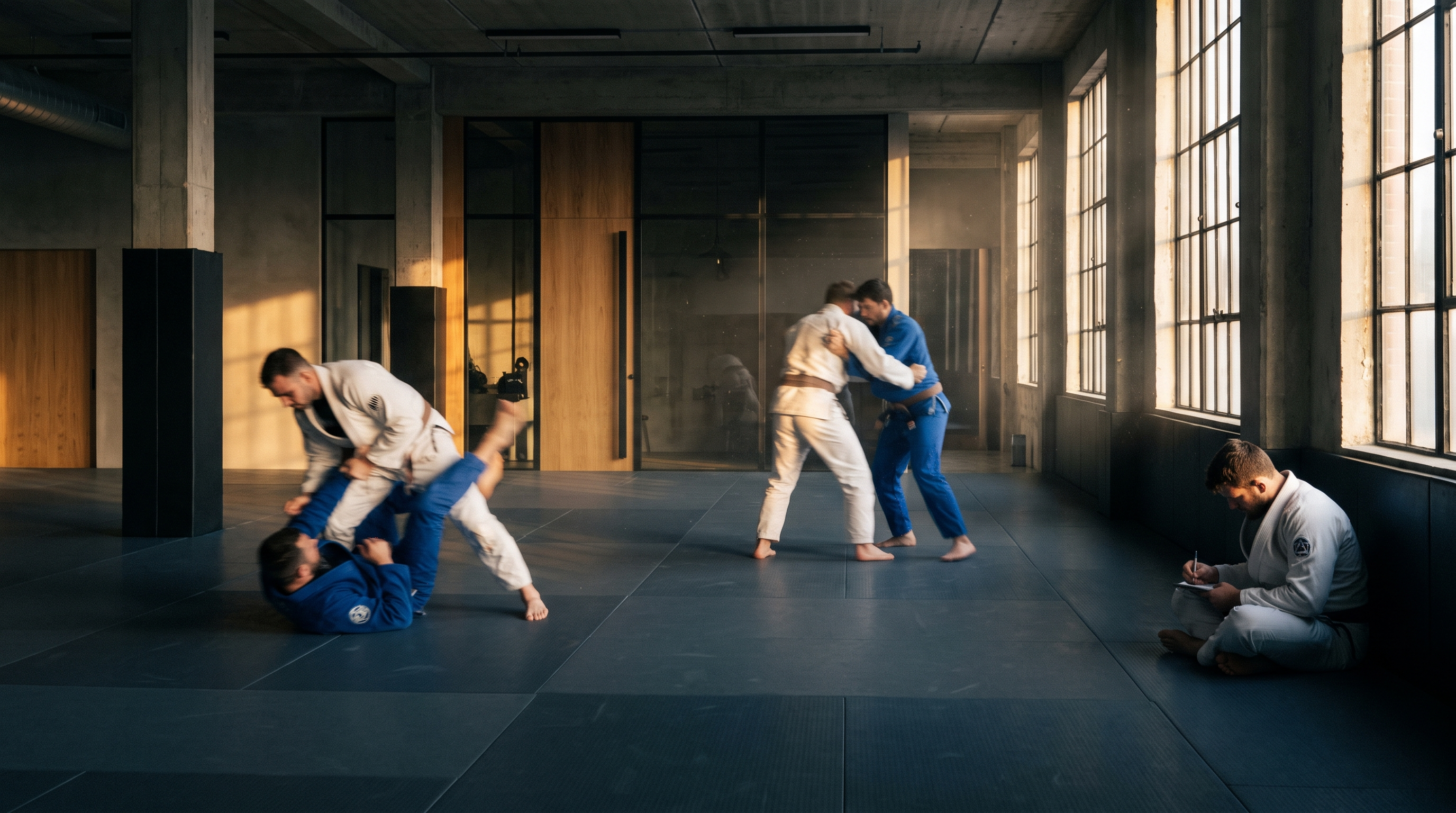
How to Structure a BJJ Open Mat: Turning Two Hours of Rolling Into Real Learning
TL;DR. Most open mats turn into two hours of random rolling and a lot of forgotten techniques. A structured open mat has a clear focus, a warm-up, positional drilling on that focus, a mix of specific and free rolls, and a short review at the end. Pick one position or problem before you arrive, block your time in rough segments, and end with two or three written notes. Do this weekly and open mat becomes the most productive session of your week — not the most exhausting.
Open mat is one of the most valuable slots in a grappler's week. There is no scripted class, no queue for the coach, and usually a wide mix of belts happy to work. That freedom is also the problem. Without a plan, most of us shake hands, roll, catch a breath, roll again, and leave two hours later with sore shoulders and no idea what we actually worked on. If you train twice or three times a week, you cannot afford to waste your longest session.
This guide gives you a simple, repeatable template for structuring open mat around learning instead of just cardio. It works whether you are a white belt trying to survive, a blue belt building a game, or a hobbyist who wants each session to move you forward. You will finish tired — but you will finish with something to remember.
Why open mats turn into random rolling
The format itself pushes you toward drift. You show up, someone waves you over, and before you have chosen a focus you are already three minutes into a hard roll. Add a bit of ego, a bit of tiredness, and a lot of unclear intention, and the next two hours run themselves.
A few things fuel this:
- No pre-set focus. If you haven't decided what to work on, your default is to play your A-game and avoid getting tapped. That is competing, not learning.
- Social pressure to roll immediately. It feels rude to say "give me five minutes" or "can we start in a specific position?" It isn't. Every serious training partner will respect it.
- Recency bias. You do whatever you saw on YouTube this morning or whatever caught you in the last roll, instead of the position you actually chose to develop this month.
- No feedback loop. Rolls end, hands slap, next partner. You never label what happened, so nothing gets reinforced. Much of what you "learned" is gone before you get home.
Structure fixes all of this. It doesn't make open mat rigid — it just gives you a spine.
A simple system for structuring open mat
Here is a 6-step plan you can run every week. Adapt the time blocks to your session length; this example assumes a two-hour open mat.
1. Pick one focus before you arrive
Decide your theme in the car, on the walk, or the night before. One position, one problem, one week. Examples:
- Escaping side control on my weak side.
- Passing closed guard with a specific pass (e.g. knee slice).
- Finishing the triangle when the far arm is trapped.
- Recovering guard from turtle.
If you don't know what to pick, use the last thing your coach corrected in class, or the last position you got stuck in. Write it at the top of a note on your phone.
2. Warm up — 10 to 15 minutes
Solo movement first: hip escapes, technical stand-ups, granby rolls, breakfalls, sit-outs. Then find a partner for flow rolling at about 30% — no resistance, no ego, just movement. This warms your joints, primes your grips, and lets you rehearse transitions without a fight.
If you skip this, the first two hard rolls become your warm-up and you spend them tight, defensive, and prone to tweaks.
3. Positional drilling on your focus — 15 to 20 minutes
With one partner, drill the exact position you chose. Reps, both sides, low pace. Talk to each other. If your focus is "pass closed guard with a knee slice," spend this block breaking posture, opening the guard, and hitting the pass at 40–60% resistance.
This is where technique actually gets absorbed. It is boring compared to rolling, and it is the block most people skip. Don't.
4. Positional (specific) sparring — 30 to 40 minutes
Start from your chosen position, not from the knees. Set a rule: reset every time the position ends. If you're working guard passing, always restart in closed guard. If you're working escapes, always restart pinned. Alternate top and bottom.
Rotate through two or three partners of different sizes and styles. Ask directly: "Can we start in [position]? I'm trying to work [thing]." Nearly everyone will say yes.
5. Free rolls — 30 to 40 minutes
Now you can play. Two to four full rounds against varied partners. Keep the focus alive: if you pull guard, try to end up in your chosen position; if you're passing, aim for the pass you just drilled. This is where you pressure-test everything under real intent.
Rest between rounds. A tired roll is a bad roll — bad technique, bad reads, higher injury risk.
6. Cool-down and review — 10 to 15 minutes
Do not walk straight to the shower. Sit down, breathe, and write down:
- One thing that worked (and why it worked — the detail, the grip, the timing).
- One thing that failed and what you'll try next time.
- One question to ask your coach or search online.
Two or three lines is enough. This tiny habit is what turns open mat into cumulative progress.
A sample two-hour open mat block
| Block | Time | What you're doing | Intensity |
|---|---|---|---|
| Warm-up | 10–15 min | Solo movement + flow roll | ~30% |
| Positional drilling | 15–20 min | Chosen position, both sides | 40–60% |
| Specific sparring | 30–40 min | Start from focus position, reset | 60–80% |
| Free rolls | 30–40 min | 2–4 full rounds, varied partners | 70–90% |
| Cool-down + notes | 10–15 min | Stretch, hydrate, write 2–3 notes | — |
Remember. Open mat is training, not a tournament. If you cannot describe what you worked on after the session, you didn't work on anything.
Common mistakes to avoid
Even with a plan, a few habits will quietly ruin the session. Watch for these.
Chasing the taps
If your only goal is to submit or avoid submissions, you'll default to your best positions and never fix your holes. Losing a position on purpose to work an escape is a sign of a serious student, not a weak one.
Rolling only with people you beat
Comfortable rolls feel good and teach very little. Aim for one round each with someone below, at, and above your level. The bigger and better partners expose the gaps; the lower belts let you test new patterns without panic.
Skipping rest
Going round after round with no break is not toughness — it is ego. Gassed rolls teach panic, sloppy grips, and unsafe scrambles. Sit out a round. Drink water. Watch the mat.
Learning a brand new move mid-session
Open mat is for consolidating what you already know or are actively drilling — not for trying a berimbolo variation you saw on Instagram this morning. Novelty belongs in a solo drilling session or after class with a patient partner.
Rolling in silence
A quick "what did you feel there?" or "how did you get that grip?" between rounds is worth more than another five-minute war. Talk to your training partners. This is how tribal knowledge in a gym actually moves.
Never writing anything down
The biggest one. You'll experience dozens of small insights during open mat — a grip that suddenly worked, a mistake your partner exploited twice, a detail an upper belt mentioned. Much of that fades within days if you don't capture it. Two or three lines on your phone is enough.
Remember. Position before submission. Focus before position. Notes before you forget.
Where BJJ Memo fits in
The hardest part of this whole system is step 6 — capturing what you learned so it survives past the drive home. This is exactly the gap BJJ Memo is built for.
If your open-mat focus this week came from a YouTube instructional (say a knee-slice detail from a Lachlan Giles breakdown), you can paste the video into the app and it turns it into a structured technique card: the key steps, the important details, and tappable timestamps of the moments that matter. After open mat, add your own notes to that card — the grip that worked, the counter you kept eating — and file it into your personal library under "Guard Passing."
Before your next open mat, spend five minutes revising that card. Now your focus for the session is loaded, sharp, and continuous with last week's work — instead of starting from zero every time. Learn more about how the technique card and revision system works, or browse the BJJ Memo blog for more articles on studying instructionals, taking BJJ notes, and building a game.
The app is a tool for retention. The mat work is still on you.
Frequently asked questions
How long should a productive open mat be?
Ninety minutes to two hours is a strong sweet spot for a hobbyist. Beyond that, fatigue drops the quality of your reps sharply, and injury risk climbs. Longer isn't better — more focused is.
Should I drill or roll more at open mat?
If you already had a full drilling class earlier, lean toward positional sparring and free rolls. If open mat is a standalone session, keep the drilling block in — 15 to 20 minutes on your focus position pays off far more than an extra roll.
What if my open mat is very competitive and no one wants to drill?
Ask for positional sparring instead of drilling. Almost everyone agrees to "can we start in [position]?" because it still feels like rolling. You get the focused reps without breaking the room's vibe.
How do I choose a focus if I'm a total beginner?
Pick a survival position: escaping mount, escaping side control, or recovering guard. These give you the biggest return in the first year and come up in every roll, so you'll get endless reps. When one starts to feel automatic, pick the next.
Is it okay to sit out rounds?
Yes — and you should. Watching a round between two upper belts and paying attention to grips, weight, and timing is real training. Sitting out to breathe, drink, and take a note is not laziness; it is why the next round will be sharp.
How do I remember what I worked on between sessions?
Write it down the same day — two or three lines is plenty. Then re-read those lines before your next class or open mat. A simple technique-card system (like BJJ Memo) makes this easier because you can pair the note with the video the technique came from.
Take it to the mat
Structure doesn't take the fun out of open mat. It gives every hard roll a reason and every insight a place to live. Pick one focus this week. Warm up properly. Drill it. Spar from it. Roll. Write two lines when you're done. Do that four weeks in a row and your game will move in a direction you can actually name.
Next time you watch an instructional for your open-mat focus, save it as a technique card in BJJ Memo so it's ready to revise before your next session. iOS and Android — build a library of what you actually train.
A note on safety and coaching. This article is a training-organization guide, not technique instruction. For real feedback on the techniques themselves, train them at a legit academy with a qualified coach. BJJ Memo helps you remember and revise what you learn — it doesn't replace mat time or good coaching.
Last updated 2026-09-03.