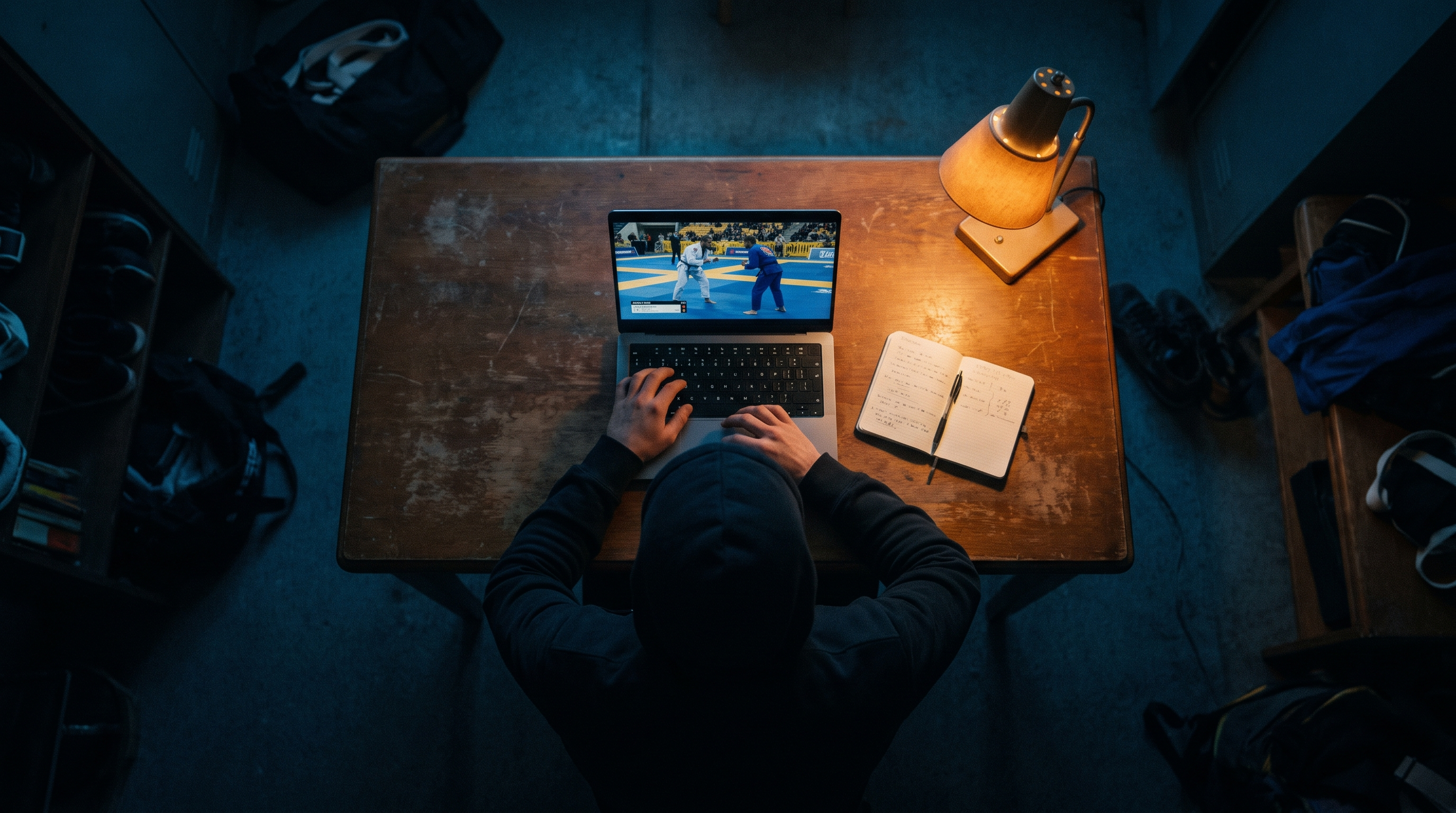
How to Study BJJ Competition Footage: Turning Match Breakdowns Into Techniques You'll Actually Use
TL;DR. Passive match-watching rarely turns into mat skill because you never isolate, label, or revise what you saw. Pick one match, one athlete, and one position focus. Watch it three times — full speed, chunk-by-chunk, then frame-by-frame on the key exchanges — writing a short technique card for each moment. Store those cards where you can review them before training. That is how competition footage becomes technique.
Most grapplers have a YouTube history full of ADCC finals, IBJJF Worlds highlights, and match breakdowns from their favorite black belts. They watch, they nod, they get hyped — and then they roll on Tuesday and default to the same three moves they always use. The footage was interesting, but nothing transferred. This guide fixes that gap. It is a practical, repeatable system for turning competition matches into a short list of techniques you can actually drill, try, and remember. No fancy software required, no black belt required, no need to "study like a coach." Just a phone, a notebook (paper or app), and about 30–45 minutes per match.
Why watching more footage doesn't make you better
There is a specific reason passive video-watching stalls out for most hobbyists. When you watch a match at full speed for entertainment, your brain treats it as content — the same way it treats a movie. You feel engaged, but you are not encoding technique. You are not naming positions, tracking grips, or noticing the small setup details that made the sweep or submission actually work.
A few things pile on top of that:
- You watch for outcomes, not mechanisms. You see the choke finish and remember the choke. You miss the grip fight three exchanges earlier that made it possible.
- You watch too much. Ten matches in a session means zero of them get real attention.
- You never revisit it. By the time you're on the mat two days later, much of the detail has faded.
- You don't translate. Even when you notice a technique, you don't decide what to do about it in your next session.
The fix is not more discipline. The fix is a system that forces you to slow down, isolate, and record — then feeds those notes back to you before you train.
Remember. You don't forget techniques because you're bad. You forget because you never revised them.
A simple system for studying BJJ competition footage
Here is the exact workflow. It works whether you're studying a full ADCC match, a five-minute IBJJF final, or a two-minute highlight of your favorite guard player.
1. Set a focus before you press play
Open the video and, before it starts, decide two things:
- One athlete you'll follow (usually the winner, or whoever plays the game you want).
- One position focus (guard retention, passing, back attacks, wrestling entries, half-guard sweeps — pick one).
Without a focus you'll drift. With a focus, everything the athlete does outside that area becomes background, and your brain has something specific to hunt for.
2. First pass: full speed, no notes
Watch the whole match at normal speed. Do not pause, do not take notes. You are just building context: who was winning position, what game each athlete was playing, roughly where the key exchanges happened. If it is a long match, jot down 2–4 timestamps that felt important — nothing more.
3. Second pass: chunked, with a rough map
Go back to those timestamps (or scrub through the match again) and this time break it into positional chunks. For each chunk, write one line: what position it started in, what the target athlete tried, and what happened. Example:
- 1:42 — standing, target athlete pulls to closed guard, immediately breaks posture with cross-collar grip.
- 2:15 — collar-sleeve setup, threatens triangle to force posture, sweeps with hip bump.
You are not trying to learn technique yet. You are mapping the match. This step alone will teach you more about how good grapplers chain positions than most instructionals.
4. Third pass: frame-by-frame on 2–3 key exchanges
Now pick the two or three exchanges most relevant to your focus and study them slowly. Pause. Rewind. Use , and . on YouTube to step frame by frame. For each one, answer:
- What grip did they establish first, and how?
- Where was their weight, hips, and head?
- What did the opponent do, and how did they react to it?
- What was the moment the position tipped?
Don't try to "understand everything." You are hunting for the one or two specific details that made the technique work.
5. Write a technique card for each exchange
For every exchange you studied, write a short card. Keep it tight — a bloated card won't get reviewed. A useful card has:
| Field | What to write |
|---|---|
| Name | "Collar-sleeve → hip bump sweep (X vs Y, 2:15)" |
| Position start | Where the exchange began |
| Steps | 3–6 numbered steps, in your own words |
| Key details | 1–3 things that make it work (grip, angle, timing) |
| Common mistakes | What to avoid — usually the mirror of the key details |
| Timestamp / source | Link + time so you can rewatch it |
Your own words matter. Rewriting forces you to actually understand it. If you can't rephrase it, you didn't see it clearly — go back to step 4.
6. Tie each card to one training task
A card that never gets used is just a screenshot. Before you close the notebook, decide one thing per card:
- Drill it — three rounds of positional reps at open mat.
- Try it live — commit to attempting it in at least two rolls this week.
- Watch for it — look for the position/grip in your own rolling, even if you don't hit the finish.
One task. Not five. Small commitments get done.
7. Revise before training, not after
This is the step almost everyone skips. Fifteen minutes before you leave for the gym, reopen your cards from the last week or two and skim them. That's it. This tiny review is where retention actually happens — the technique is loaded into short-term memory right before you have a chance to try it.
Remember. Position before submission — and revision before rolling.
Common mistakes when studying competition footage
Even with a system, people trip themselves up. Watch for these:
- Studying too many matches at once. Two matches studied properly beats ten matches skimmed.
- Copying the wrong athlete. A 250-lb heavyweight's pressure passing game may not translate cleanly to a 145-lb hobbyist. Pick athletes whose body type and style resemble yours or the game you want to build.
- Ignoring the loser. You often learn more from what didn't work and why — the failed grip fight, the late frame — than from the finish itself.
- Trying to learn a technique you have no positional context for. Studying a berimbolo when you don't yet have a stable open guard is wasted study time. Match the technique to where you actually are.
- Watching without a focus. If you can't say in one sentence what you're looking for, close the video and pick a focus first.
- Never revisiting your notes. A notebook of unread cards is just a diary of things you've forgotten.
- Confusing analysis with mat time. Studying footage is a multiplier on training, not a substitute for it. If you're not drilling and rolling, no amount of watching will make you better.
How BJJ Memo fits into this
The workflow above works with a paper notebook. It works better when your cards live somewhere searchable and get pushed back to you before training. That is what BJJ Memo is for. Paste a BJJ YouTube URL — a full match, a breakdown, an instructional clip — and the app builds a structured technique card with steps, key details, and tappable timestamps for the important visual moments. Cards go into a personal, searchable library organized by position, and a simple revision flow surfaces them before your next session. It is a helper for the retention loop, not a replacement for a coach or mat time. You can see how it works on BJJ Memo, read more on the blog, or jump straight to how to remember BJJ techniques and how to learn BJJ from YouTube if that's your bottleneck.
Frequently asked questions
How long should I spend studying one competition match?
Aim for about 30–45 minutes for a full match, split across the three passes described above. Highlights or short breakdowns can be done in 15–20 minutes. If you're spending two hours on one match, you're probably drifting — cut it off and turn what you have into cards.
Should I study matches from athletes at my level or from world champions?
Both, for different reasons. World-class matches show you the ceiling of positions and setups you can aspire to. Matches at your level (local tournaments, colored belt divisions on YouTube) show you what actually happens with imperfect timing and grips — often more directly useful for a hobbyist.
How many technique cards should I make per match?
Fewer than you think. Two to four solid cards per match is plenty. If you write ten, you won't revise any of them. The goal is a small, growing library of techniques you actually try, not a wall of notes.
Can I learn a new technique purely from footage without a coach?
You can identify it, understand the mechanics, and try it — but for real feedback, safety, and troubleshooting, you need a qualified coach and live training partners. Use footage to bring specific questions and ideas to class, not to bypass coaching.
What if I don't know the names of the positions I'm watching?
That's fine. Describe what you see ("knee on belly with a cross-collar grip") and look up the name later. Naming positions is useful for searching your notes, but understanding the mechanics is what matters on the mat.
How is studying footage different from watching instructionals?
Instructionals show you the technique in isolation, cleanly. Competition footage shows you when, why, and against resistance. Both are valuable — instructionals for the how, footage for the when. A good study habit uses both, with cards to tie them together.
Bring it to the mat
Watching more BJJ won't make you better. Watching less, more carefully, and revising it before you train will. Pick one match this week. One athlete. One position focus. Run the three passes, write two or three cards, and skim them before your next session. That is the whole system.
When you're ready to make it stick, BJJ Memo turns any BJJ YouTube video into a structured technique card and files it into a personal library you can revise in one tap before training. Available on iOS and Android.
For real feedback and safety, train the technique at a legit academy with a qualified coach — BJJ Memo helps you remember and revise, it doesn't replace mat time.
Last updated 2026-08-26.