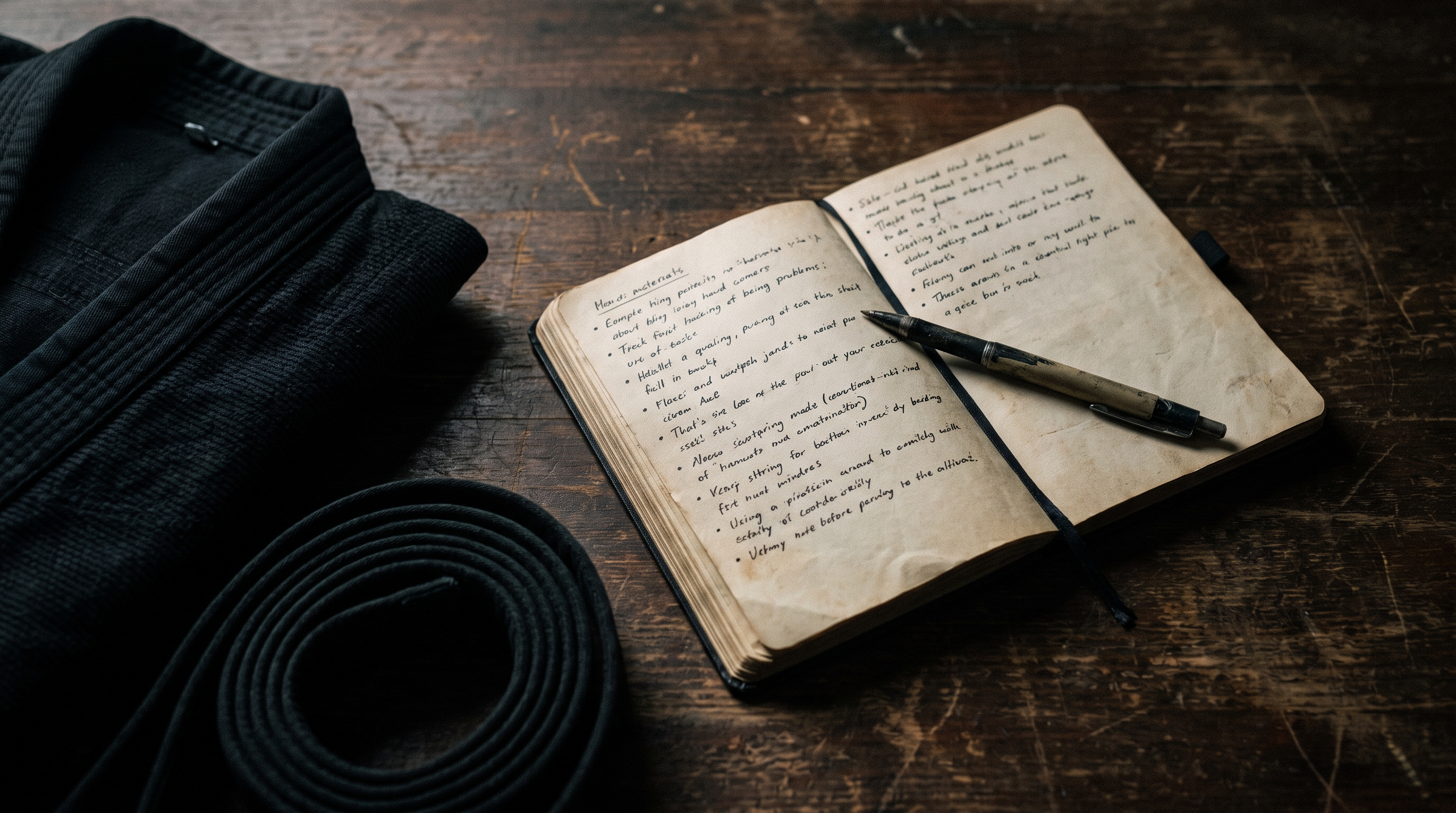
How to Take BJJ Notes That You'll Actually Read Before Training
TL;DR. Most BJJ notebooks die because they try to record everything. A useful jiu jitsu journal captures only one position, one detail, and one problem per session — in that order. Write within an hour of class, keep entries short enough to reread in under a minute, and tag by position (not by date) so you can actually find what you wrote. Review two or three cards on the way to training, not the night before bed.
If you've tried keeping a BJJ notebook before, you already know the pattern. The first week is beautiful — detailed steps, arrows, little diagrams. By week three the entries get shorter. By month two the notebook is on a shelf, and you're back to forgetting the same escape you drilled six times last month. This isn't a discipline problem. It's a system problem. Most grappling notes are built like class summaries, when they should be built like flashcards you can actually reread. This guide walks through why traditional BJJ journaling fails, a simple five-step system that survives long term, the mistakes that quietly kill a notebook, and how to build a review habit that fits into a training week without adding another chore.
Key takeaways
- Note-taking fails when it feels like homework — keep each entry to three lines: position, key detail, one mistake to avoid.
- Organize by position (side control, closed guard, back take) rather than by class date, so entries stay findable months later.
- Write notes within an hour of class while the physical feeling is still fresh, not the next morning.
- Rereading beats writing — schedule a two-minute review during your commute to the gym, not in a quiet moment at home.
- Video from an instructional or a class clip is far more useful when paired with a written cue, because the cue triggers recall on the mat.
- A dead notebook is fine — throw it out and restart with a smaller structure. Perfection is why grapplers quit journaling in the first place.
- The goal of BJJ notes is retention, not documentation. If you can't recall the move under pressure, the note didn't work.
Why BJJ notes usually stop working
Ask any grappler with a stack of half-filled notebooks and you'll hear the same story: the notes were too long, too vague, or too hard to find. The three failure modes look like this:
Too long. A page of numbered steps for a single armbar is beautiful when you write it and useless a week later. You will not sit down and reread a page of prose before a Tuesday-night class. You will glance at your phone in the car.
Too vague. "Worked on side control escapes" is not a note. It's a headline. Six weeks later you cannot remember which escape, which side, which grip, or what the coach actually corrected. The note gives you nothing to retrieve.
Too hard to find. Chronological notes ("Tuesday, class 47") assume you remember when you learned something. You don't. You remember the position. If the notebook isn't organized by position, the notes may as well not exist.
Underneath all three is a bigger problem: writing and reviewing are treated as the same act. They aren't. Writing helps you compress the lesson while it's fresh. Rereading is what actually plants it in long-term memory. A journal that gets written but never reread is just a diary of forgotten techniques.
Remember. Your notebook is not the point. Reading your notebook is the point. If a system doesn't get reread, it doesn't count as a system.
A simple system: five steps that survive long term
This structure is deliberately minimal. It's designed for a hobbyist who trains two or three times a week and doesn't want note-taking to become a second job.
1. One card per technique, not one page per class
Every technique gets its own short entry — a card, a note-app page, whatever your medium is. If a class covered a pass, a sweep, and a submission, that's three cards, not one long class summary. Cards are searchable. Class summaries are not.
2. Use a three-line template
Keep the structure identical every time so you can read it in a glance:
- Position: where you are when this starts (e.g., "bottom side control, far-side underhook available").
- Key detail: the single most important cue the coach gave (e.g., "frame with elbow to their hip, not their shoulder").
- Common mistake: the mistake you or a partner actually made (e.g., "turned to the knees too early and got taken to back").
Three lines. If you find yourself writing a fourth, ask whether it belongs in a separate card.
3. Tag by position, not by date
Organize entries under position headers: closed guard, half guard, side control top, side control bottom, mount, back, standing/takedowns, guard passing. When you get smashed in half guard on Monday, you want to open one folder and see every note you've ever written about half guard, not scroll through six months of dated pages.
4. Write within an hour of class
The kinesthetic memory — how the grip felt, where their weight was — fades fast. A one-line note written in the car before you drive home beats a paragraph written the next morning. If you can't write anything else, write the position and the key detail. Common mistakes can come later.
5. Reread on the way to training, not in bed
This is the step almost everyone skips. Pick two or three cards from the position you plan to work that night, and reread them on the way to the gym. Not the night before. Not on the weekend. The car, the bus, the walk in. The gap between reading a cue and testing it on the mat should be minutes, not days.
6. Prune ruthlessly every month
Once a month, delete or archive anything you no longer need. If a technique is now automatic, the card has done its job — get it out of the way. If a card is confusing to reread, rewrite it or throw it out. A small, sharp notebook is far more useful than a huge messy one.
7. Restart without guilt when it dies
Every grappler's system dies eventually — a busy month, an injury, a move. When you come back, don't try to reconstruct what you missed. Start a new stack of cards from the next class. The old ones aren't wasted; they're just closed.
What a good card looks like vs. a bad one
| Bad card | Good card |
|---|---|
| "Tuesday class — worked side control escapes, felt good." | Position: bottom side control, opponent has cross-face. |
| "Coach said do the shrimp better." | Key detail: get the near elbow inside their cross-face grip before shrimping. |
| "Got tapped a lot." | Common mistake: shrimping without clearing the cross-face — they follow and re-pin. |
| Filed under "Class 47." | Filed under "Side control bottom." |
The bad card is a diary entry. The good card is a cue you can actually use next time you're stuck under a heavier partner.
Common mistakes that quietly kill a notebook
- Recording everything from an instructional. A one-hour Danaher lecture will fill twenty pages if you let it. Pick the single detail that fits a hole in your current game and card that. The rest is noise until you need it.
- Copying the coach's words instead of your own. Notes work when they match how you think. "Elbow-to-hip frame" might be what your coach says, but if what clicks for you is "point the elbow at their belt," write that.
- Trying to make it look nice. Diagrams and color coding are pleasant. They also make notes feel like a project, and projects get abandoned. Ugly, functional, fast.
- Only writing after good classes. The classes where you got smashed are the ones with the most useful notes. Write especially when you're frustrated.
- Never rereading. This is the whole ballgame. A notebook that only gets written to is a hobby, not a learning tool.
- Mixing notes with life admin. Keep your BJJ system separate from grocery lists and work notes. When jiu jitsu lives in a dedicated space, you actually go there.
Remember. Note-taking for grapplers isn't about writing more. It's about writing less, more often, and rereading before you step on the mat.
How BJJ Memo fits in
Most of the friction in a jiu jitsu journal is the writing itself — pausing an instructional, scrubbing back to catch the detail, typing it up, tagging it. BJJ Memo is built to remove that friction for video-based study. You paste a BJJ YouTube URL and the app turns it into a structured Technique Card: the steps, the key details, and tappable timestamps for the moments that actually matter. Cards get filed into your personal library by position and surface again in a review flow before training. It's a companion to the paper notebook you keep for class, not a replacement — one holds what your coach shows you live, the other holds what you learn from instructionals. Together they cover why you forget BJJ techniques and give you something concrete to reread. You can download BJJ Memo on iOS and Android whenever you want to start capturing videos this way. For more on structuring learning outside class, see our guides on how to remember BJJ techniques and how to study BJJ instructionals.
Frequently asked questions
How many BJJ notes should I take per class?
One to three cards is plenty for most classes. If the class covered a single technique in depth, one detailed card is better than three shallow ones. The test is whether you'll actually reread it — not how much you wrote.
Should I use a paper BJJ notebook or a digital app?
Whichever one you'll open again. Paper is fast and distraction-free but hard to search. Digital notes are searchable and taggable but easier to ignore. Many grappers use paper for class notes and a digital library for video-based study, so each medium plays to its strength.
When should I write my BJJ notes?
As soon as possible after class — ideally within an hour, while the physical feel of the position is still fresh. If you can only write one line, write the position and the single most important detail. Everything else can wait until the next day.
How do I organize my jiu jitsu journal?
By position, not by date. Group notes under headers like closed guard, half guard, side control top, side control bottom, mount, back, and guard passing. When you get stuck in a position at training, you want one place to look.
How often should I reread my notes?
A short review of two or three relevant cards immediately before training beats a long weekly review. The goal is to have the cue fresh in your head when you step on the mat, not to feel like you "studied."
What if I miss a week or a month of note-taking?
Don't try to catch up. Start fresh from your next class. Guilt is the fastest way to kill a note-taking habit. A working system that skipped a month is worth infinitely more than a perfect system that lives in your head.
Start small, reread often
A useful BJJ notebook isn't the one with the most pages. It's the one you actually open before class. Keep entries to three lines, file them by position, write them while the feeling is fresh, and reread a couple on your way to the gym. If your current system is dead, throw it out — no guilt, no reconstruction — and start again with something smaller.
Next time you watch an instructional at home, try capturing it as a structured card in BJJ Memo so it's waiting for you the next time you're stuck in that exact position on the mat.
For real feedback and safety, train the technique at a legit academy with a qualified coach — BJJ Memo helps you remember and revise, it doesn't replace mat time.
Last updated 2026-08-11.