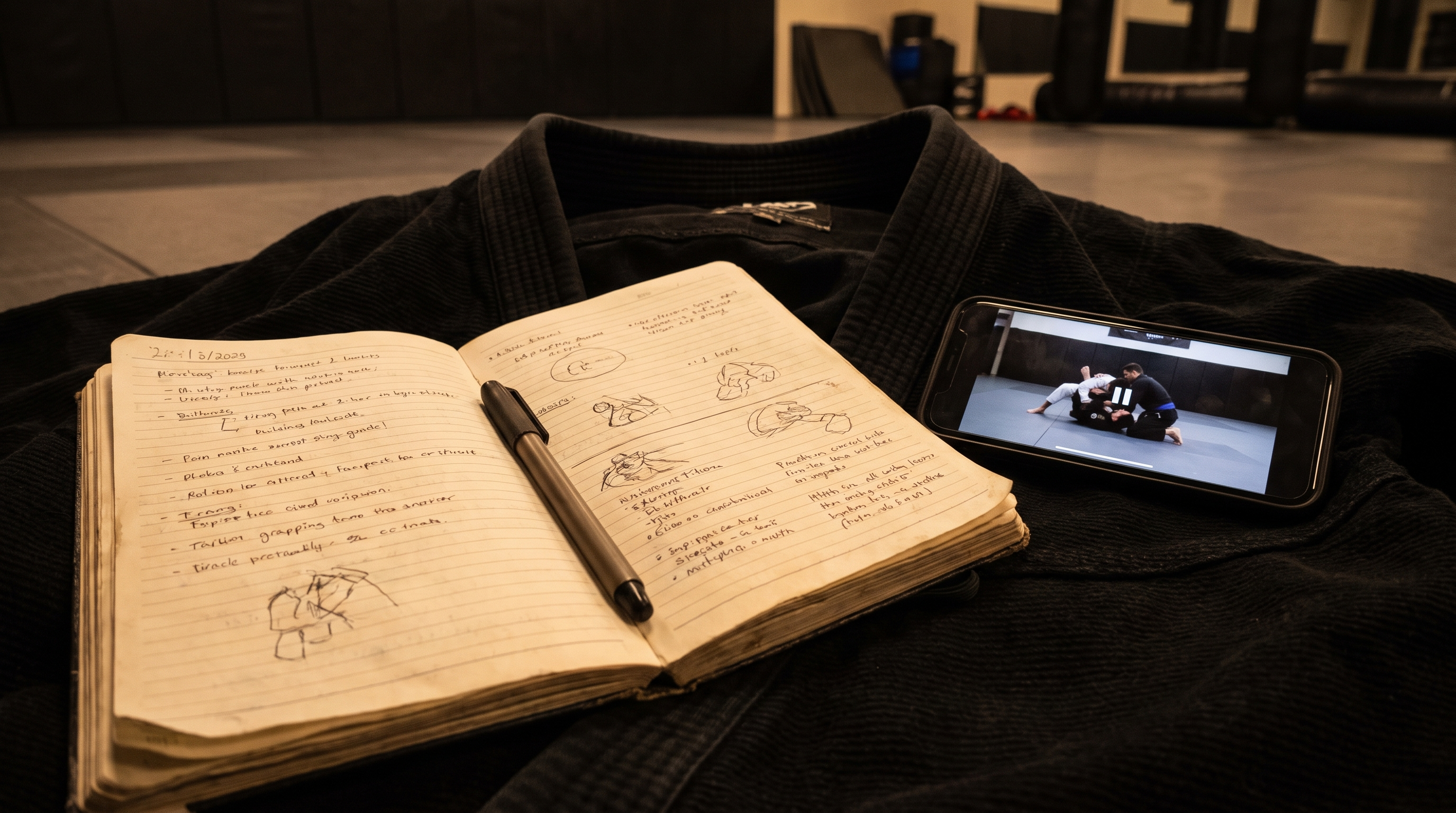
How to Watch a BJJ Seminar and Actually Retain It: A Note-Taking System for the Whole Weekend
TL;DR. Most grapplers leave a BJJ seminar with a notebook full of details they never revisit — and most of it fades within days. To actually retain a weekend seminar, capture techniques in a repeatable format (position → entry → steps → key details → common mistakes), film short reference clips with the instructor's permission, review your notes the same night, drill 2–3 techniques the following week, and revise the whole seminar again a month later. Quality of capture beats quantity of pages every time.
You paid a few hundred dollars for the weekend, drove across the state, warmed up early, and stood shoulder-to-shoulder with strangers to watch a world-class black belt break down a system you've admired for years. You scribbled fast. You nodded a lot. You told yourself, "I'll remember this one — it's too good to forget."
Then Tuesday came. You tried the entry in class, botched the second grip, forgot which foot went where, and by Wednesday your notebook was already sitting on a shelf you never look at. This is not a personal failure — it's what every grappler experiences when they try to absorb a firehose of information without a system to catch it. The good news: the fix is straightforward. This guide gives you a repeatable note-taking and revision workflow you can run for any seminar, so the techniques you learn this weekend are still in your game six months from now.
Why this happens
A seminar is an unusually dense learning environment. You're seeing new positions, new grips, new footwork, new concepts, and new terminology, all in a state of fatigue, adrenaline, and social pressure to keep up with the group. Your brain is not going to retain most of it by default. It never was.
Memory works on use and repetition. Techniques you touch once and never revisit are treated by the brain as low-priority information and quietly discarded. That's why the same grapplers who can recite every detail of their favorite closed guard sweep — because they hit it every roll — cannot remember a seminar move they saw once and never drilled again.
There are three specific reasons seminar retention is uniquely brutal:
- Volume. A single afternoon can cover a dozen techniques, each with its own setup, grips, and key details. That's more new information than most weekly classes.
- No sparring context. You rarely get to live-roll the techniques the same day, so nothing tags them as "this actually works" in your motor memory.
- Passive note-taking. Writing down what the instructor says feels like learning, but if the notes are unstructured — a wall of hurried sentences — they become unreadable within days.
Once you accept that forgetting is the default, the whole problem changes. You stop trying to "just remember harder" and start building a capture-and-revision loop instead.
Remember. You don't forget seminar techniques because you're a bad student. You forget because you never revised them. A system beats effort.
A simple system: 6 steps for the whole weekend
Here is the workflow, in the order you actually use it — from the drive there to a month after the seminar ends.
1. Prep before you arrive
Bring one physical notebook or a tablet, a pen, and your phone (charged, storage cleared). Write the seminar date, instructor, and topic at the top of a fresh page. If the instructor teaches a defined system (say, a leg-lock ladder or a guard-passing framework), skim their public YouTube content the night before so the vocabulary isn't brand new when you hear it live. Ten minutes of prep saves you an hour of confusion on the mat.
2. Capture every technique with the same template
The biggest note-taking mistake is free-form scribbling. Instead, use the same six-field template for every single technique. It forces you to catch the parts that actually matter and makes your notes readable later:
| Field | What to write |
|---|---|
| Position | Where the technique starts (e.g. "closed guard, cross-collar grip"). |
| Entry | How you get to the setup (grip fight, angle change, reaction to their move). |
| Steps | Numbered, in order. Keep each step short — one action per line. |
| Key details | The 1–3 non-obvious things the instructor emphasized. This is where the technique actually lives. |
| Common mistakes | What the instructor warned against, or what you personally messed up when drilling. |
| Cue for future you | One sentence in your own words that will remind you of the whole technique in 3 months. |
That last field — the personal cue — is the one people skip and later regret. "Feels like closing a book on their neck" will pull the technique back faster than three paragraphs of formal description.
3. Film short reference clips (ask first)
Most instructors are fine with filming, but ask before the seminar starts. If they say yes, keep clips short and specific: 10–30 seconds each, one technique at a time, from an angle you can actually see. Label the clip immediately (a voice memo at the end saying "triangle from spider, closing detail" is enough) or note the timestamp next to the technique in your notebook. A phone full of unlabeled two-minute clips is worse than no clips at all — you will never scrub through them.
If filming isn't allowed, film yourself and your drilling partner performing the move on the last rep, so you have a personal reference. Just you doing it slowly, with the details, is often more useful than watching the instructor anyway.
4. Review the same night
This is the single highest-leverage habit in the whole system. Before you sleep, spend 10–15 minutes going back through your notes while the images are still fresh. You are not rewriting — you are:
- Filling in any missing key details you now remember.
- Cleaning up messy handwriting or typos so tomorrow-you can read it.
- Adding your personal cue if you skipped it under pressure.
- Flagging the 2–3 techniques you actually want to add to your game.
Skip this step and you'll lose a significant chunk of the detail overnight. Do it, and your notes stay usable for months.
5. Drill 2–3 techniques the following week
The temptation after a great seminar is to try everything at once. Don't. Pick the two or three techniques that fit your current game and drill only those at open mat. Everything else stays in the notebook for now.
Why so few? Because a technique doesn't enter your game until you've done it enough times, in live-ish resistance, to trust it. Trying to install ten new moves in one week guarantees you install zero. Two or three, drilled properly, is how a seminar actually changes your jiu-jitsu.
Remember. A seminar is a menu, not a meal. Pick the two dishes you'll actually cook this month.
6. Revise the full seminar one month later
Put a reminder in your calendar for four weeks after the seminar. Sit down, open your notes, and go through every technique. For each one, ask:
- Can I still explain the setup and the key details out loud?
- Can I demonstrate it slowly (even shadow-drilling in the living room)?
- Did I actually try it in a roll?
Techniques that pass go into your long-term library. Techniques that don't either get one more focused drilling session or get archived — better to keep a small library of moves you truly own than a huge one full of half-remembered fragments.
Common mistakes
Even grapplers who take notes still lose most of a seminar. These are the patterns to watch for:
- Writing full sentences during the demo. You'll miss the demo. Use shorthand and fill in the details during the drilling round or immediately after.
- Trying to capture everything. If the instructor shows a variation you have no context for, note the name and skip the details. Chasing every branch dilutes the branches you actually needed.
- Filming without labels. A camera roll of nameless clips is a graveyard. Ten seconds of labeling per clip saves the entire library.
- Never re-reading. Notes you don't review are notes you didn't take. The revision loop is the whole point.
- Adding the seminar to your game all at once. Ten new techniques on Monday means zero new techniques by Friday. Pick a few.
- Judging the seminar by how much you "got." A great seminar might yield one concept that reshapes a position you already train. That's a huge win.
Where BJJ Memo fits in
If you'd rather not keep another paper notebook that ends up in a drawer, this is exactly the workflow BJJ Memo was built for. You can capture techniques directly on your phone using the same structured card format described above — position, entry, steps, key details, common mistakes — and file them into a personal, searchable library by position or submission. When the instructor's public YouTube breakdowns come out after the seminar, you can turn those into technique cards in one paste, matched to your handwritten notes.
The revision flow will surface techniques for you before your next session, so the one-month checkpoint in step 6 happens automatically instead of relying on you remembering to remember. It doesn't replace mat time or your coach — it just makes sure the weekend you paid for doesn't fade out by Wednesday.
Frequently asked questions
Should I take notes on paper or on my phone?
Both work. Paper is faster for on-the-fly capture and doesn't distract you; digital is easier to search, re-organize, and revisit months later. A common hybrid is paper during the seminar, then transferring the keepers into a digital library that same night while everything is fresh.
Is it rude to film the instructor?
Only if you don't ask. Most instructors are happy for personal-reference filming and will say so at the start of the seminar. Public posting is a different question — never post clips of a paid seminar without explicit permission, out of respect for the instructor's material.
How many techniques should I actually try to add to my game per seminar?
Two or three. That's it. A seminar can inspire you, refine concepts you already train, and give you long-term reference material, but the techniques that actually stick are the ones you drill repeatedly in the weeks after. Trying to install ten at once is the fastest way to install none.
What if the seminar was pure concepts, not techniques?
Use the same template with different fields: instead of "steps," write down the concept in one line, the position it applies to, an example of when to use it, and a counter-example of when not to. Concepts are actually easier to retain than techniques because they apply everywhere — but only if you write them clearly enough to recognize them later.
How long should the same-night review really take?
Aim for 10–15 minutes. You're not rewriting the notebook — just cleaning up, filling gaps, and flagging the techniques you want to drill. If it's taking an hour, your live capture template is too loose; tighten it next time.
I've been to seminars where I remembered almost nothing. Can I still recover them?
Sometimes. If you have any notes or clips at all, sit down with them and reconstruct what you can — even three or four techniques recovered is a win. For seminars where you have nothing, look for the instructor's public content on the same topic; the vocabulary will jog specific memories you didn't know were still there.
Bringing it back to the mat
A weekend seminar is one of the best investments a grappler can make — but only if the techniques survive contact with normal life. The system above (structured capture, same-night review, small drilling focus, one-month revision) is boring on purpose. Boring systems are the ones you'll actually run for every seminar you go to for the rest of your BJJ life.
The next time you sign up for a seminar, block off 15 minutes on Sunday night and 30 minutes four weeks later before you even book the ticket. That's the difference between paying for an experience and paying for permanent additions to your game.
If you want a structured place to build that library — one that surfaces techniques for you before training instead of waiting for you to open a drawer — BJJ Memo is built exactly for this. Capture the seminar, organize the cards by position and submission, and let the revision flow do the remembering. For related workflows, see our guides on how to remember BJJ techniques and how to study BJJ instructionals from YouTube.
And — this always applies — for real feedback and safe execution of everything you learned this weekend, drill the techniques at a legit academy with a qualified coach. BJJ Memo helps you remember and revise; it doesn't replace mat time.
Last updated 2026-09-22.