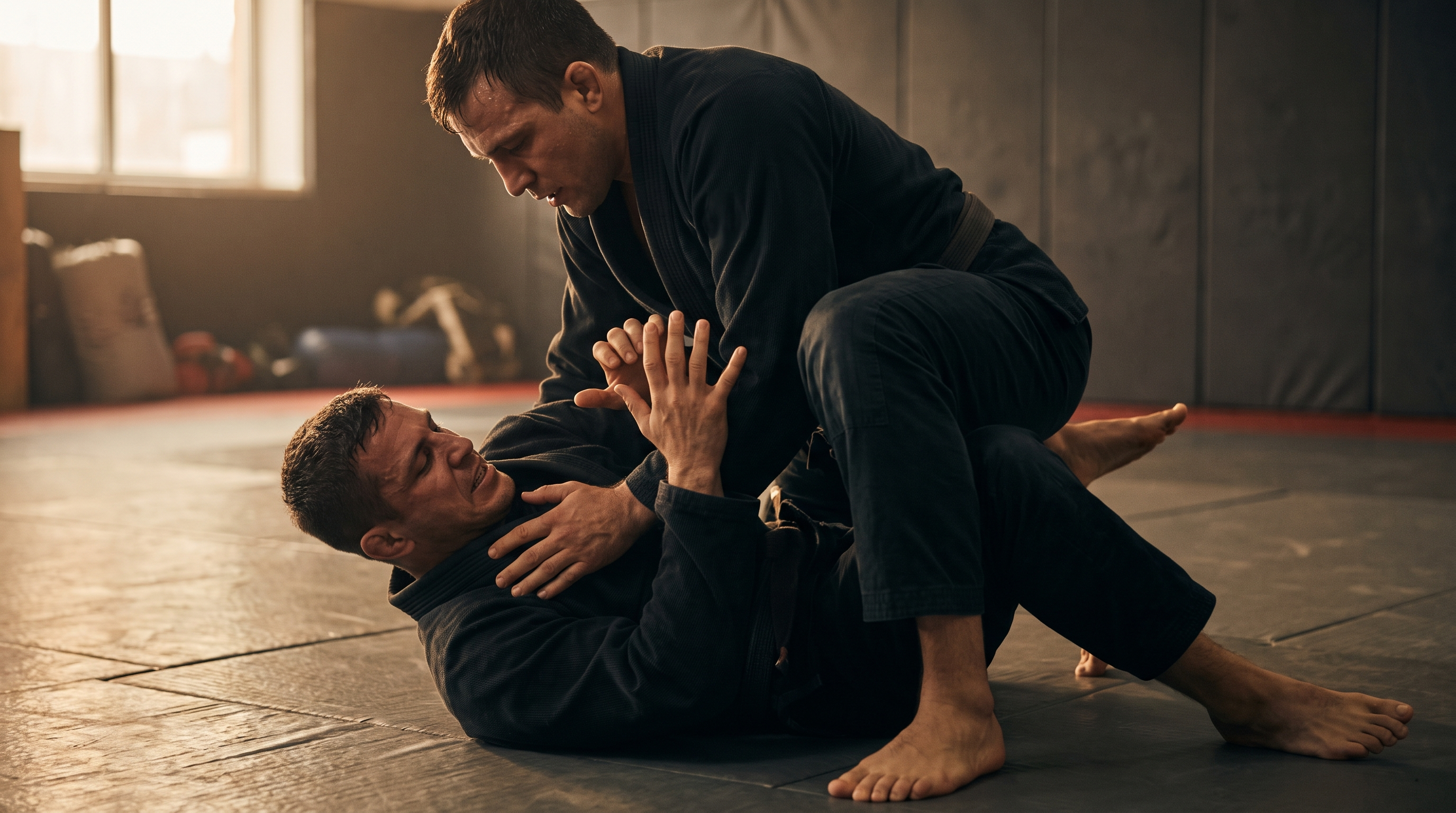
Knee on Belly Escapes: How White Belts Can Stop the Pressure and Recover Position
TL;DR. Knee-on-belly hurts because your training partner is stacking their bodyweight through a small point on your ribs or sternum. The escape is not about strength — it is about killing the pressure with your near-side elbow, turning to your side to unload your ribs, and using a controlled hip escape to either recover guard or come up to a knee. Never push straight up on the knee with a flat back, never turn your face away, and never give up your inside space. Drill the same three-step sequence every round until it becomes automatic.
If you are a white belt, knee-on-belly (KOB) is probably one of the worst positions you land in. It is not a submission, but a heavier training partner can make you feel like your ribs are about to fold. Most beginners react by panicking, bridging blindly, or trying to bench-press the knee off with two hands — all of which usually make the pressure worse and set up an easy transition to mount or an armbar.
The good news is that knee-on-belly is a very escapable position once you understand the mechanics. You do not need to be strong. You need a simple, repeatable system: kill the pressure, create space, and recover. This article walks through exactly that, plus the common mistakes to cut out of your game this week.
Why knee-on-belly hurts so much (and why that is fixable)
Knee-on-belly works by concentrating a lot of weight into a very small surface area — your partner's shin or kneecap driving down onto your ribs, sternum, or diaphragm. When you lie flat on your back, three things happen at once:
- Your ribs have nowhere to go, so every breath fights the weight above you.
- Your arms are extended toward the ceiling, giving your partner easy access to armbar and mount transitions.
- Your hips are pinned flat, which is the exact position from which you have the fewest options.
The fix comes from a basic principle of grappling: pressure lives on a flat back. The moment you get onto your side, most of that weight rolls off your ribs and onto the mat next to you. Everything else in this system is built to get you to your side, safely, without giving up a worse position.
Remember. You are not trying to lift your partner. You are trying to get out from underneath them. Those are two completely different movements.
A simple system: 5 steps to escape knee-on-belly
Use this sequence every time you feel a knee land on your torso. It works for gi and no-gi, and it works whether your partner is much bigger than you or not. The idea is to make the same pattern automatic so you are not thinking under pressure.
Step 1 — Protect your inside space and get your near elbow down
As the knee lands, immediately bring your near-side elbow (the one closest to their knee) tight against your ribs and hip. This does two things: it stops them from feeding a hand under your arm for an armbar, and it gives you a frame to place on their knee in the next step. Keep your far arm across your chest or reaching for their far lapel/wrist — do not let it float toward the ceiling.
Step 2 — Frame on the knee, not the thigh
Place your near-side forearm across the top of their knee or shin, palm down, elbow tight to your own ribs. Your far hand grips their belt, hip, or pants at the hip. You are not pushing. You are creating a rigid connection so that when you turn, the knee is pushed off you rather than sliding up into mount.
Step 3 — Turn to your side, unload your ribs
Roll onto the side away from their base. As you turn, your near shoulder comes off the mat, your ribs face them, and their weight drops off your body onto the floor next to you. This is the single most important moment of the escape. If you feel their weight vanish, you are doing it right. If you still feel crushed, you turned into their knee instead of away from it — reset and turn the other way.
Step 4 — Shrimp (hip escape) to make space
With the frame still active, push off your outside foot and shrimp your hips backward, away from them. Do not try to push them; push the mat. Your goal is to create just enough space to slide your bottom knee in between your body and theirs. One clean shrimp is usually enough. Two if you are gassed.
Step 5 — Insert the knee and recover
Slip your bottom knee (the one you just shrimped away from) into the space you just made, using it as a wedge against their hip or thigh. From here you have two choices:
- Recover guard: feed your other leg in, close half or full guard, and reset.
- Come up to a knee: post on your near elbow, drive off your bottom foot, and stand up in base facing them.
Which one you pick depends on your game and how tired you are. Recovering guard is safer for beginners. Coming up is more offensive and scores you nothing back if you fail cleanly.
Remember. Escape hips before you escape people. If your hips are pinned flat, no amount of arm strength will get you out.
The two escapes at a glance
| Escape | Best when | Key detail | Risk if rushed |
|---|---|---|---|
| Hip escape to guard recovery | Partner is heavy, patient, and stacking straight down | Frame on the knee, shrimp, insert bottom knee | Giving up mount if the knee slides high |
| Turn-in to knees | Partner is light on the knee or reaching for a submission | Turn away, post, drive off the bottom foot | Exposing the back if you turn too early |
Both escapes share the same first three steps. Only step 5 changes. That is by design — one system, two exits.
Common mistakes white belts make under knee-on-belly
These are the errors you will see in almost every open mat. Fix them and your escape success rate climbs quickly.
- Bench-pressing the knee with two hands and a flat back. You give up both arms, you never turn to your side, and the pressure stays exactly where it started. Frame with the near forearm only.
- Turning your face away. This is the classic panic reaction. It exposes your neck, invites the far-side collar, and blinds you to what your partner is doing. Keep your eyes on your training partner.
- Bridging up into them. A big bridge lifts their weight for a second, then drops you back into the same position, more tired. Turn to your side instead.
- Reaching for the far foot or ankle. Feels productive, achieves nothing, and gives away your inside space. Save the leg attacks for later in your journey.
- Waiting too long. Knee-on-belly gets worse every second, not better. The escape starts the instant you feel weight land, not after they set their grips.
- Only training the escape at 100%. You will not learn timing by scrambling. Ask a training partner for slow, cooperative reps first — then live rounds.
Drilling this on your own and with a partner
You can drill the frame-turn-shrimp sequence solo on the mat or on your living room floor. Lie on your back, imagine the knee landing, and go through steps 1–4 slowly, focusing on the turn to your side and one clean hip escape. Ten reps per side, three times a week, will make a visible difference within a month.
With a partner, start from KOB with them at maybe 30% pressure. Have them hold position while you rehearse the sequence to a clean guard recovery. Add resistance in stages: 30% → 50% → 70% → live. Skipping straight to live rolls is why so many white belts still cannot escape KOB two years in.
Where BJJ Memo fits in
The real reason most white belts never fix their KOB escape is not physical — it is that they learn the details in class, watch an instructional that weekend, and by the next Tuesday the specifics are gone. You remember there was "something about a frame," but not which arm, which direction, which hand grip.
BJJ Memo is built for exactly this. Paste a YouTube instructional on knee-on-belly escapes and the app turns it into a structured technique card — steps, key details, and tappable timestamps for the visual moments. The card goes into your personal library, and a revision flow surfaces it before your next session so the details are actually loaded when you step on the mat. It is not a replacement for training with a qualified coach — it is the layer that makes your training stick.
Frequently asked questions
Is knee-on-belly a submission?
No. Knee-on-belly is a dominant control and scoring position (worth points in most rulesets), not a submission. However, it is a launching pad for many finishes — the far-side collar choke, the near-side armbar, and the transition to mount are all common. Escaping quickly means escaping the position and the attacks it sets up.
Should I try to escape before or after they set their grips?
Before, every single time. The instant you feel the knee land, start the sequence. Once your partner has a cross-collar grip and their base spread, the escape is much harder. Timing beats technique at this position.
What if my training partner is much heavier than me?
The system does not change — but the turn to your side becomes even more important, because that is what unloads the weight from your ribs. Do not try to push a much heavier partner off; turn away from their base so their weight rolls onto the mat, then shrimp. See our guide for smaller grapplers for related mechanics that apply here.
Can I just wait for them to try a submission and escape from there?
You can, but it is a bad plan. Every second under KOB drains your air and stamina, and by the time you defend the submission you will be too tired to recover position cleanly. Escape the position first, then worry about attacks. See our notes on pressure escapes for the general principle.
How long does it take to get comfortable escaping knee-on-belly?
With deliberate drilling — cooperative reps plus positional sparring starting from KOB — most white belts see a real improvement within a few weeks. Without drilling, you can go a year or more and still get stuck. Consistency beats intensity here.
Should I learn escapes or attacks first as a white belt?
Escapes first. Position before submission is the oldest rule in jiu-jitsu for a reason: you cannot attack from underneath someone. See our white belt roadmap for the order we suggest learning core positions in your first year.
Bring it to your next session
Escaping knee-on-belly is not a talent — it is a pattern you drill until it fires without thinking. Save this article, run the frame-turn-shrimp sequence in your next warm-up round, and ask a black belt at your academy to check your details in person. Video and articles help you understand; only mat time with a qualified coach gives you real feedback.
When you find an instructional on knee-on-belly that clicks, save it as a technique card in BJJ Memo so the details are ready to revise before your next roll. Build a small library of the escapes you actually use — and stop losing what you learn.
For real feedback and safety, train the technique at a legit academy with a qualified coach — BJJ Memo helps you remember and revise, it doesn't replace mat time.
Last updated 2026-08-30.