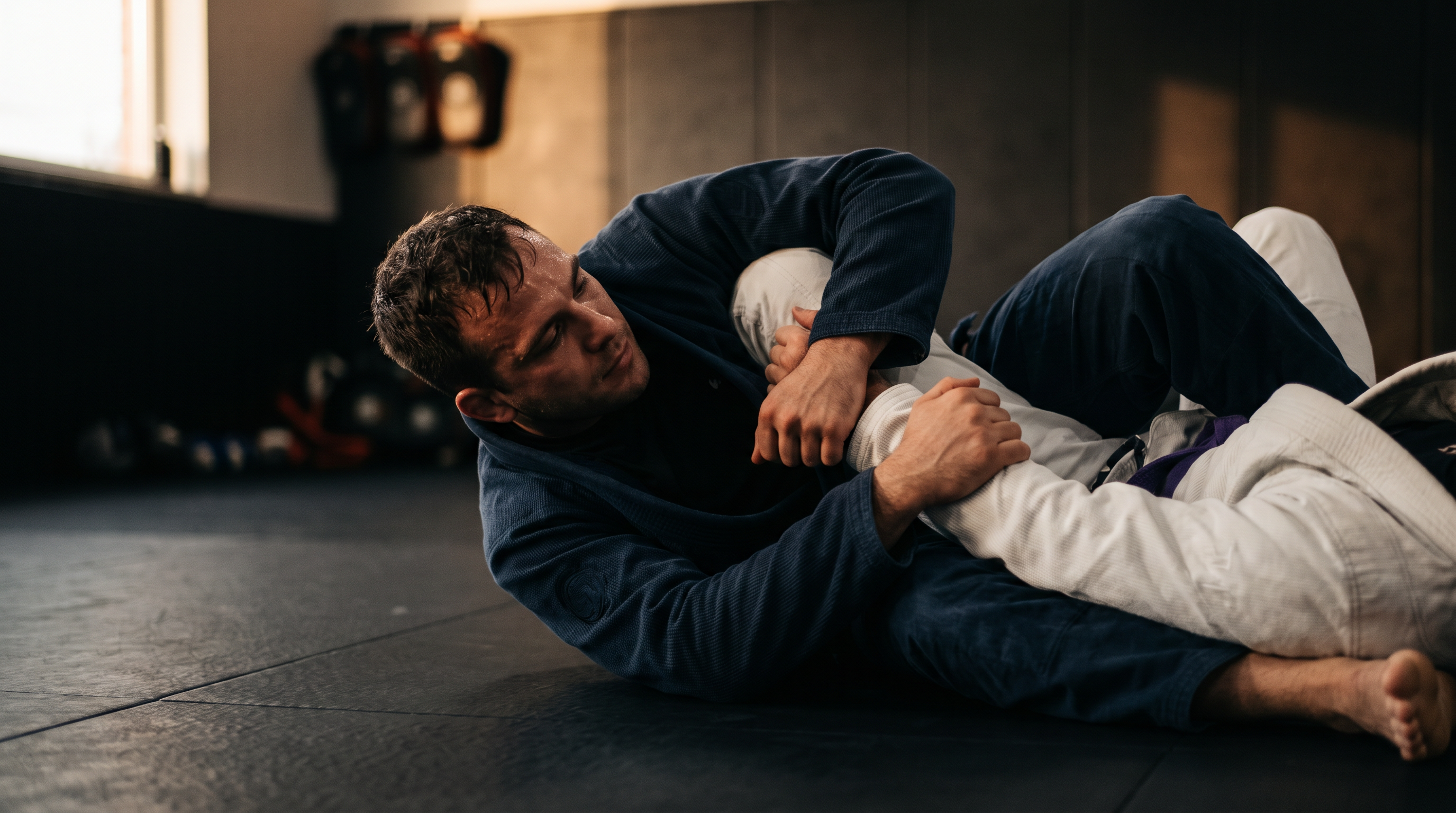
Lasso Guard for Beginners: How to Set the Grip, Break Posture, and Sweep
TL;DR. Lasso guard is a beginner-friendly open guard built on one deep sleeve grip and one leg wrapped around your opponent's arm. It stops the pass, kills posture, and opens up simple sweeps like the lasso-hook sweep and the tripod. Start by mastering the grip sequence, learn to bend your training partner forward, and drill two sweeps in both directions before adding attacks. Treat it as a controlled position, not a scramble — patient grips beat frantic movement.
Lasso guard is one of the first open guards a gi player should learn after closed guard. It uses your own leg as a lever against your opponent's arm, which means you can control a much stronger partner without a strength battle. The grip is stable, the position defends the pass well, and the sweeps are logical — you push where they cannot post and pull where they cannot base.
This guide is written for white and blue belts who keep hearing "try lasso" in class but never really understood how to enter it, how to keep it, or what to do once you have it. We will walk through the grip, the posture break, a simple sweep system, and the mistakes that quietly kill the position. It is a gi-focused guide (lasso lives on the sleeve), but the concepts about frames, angles, and posture apply to no-gi open guard too.
Key takeaways
- Lasso guard uses a same-side sleeve grip plus a leg threaded under and over your opponent's arm to trap it.
- The grip goes on first — no grip, no lasso, and no sweep.
- Your priority is breaking posture forward, not immediately hunting a submission.
- The lasso-hook sweep and the tripod sweep cover both directions and are enough for your first six months.
- Common failures come from a shallow sleeve grip, a flat back, and letting your opponent stand tall.
- Lasso is an open guard, so foot and hip mobility matter more than raw strength.
- Drill the grip-and-break sequence slowly before adding sweeps or transitions to triangle and omoplata.
Why lasso guard works (and why beginners struggle with it)
Lasso guard works because it does two annoying things to the top player at the same time. Your leg wraps around their arm from the outside, threads under, and lands on top of their bicep. That leg pins their arm, disconnects it from their base, and rotates their shoulder inward. Meanwhile, your sleeve grip on the same side keeps them from ripping the arm free.
Once their arm is trapped and their posture is bent forward, they only have one free hand to base and pass with. That is a losing math problem for the top player, which is why you see lasso used at every level, from local white-belt tournaments to ADCC.
Beginners struggle with lasso for three predictable reasons:
- They set the leg before the grip. The grip has to come first. Without the sleeve grip, your opponent can just stand up and shake the lasso off.
- They lie flat. Lasso is played on your side, with your hips loaded. If your back is flat on the mat and your shoulders are square, you have no angle and no sweep.
- They wait too long. Lasso is a control point, not a resting position. The longer you sit there without threatening, the more time the top player has to stack you or pin your free leg.
Remember. Lasso is a lever, not a wrestle. If you feel yourself grinding, your grips are wrong or your hips are square — reset before you burn out.
A simple lasso guard system (5 steps)
Here is a beginner-friendly system to enter lasso, keep it, and sweep from it. Drill this in order. Do not skip ahead to the sweeps until the grip and posture break feel automatic.
1. Get the sleeve grip first
From seated guard or your back with feet on the hips, reach across with your same-side hand and grab their sleeve at the cuff. Pistol grip — four fingers inside, thumb out. If you cannot get the sleeve, you cannot play lasso. Fight for it patiently before doing anything with your legs.
2. Thread the lasso leg
With the sleeve grip locked, take the leg on the same side as the grip, circle it under their arm (from the outside), and let your shin land on top of their biceps. Your foot should point roughly toward their opposite hip. The shin acts as a shelf that carries their arm.
3. Frame with your other foot
The non-lasso foot goes to their hip or biceps. This is your steering wheel. It manages distance and creates the angle you need to sweep. Without this frame, they will simply walk around your lasso leg and start passing.
4. Break their posture forward
Pull the sleeve toward your hip while pushing your hip-side foot away and rotating onto your shoulder. Your goal is to bend them forward so their chest turns toward the mat. A tall opponent is a passing opponent; a bent opponent is a sweepable one.
5. Choose your sweep based on their reaction
- If they base wide and drive forward → lasso-hook sweep: kick the trapped arm up and over your head while sweeping their base leg with your free hook.
- If they stand up to try to pass → tripod sweep: post your free foot on their far hip, kick their near-side ankle out, and use the sleeve grip to pull them past you.
- If they duck their head to stack you → transition to omoplata or triangle using the same lasso leg. Save this for later; sweep first.
6. Recover if they escape the lasso
If they yank the arm out, do not chase. Retract the leg, re-establish feet on hips, and rebuild grips. Trying to hold a broken lasso is how you get passed.
7. Reset your grips constantly
Good lasso players re-grip every few seconds. Sleeves slide, sweat happens, and dead grips are the reason "my lasso does not work". Treat re-gripping as part of the position, not an interruption.
A quick comparison: lasso vs other beginner open guards
| Guard | Main control | Strength needed | Best first sweep | Common at white belt? |
|---|---|---|---|---|
| Closed guard | Legs locked around waist | Low | Scissor / hip bump | Yes |
| Lasso guard | Sleeve grip + leg on biceps | Low | Lasso-hook / tripod | Yes |
| De la Riva | Hook behind far leg + sleeve/collar | Medium | Berimbolo / back take | Not usually |
| Spider guard | Two sleeve grips + feet on biceps | Medium-high (grip endurance) | Overhead sweep | Sometimes |
| Butterfly | Two hooks under thighs | Medium | Basic butterfly sweep | Sometimes |
Lasso is one of the few guards where you can neutralize a stronger partner with clean mechanics rather than muscle. That is why it belongs in your beginner toolbox.
Common mistakes and how to fix them
Mistake 1: Shallow sleeve grip
A grip halfway up the forearm gets stripped instantly. Grab the cuff, deep, with four fingers inside. If your grip keeps failing, your hand placement is the problem, not your strength.
Mistake 2: Playing lasso flat on your back
Lasso lives on your side. Rotate onto the shoulder of the lasso-leg side so your hips are loaded and your top leg is free to frame or hook. Flat backs get stacked.
Mistake 3: Trapping the arm without breaking posture
The leg wrap alone does not sweep anybody. If your partner stays tall, they will drive forward, kill your angle, and start passing. Always follow the wrap with a posture break.
Mistake 4: Forgetting the free foot
Beginners obsess over the lasso leg and forget that the other foot has a job: hip frame, biceps frame, or hook. Without it, you are a stationary target.
Mistake 5: Holding on when the position is dead
If they pull the arm out or step over your leg, let go and rebuild. Ego-holding a broken lasso is how you end up in half guard bottom or worse.
Remember. In lasso, movement beats grip strength. Loose grips + active hips will always outperform tight grips + a static body.
How to actually retain what you learn about lasso
Lasso has a lot of small details — the depth of the sleeve grip, the exact angle of your shin on the biceps, where the free foot posts. It is the kind of position that makes sense in class and then evaporates by your next session, especially if you only see it once every few weeks.
That is exactly the gap BJJ Memo is built to fill. When you find a good lasso instructional on YouTube — from a coach you trust — you can paste the link into the app, and it turns the video into a technique card: the steps, the key details, and tappable timestamps on the important visual moments. The card lands in your personal library, filed under "open guard" or "lasso", and the review flow surfaces it again a few days later, right when you are about to forget it. It does not replace drilling or your coach's corrections; it just makes sure the details you already learned are still in your head when you tie your belt.
If you want a broader look at building a personal system, see our guides on how to remember BJJ techniques and how to study BJJ instructionals from YouTube. For a wider view of open guard entries and beginner positions, browse the technique explainers on the BJJ Memo blog.
Frequently asked questions
Is lasso guard good for beginners?
Yes. Lasso is one of the more beginner-friendly open guards because it relies on a lever (your shin on the arm) instead of strength. If you can secure a deep sleeve grip and stay on your side, you can play a functional lasso within your first year of training.
Do I need to be flexible to play lasso guard?
Basic hip and hamstring mobility helps, but you do not need to be extremely flexible. You are not doing a full split — your lasso leg is more of a wrap than a stretch. If you can sit in butterfly or comfortably touch your shins, you have enough range.
Can I play lasso guard in no-gi?
Not really. Lasso depends on the sleeve grip to keep the arm trapped. In no-gi, the arm slips out too easily. The concepts (framing, breaking posture, controlling one arm) transfer, but the specific position is a gi tool.
What is the best first sweep from lasso guard?
The lasso-hook sweep and the tripod sweep together cover both directions. Start with the tripod — it is the most forgiving when your opponent stands up to pass, and the mechanics are similar to the tripod sweep you may already know from open guard.
How long should I drill lasso before using it in rolling?
A few focused sessions are usually enough to try it live at slow pace. Drill the grip-thread-frame-break sequence until it is reflexive, then start pulling it out against training partners you are comfortable with. Expect it to fall apart at first — that is normal.
Is lasso guard safe on the knee?
Lasso is generally safe if you play it correctly, but the wrapped leg can be exposed if your partner drives forward hard while you are locked in. Tap early if you feel any knee twist, do not stubbornly hold a bad angle, and always train under a qualified coach who can spot bad positioning in real time.
Wrap-up and next steps
Lasso guard is worth the effort. It gives you a real, strength-independent way to shut down the guard pass and create clean sweep opportunities — and it plays well with other positions you will learn later, like spider, de la Riva, and the whole triangle/omoplata family.
Start small: get the grip, thread the leg, break posture, hit one sweep. Add the second sweep next week. Build from there.
For real feedback and safety, drill lasso at a legit academy with a qualified black-belt coach — an app can help you remember details, but it will never replace mat time, live rolling, and hands-on correction. Next time you save a lasso instructional, capture it as a technique card in BJJ Memo so it is still in your head before your next training session, not lost in your YouTube history.
Last updated 2026-09-05.