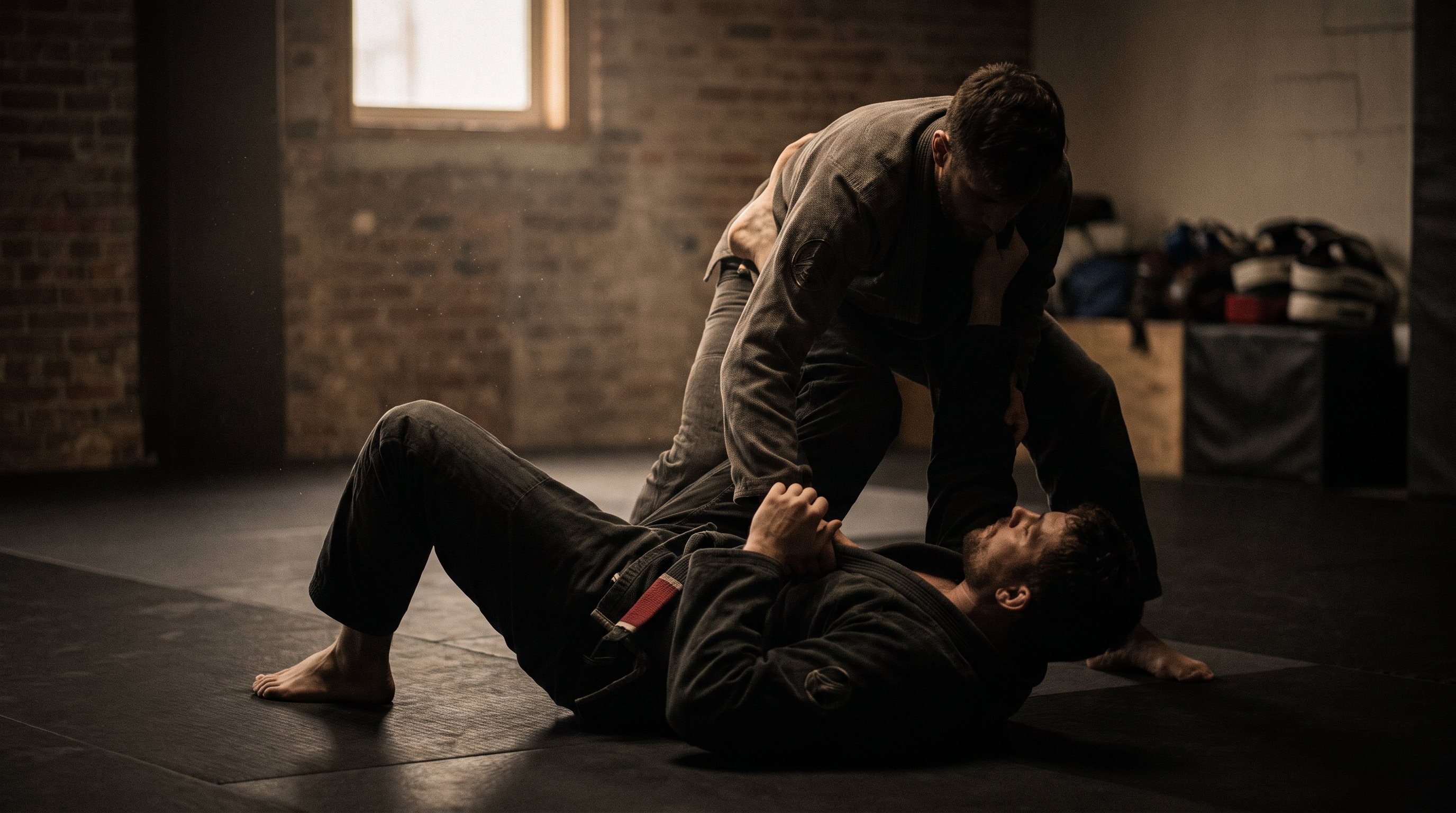
Lasso Guard for Beginners: Grips, Sweeps, and How to Keep Attackers at Distance
TL;DR. Lasso guard is an open-guard system where you thread one foot through your opponent's sleeve grip to control the arm and shoulder line. For beginners, the priority is not fancy sweeps — it's posture, distance management, and two reliable grips (sleeve + collar or sleeve + pant). Learn the frame, the leg pommel, and one sweep (the tilt/hip-bump entry to single-leg) before adding attacks. Drill it slowly, keep your hips mobile, and treat it as a stalling-and-off-balancing tool, not a submission trap.
Most white and blue belts meet lasso guard by getting stuck in someone else's — a foot digs under your armpit, your posture collapses, and suddenly you're rolling to the wrong side while your partner casually threatens a sweep. Then you try to play it yourself, your leg gets ripped down, and you eat a knee-slice.
Lasso guard looks like a technical trap. In reality, for a beginner, it's a posture-and-distance system built on one sleeve grip and one threaded leg. If you understand what the lasso is actually doing to your opponent's shoulder and hip, you can play a very simple version that stalls the pass, tires the passer out, and offers one reliable sweep. This guide walks you through the mechanics, a beginner-friendly system, the mistakes that kill it, and how to drill it so you actually find it in live rolling.
Why lasso guard works (and why beginners struggle with it)
Lasso guard exists because the human shoulder doesn't like being externally rotated and pinned to a raised knee at the same time. When you thread your shin under your opponent's arm from the outside and lift, three things happen at once:
- Their far shoulder gets loaded and rotated back.
- Their same-side hip has to stay square, or they collapse over your leg.
- Their base leg is forced to carry all their weight, which makes it easy to lift.
That is the entire mechanical point of the lasso. It's not a submission trap — it's a posture wrecker. The passer either stands to relieve the pressure (which opens up sweeps), or stays low and slowly gets tilted onto the mat.
Beginners struggle with lasso for three predictable reasons:
- Grip management. Losing the sleeve grip means losing the lasso in one motion.
- Leg tension. A straight, tense lasso leg is easy to strip. A bent, active shin is not.
- Second point of contact. Without a collar, pant, or foot-on-hip anchor, you spin under your opponent instead of moving them.
Fix those three and lasso stops being a mystery.
Remember. Lasso guard is a frame, not a finish. Your job is to keep distance and load your opponent's shoulder, not to hunt a submission on the first grip.
A simple lasso guard system (5 steps)
Before anything else: this is a training tool, not a finished game. Learn each step in isolation, then chain them.
1. Establish the base position
Sit up in a light seated guard, or lie back with your knees framed toward your partner. Pick a side — most beginners start with the right lasso (right foot threading through). Get a deep right-hand grip on your partner's right sleeve, ideally at the cuff or just above the wrist. This is your anchor grip. Don't lasso without it — the whole system falls apart without a sleeve grip on the arm you're threading.
2. Thread the lasso leg
Bring your right knee across your own body, then pommel your right shin under your partner's right bicep from the outside in. Your foot should end up between their arm and their torso, sole facing roughly upward. Keep the shin bent, not straight — a bent shin is a hook you can drive with; a straight leg is a lever they can strip.
3. Add a second point of contact
A lone lasso is unstable. Immediately add one of the following:
- Cross-collar grip with your left hand (classic De La Riva/lasso hybrid).
- Same-side pant grip on the passer's far knee or ankle.
- Left foot on the hip to manage distance.
The rule is simple: one grip on the arm, one grip on the leg or collar, and one foot posting for distance. Three points of contact.
4. Manage distance with the free leg
Your left leg is the steering wheel. Post it on:
- The hip (to keep them off you when they try to stack).
- The bicep or shoulder (to stiff-arm the pass when they drop their weight).
- The far knee (to windshield-wiper if they try to come around).
If you feel your partner's weight coming forward, extend the post. If they back away, retract and prepare to sweep.
5. Attack the tilt sweep when they stand
Most passers, at some point, will stand up to strip the lasso. That's your cue.
- Keep the sleeve grip.
- Pull your lasso knee toward your same-side ear to load their shoulder.
- Kick your free leg out and use it to chop or lift the near ankle.
- Roll toward the lasso side and come up on top for a single-leg finish.
Drill this one entry a hundred times before you learn any others. If you can hit it clean at 50% resistance, you have a functional lasso guard.
Bonus: the retention play
If you don't get the sweep, don't panic. Frame with the free foot, keep the sleeve grip alive, and reshoot the lasso. Lasso guard is a war of attrition — the person who keeps the grip longest usually wins the exchange. For more on holding open guards under pressure, see our guide to open guard basics for BJJ beginners.
Grip and posture reference
| Element | What it does | Beginner cue |
|---|---|---|
| Deep sleeve grip | Anchors the lasso arm | "Pinky to their pinky, thumb-in" |
| Threaded shin | Loads shoulder, breaks posture | "Bend the knee, drive the shin up" |
| Cross-collar grip | Prevents them from posturing away | "Elbow tight, knuckles up" |
| Free foot on hip | Manages distance, blocks stack | "Toes point out, hip is a shelf" |
| Pant grip (far leg) | Prevents them from circling around | "Grab the seam, don't wrestle the pants" |
| Hip angle | Powers sweeps | "Never square — always angled off" |
Common mistakes (and the fixes)
Every beginner makes the same handful of mistakes with lasso guard. Fix these before you add new attacks.
Mistake 1: Flat back. Lying flat kills every open guard. Your shoulders should be slightly elevated, chin tucked, so you can see and react to your partner's weight shifts.
Fix: Keep at least one elbow off the mat at all times. If you find yourself pancaked, sit up and reset.
Mistake 2: Straight lasso leg. A locked-out leg is a lever your opponent will strip by driving forward.
Fix: Bend the knee actively. Think "shin drives up into their armpit," not "leg extends past their arm."
Mistake 3: Losing the second grip. Lasso alone is a spinning top. Without a collar, pant, or hip post, your opponent walks around your legs.
Fix: Before you thread the lasso, decide which second contact you're taking — collar, pant, or foot on hip. Take it before they react.
Mistake 4: Staying square. If your hips face straight up at your partner, you have no sweeping angle.
Fix: Shrimp your hips slightly toward the lasso side. Your belly button should point off-center.
Mistake 5: Chasing submissions too early. Omoplatas and triangles are available from lasso, but they're advanced entries. Chasing them as a white belt costs you the position.
Fix: For your first six months of lasso, only pursue sweeps. Submissions come later, once your positional control is automatic.
Remember. If your lasso leg ever feels tired rather than active, you're doing it wrong. The shin should feel like it's constantly working — pommelling deeper, adjusting height, resisting the strip.
Where BJJ Memo fits in
Lasso guard has a lot of moving parts — a sleeve grip, a threaded leg, a second point of contact, a posting foot, and an angled hip. Watching a fifteen-minute instructional once and heading to class is a great way to remember about a third of it, and none of the details.
If you use BJJ Memo, you can paste the URL of any lasso guard breakdown on YouTube and the app turns it into a structured Technique Card — steps, key details, and tappable timestamps for the visual moments. Save the tilt sweep, the collar-lasso setup, and the retention detail as separate cards in your open-guard folder, then run the review flow the morning of training. You'll walk in remembering the cues — "bent shin, angled hip, pant grip first" — instead of vaguely recalling that you watched something on lasso guard three weeks ago. See our primer on how to remember BJJ techniques for the wider system.
Frequently asked questions
Is lasso guard good for beginners, or is it too advanced?
Lasso guard is often taught as an intermediate position, but the beginner version — one sleeve grip, one threaded leg, one posting foot — is genuinely accessible to a white belt with a few months of mat time. What's advanced is the submission web on top of it (omoplatas, triangles, worm guard entries). Start with the retention and one sweep; leave the rest for later.
Do I need a gi to play lasso guard?
Yes. Lasso guard depends on a sleeve grip, which requires the gi jacket. In no-gi, the analogous position is a two-on-one arm control with a knee shield, but the mechanics differ. If you train mostly no-gi, focus on other open guards first.
How do I stop people from ripping my lasso?
Three things: keep the sleeve grip deep and thumb-in, keep the shin bent (never straight), and take a second grip immediately (collar or pant). If they still strip it, don't fight the strip — reshoot the lasso as they pass, or transition to a De La Riva hook on the same side.
What if my opponent just stands up and backs away?
Good — that means the lasso is doing its job. When they stand and disengage, either follow with your sleeve grip and shoot the tilt sweep, or come up to seated guard and re-engage. Standing to strip a lasso is one of the most common passer responses and it opens sweep opportunities every time.
How long does it take to develop a decent lasso guard?
Realistically, a few months of consistent drilling to hold the position under light resistance, and longer to hit sweeps on higher belts. Progress depends far more on how often you revise the details than on total mat hours. A grappler who reviews the same three cues before every session will move faster than one who watches new content constantly.
Can lasso guard get my knee hurt?
Lasso puts your knee in a rotated, loaded position — if a passer smashes forward hard while your leg is straight, it can stress the knee. This is why the bent-shin cue matters. If a pass is going badly and your knee feels compromised, release the lasso and reshoot rather than defending to the last inch. When in doubt, ask a coach.
Wrap up and next steps
Lasso guard is not a magic bullet. It's a positional framework: one sleeve grip, one threaded leg, one second contact, one posting foot, and an angled hip. Get those five pieces right and the position starts to feel like a hammock your opponent has to fight to escape — instead of a puzzle you fumble every round.
For real feedback and safety, train the technique at a legit academy with a qualified coach — this article helps you organise and revise, it doesn't replace mat time. Next time you find a good lasso guard video, save it as a Technique Card in BJJ Memo so it's ready to review before your next roll. If you want to build out the rest of your open-guard game, our beginner's guide to the first six months of BJJ is a natural next read, along with our breakdown of how to study BJJ instructionals on YouTube.
BJJ Memo is available on iOS and Android — turn what you watch into something you can actually use on the mat.
Last updated 2026-08-31.